
Spoilers, I guess!
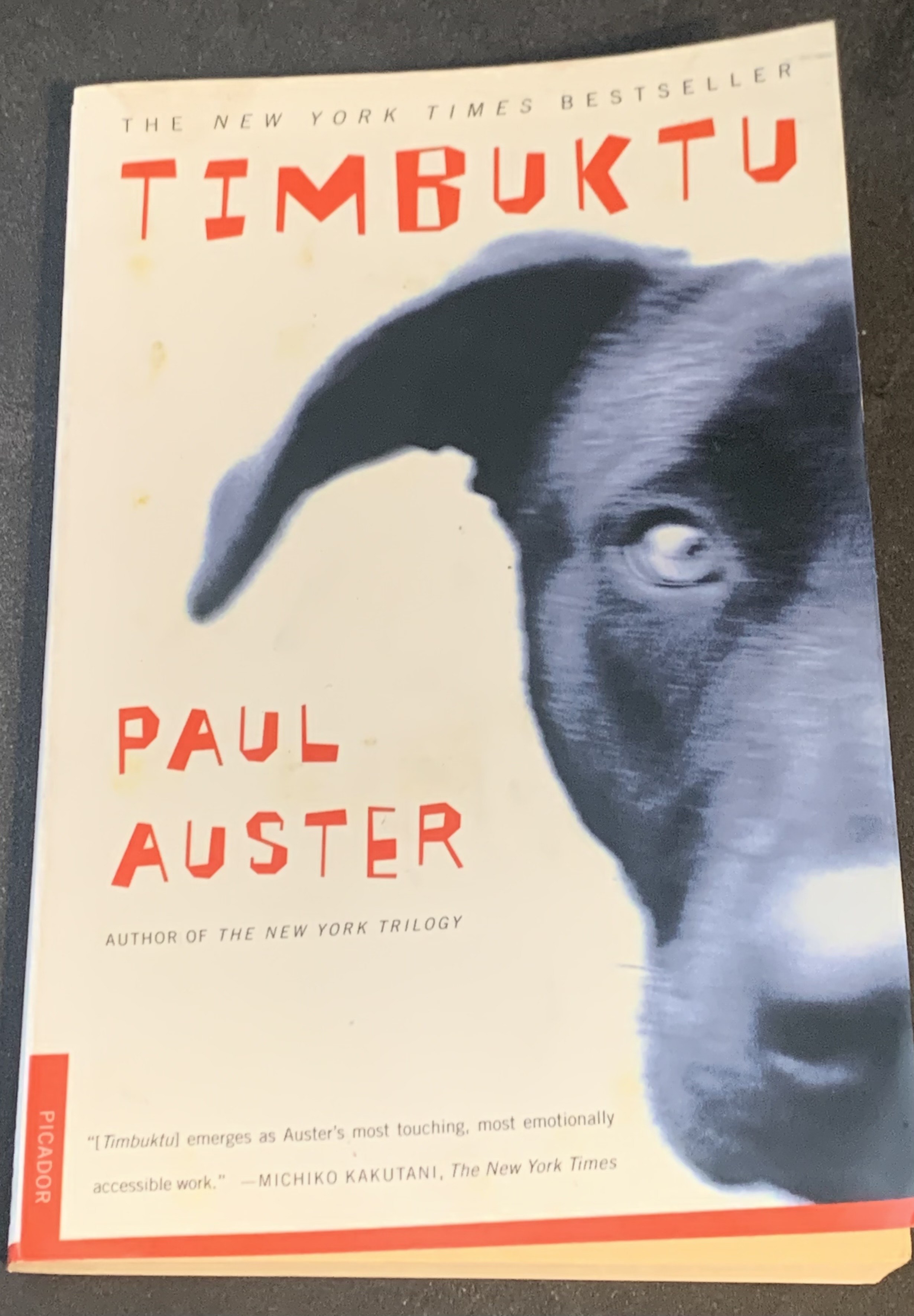
The worst aspect of owning a dog is that one day, you will have to experience the dog dying. And in my experience, what is particularly brutal about such an experience is that the dog’s mind is still there — and their heart is still willing to give you unconditional love as always — but their body is simply giving out. In Paul Auster’s 1999 book, Timbuktu, told from the perspective of Mr. Bones, a mixed Labrador, the reverse is the case. His owner of more than seven years, Willy Christmas, who is an unhoused man with mental health issues and facing alcoholism, is dying. His body is giving out, but his mind, inasmuch as it was ever there, is still chugging along, chattering away to Mr. Bones in his final days. This worries Mr. Bones, not only because he doesn’t want to see his master die, but because of what it portends for him. What becomes of the dog when the master dies? He’s heard bad things about shelters, and he certainly doesn’t know how to live out in the urban wild.
After Willy does die, Mr. Bones initially hooks up with a young Chinese boy who is hiding Mr. Bones in a box outside from his strict father. The funny part is that the kid is a huge Baltimore Orioles fan, and Mr. Bones can’t make sense of all these baseball players turning into animals playing baseball. An oriole is a bird, after all! Then it occurs to Mr. Bones that the father runs a Chinese restaurant, one of the things Willy Christmas warned him against: dogs are eaten there. Fortunately for Mr. Bones, he’s able to escape the wrath of the father, but that would not be his last run-in with a strict father.
He comes upon Polly, Alice, and Tiger in the garden of their suburban home. Lush grass to roll around in and smell! Alice and Tiger, of course, take to him right away, despite his bedraggled appearance. It doesn’t take much cajoling either for their mom, Polly, to provisionally accept Mr. Bones, now known as Sparky (much to his chagrin), into the home. The provision is if the husband and father, Dick, accepts. Dick does, but Mr. Bones has to stay outside and chained up. To Mr. Bones’ confusion and pain, the other rule Dick had was that Mr. Bones would be fixed, which, along with the veterinarian hitting on Polly, turns Mr. Bones off of the vet. Dick seems right out of the 1950s, certainly not a man of the ’90s. He believes in so-called traditional gender norms and that the woman’s role is first, obeying him, and second, being a wife and mother. Mr. Bones even gleans early on that Polly isn’t happy in her familial arrangement, and much like him, is chained to her circumstances.
At the end of the book, in a grandiose gesture, I think to win back their marriage, Dick takes the family to Disney World, which means Mr. Bones has to stay in the much-feared kennel. And it’s not even that the kennel is all that bad, but he feels dejected that he was left behind. Shortly after arriving in the kennel, Mr. Bones is violently sick and feverish. When it seems like they’ll take him back to the dreaded vet, Mr. Bones absconds from the kennel and heads far away. But he’s took weak to make it back to his doggy house (and even if he had, they wouldn’t be back from Disney for two weeks!). So, instead, hearing the ghost of Willy in his dreams, he decides to join his former master in Timbuktu, the name given to a heaven of sorts where Mr. Bones realizes dogs, or at least, special dogs, are welcomed in. He plays a game of dodge-the-car as the book ends. Ugh. I didn’t want Mr. Bones to die, but it seemed like his time had come and he was just too tired and sick to go on.
Despite the sadness inherent in the book, and again, inherent in the very act of owning a dog, this was exactly the book I needed. Light, with nevertheless smatterings of profundity, and amusing in a way only dog-owners will understand, reading a book from the perspective of Mr. Bones, the introspective dog, flabbergasted by two-leg-humans, was delightful. Dogs just want to please us and be loved and feel safe. Given how unconditionally they love us and how short of a time we get with them, that’s least we can give to them in return.

 Milam's Musings