
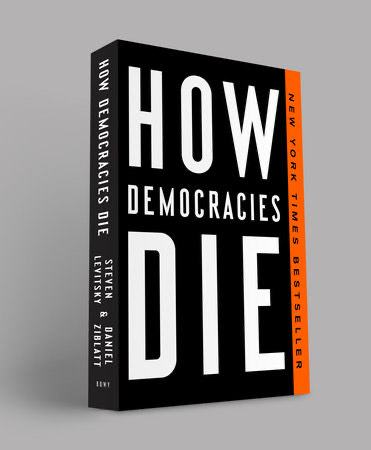
It seems apropos that I go from reviewing a (fictional) book about Lincoln — the president who saved the union and spurred on the second founding of the United States — to reviewing a book about how democracies die. Because to be certain, the United States’ experiment in democracy, ironically approaching its 250th anniversary, is in a perilous state. That’s because for the first time ever, the United States elected an explicit, unashamed demagogue to the presidency in Donald Trump, not once, but twice. The second time in 2024, nearly 77.3 million Americans voted for a man who tried to overturn the prior presidential election in 2020 that he lost. What’s particularly jarring about reading 2018’s How Democracies Die by Harvard political scientists Steven Levitsky and Daniel Ziblatt is that it came before Jan. 6 and the second election of Trump to the presidency. That, even at the time of their writing during Trump’s first (more constrained) administration, Trump was already checking the boxes for a would-be authoritarian and further checking the boxes that indicate democratic backsliding. The situation has only grown more dire since 2018.
Right away, Levitsky and Ziblatt disabuse people of the notion that democracies do not die. In other words, it’s comforting to think that once established, democracy will continued unabated into perpetuity. We especially think this in the United States, owing to our myth-making about exceptionalism, and that, of course, we inspired democratic uprisings and creations the world over, and well into the 20th century at that. But democracies do die, and in point of fact, it’s more common than one may think. Levitsky and Ziblatt point out that prior to the Cold War, three out of four democracies died via military coups, which is to say, at the point of a gun. More pernicious and less obvious, though, is what has occurred in the post-Cold War era: democracy dying after a democratically elected leader erodes and eliminates the democracy. Obviously, prior to the Cold War, Hitler is the classic example of how that could happen and happen quickly, but in modern times, it tends to be incremental and thus, more difficult to notice in real time. Hugo Chavez, who took power in Venezuela in 1999, is an example of slow motion democratic backsliding. What makes this version of democratic backsliding pernicious is not just that the leader was democratically elected or that the backsliding moves slowly, but that it has the veneer of legality to it — both the election itself and the processes by which the leader dismantles democracy.
Levitsky and Ziblatt put it succinctly, “Democratic backsliding today begins at the ballot box.” In other words, we can vote for our own demise. To put an even finer point on it, when MAGA types are disparaging the No Kings protests and movement with, “Trump isn’t a king, idiots. If he was, he wouldn’t even let you protest,” such people are ignorant in the ways in which democracy can die. That Trump was popularly elected is no bulwark against an authoritarian takeover, hence the No Kings protests and movement. You try to stop the king before he becomes one. It becomes much more difficult otherwise.
Speaking of bulwarks, the United States failed the first test in ensuring democratic backsliding does not occur. For most of our history, the two-party system, as much as I have derided it over the years for keeping independent parties from ever properly challenging them, kept extremists, like Trump, from gaining power. That is, the so-called “smoke-filled” backrooms with party elites. To gain either party’s nomination, the nominee had to gain the favor of those elites instead of primary voters, or the “base,” like now. There is something to be said, as Levitsky and Ziblatt do, for the ironically anti-democratic posture of those smoke-filled elite backrooms, but they were the democratic bulwark, nonetheless. We failed that test, as Trump steamrolled through the party establishment, although, as I’ll talk about later, the establishment was ripe for the taking by 2015. The second test we failed was trying to contain the would-be authoritarian once they were in power. In hindsight, Trump’s first administration was “contained” relative to what we’re seeing now with his second administration, but it wasn’t “contained” along the rubric of democratic backsliding. That’s the folly party leaders tend to make, thinking they can contain a would-be authoritarian once they have power. The greatest mistake of the 20th century was German politician and former Chancellor, Franz von Papen, insisting Hitler be appointed Chancellor, thinking he could contain the fool. Alas. Of course, containment also isn’t just about the United States Constitution, but about unspoken, unwritten norms of politics and a democratic society. Two central norms Levitsky and Ziblatt argue that have supported American democracy are mutual toleration (recognizing the legitimacy of other parties, i.e., that the opposing party does not represent an existential threat) and forbearance (leaders constraining themselves despite having power at their disposal). We take norms like that — and I would say, a certain level of civility — for granted. Toleration and restraint are what are known as soft guardrails that prevent a partisan fight to death that killed democracies in Europe in the 1930s and South America in the 1960s and 1970s. With the United States, as I alluded to, the weakening of these guardrails started in earnest in the 1980s with the rise of cable TV and talk radio, and New Gingrich, who was a firebrand politician. Those forces ripped through the soft guardrails, and to be certain, both parties played a part in the escalation and the weakening of those guardrails, although I think it’s quite obvious the Republican Party, which has the would-be authoritarian as its standard bearer for three elections in a row now, is most to blame. Indeed, the 2000s accelerated the weakening, most notably with the election of President Barack Obama, where an entire faux-Tea Party movement arose to combat the first Black president, many of whom thought he was illegitimately elected because he wasn’t born in the United States, otherwise known as the birther movement. In years past, the birther movement would have been relegated to the fringes by those smoke-filled backroom party elites. In the modern Republican Party, they nominated the chief birther to the presidency three times, and he won twice. Which is all a long way of saying, Trump is the obvious result of all the weakening guardrails versus being the genesis.
A nice fable that elucidates Levitsky and Ziblatt’s point about the folly of containment, which we saw a lot of attempts at in Trump’s first administration — contrasted to the second administration where either most are acquiescing for their own selfish reasons or a few are actual true believers — is that of the Aesop fable, the Horse and the Stag. After the Horse and the Stag quarrel, the Horse enlists the Hunter to take revenge upon the Stag. While the Hunter agreed, he said the Horse must permit him to place a piece of iron between the Horse’s jaws to guide him with reins and with saddle on its back. Once the Horse was saddled and bridled and they overcame the Stag, the Horse told the Hunter to get off of him. The Hunter responds, “Not so fast, friend. I have now got you under bit and spur, and prefer to keep you as you are at present.” Swap out the Horse for the Republican Party would-be containment types, media, law firms, universities, and so on, the Hunter for Trump, and the Stag for liberals and the soft norms of society, and you see the parallels. Quite a lot of people allowed Trump to ride them in their thirst to “upset liberals” or to “burn it all down.” And welp. Here we are. (I can’t quite square the joke/connection to John Mulaney’s “there’s a horse in the hospital” bit, but it feels relevant here.)
One thing that astounds me, though, when I think about Americans voting for Trump, an authoritarian, twice, is that at least European countries of the past, Venezuela, and other denizens the world over had the apparent rationale (inasmuch as one wants to grant a rationale to electing a would-be authoritarian) of economic ruin. The United States did not. Americans voted for an authoritarian because they so hated the left and reneged on prior stated principles, or they truly believed in the authoritarian project. Some, of course, were woefully misguided and misled by the aforementioned voices on cable TV and talk radio (and of course, today, podcast and tech bros). Or tragically, some just couldn’t see it. That United States was far from experiencing anything like economic ruin. And in point of fact, the last time we did, in the 1930s, when the rest of the world was voting in authoritarians, the United States did not. This despite firebrands like Charles Coughlin on the radio, and popular figures like Charles Lindberg agitating for such. Even an elected figure, Huey Long, was called the “first dictator out of American soil.” Even Henry Ford, who is a decent analog to Trump, couldn’t get past party elites in his day when considering a run for the presidency. McCarthy in the 1950s and George Wallace in the 1960s are further examples of gatekeeping to an extent. I should note, Levitsky and Ziblatt highlight Belgium and Finland as two other examples of countries that fended off would-be authoritarian takeovers in the 1930s. Essentially, the parties worked together to gatekeep. The throughline to 2015 would have been if the Republican Party and the Democratic Party worked together to ensure Trump did not reach the presidency. A modern example of this happening is Austria in 2016. So, it could have been done! If our party elites had had the will and the courage.
And that also gets at another important point from Levitsky and Ziblatt. As much as the elites are derided in society today (and not just the political ones), democracy cannot be saved by the collective wisdom of the voters. Clearly, right? The party elites need to step in and reestablish gatekeeping. I’m skeptical that that can happen, but there’s evidence Levitsky and Ziblatt present that has happened elsewhere, like in Chile after its democratic backsliding and partisan fight to the death.
So, what were the behavioral red flags that Trump presented, again, even before attempting to overturn an election in which he lost through Jan. 6, 2021, or the various ways in which he’s flouted norms in his second term (bribing, shaking down, bullying media, universities, law firms, and so on)? Levitsky and Ziblatt have four behavioral red flags to recognize an authoritarian in the making:
- Rejects the democratic rules of the game.
- Denies the legitimacy of opponents.
- Tolerates or encourages violence.
- Indicates a willingness to curtail the civil liberties of opponents, including the media.
I could spend another 3,000 words explaining in detail how Trump has flouted each of these numerous times, flagrantly, over the years, but suffice it to say, he has. There is no amount of whataboutism in the world that can negate such a fact.
However, again, the overall issue of democratic backsliding didn’t begin with Trump. The flashpoint that Levitsky and Ziblatt zero in on is the 1968 Democratic Convention in Chicago, where the old gatekeeping system went to die. But actually, as they essentially argue, the genesis goes back a few years earlier to the passing of the 1964 Civil Rights Act. Attempting to bring minorities into our full democracy is what caused the backlash that, in part, led to what happened at the convention. After the convention, that led the way to reforms on how people became nominated in the parties, creating a far bigger primary system. The Democrats did put in super delegates to counterbalance the weight of the new primary system, but the GOP did not. The evidence for how momentous not doing so is in the numbers. For the 20 years prior to the change, only one outsider vied for the presidency and in fact, became president in Eisenhower, and that’s a rather unique case. In the 20 years after the primary system change, eight outsiders vied for party nomination. And the next 20 years? 18, with of course, Trump actually becoming president twice.
The parties also underwent a major realignment after 1964. Instead of big tent parties, the parties became more partisan and ideological. Levitsky and Ziblatt point out that Britain, Sweden, and Germany all have parties reflective of such partisan divides, so, why is it such a source of unraveling for us? They argue the difference is that our fault lines run along ethnic, racial, religious, and cultural aspects, which tend to be more fervent, hot button issues. Immigration has always been a source of angst in American politics, but that’s ramped up in the 21st century for certain. Then there is the much larger involvement of evangelicals, particularly after the 1973 Roe v. Wade decision. Evangelicals are an even better analog to Aesop’s fable, as the horse trusting the hunter because of the single issue of abortion (supposedly). All of this creates what Levitsky and Ziblatt call “status anxiety.” That leads to overheated, apocalyptic, existential politics. The authors point to Richard Hofstadter’s 1964 essay, “The Paranoid Style in American Politics,” which feels entirely relevant to today, as elucidating this issue and throughline in American politics. It’s not just status anxiety, but that the anxiety leads to perpetuating a paranoid view of the world and potent backlash against elites and gatekeepers who safeguard democracy.
The quirk, for lack of a better word, of American history and democracy is that we were not a fully realized democracy until 1964. Indeed, after our second founding in 1865, the American South became a prime example of rewriting the rules to eliminate democracy via Black Codes, Jim Crow, and other mechanisms to curtail the democratic involvement of recently freed Black slaves. And of course, obviously women weren’t full participatory in democracy until the 19th Amendment became ratified in 1920. The American South, in ensuring the elimination of democracy in the South for Blacks, created the quirk or paradox or aberration of American democracy for the next 100 years. Which is to say, one of our foundational democratic norms of not seeing political rivals as an existential threat manifested out of removing racial inequity from the conversation. The North and the South, the Republicans and the Democrats, were able to establish and abide by such a norm for the next 100 years precisely because they avoided the racial inequity question. The further paradox, though, as Levitsky and Ziblatt point out, is that such cooperation led to positive reforms, again, like the 19th Amendment. It’s tough to reckon with the contradictions in American history. But it is these soft guardrails, these unwritten norms, that have distinguished the United States as a democracy. Even when a country, like Argentina in 1953, virtually copies our Constitution word-for-word, it’s not enough to stave off democratic backsliding without those established norms as well.
There were three prior periods in modern American history that tested our guardrails. First, was FDR, who not only flouted the norm about term limits for the presidency, but also attempted to pack the Supreme Court. In the first instance, while he was elected four times, the 22nd Amendment was ratified shortly after FDR’s death making that norm of two-terms law. (Of course, Trump has played footsie with flouting the law on that front, with his 2028 hats and words.) As for the second instance, even FDR’s own party pushed back on the court-packing scheme. Second, was the aforementioned McCarthy in the 1950s. He petered out fairly quickly, though, once people tired of his lack of decency, as it were. And finally, in the third instance, is Nixon, where eventually even Republican elites had enough, and I suppose to his credit, Nixon resigned. (Trump would never resign.)
Before, I talked about how the 1980s is the origin story of our democratic guardrails being tested, and it’s interesting actually, how well government shutdowns track with that. The first started in 1981, a few times more throughout the decade, a notable one with Gingrich and Clinton in the 1990s, and then repeated incidents in the 21st century, the two longest of which have occurred under Trump. Government shutdowns reflect dysfunction and polarization among the parties. Then, the testing of the guardrails and norms accelerated under Obama, particularly with the birther conspiracy. Levitsky and Ziblatt highlight the three crises that occurred under Obama that showed the forbearance norm in particular was eroding.
- The debt limit fight in 2011, with the attempt at the “burn it all down” approach to the killing the debit ceiling.
- Senator Tom Cotton and others wrote an open letter to Iran’s leaders saying Obama had no authority on the nuclear deal he created, flouting the norm that diplomacy is the domain of the president.
- Garland being the first time the Senate wouldn’t even consider a Supreme Court Justice nomination.
In effect, while yes, again, Levitsky and Ziblatt argue Democrats have played a role in norm-busting (Harry Reid using the nuclear option on the filibuster or Obama’s executive orders and going around Congress, as they note), the Republicans in the 21st century played a larger role and became the anti-system party. That tracks with electing the anti-system Trump.
One of the chief concerns Levitsky and Ziblatt had with the first Trump administration was that a crisis would happen enabling a full-on authoritarian takeover by Trump. That’s been the impetus for many authoritarian takeovers the world over. This is known as the “rally around the flag” effect. It’s why, for example, after 9/11, George W. Bush enjoyed the most favorable rating for a president since polling began, with a 90 percent approval rating. (The only president to get close to that was his father, George H.W. Bush after the Persian Gulf War, with an 89 percent approval rating.) The rally around the flag effect is among the best proof we have that we learn nothing from history. While a once-in-a-century pandemic did occur under Trump (and he handled is poorly, to say the least), a crisis of the kind Levitsky and Ziblatt are referring to, did not occur.
Prior to Trump, Levitsky and Ziblatt were more skeptical there was a “democracy recession” occurring, or democratic backsliding, going on globally. However, with Trump’s first election and turbulence in the European Union, they are not as sure now. Again, I would love to know their thoughts in the present day post-Jan. 6 and the 2024 presidential election, as well as Trump’s nearly full first year back in office.
They saw three possibilities for Trump’s future:
- Swift democratic recovery after Trump is removed from office and Republicans face an electoral price. Obviously, that didn’t happen, although Republicans did lose the 2020 election and other key elections throughout the country. But Levitsky and Ziblatt knew this was unlikely. Furthermore, they note that even removing Trump from office wouldn’t be enough to stave off our democratic backsliding because it had been going on for decades prior to Trump descending down the escalator in 2015.
- Trump continues to win based on white grievance. I gave that a mixed bag score in the sense that Trump did lose in 2020, but rebounded in 2024, and is far more openly catering to white grievance now. Levitsky and Ziblatt also saw this option as unlikely (I think they couldn’t envision Americans electing Trump again), but not impossible since declining ethnic minorities (as is happening to the white population) “fight back.”
- More polarization. That was the most likely option and outcome they saw happening. Democracy without guardrails. That even if Trump failed, as mentioned in the first point, the divide between parties would grow.
The fatal flaw the Founders and others of their time made is assuming political ambition would be a natural check on would-be authoritarians, i.e., each co-equal branch of government — the Legislature, the Supreme Court, and the Executive Branch — would be safeguarding their own political power and would not abdicate it to the other branches. In effect, though, what’s occurred is that the presidency amassed more and more power over the years to become the “imperial presidency.” Sure, there was that blip after the Nixon years where Congress tried to rein in the presidency, but ever since, particularly after 9/11, the presidency become bloated with power, just in time for a would-be authoritarian like Trump. I would argue, then, that the weakening of democratic norms while at the same concentrating far greater power into the presidency than ever, has been the one-two punch of our democratic unraveling. When the presidency is imbued with so much power — and the Supreme Court, too, for that matter — then naturally, the political parties will see each election as existential. Therein comes the partisan death spiral. As I alluded to, Levitsky and Ziblatt point to Chile as an example of how to move beyond extreme partisanship. In 1985, the parties signed an accord to transition to a full democracy after Pinochet’s rise to power and dictatorship. New norms then staved off democratic destabilization since. Ominously, Levitsky and Ziblatt are doubtful we can follow a similar path. Moreover, they are dubious of the efficacy of various electoral reforms to help alleviate polarization and partisanship. Instead, they see racial and religious realignment and growing economic inequality as two areas underlying polarization to focus upon. Additionally, they argue that Republicans need to reestablish the establishment of the party in these four leadership ways: 1.) finance; 2.) grassroots organization; 3.) messaging; and 4.) candidate selection. Again, they offer a real-world example of this happening with West Germany’s CDU, or center-right Christian Democratic Union. The CDU expanded their base to include Catholics and Protestants in repudiation of what occurred with Nazism. Of course, Levitsky and Ziblatt hope something calamitous like the rise of Hitler and Nazism doesn’t need to occur to necessitate a CDU-like reaction from the Republican Party.
There have been a lot of pundits and politicians offering post-election autopsies for the Democratic Party, both after Trump’s first victory and his second victory. In both instances, there have been calls for the Democrats to appeal more to blue collar, white working class voters, and in turn, downplay or outright abandon overtures to ethnic minorities (or now, transgender people). Levitsky and Ziblatt explicitly denounce this strategy. Indeed, there is a certain irony in Democratic pundits, politicians, wonks, and consultants agitating for implementing such a strategy to win elections again when it was this very strategy that led to the unnatural status quo prior to the deep polarization that began in 1964. It doesn’t solve anything; rather, it pushes salient issues under the rug.
To be sure, Levitsky and Ziblatt recognize that the great challenge of our time and our situation is that no multiethnic democracy has ever really been achieved where no particular ethnic majority is dominant. Still, they offer a few ways in which Democrats could help stem the tide of polarization, including switching from means testing with social policies to universal social policies that benefit everyone to help reduce resentment, racial backlash, and income inequality; ensure comprehensive health coverage; raise the minimum wage; implement a universal basic income; and agitate for more family-focused and labor market policies (training, mobility allowances, etc.). While they’re under no illusions about the challenging of building a multiethnic coalition, they believe this is the way forward. To be fair, the Democratic Party is a multiethnic coalition already! But I presume they mean creating a wider tent for conservative-leaning types, more evangelicals, and the disaffected white working class.
How Democracies Die is a must-read to better understand the importance of the soft guardrails of democracy, how democracies have died historically and in modernity around the world, and certainly, how the United States has blown past many warning signs for democratic backsliding, not just recently, but in the past few decades. Levitsky and Ziblatt also provide a valiant effort at how to turn back the backsliding, mitigate further polarization and partisanship, and establish firmer norms going forward, even when I disagree with them on policy questions. But it all sure seems bleak! Especially considering the context of the unnatural status quo of democratic norms holding between 1865 and 1965. As I see it then, to rid ourselves of the yolk of MAGA authoritarianism and gird ourselves against future would-be authoritarians, we need a third American founding. That is certainly audacious to undertake, but it’s what’s necessary to ensure we remain a democracy. Or to put it in Lincoln’s words from the Gettysburg Address and pull this all back aground, “It is rather for us to be here dedicated to the great task remaining before us — that from these honored dead we take increased devotion to that cause for which they gave the last full measure of devotion — that we here highly resolve that these dead shall not have died in vain — that this nation, under God, shall have a new birth of freedom — and that government of the people, by the people, for the people, shall not perish from the earth.” I hope we do not reach the stage of needing to dedicate our task to any dead persons, but rather to the future children of America.
I also think what will be crucial to a third American founding is holding accountable those who have attempted to dismantle our democracy from Trump on down. To tell those hard truths. To show that justice can actually reach the elites (yes, Trump is an elite). And while it all seems daunting and bleak to undertake, there is also signs that Trump and his movement is weakening and losing steam — while still carrying out injustices — and there is daylight on the other side of all of this. To use that word again, it’ll be crucial in the post-Trump years, as Levitsky and Ziblatt make clear, to ensure democracy’s protection and not assume with Trump out of power, all is well again. Trump was an outgrowth, a symptom, of a broader problem that needs addressing. Indeed, to quote Garrett Graff, “The Biden administration’s original sin was believing that January 6th was the end of something, rather than the beginning.” We cannot afford to make that mistake again. Presuming, of course, that my optimism that we will get to the other side of Trump and MAGA, prevails.

 Milam's Musings
2 thoughts