
Spoilers!
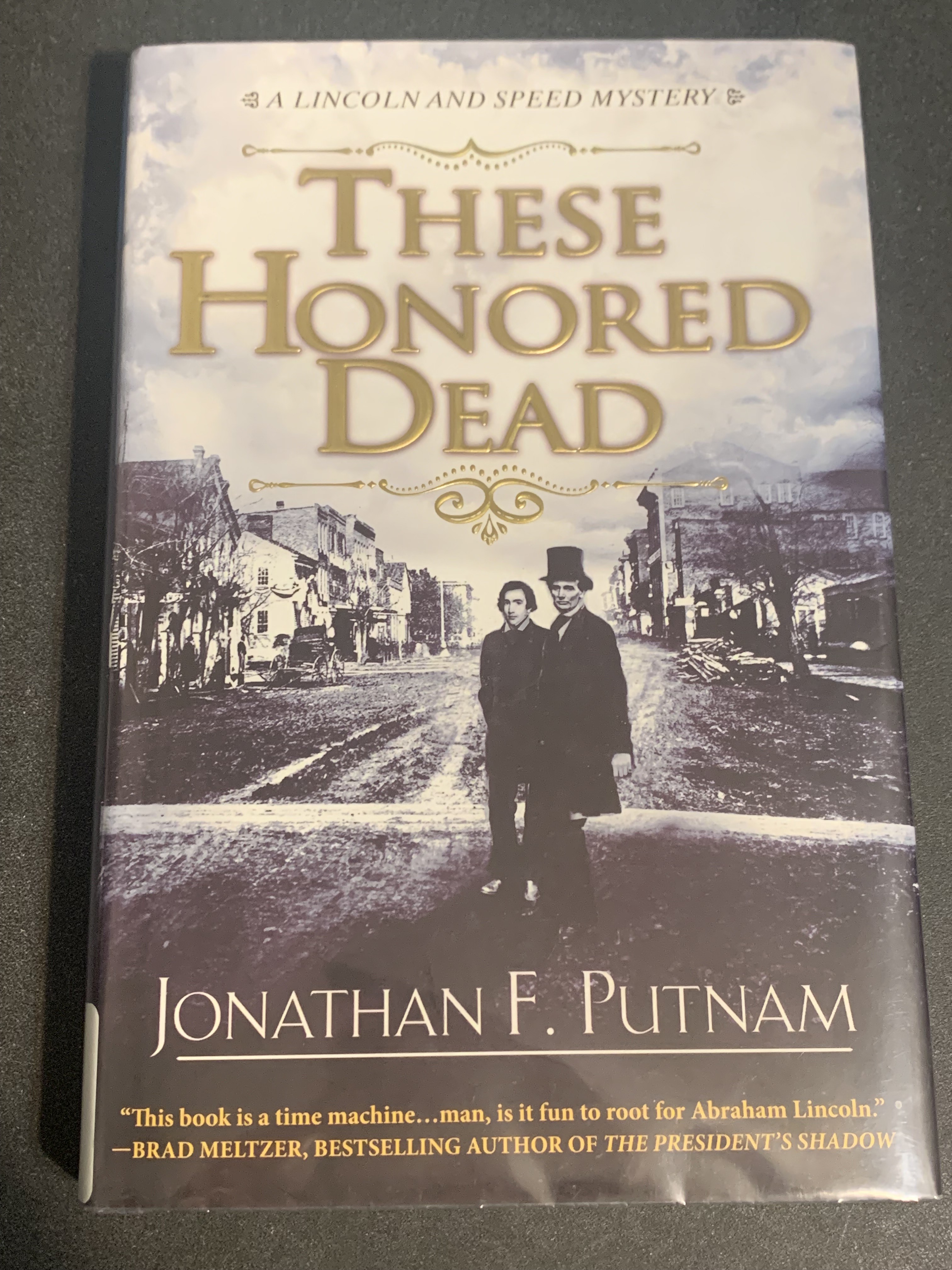
Did you know Abraham Lincoln got the idea for his famous stovepipe hat from a humble shopkeeper, and his friend, Joshua Speed, as a budding lawyer in Springfield, Illinois? Well, he did in Jonathan F. Putnam’s delightful 2016 fictional account of Lincoln, These Honored Dead. While it’s a fictional story about Lincoln and the aforementioned Speed helping to solve a series of murders in Springfield during the Panic of 1837 (the panic was related to a financial crisis, not the murders), Putnam did a lot of research and incorporated real people from Lincoln’s life and people embedded in Springfield at the time, and built off of real anecdotes. Indeed, Joshua Speed, and the entire Speed family (Joshua’s older brother, James, was appointed by Lincoln to be U.S. Attorney General), were friends of Lincoln’s. Joshua and Lincoln, in real life, as in the book, quite literally shared a bed during their time in Springfield. As someone who in the last few years has become obsessed with devouring all things Lincoln and the Civil War period (including the lead-up and Reconstruction), I had to grab this book when I saw it at a used book sale. Granted, I was leery at first: was this going to be an overwrought gimmick that doesn’t work? I’m happy to report that is not the case at all. Joshua is more the lead in this story, with Lincoln as the supporting character. But with Putnam’s extensive research and staying close to real history, while adding obviously fictional flourishes, this made for a serious, fun rendering of history! I would go as far as to say, it was one of my favorite reads of the year, much to my pleasant surprise. More people need to know about Putnam’s book and support it, in my humble opinion.
Even the title, These Honored Dead, which is a great title in and of itself, but of course, works well for a murder-mystery story as well, is a play off of Lincoln’s famous Gettysburg Address. Excuse me the indulgence of reproducing the full quote here, and if it doesn’t give you goosebumps, check that you are still alive.
“It is rather for us to be here dedicated to the great task remaining before us — that from these honored dead we take increased devotion to that cause for which they gave the last full measure of devotion — that we here highly resolve that these dead shall not have died in vain — that this nation, under God, shall have a new birth of freedom — and that government of the people, by the people, for the people, shall not perish from the earth.”
Emphasize is mine so you see where “these honored dead” is in the quote.
Joshua Speed partly owns or invested in a general store in Springfield, leaving behind prospects on his farm in Louisville (where they owned many slaves), but somewhat bad timing given the worst financial crisis up to that time is about to hit the United States. A fellow merchant, Rachel, who is a relatively recent widow, comes down from a nearby settlement, and they take up a torrid affair. Meanwhile, Stephen Logan inquires of Speed if his new lawyer friend, Abraham Lincoln, can take the berth (bed) opening Speed has above the store. Speed, reluctant at first given prior inhabitants of said berth, agrees after meeting Lincoln.
Rachel then takes in her niece, Lilly, who is 17, and her nephew, Jesse, who is 10, after both are pushed out of the poorhouse. She even takes on their debts to ensure as much. I believe both parents, or at least, the dad, died. Shortly thereafter, Lilly is found with her throat slit in Rachel’s barn. The local prosecutor, and soon, the sheriff, believe Rachel must be the culprit. They don’t really have a motive, but they did find a second Bowie knife — the same knife used to kill Lilly — on Rachel’s property. She also can’t or won’t account for her whereabouts that night. Speed is in a panic to help solve the murder so as to acquit Rachel of any suspicions. He doesn’t think she did it, surely. Rachel isn’t much help though because she wants to be a strong, independent woman, not reliant upon anyone else, and in this case, much to her literal downfall.
See, where I thought the book was heading was that Lincoln would inevitably defend Rachel at Speed’s insistence, and being the great orator he is (or would become), Lincoln would successfully defend her against the charges of murder. But phew, Putnam had more to come! Because soon, Jesse is killed after being bludgeoned with a stone. Related to all of this, not long after that, a Prussian traveling through crashes his cart and breaks his leg. He’s helped by the local, famous doctor, Dr. Patterson, and his daughter, Jane. In fact, Dr. Patterson does a new fangled treatment for the Prussian’s leg instead of amputating it, he puts a cast on it! (For all his know-how and being on the cutting edge, as a “modern man of medicine,” Dr. Patterson sadly still believed in bloodletting!) All of that to say, Speed figures perhaps it was the Prussian who killed Lilly and then Jesse. After all, he found Jesse’s corpse in the Prussian’s carriage. But after interrogating him, he doesn’t think him a murderer.
Joining in on the investigation, by the way, is Martha Speed, Joshua’s sister, who came up from Louisville to visit. She becomes friendly with Jane, is helping the sheriff’s wife deliver her baby (with the help of her slave, Phillis, who becomes pivotal later!), and is quite audacious beyond what would be considered her station at the time in matters of talk among men and her own know-how with the law. My brain thought she was the soon-to-be wife of Abraham Lincoln until I remembered that that is Mary Todd, not Martha Todd. Ope.
I mentioned where I thought the book was heading with Lincoln defending Rachel. Welp. That was upended about a third of the way into the book when Rachel herself is strangled to death and Speed finds her body. She was just on the cusp of being arrested for the two murders by the sheriff. I was stunned! Now what?! As it turned out, the prosecutor intercepted a letter that Rachel sent to … Dr. Patterson, that hinted at some sort of union and conspiracy of sorts between the two. At first, the prosecutor saw it as indication of Rachel’s guilt, but with her death, turned it around as indication of Dr. Patterson’s guilt. He’s promptly arrested and tried for the three murders. So, Lincoln is defending Patterson (who he was already defending in a prior land dispute), not Rachel in the last third of the book. Given Putnam was an attorney for many years, it’s not surprise the trial portion of the book not only read authentically, but was riveting! I also just love a legal thriller, which the book turned into. Particularly fun was the accoutrements one would expect of an 1830s courtroom: the judge smoking through copious cigars, all the jurors being white men who owned property and were of a certain age, and the spectators rowdily calling for Patterson to hang.
During the excitement of the trial, Speed, who now thinks Patterson should hang, too, is still trying to figure out the what and why of it all. He especially is flabbergasted when Lincoln reveals to him and Martha that Dr. Patterson confessed to the murders on account of gonorrhea-inspired episodic madness. In other words, their defense is going to be that Dr. Patterson killed the three people out of insanity, and thus, cannot be found guilty of such crimes. When he testifies on his own behalf later, Dr. Patterson actually argues he was trying to find a cure for the “depression of the spirits” that resides in the head, hence the cutting of the throat (relieve the blood pressure on the brain), bludgeoning of the head (knock it out of them), and strangling (depriving the depression of air). During a moment of chaos when the sheriff’s wife’s baby is due, the blackguard operator of a nearby poorhouse, kidnaps Phillis, which inadvertently brings along Martha and Jane, as Martha was trying to stop it. Lincoln had warned Speed to have Phillis registered in Illinois (a free state), otherwise he’d have no proof of connection to Phillis. That resulted in an argument about slavery, with the Speeds more on the side of slavery given that they literally owned slaves versus Lincoln. I think that sentiment might have been about 20 years early for Lincoln’s evolving thinking on the slavery question and abolition, but for the purposes of the story, I liked it’s inclusion here. But I digress. So, of course, Speed goes after the blackguard to rescue Martha, but also because Jane is set to testify on her dad’s behalf and also because he knows Phillis overheard something between Jane and Dr. Patterson and he’s curious as to what it was. He’s able to reconnect with Martha and Jane, who went to a nearby tavern, but Phillis was put inside the poorhouse. After knocking out the blackguard, Joshua, Martha, and Jane go inside to rescue Phillis. That’s when the brave and daring Phillis reveals what she overheard between Jane and Dr. Patterson, while Dr. Patterson was in the local jail during court recess. “I’ll not cover for your madness again.” They figured she heard wrong and it was Jane saying that to Dr. Patterson. Jane tries to play it off, but then essentially fesses up in a read-between-the-lines way to killing all three because Lilly, who was her childhood friend, knew she had killed her stepmother and when she arrived in Springfield after leaving the poorhouse, tried to blackmail Jane over it. Jane is the crazy one! She tries to shoot Phillis, but Martha and Joshua intervene, and either inadvertently or purposefully, Jane shoots herself dead.
However, there is no way to clear up the matter for the purposes of the trial! Obviously, even in a free state like Illinois, a Black person, much less a slave, is not going to be allowed to testify as to what she heard. This also gets Joshua marinating on the injustice of it all as it concerns Blacks. So, instead, Martha concocts a plan whereby the Prussian, in cahoots with Dr. Patterson, would make it seem like they escaped, tied up Martha, and absconded. The trial can’t be finished then. That’s a play off a real life anecdote from Lincoln’s attorney days, Putnam explained in his Historical Note. Lincoln was representing Melissa Goings, who was charged with killing her abusive husband. She fled during a recess in the trial, and when the judge asked Lincoln if he encouraged her flight, he is said to have responded, “Your Honor, I did not chase her off. She simply asked me where she could get a good drink of water, and I said Tennessee has mighty fine drinkin’ water.” That’s amazing. And he’s the one, in our story here, who planted the seed in Martha’s head for her little scheme with the Prussian.
I loved this book. Can you tell?! I need more Lincoln and Speed stories. Come on, Putnam! (Addendum after I published this review: Turns out, there are more Lincoln and Speed mystery books, yay!) This was just delightful, rich in historical intrigue, a genuinely puzzling and surprising whodunit, and to top it off, it turned into a compelling legal thriller. It had everything I’d want in a book. I can’t recommend These Honored Dead enough. This is no Lincoln-spurred gimmick book; it’s the real deal.

 Milam's Musings
2 thoughts