
Spoilers!
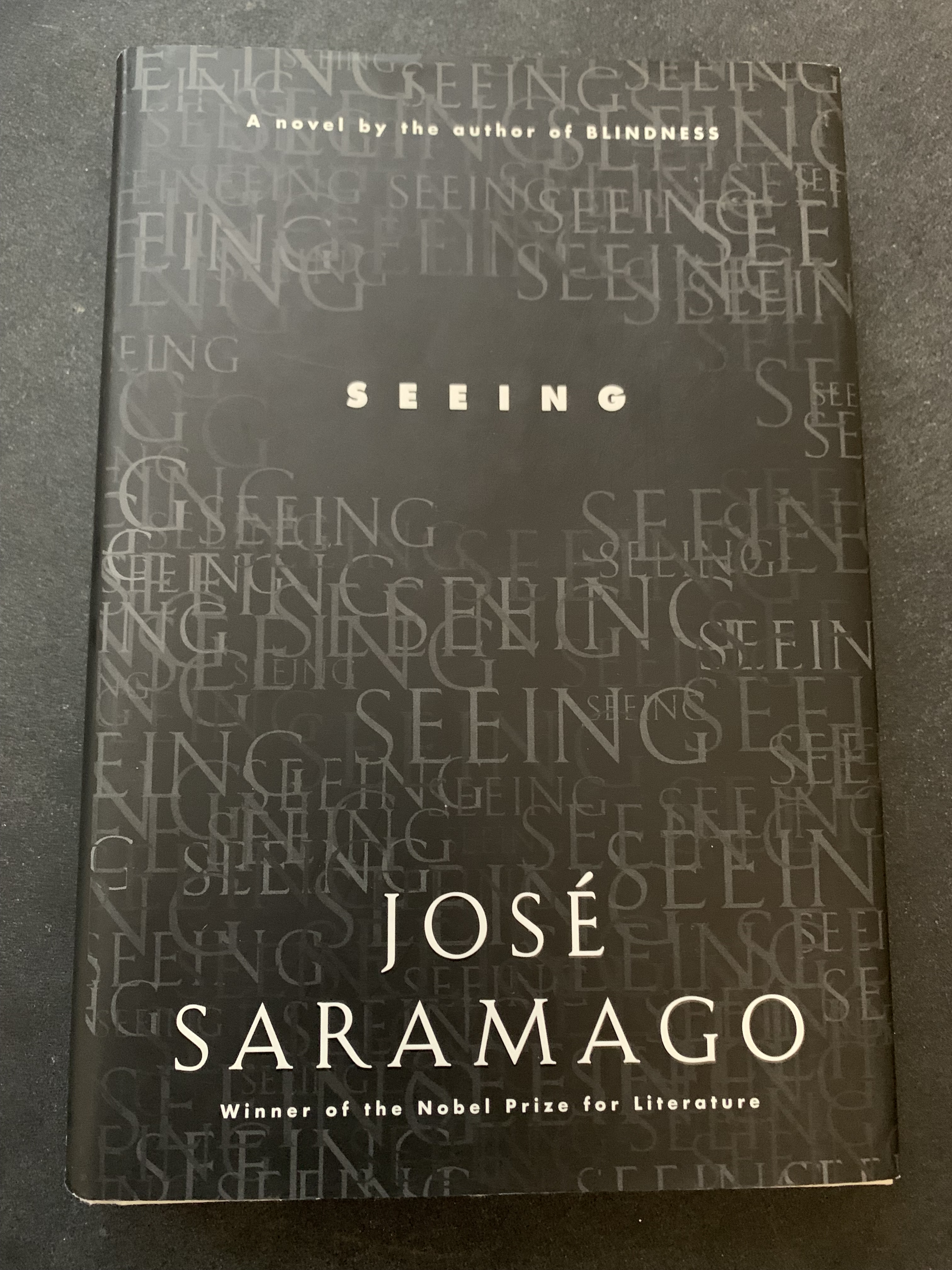
There are variations on it, but Thomas Jefferson is reported to have said, “When government fears the people, there is liberty. When the people fear the government, there is tyranny.” In his 2004 book, Seeing, José Saramago (translated from Portuguese into English by Margaret Jull Costa and released in 2006) takes that sentiment to its logical, albeit, absurdist, end. What if, in a democracy, the people stopped participating … actively? Which is to say, what if they voted, but not for anyone? In Saramago’s book, the voters of the capital on election day, more than 80 percent, return blank ballots to the ballot box (the remaining votes go to the p.o.t.r., p.i.t.m., and to a much lesser extent, the p.o.t.l.). In reaction, the government leaders, including the prime minister, the president, the interior minister, the defense minister, the minister of culture, the minister of transportation, and so on, flip out. The thinking goes, there must be a coordinated conspiracy to this insurrection, this attempt at subterfuge and subversion. This banal, legal act from the voters has scared the government.
The government’s first response is to simply hold another election shortly thereafter. When the results prove virtually the same (the poor p.o.t.l. receives even fewer votes, though), the government is flummoxed. The capital is put “under siege” by the government, where nobody is allowed in or out, with the military and police guarding the exists (or entrances). The media, save for two newspapers, are seemingly in the pocket of the government and/or are obsequious in advance out of fear of censorship. Then, the prime minister comes up with the idea of abandoning the capital and the people therein. The now-former capital will remain under siege, but without the “fatherly” protection of the government, the police, and so on. When lawlessness, looting, rapes, murders, thievery, and the like go unabated and without justice, then the “blankers,” as those who cast blank ballots come to derisively be known as, will surely relent and beg the government to come back. But … nothing happens. Even when the government prepares a dramatic, well-armored strategic exit from the capital, prepared for the blankers to attack, nothing happens. If anything, the citizens help light the way, as it were, by turning on the lights in their buildings. When the government fully retreats from the capital, none of the prophesied lawlessness comes to pass. In fact, only one random attempted bank robbery is noted, and the culprit was caught, given a stern talking to at the fire station, and let go.
All of this leaves the government unsure of what the next play ought to be. The president considers building a wall around the capital, to what end, who knows. Then, a bomb goes off in the metro, ostensibly caused by the blankers, the terroristic element that caused all of this disorder and democracy-weakening. Instead, as a council member still within the capital comes to highly suspect (and tenders his resignation thereafter), it was the government who set off the bomb. Again, the thinking being that it would scare — certainly we’re beyond cajoling — the capital denizens into begging for the government’s return. More than 30 citizens were killed in the blast. In response, the government expects rioting and violence. Instead, 500,000 people hold a mournful burial for the victims and demonstrate peacefully and quietly before returning to their homes.
Then, it’s time to “infiltrate” the evildoers with a trio of police officers: the superintendent, the inspector, and the lowly sergeant. What prompted that infiltration and resulting investigation was a letter sent to the government from a man telling a miraculous story about an event from four years prior. Even though Seeing is a standalone novel, it does have a throughline to Saramago’s 1995 book, Blindness, where the same country is struck by an epidemic of inexplicable blindness. Social order breaks down, a contrast to Seeing where it is the government orchestrating the breakdown to prove their worthiness and necessity. The miracle, as the man tells it, is there was a woman who was not blinded like everyone else. Furthermore, she killed a man, and since everyone else was blind, there were no witnesses to it. The superintendent, inspector, and sergeant soon find the man, which leads them to the woman and her husband, who funny enough is an ophthalmologist, and three other people that were part of that group. The interior of the ministry sees this as the nexus of the ballot box conspiracy. Which is to say, he sees a parallel between a society struck blind and a society issuing blank ballots at the ballot box. This woman is the maestro of it all.
However, as the superintendent “interrogates” the woman and learns more about everything, like the council member before him, he has doubts as to the veracity of the government’s claims or sincerity that they are after a truly guilty party. Rather, he sees the woman as the government’s unwilling scapegoat, someone to be the poster child for the insurrection as propagandized by the government. Before he fully turns the other way, however, he does comply with the interior minister’s wishes and gives over a photograph of the woman and her group to an unnamed and unknown man. I figured he was going to be an assassin, but more on what he does in a second. After this, the superintendent warns the woman and the group about the government’s efforts. Still, the government uses the willing newspapers as a vehicle to finger this woman as the culprit using the group photograph. Ope, I figured they were all about to be assassinated. So, the superintendent takes it upon himself to let the facts be known, inasmuch as they can be, to a newspaper willing to print it. Even though the government tries to seize all copies of the that newspaper edition in print, the citizens of the capital photocopy the article and distribute it throughout the city.
In a shocking, almost blasé manner, the superintendent, who has disobeyed orders to leave the capital, goes to a lake to reflect on all that he’s done, and as he’s sitting there, the unnamed and unknown man comes up behind him and shoots him in the head. The government uses his death to further cast aspersions on the blankers. The prime minister further uses it as an opportunity to fire the interior minister for his “blunder” in whichever direction you want to view the situation (for “letting” the superintendent be killed or for ordering his death) to amass more power for himself whereby he’s the head of a few different departments by that point in the story. The woman’s ophthalmologist husband is then arrested. As the woman steps out on to her balcony, she’s shot to death by the unnamed and unknown man. When her dog comes out to investigate, he kills the dog! That’s where Saramago leaves the book. Oof. Certainly, a government willing to bomb its citizens to rationalize their necessity will not stop at executing individual citizens (and their dog!). Those who wield the power of the government think themselves gods, or at least, short of that, His representatives. Saramago points out, “for, as it is always wise to remember, while it is true that man proposes, it is god who disposes, and there have been very few occasions, almost all of them tragic, when both man and god were in agreement and did all the disposing together.” Man, through government, proposes an awful lot, but there is much the government cannot ever control and properly dispose. That said, obviously, they can still impose a lot of carnage along the way.
In a democracy, as in the case of the capital citizens in Seeing, the government cannot always propose how the citizens will dispose of their duties. Indeed, as the superintendent came to realize (or again, “see”), the very contract, which is to say, the social contract of Rousseauean origin, was dubious upon further consideration. As he remarks to another, “When we are born, when we enter this world, it is as if we signed a pact for the rest of our life, but a day may come when we will ask ourselves Who signed this on my behalf.” It was at that point the superintendent “broke” the contract with his letter to the newspaper. But he was the not the first to break it! The government did by retreating from the city, and worse still, by bombing its own citizens. Saramago gets at something people often don’t understand when demonstrations, and even riots, occur. They see the demonstration, and certainly the riot, as the flashpoint, or the origin, of a breakdown in civic order. What they overlook is the role the government, the ones entrusted with maintaining civic order within society, did to erode civic order. The origin is that incremental erosion, often leading to that flashpoint (egregious police violence, for example) that then results in demonstrations and/or riots.
You’ll notice in this review that I didn’t use character names. That’s because Saramago didn’t. He also used very few paragraph breaks, long sentences, no quotation marks to indicate speakers, and indeed, no paragraph marks to indicate different speakers speaking. I think it added to the narrative heft of the paranoia rampant among the government, and the resulting “seeing” (of the light) the council member and the superintendent, in turn, experienced. Going into the book knowing Saramago won the Nobel Prize for Literature, and having read his 2009 book, Cain, I knew it was going to be a challenge, but I welcomed it. Upon seeing how the book would be structured, I did, nevertheless, worry if Saramago would be capable of reeling me in. But c’mon. Nobel Prize! Once you get into the rhythm of Saramago’s prose, it read beautifully, with that aforementioned paranoid frantic pace. He deliberately didn’t bother with the minutiae of description instead sticking to the deliberations among the government, the cerebral inner monologues of the council member and the superintendent, and the occasional meta-reflections from the narrator of the story. This sort of detached style where we don’t get names or more fleshed out world-building descriptions allowed for the shock of the superintendent’s casual assassination and the closing words conveying the death of the woman and her dog on the balcony.
Saramago’s Seeing is not an easy book to read, but if you are truly seeing what he’s writing, in the way he’s writing it, you’ll see the truth of his wisdom about the ways in which citizens operate in a democracy, interact with their government, and indeed, how that government interacts with its citizens.

 Milam's Musings
❤️💯✨
LikeLike
Awesome work always my dear friend! Merry Christmas! 🎄🎁🧑🎄⛄✨ Love and Light God Bless ❤️💯🙏
LikeLiked by 1 person
Thank you, and merry Christmas!
LikeLiked by 1 person
You’re very welcome my dear friend! 🎄🎁
LikeLike