
Spoilers!
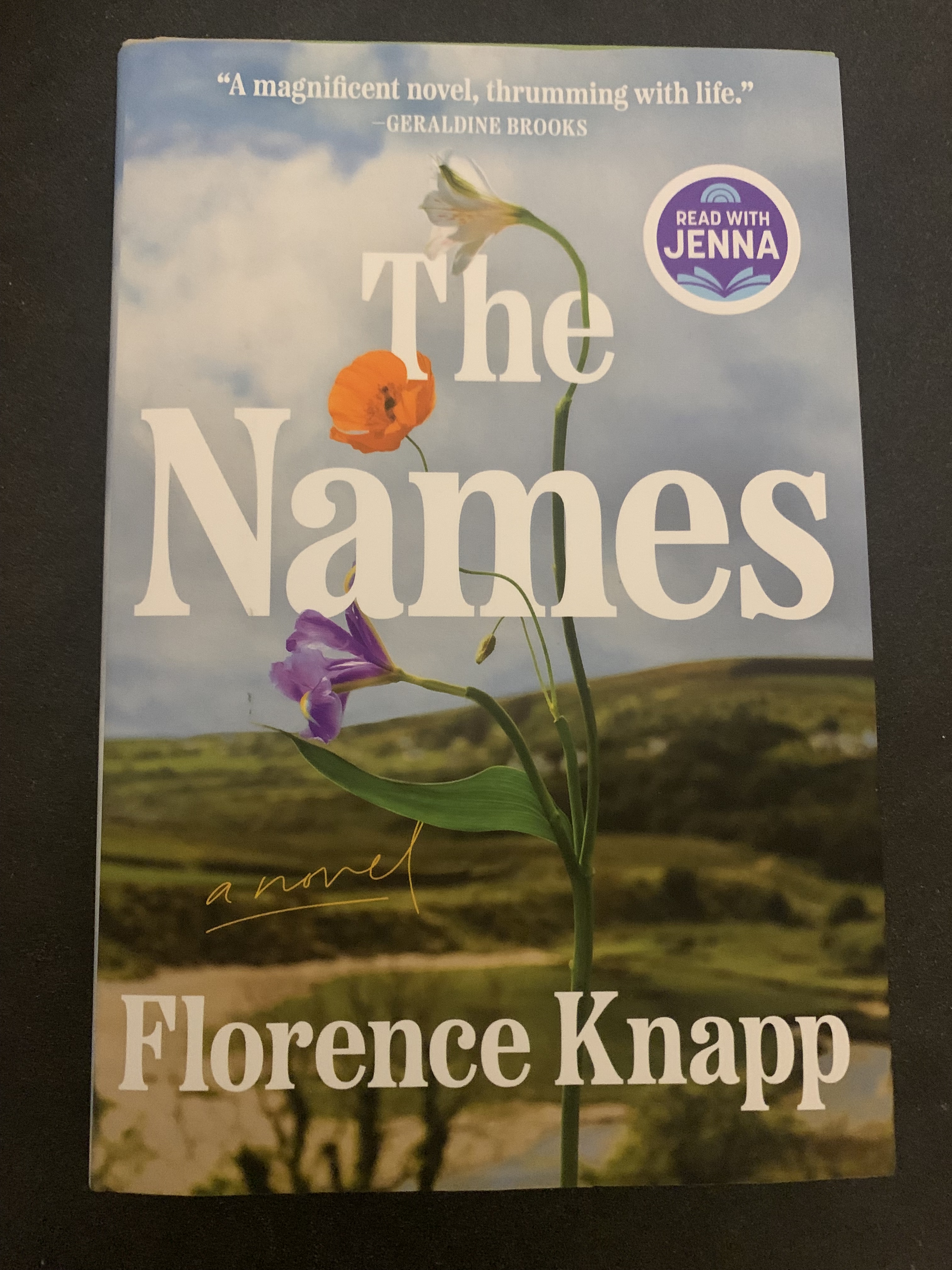
Is a name destiny? Perhaps in hindsight, a name like Abraham Lincoln seems destined for historical greatness, but what if the path of history had titled and the man from Kentucky was never known? He instead lived a humble, unassuming life, his oratory skills never stretching behind the confines of his cranium. In Florence Knapp’s spellbinding debut 2025 novel, The Names, she shows three different paths unspooling from a name, and how the resulting destines reverberate across myriad lives and deaths.
Cora’s (the core of the story) doctor husband, Gordon, named after his brain surgeon father by the same name, is by all accounts a “perfect husband.” He’s loved by the patients he treats and the wider community. He provides a big, beautiful house for Cora and their two children, Maia (mother), 9 years old, and a newly-born yet-to-be-named boy. But within those walls, Gordon is abusive to Cora, physically and emotionally. He controls every facet of her life. And indeed, he wishes the new boy to carry his family name, Gordon, which fittingly means great hill; a hard climb to reach the other side. Cora’s husband would become a great climb to the other side, as extricating one’s self from an abusive relationship always is, no matter which path the boy’s naming unleashes.
For her part, Cora does not want to name him Gordon, worried he’ll become just like his father. Rather, she prefers the name Julian for sky father, or jeweler. A sky father would “transcend” the fallible, abusive earthly fathers — would rise above the familial lineage of abuse seemingly inherent to the Gordon name. As for Maia, she likes Bear because it means soft and cuddly, but also brave and strong. So, we have our three paths where Cora registers the boy’s name as Bear, Julian, and sticking to Gordon’s wishes, Gordon.
The story begins in 1987 England, and as each of the three paths unspool, takes us to Ireland as well, and Knapp time leaps seven years for each new iteration of our core characters, ultimately ending in 2022. The COVID-19 pandemic even becomes an integral plot beat in the Julian section in particular.
Bear
On the Bear path, Gordon becomes explosively violent to such a point, Cora calls out for help, and a neighbor, Vihaan (dawn, or the beginning of a new era), out walking his dog, hears and tries to intervene. In the ensuing scuffle, Vihaan is shoved through a glass window and killed. Gordon is arrested and convicted of murder. Thereafter, Cora becomes close friends with a neighbor woman and her daughter, Mehri (kind) and Fern (provider of shelter), who offered assistance, should Cora ever need it. On the anniversary of Vihaan’s death, Cora, Maia, and Bear celebrate the sacrifice he gave them.
Bear is so carefree, unencumbered by a father he never had to endure in the way Cora and Maia had to. Maia, who Bear takes to calling Bees, dotes upon him. I figured this would remain the more, well, to use the word again, carefree, section of the book, but it’s not without its ripple effects from Gordon’s abuse, especially upon his potential release after 14 years in prison. Maia is constantly fearful she will run into him or that he will come after them. But also, in a more subtle way, Bear is still molded by the father he never knew. First, he begins to suspect that his very name was the harbinger of Vihaan’s murder, and so, he blames himself. Secondly, I think there’s something to be said for Bear becoming a globe-trotting archeologist — despite a budding relationship to Lily (purity, innocence), a girl he met when they were 14 — both in the sense of taking up on the occupation of excavating the past when he can’t seem to excavate his own origin story, and because it becomes a convenient way to avoid intimacy with Lily, creating a simmering rift to mix metaphors. That rift becomes a nearly uncrossable chasm when Lily is almost killed during a terrorist attack in Paris in 2015. That’s when Bear realizes he needs to get his priorities in check.
Unfortunately, the carefree section, despite some of those bumps along the path, stops being so carefree. Yes, Cora is out from under the yolk of Gordon’s abusive tyranny and is embracing her gardening nature, and Maia seems happy enough pursuing a career in medicine and is in a happy marriage with Charlotte (free). But then, Bear dies after having an allergic reaction to a wasp sting. Oof. That hurt! After his death, Cora reconnects with Felix (fortunate), a veterinarian, who she had dated, but dismissed. Felix is a widower now, and they bond over their grief and what they’ve been through.
Julian
Cora is dead from the outset. The most dangerous moment for a woman is trying to leave a man, and so it was with Cora trying to leave Gordon. Maia and Julian go to live with Cora’s mother, Sílbhe (Irish version of Sylvia, silver-haired, which Gordon insisted on the American version to further exert control over Cora), in Ireland. In contrast to his Bear persona, Julian is afraid to even play hide-and-seek with Maia because he doesn’t like seeing her scared or unsure. And it’s Maia, who, despite being nine years older than Julian, wets the bed at night.
Sílbhe doesn’t believe in God anymore, but she does believe in her purpose to take care of these two children, even if it means putting on hold a late-in-life renewed romance with a metal worker named Cian (enduring one). By the time she’s in her mid-70s, she’ll be in the best shape of her life. But she also holds regret for letting Cora go off to England at 14 to pursue a career in ballet. That if she had stopped Cora’s path from unspooling then, she could have prevented her ever getting into Gordon’s clutches. Soon, Cian does become part of the family through first teaching Julian his metal work. Perhaps again there is something to be said where Julian picks a quiet, unassuming, intimate profession where he has to work delicately with his hands instead of using his hands to abuse. Julian, though, is terrified that he has the gene of a murderer inside him, which begins to sabotage his relationship to Orla (golden princess) and their two daughters. COVID-19 only enhances the pressure, especially because Julian is stubbornly (afraid?) of sending his jewelry to England because he associates England with his father, and more importantly, with England failing his mother. However, he soon realizes, much like Bear with Lily, that he can’t let his past be destiny with the one he loves. He rekindles his love with Orla.
On the other hand, Maia has largely repressed her true identity and orientation until well into her 40s, wherein she finally allows herself companionship and love. Also, instead of the medicine path of her father, Maia takes on homeopathy, which would have absolutely been derided by the “proud” Gordon lineage. So, all in all, despite Cora being dead at the top of this section, and Sílbhe’s death at the end, this might be the sweetest, least bumpiest of the sections. That’s also life! The path is never going to be perfectly straight, with roses all along the way.
Gordon
My chest tightened any time I reached another Gordon section because it was so difficult to read how he controlled Cora’s life, including through his son, Gordon Jr, who he saw only as a vessel to further manipulate and punish Cora. And sadly, because Gordon Jr. was so young, impressionable, and yearning for his father’s love and attention, he willingly provided hyperbolic tales to help his father punish his mother. That’s something Gordon would regret in his adulthood until he gave himself the grace of realizing he was as mere child at the time. I mean, Gordon controls so much about Cora’s life, he leaves the house with the freaking remote control so she can’t watch television! As for Maia, she does try to circumvent her father’s dome of control by writing to Sílbhe in Ireland, who then gets the police involved, but the police, who are patients of Gordon’s, don’t believe he could be abusive. Cora also isn’t ready to step away from him, either. She’s afraid of losing her children. Surely, Gordon will depict her as psychotic. After that, Maia largely washes her hands, sadly, of her mother’s situation. She came to see it as just too difficult to figure out how to “solve,” which is a helluva burden for a child to place upon themselves for the parent. Indeed, when she does check in, Maia realizes it’s become a habit to “want to know if her mother’s all right.”
Gordon Jr, like Bear, begins a budding romance with Lily at the age of 14, but unlike his soft, cuddly counterpart destiny, he forces himself on Lily when they’re kissing and then after being rebuked by her, starts an ugly rumor about her. He has become just like his father, and keeps that going in his early adulthood, only in more expressive ways. He becomes a banking bro, an alcoholic, and a womanizer.
In another throughline to an alternate path, Cora’s first escape from Gordon occurs because she happens upon a piece of mail notifying her of Sílbhe’s death. Her own mother died months ago and Cora, forced to be isolated from her own mother, knew nothing about it. Worse still, Gordon is reallocating Cora’s inheritance to ensure she cannot gain financial independence. When she’s seeking help, with nowhere else to turn, she goes to a veterinarian’s office. His name is never given, but it’s assumed, once we learn of Felix, that it’s him. Despite escaping and getting help, Cora does return to Gordon, and repeats this cycle multiple times over the years. Knapp reminds us of a true fact: that it takes women, on average, seven attempts before they permanently leave an abusive husband. If they’re not killed in any of those attempts, of course. Cora is ultimately able to leave Gordon thanks to a redemptive arc from Gordon Jr. He becomes sober, reconnects with Maia, and then his mother while he’s living at home. Before he moves out, he takes a page out of his dad’s controlling playbook by surreptitiously placing cameras in the smoke detectors of the house to capture his dad abusing his mother. He then uses that footage to blackmail his father into leaving his mother.
As for Maia, she did take the doctor path like her father (which further added to her guilt whereby she feels she’s been rightly protective of her patients, but “left” her mom with Gordon), and while she’s not as repressed as in the Julian section, she still doesn’t want her father to know about her gayness.
Finally, I think it’s worth mentioning the flip Gordon Jr has with Francisco Goya’s macabre painting, Saturn Devouring His Son. When Gordon Jr first sees this painting, he interprets it as Maia seeing him as devoured by their father. It almost compels Gordon Jr to drink again, but thankfully, he doesn’t. Instead, he comes to see Saturn for what he is in the painting: desperate and fearful. That takes away all the power and control Saturn, or in this case, Gordon, held over him. I loved that.
I’d also be remiss if I didn’t mention this little detail. Bear has a birthmark that people interpret as looking like, well, a bear! In the Julian and Gordon sections, however, they see it as a sort of wonky heart. I think you could imagine that the outline of a bear could look like a heart and vice versa. I also loved that.
Knapp’s book has so much heart, so much tenderness and rawness about human relationships and how they “bump into each other,” as I believe Mehri says, that I just fell in love with it. I was fully invested in each of the three sections to see how the lives of these characters would develop over the years. I was heartbroken at parts, elated at others. But importantly, Knapp handled each with aplomb; there was nothing too sappy or contrived here. It all worked. And the reason it was spellbinding, masterful work is because I loved trying to catch the throughlines of each narrative path. In my humble opinion, names are not destiny, even if they do confer certain meanings; rather, it is our choices that create our destiny. The choices we make each and every day that set the foundation for our path, but those we bump into along the way, and in turn, how they shape us. What a delightful, if at times chest-tightening, story. I highly, highly recommend The Names, which is easily among my favorites reads of the year.

 Milam's Musings
I have been searching for someone on the internet who read the author’s note and was also wondering about the flowers and the narratives they represent. here are what the flowers symbolize:
white alstromeria: love, devotion, friendship, strength, and support
red poppy: remembrance, sacrifice, hope, and resilience
purple iris: royalty, wisdom, valor, and courage
do your thoughts change after knowing what the flowers symbolize? without writing an essay on this, my guesses would be alstroemeria- bear, poppy- julian, iris- gordon.
LikeLiked by 1 person
Thank you for this! I think seeing what the flowers represent, you’re spot on with the corresponding characters/narrative arcs!
LikeLike