
Spoilers!
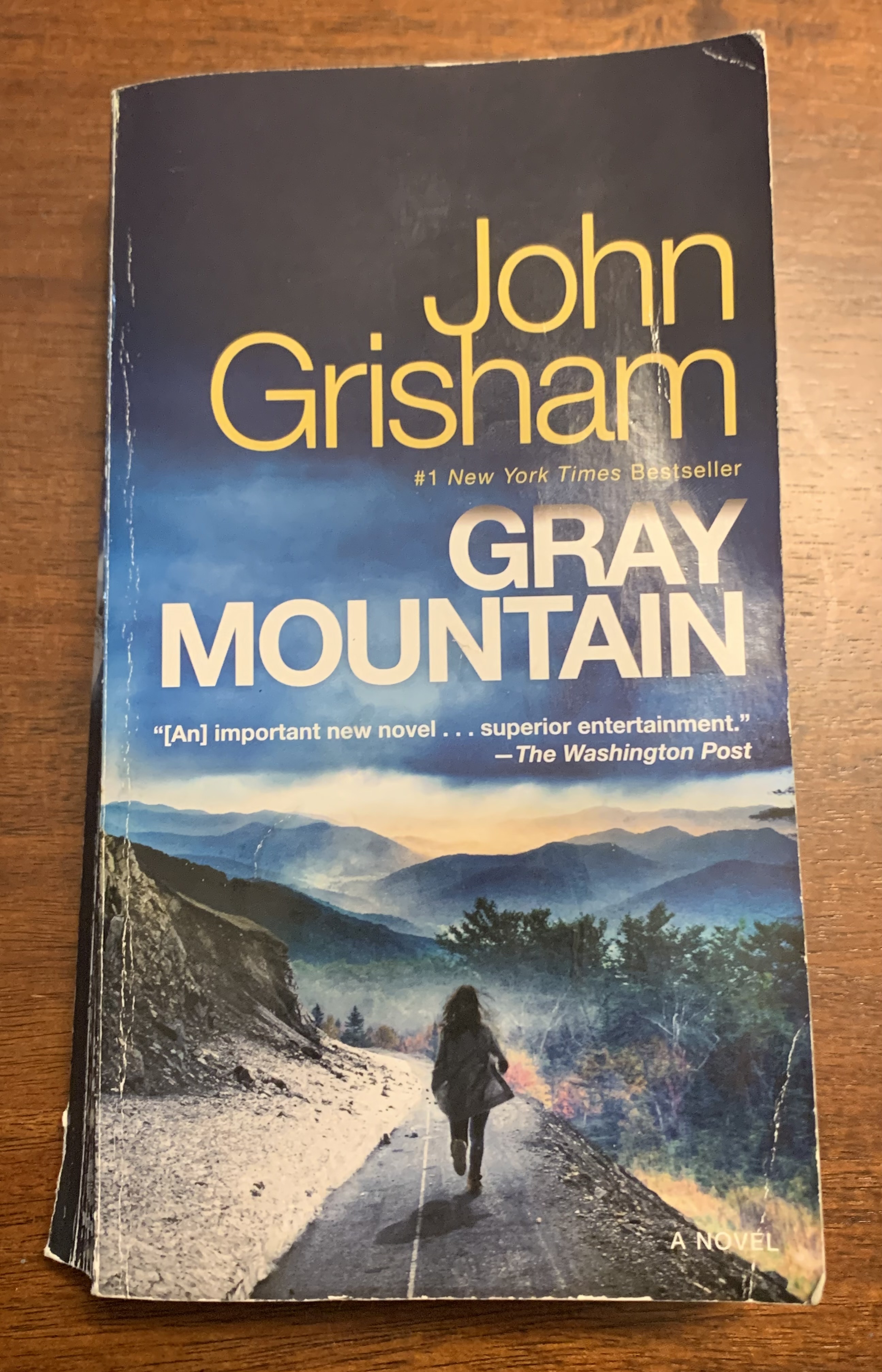
It’s a bit of a cliche at this point to take a city-dweller and pluck them in the backwoods of Appalachia, but the cliche works because of the inherent appeal of a fish-out-of-water story. In the case of John Grisham’s 2014 book, Gray Mountain, there is the added appeal of taking a Big Law lawyer from New York City, Samantha, and dropping her into the Mountain Legal Aid Clinic in fictional Brady, Virginia, where she would work for free helping the low-income residents of coal country. But I also have to say, it’s perhaps the first time I can recall reading a Grisham book where I wasn’t totally enamored with the main protagonist. I thought Samantha took too long to make her character change from having one foot still back in the city to being all in on the mission of the Clinic. Nonetheless, I devoured the book because Grisham rules.
Set at the beginning of the Great Recession in 2008, Samantha was “furloughed” by the biggest law firm in NYC where she was doing real estate law, never having seen the inside of a courtroom or doing any kind of trial work. The furlough stipulated that the law firm would keep her benefits going, so long as she interned for free at one of the recommended nonprofits. Because so many lawyers were looking to connect with these nonprofits, few said yes. Mattie at the Clinic took Samantha in, though. Down into the boonies Samantha went, from on the partner track to pro bono work.
Much of what the Clinic deals with is low-income folks who need representation against businesses taking advantage of them, divorce proceedings, domestic abuse, child abuse, and so on. The Clinic is funded by private benefactors. A private attorney, who is Mattie’s nephew, Donovan, is the brash trial litigator, ready to take on the corrupt coal companies. The coal companies not only strip-mine with reckless abandon, regulations, their own employees suffering from black lung disease, and the environment be damned, but they will fight any litigation against them with an army of well-paid attorneys. Donovan loves the fight, though, and it’s also personal. His father sold the titular Gray Mountain to a coal company, who strip-mined it, never paid the father, and then their mother killed herself. So, now it’s just Donovan and his brother Jeff. The brothers seem to match fire with fire: if the coal companies are going to fight dirty with thugs attempting to intimidate people out of litigating, then they’ll fight dirty by stealing sensitive coal mining documents and even shooting out the tires of the big trucks they use to do the strip-mining in the first place.
The coal mining element was intriguing because I don’t know much about that history and how it has shaped Appalachia, both literally with the environment and the people who depend on those coal jobs, including a real life incident Grisham references, the Martin County coal slurry spill in 2000. Until 2008 incidentally, it was one of the worst environmental disasters in the United States. And I’d never heard of it! I don’t want to opine much about coal mining, “clean coal,” and such, because, again, I’m not knowledgeable about it, but Grisham used this thorny issue to great drama for his book.
That said, some of my favorite parts of the book were actually the cases where Samantha was tasked with helping the downtrodden in less dramatic cases, whether that’s a woman abused by her meth-addicted husband (who unfortunately she later returns to, rescinding the divorce and dropping charges against him for abuse), or a woman who wants to leave her land to her neighbor instead of her five greedy children who will surely sell it to the coal companies and needs to write up a new will, or a mother forced into homelessness by a mistaken garnishing of her wages from a collection agency, or finally, Buddy, a poor guy who has black lung disease from working in the mines for nearly three decades and just wants the benefits owed him. Samantha is particularly thrilled when she wins a $10,000 judgment against the collection agency on behalf of her client. It was the first time she’d been a trial litigator and succeeded at that.
Shockingly, mid-way through the book, Donovan is killed in an airplane accident (he flew his own little plane to jet around Appalachia to take up cases against the coal companies), which Jeff suspects was murder orchestrated by the coal companies, particularly because Donovan had a.) just achieved a $3 million settlement against a coal company in the death of two boys, and b.) was planning two big lawsuits against other coal companies, one for causing cancer to an entire valley of residents, and another for the Buddy case. While Grisham never fully says one way or another, it’s insinuated that Donovan was murdered. After Donovan’s death, everything is in turmoil, and it seems like none of those cases will go through. The one coal company is even disputing the $3 million settlement. Samantha also ends up shacking up with Jeff, which is when she learns for certain that he has the stolen documents from the coal company that implicate them in wrongdoing (stashed away in Gray Mountain, of course) and is likely also behind the shooting of the tires. Meanwhile, Samantha’s former boss at the Big Law firm is breaking away to start his own law firm and is trying to cajole Samantha into returning to NYC. And then sadly, the mother with the greedy children dies, but not before someone sends the original will Samantha worked on with her to dispute the fraud claims of the children (Grisham never answers who sent the will, though). Buddy also dies by his own hand so his family will get the insurance payout. Oof.
In the end, Samantha decides to stay on longer with the Clinic because she likes feeling part of something important, and she also wants to prove that women can be trial litigators, sticking it to the chauvinistic male lawyers she encountered earlier in the book. She does negotiate with Mattie for an actual salary, however. I’m glad she’s doing that kind of meaningful work and helping real people. Again, I think where I got irritated with her is how long that change of heart took to happen! Or that realization, rather. Also, as someone just preternaturally opposed to the concept of being bored, the number of times she said she was bored grated on me. And finally, the Jeff fling was whatever, but at least Samantha was clear from the get-go that’s all she wanted out of it. (She was still rather reckless, as a lawyer, to implicate herself in a potential criminal conspiracy, of which she was well-aware she was doing.) Still, she made the right choice in the end.
I’m always going to be fascinated and absorbed by a well-done legal thriller, and of course, Grisham is the top author in the game for legal thrillers; ergo, I enjoyed this fish-out-of-water story even if it wasn’t his best work.

 Milam's Musings
One thought