
Spoilers!
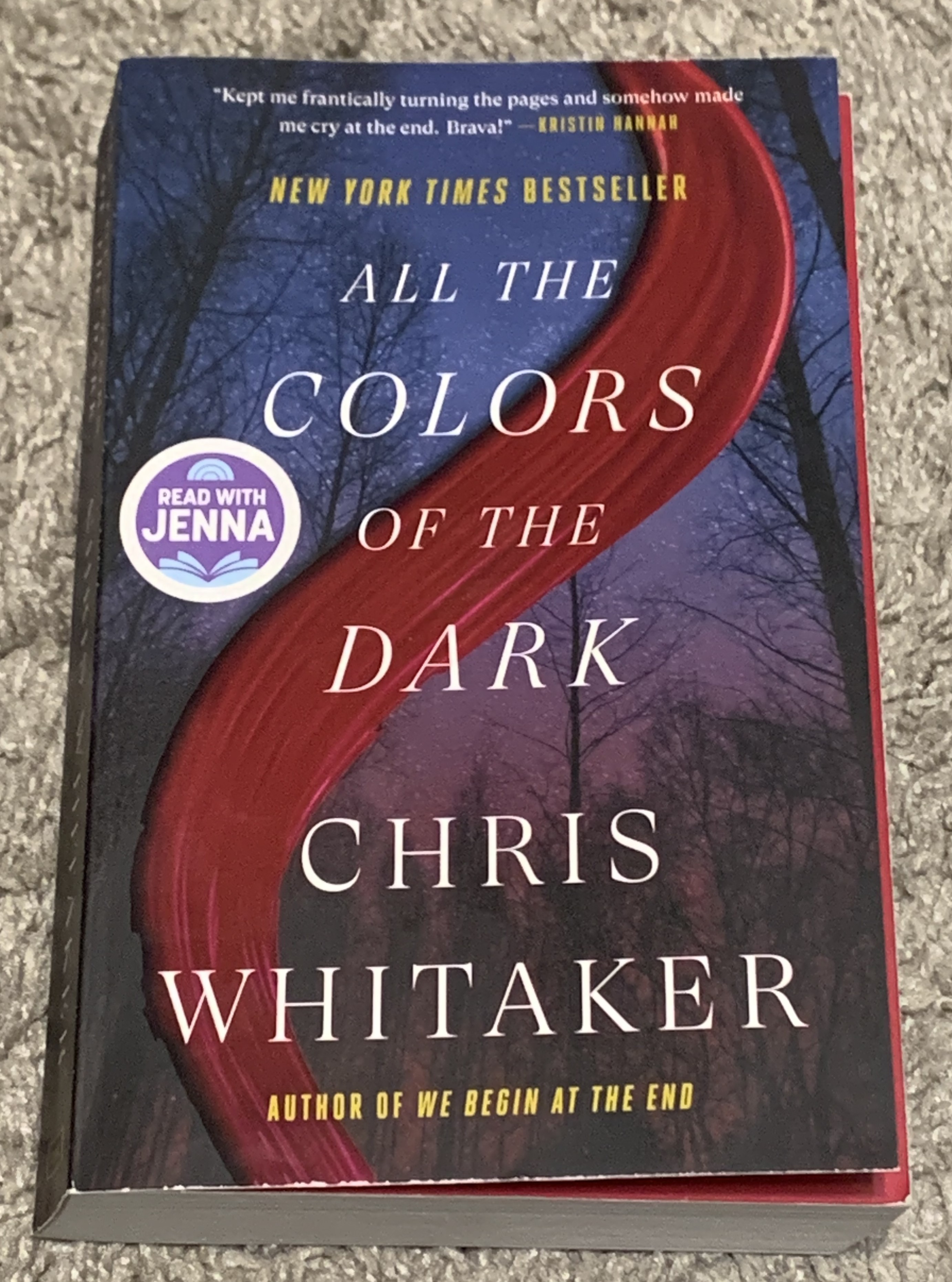
Author Vladimir Nabokov said, “The cradle rocks above an abyss, and common sense tells us that our existence is but a brief crack of light between two eternities of darkness.” To love and be loved, to be seen, is that crack of light in the darkness, that color of light. So it is in Chris Whitaker’s 2024 book, All the Colors of the Dark, a tour-de-force across a quarter century, where a pirate and a beekeeper rock upon that abyss trying to catch that crack of light before it knocks them topsy-turvy. A book that is nearly 600 pages (in the paperback edition) should not read so easily, with such flow, propulsion, and profound prose. Yet, Whitaker’s book does, which is a testament to an author at the height of their considerable powers and talent.
Patch is a kid in 1975 trying to make the best of his situation in the fictional small town of Monta Clare, Missouri. His mother turned into an alcoholic after her husband, Patch’s father, was killed in the Vietnam War. And for his own part, Patch was born with one eye, is bullied for it, and leans into being a pirate with perhaps dubious facts about pirates. To try to help his mother, he steals. He also dotes upon the rich and popular girl “on the other side of the street,” as he thinks of it, Misty. But he ends up making friends with Saint, who is being raised by her grandmother, Norma, and is fond of bees, hence the moniker, beekeeper. She’s also wickedly smart and talented in pretty much anything she attempts, only surpassed by her unyielding and indefatigable tenacity and loyalty. She brings those smarts, talents, and spirit to bear upon her friendship with Patch. She loves him, even if he has eyes for Misty.
One day, Patch comes upon Misty being accosted by a large, unknown man. Patch doesn’t think twice about intervening to help Misty. He’s able to heroically distract the man long enough for Misty to escape, but in the process, Patch is stabbed with his own knife. That is the inciting incident of All the Colors of the Dark, and the moment that changes the lives of everyone involved in the story: Patch, Saint, Misty, Norma, and so many more townsfolk of Monta Clare, including Police Chief Nix, Dr. Tooms, and Sammy, who owns an art gallery in town and is quite well off, as well as being an alcoholic. Unfortunately, I don’t think Patch’s mother’s trajectory changed much since she remained an alcoholic until her death. The most you could say is that Patch’s abduction hastened it. But it is Saint and her tenacity, despite being only 13 years old, who keeps the possibility of Patch being alive, well, alive. She not only continually pesters and prods Police Chief Nix, but she boldly does her own investigation, like she’s Lois Lane or something. I freakin’ adored Saint. She keeps a vigil of sorts on Dr. Tooms’ house, not believing his story of searching for his dog in the same field where Patch was abducted. Later in the story, I did believe that Dr. Tooms was implicated in the abduction of Patch and perhaps other girls. After all, as we learn, Patch’s stomach wound from his knife was stitched up. Since Dr. Tooms is a doctor, it follows that he was involved.
Saint also learns of someone named Eli Aaron, a photographer at dozens of schools, who also took photograph of Misty. Again, she boldly goes to his house alone. But she’s right, that’s where Patch is being kept, and Eli Aaron is a serial killer and a sociopath. Luckily for Saint, Jimmy, a boy from town who loves her (unrequited, it should be said), mentioned to Police Chief Nix where she was going. Although, up until the point at which he rescued Saint, she was doing well enough evading Eli Aaron on her own. She even set fire to the home. First, Patch was a hero to Misty, and now Saint is a hero to Patch.
After it all, Patch is rescued, but Eli Aaron is in the wind, as they say, presumed either dead from the flames or on the lam. We then see Patch’s side of the abduction, where a girl named Grace, as wickedly smart and bookish as Saint, kept Patch going. She kept him alive; she was his “color in the dark.” In one lovely exchange, Grace reflected that her mother was decent, but weak, and that perhaps the “two go hand in hand.” Patch responded, “Being decent takes more strength.” For sure. Decency is far more radical and courageous than cruelty; cruelty is easy and for the weak-minded.
So, after Patch returns to “normal life,” he’s not only a different Patch than the one Saint previously knew, but preternaturally driven with tracking down Grace, proving that she wasn’t a figment of his imagination amid an unspeakable trauma, but a real person he needs to know is safe. Patch, through a budding friendship with Sammy, takes up learning how to paint, and paints Grace as he remembers her and her home she described. He also leaves voicemail messages for Saint recalling everything he can remember Grace telling him. Nobody but Saint believes him, and again, because of her tenacity and loyalty, she’s doing everything within her power to help find Grace.
Meanwhile, Misty now courts Patch. They soon become a couple. Her dad thinks she feels obligated and hopes their relationship ends before Misty inevitability goes on to Harvard and a much loftier life than whatever Patch can give her. For his part, Patch doesn’t need the dad to outright say that, as he already feels like an anchor on her destiny.
As the story progresses and the seasons progress, Saint settles in with Jimmy, quite literally, by marrying him, really at the behest of Norma. Jimmy is a devout man, who is something of a mama’s boy (which, as a mama’s boy, I intend it here more derogatory in that he’s looking for Saint to essentially take the place of his mother in the wife role), and appears on the fast track to life as a veterinarian. Shortly after marrying Saint, though, he fails his exams and is knocked asunder. He begins drinking, gaining weight, and stops going to church. He’s also a jerk who doesn’t check in on Norma. I say “check in” because as it turns out, the FBI has an interest in Saint working with them, which takes Saint from Monta Clare. Saint, I should note, had become a rookie cop under the tutelage of Police Chief Nix, deciding against going to Dartmouth. Anyhow, the reason the FBI has an interest in Saint is because of the Robin Hood proclivities of Patch. After breaking up with Misty, he’s not only taken to painting missing girls all over the United States after meeting with their grieving parents in the long-shot hope of finding Grace, but he’s also robbing banks to fund the charities that help find missing girls. The FBI doesn’t take kindly to banks being robbed, even of the relatively paltry sums Patch is absconding with, and with no violence. So, yeah, Jimmy doesn’t like his new bride “galivanting” around in Kansas while he’s at home being a loser. When Saint finds out she’s pregnant, it appears she gets an abortion. Mind you, this in the 1980s, even more taboo, especially in a small religious town, than now. Jimmy, the supposedly good guy that Norma vouched for, immediately pummels and beats up Saint upon learning this. Thankfully, after the next time jump, we learn she divorced him.
Whitaker’s book was interesting with the second half of the middle part. A quick recap of events after Patch returns and time passes: Grace has still not been found; Saint is on the hunt on behalf of the FBI to find Patch, and does eventually bring him in (after shooting him in the leg); he then serves a few years in prison and is released; after which, he builds the house he remembers Grace regaling him with (as well as painting it) over the ashes of his childhood home; and Saint even becomes the next Police Chief. After those events, Patch reunited, in a way, with Misty, who was back in Monta Clare because her father died, and it turned out, she had a daughter named Charlotte, also Patch’s kid she never told him about, after they had a one-night stand when Misty was still at Harvard. I said this portion of the book is interesting because Whitaker hit us with what felt like an extended epilogue phase. But then the book ratches back up — and to be clear, I think it’s another testament to Whitaker’s confidence in his story that he takes the reader through this simmering slow-down and the machinations of these characters’ lives — when another inciting incident occurs.
After Misty dies from cancer, Patch is raising Charlotte. He takes her to the zoo, where the reptile house reminds him of his captivity and he passes out. Lo and behold, it’s Jimmy who is there when Patch comes to; Jimmy is still working at the zoo. Once Patch realizes it’s Jimmy, on behalf of Saint’s honor, he slugs Jimmy. He threw one punch. But Jimmy fell down, hit his head, and died. Now, Patch is in prison for murder. That brings him to death row where Dr. Tooms is (ingeniously, Patch made a mark of the warden by saying he wanted to bring books to the death row inmates), and so, each week, Jimmy peppers the man he thinks abducted him with questions about Grace. Soon thereafter, thanks to a few helpful (grateful) men related to missing girls Patch painted, Patch is able to escape from prison and head to Alabama, where a fellow inmate tipped him off that his painting of Grace’s supposed house is a real place there.
Meanwhile, Saint is unraveling the veracity of what happened two decades ago as well. For one, she has confirmation that Eli Aaron is still alive and kills children he thinks are sinners. Secondly, that Dr. Tooms is innocent! She even saves him from lethal injection. As it turns out, Dr. Tooms, who was largely thought to be an accomplice of Eli Aaron because the blood of Callie Montrose, a missing girl, was found in his farmhouse, was helping high school girls get an abortion, including Callie, hence the blood. In particular with Callie, she was being raped by her father, Richie, a cop in another town. He impregnated her and she sought Dr. Tooms’ help with an abortion. Unfortunately, she hemorrhaged and died. This is where the story gets even deeper. Police Chief Nix and Dr. Tooms were secret lovers and Police Chief Nix helped cover up Callie’s death. The reason Dr. Tooms didn’t want to shout his innocence from the rooftops, and was even willing to quite literally die for it, was because he took an oath to protect Callie’s secret. He was as stubborn about that as Saint is tenacious. After his retirement, Police Chief Nix shoots Richie dead and then kills himself.
Speaking of abortion, we find out at the end of the book that Saint never actually had one. Instead, she gave her boy, named Theo, to a couple that she sometimes visits and sends trinkets to. The only wrinkle in this is that it’s rather unfortunate Saint never told Norma this before she died of a heart attack.
Also at the end, Patch does find Grace, who is Eli Aaron’s daughter. She’s essentially been captive for three decades and made to journey with her father as he kills people. When Saint also comes to the house to find Patch, Eli Aaron almost kills Saint for the second time in her life. Patch, though, picks up Saint’s dropped gun and shoots Eli Aaron dead. This time, Patch rescued Saint. It then seems like Saint will do what she did before and bring Patch in, but instead, she allows him to go free and run.
The true end of the book sees Saint and Charlotte reuniting with Patch in the Outer Banks, where he has a boat and still paints. His newest painting is his first of Saint and of himself together when they were kids at the beginning of the book: the pirate and the beekeeper, the one who saved him all those years ago.
As I mentioned at the top, the “colors of the dark” refers to receiving love and giving love during our brief time on earth, but it also represented for Patch the missing (and forgotten) girls across the United States, whether at the hand of Eli Aaron or otherwise. His tireless pursuit of Grace, and his paintings, kept them alive. In that way, true meaning and purpose are also like colors in the dark. Moreover, being decent during that crack of light between the bookended darkness of eternity, that’s everything, even if we veer on that path, as inevitability we will. As Patch certainly did, and even Saint.
When I read a tour-de-force book like Whitaker’s, I’m not sure I can do it justice in a review, given the depth, the twists and turns, the meaningful, intricate characterization. But I hope it suffices to state how much I loved this book. I adored Saint, admired Patch, warts and all, and even came to like Sammy, who was a father figure (and benefactor) to Patch. I was also so thankful Police Chief Nix was, again warts and all, on the up and up despite the murder of Richie. You could at least understand it. All the Colors of the Dark is not just one of the best books I’ve read in 2025, but one of the best books I’ve read period. I will think about it long after I’ve finished it and this review. What a towering achievement for a book not easily categorized or defined, but indeed, like many colors of the dark, one to be experienced.

 Milam's Musings
3 thoughts