
Spoilers!
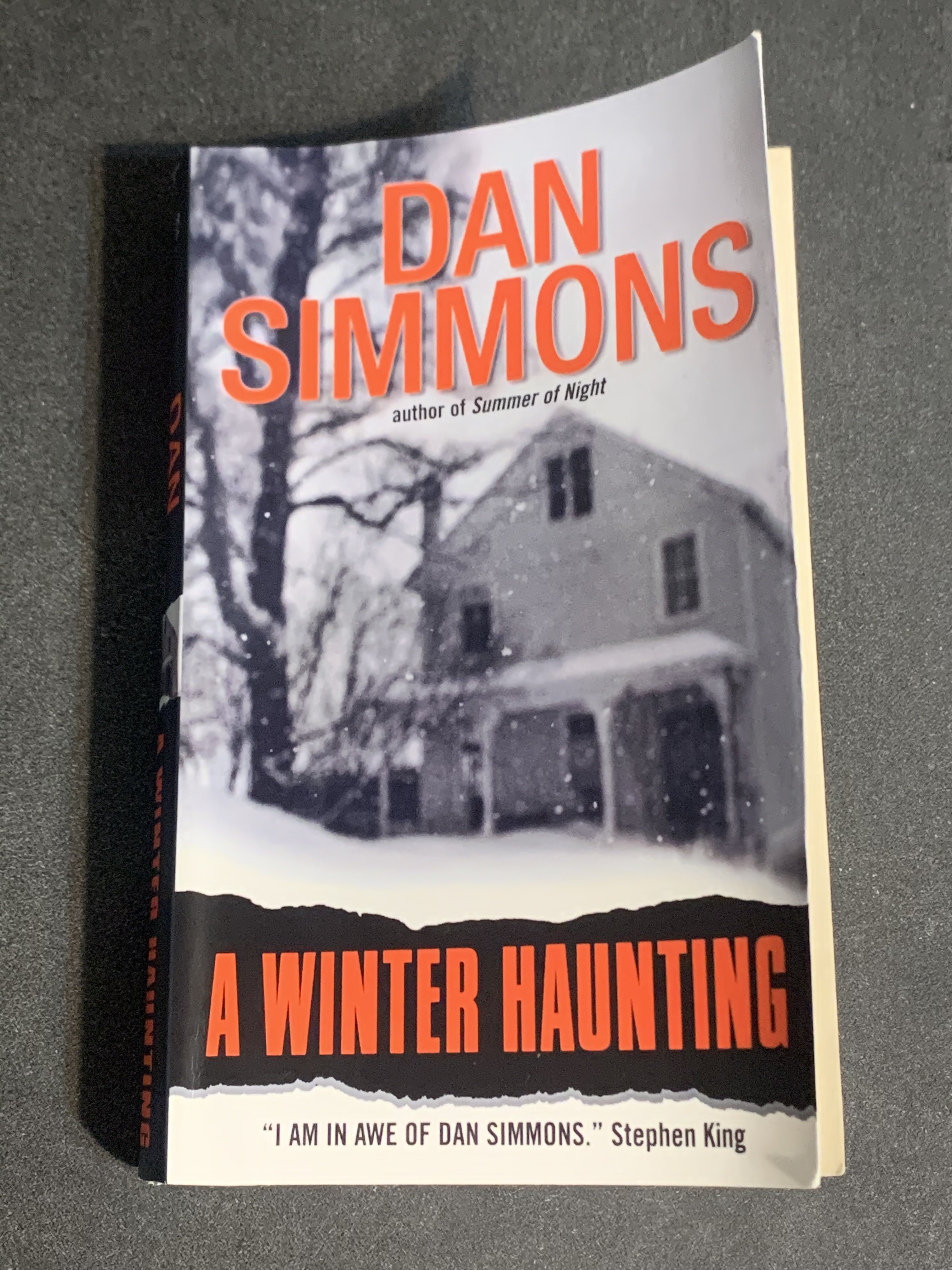
The real ghosts are all in our head, man. But also, ghosts are real and protective of us, at least some of us. Dan Simmons was ahead of the curve with his 2002 book, A Winter Haunting, which is the fifth and final of his Seasons of Horror series. Ahead of the curve in that, yes, psychological thrillers have been around for a while, but horror where the real horror is what’s in our minds — our mental maladies — rather than some sort of external horror is somewhat of a recent trend, at least in film and television, as I can’t speak for all of the horror book world. That said, it’s also caveated by Simmons suggesting the ghosts are, nevertheless, real in A Winter Haunting. Regardless, it was a real joy during winter, no less, to dive into a horror story again; it had been a while for me.
Dale is an English professor in Missoula, Montana, a moderately successful novelist, and in his mid-50s, with a wife and two college-aged daughters. He begins an affair with one of his graduate students, Clare Two Hearts (of the Blackfeet heritage), that goes from hot and heavy lust to love, at least from Dale’s perspective, to break-up (her breaking up with him), and sadness in a relatively quick fashion. At one point, Clare tells Dale she is with him because “he’s haunted.” That there is clearly something within him imminently ready to burst out. I guess she has a “mentally screwed up” fetish. No kink-shaming here!
After the break-up, Dale tries to kill himself. The shotgun misfires. He goes to talk therapy and takes antidepressants and sleeping pills to help him recover. About a year later, he decides to rent out his best friend, Duane’s, boyhood home in Elm Haven. Duane called it The Jolly Corner during the 1960s after the Henry James short story that is certainly an influence on Simmons’. There, Dale will attempt to work on his latest novel in earnest. The story about Elm Haven is the story of any childhood nostalgia: hanging out with a few friends, enjoying bike rides, good chats, and the seeming infinity inherent to innocence. But of course, that very innocence obfuscates the reality of the time. In the case of Elm Haven, Duane died in a tragic farm accident. Or so the story went.
While Dale is trying to work on his novel, his mind is unraveling again. For starters, Duane is communicating with Dale through his computer. Duane was something of a young genius, who enjoyed Old English and Beowulf, and learned Egyptian and how to interpret hierographic because he decided to worship the Egyptian god Anubis, the jackal-headed deity of the afterlife, who guided souls and protected tombs. In other words, dog-like. It’s interesting how many cultures and traditions share some sort of depiction of demonic dogs, or the hounds of hell, as it were. In this story though, the dogs are protective of Dale at the behest of Duane. For Dale’s part, he assumes the “person” messaging him is a computer hacker messing with him.
Then, a former Hollywood actress reconnects with Dale; she was the popular, attractive girl of their childhood. She tries to initiate sex with Dale, but he freaks out and leaves the room. That’s when the dogs attack her. The police come to investigate and she’s nowhere to be found. The Sheriff’s deputy then shows Dale newspaper clippings from a few months ago detailing the actress’s death at the hands of her former lover in Hollywood.
Dale is also just losing track of time. Thanksgiving to Christmas seem to pass in the blink of an eye. He’s confused and seeing things. As someone stridently anti-ghost, Dale doesn’t believe it’s ghosts, but rather a product of him going off his medicine.
And lastly, the person Dale thought was the sheriff, his childhood bully in fact, isn’t the present-day sheriff, and come to find out from the real, flesh-and-blood sheriff, he killed himself. Worse still, again reflecting how innocence obscures reality, it turns out the former sheriff (and his father, the sheriff before him) were corrupt, violent men. They likely killed Duane and another person and covered it up, and raped the aforementioned Hollywood actress when she was a girl in Elm Haven. It’s all very messed up, and is why Duane is trying to enact some modicum of justice vicariously through Dale.
If all this wasn’t enough, five skinhead punks are terrorizing Dale because he wrote anti-Nazi articles as a professor. These skinheads are very real.
Toward the end of the novel, Dale decides he’s going to kill himself again by hanging himself from the chandelier. The chandelier breaks from the weight (and weather erosion), keeping Dale alive. We find out Duane has been behind keeping Dale alive through both of his suicide attempts. But there’s no respite for Dale; the five skinheads appear and firebomb Duane’s old house with Dale still in it. He uses a Prohibition-era tunnel to escape to a nearby chicken coop, but is still nearly killed by the leader of the skinheads before Anubis’ dogs (Duane) save him.
Simmons almost lost me on some of the Beowulf and Egyptian gods stuff, only because I’m not well-versed in either, but the mental unraveling of Dale was right in my wheelhouse. It was indeed a “winter haunting,” just of his mind rather than the Elm Haven house. I’m always down for a mental haunting, with a side of ghost, as well as some skinhead punks getting their comeuppance. I look forward to one day reading the other books in the Seasons of Horror.

 Milam's Musings