
Spoilers!
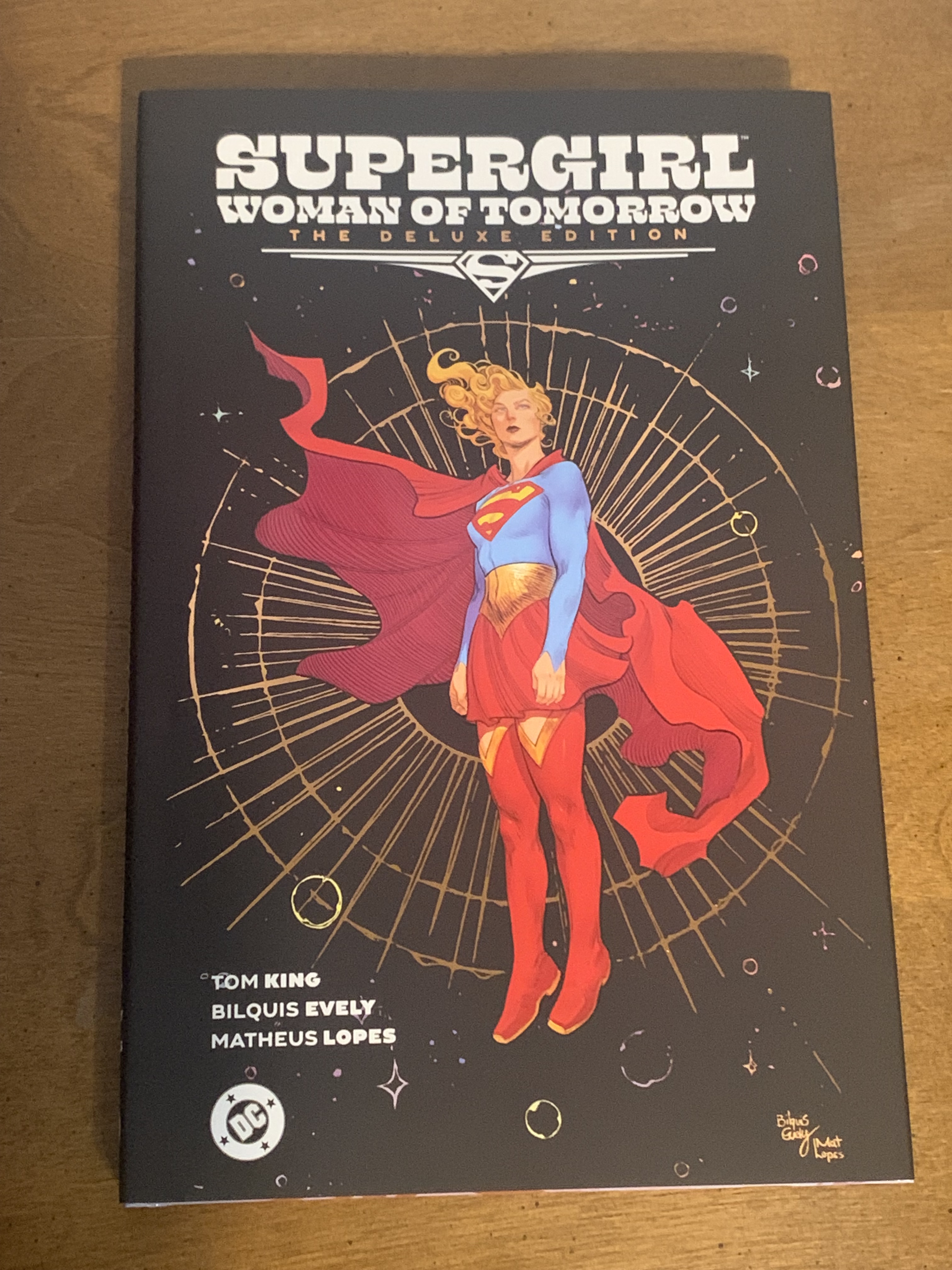
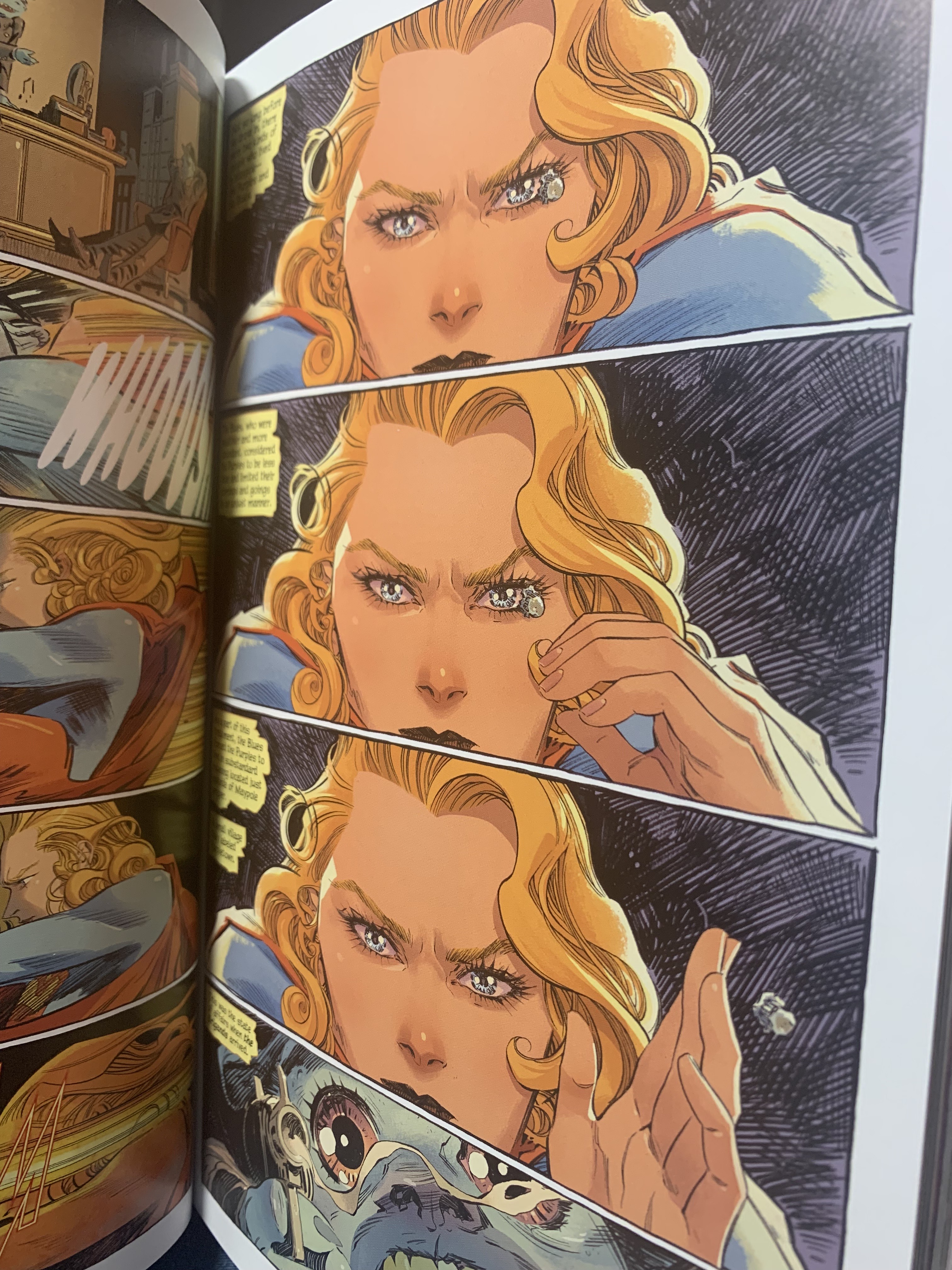
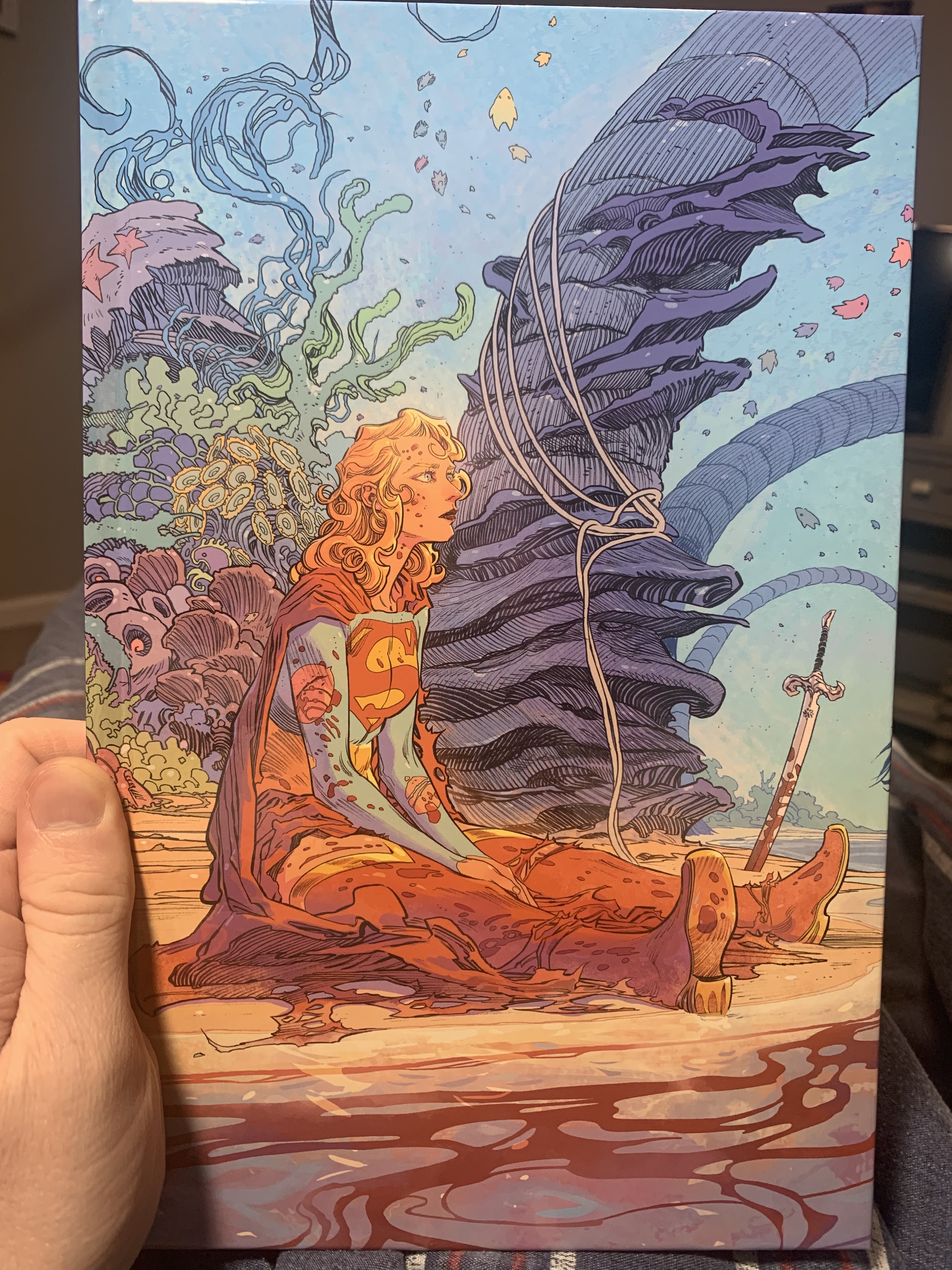
Supergirl is so damn cool. As someone who always focused on Superman, with the belief that it only ever made sense for their to be one superpowered being, I’ve been sorely missing out. Tom King, Bilquis Evely, and Matheus Lopes’ 2021-2022 saga, Supergirl: Woman of Tomorrow, bundled in this gorgeous 2024 deluxe edition, is one of the best graphic novels I’ve ever read. I was giddy (giddiness happens when I read about Superman, and now Supergirl, or Jack Reacher), I was awed by the art and the prose, I had goosebumps, and simultaneously (because of that panel), I had a few tears. Supergirl is just as inspiring as her cousin, and just as much a beacon of light and hope in a dark world.
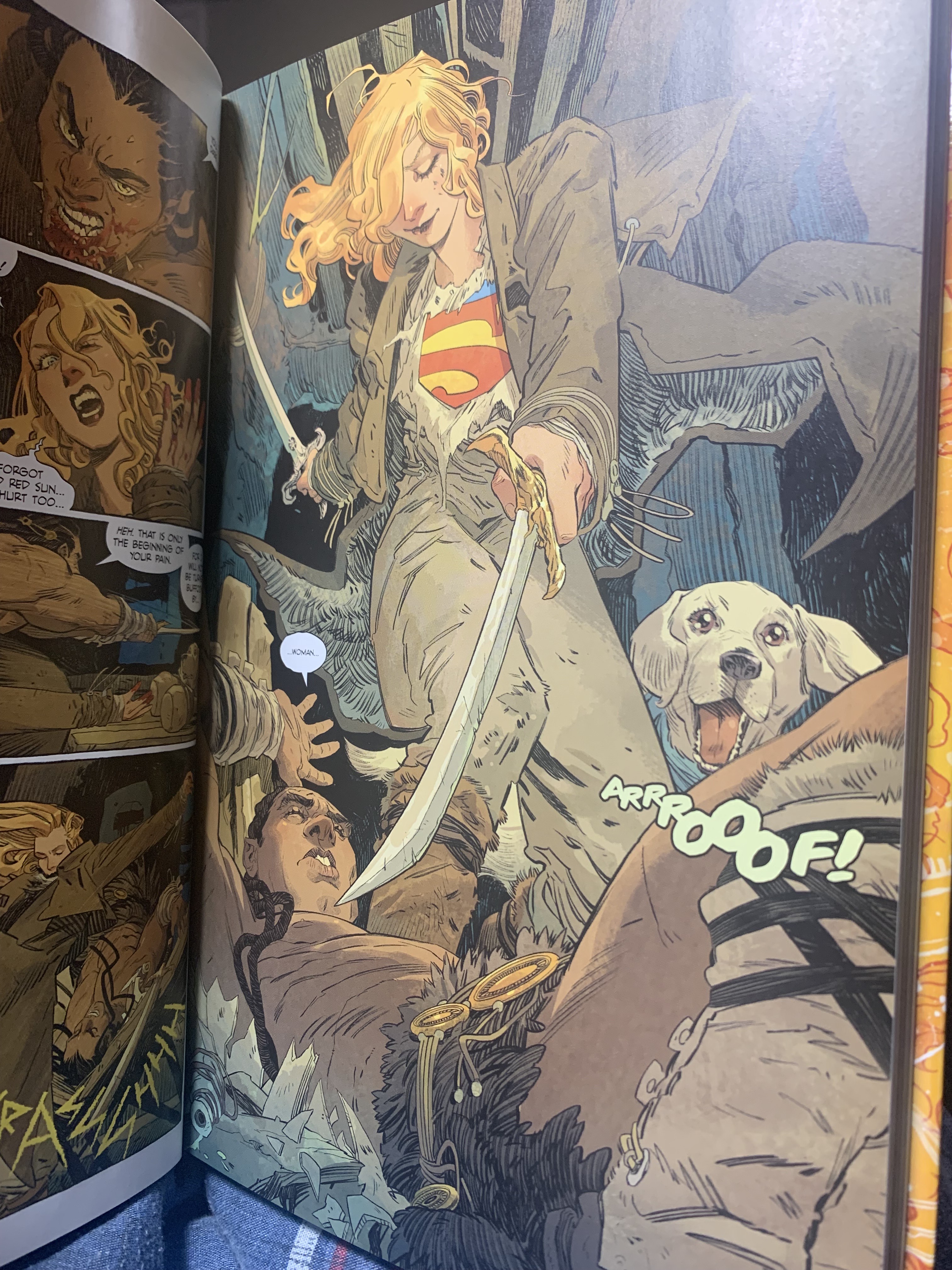
Why is Supergirl so damn cool? For one, she’s layered with depth and conflict in the same way Superman is — contrary to what people might expect — but in a different direction, which is to say, she experienced the destruction of Krypton, her home planet; she quite literally has a dead world on her shoulders. When this happened, when she suffered the death of her planet three times over, she was only 14. And yet, she keeps walking, she keeps moving forward. Also unlike Superman, she curses a lot and it’s hilarious. Finally, it must be said, she ends up fighting a lot of his battles at people chagrined with him and desiring to take out someone connected to him.
In Superman: Woman of Tomorrow, Ruthye, who lives on a rock farm with her parents and six brothers, suffers the senseless murder of her father by a man known as Krem of the Yellow Hills. Krem then allies himself with Barbond’s Brigands, a roving band of genocidal warriors. Ruthye eventually implores a drunken Supergirl, (because she’s under a red sun), who was trying to enjoy her 21st birthday, to take up the chase. When Krem is able to hit Krypton, Supergirl’s superpowered good boy dog, with a poisoned arrow, Supergirl is now particularly invested in chasing Krem and Barbond’s Brigands from galaxy to galaxy.
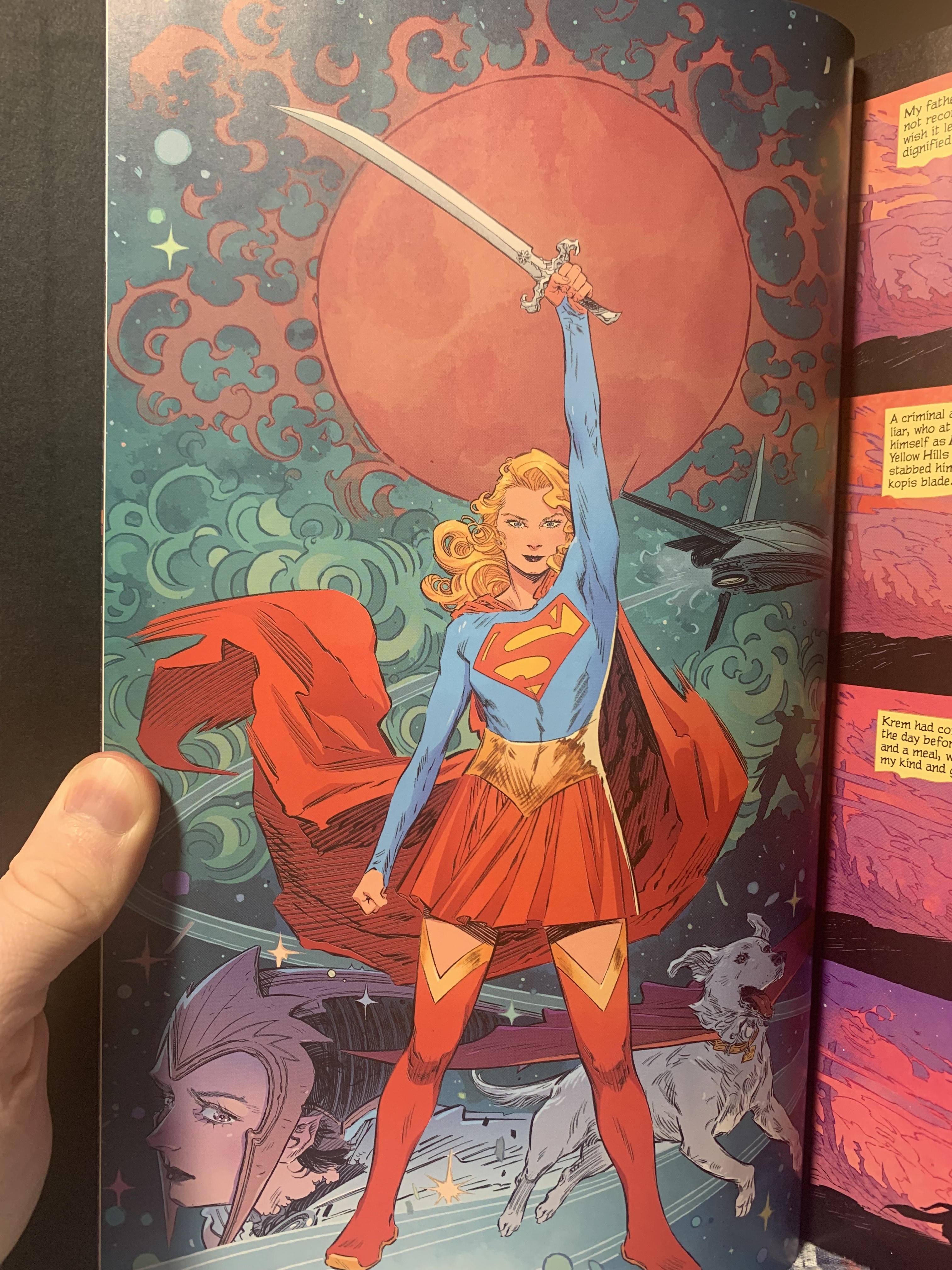
What also makes Supergirl (and Superman) so cool is what Ruthye, who narrates the story in her now-old age, observes about her. She says, “You see, what is not well understood about the daughter of Krypton is that her power was not one of action, but of restraint, endurance, and passion.” They wield their powers for the good and downtrodden, and restrain themselves in equal measure to be among them. Another favorite line of mine from Ruthye’s observations, “All I knew is that first there was a botheration. Then there was Supergirl. Then everything was peaceful once again.” I loved Ruthye’s narration throughout the book, not only because of these pithy, dry-humored observations, but also because of her plainspeople naïveté that made for amusing interactions and other remarks she proffered.
“The Maid of Might” Supergirl is able to eventually catch up to Krem, but he then uses this magical orb doohickey — Supergirl and Superman are not impervious to the powers of magic — to send Supergirl and Ruthye to Barenton, a planet with a green sun permeated with abhorrent monsters, built for the sole purpose of trapping and killing Superman. According to Supergirl, Superman lasted about 45 minutes on the planet, experiencing his closest dalliance with death in his life, before the Justice League saved him. Now, Supergirl would have to spend 10 hours on the planet before the green sun set and she was able to restore her powers to fly them out of there. Again, cool as hell and a bad-ass.
Another great line comes from Ruthye has she’s watching over Supergirl and waiting for that dang green sun to set. A monster looks to eat them both, and at first, Ruthye prays to the gods of the heavens for that sun to set. She repeats it like a mantra: let the sun set. Then, Ruthye comes to a resonant realization: “And that’s when I learned that far-off gods are fine for prayer and I judge no person who seeks comfort in the infinity of the heavens. But here below when the demons come in close … You’re better off just relying on the staunch will of a good woman.” Supergirl, even in a diminished state, protects Ruthye, the sun sets, and they fly away.
One of the most ingenious aspects of this graphic novel is that King and company waited until Book Six (of eight books) before getting into Supergirl’s origin story. Normally, obviously, the origin story would kick things off. Instead, we don’t get it until Book Six, where Supergirl relents in telling Ruthye what happened with Krypton. She does so in case Krem and the genocidal warriors kill her. I already mentioned what Supergirl endured, and I’ll add to it, the death of her mother, but the panel in particular that had me getting goosebumps and teary-eyes at the same time was her father, Zor-El. Taking a page from Jor-El’s book, he builds a rocket with the last bit of lead left on the asteroid they’ve taken refuge on, and plans to send Supergirl far, far away. Like with Superman, the rocket is only big enough for one person. She wants to know from her father: “Why me?” He responds simply, “You are my little girl. And I will save you.” So good. (King had a different version of Book Six, where the first half is Supergirl and Othan, the leader of the Brigands, trying to arrive at some sort of truce. She then tells him that aforementioned origin story. King’s editors, rightly in my estimation, said that it was a “swing and a miss” and to try again. Thank goodness for editors!)
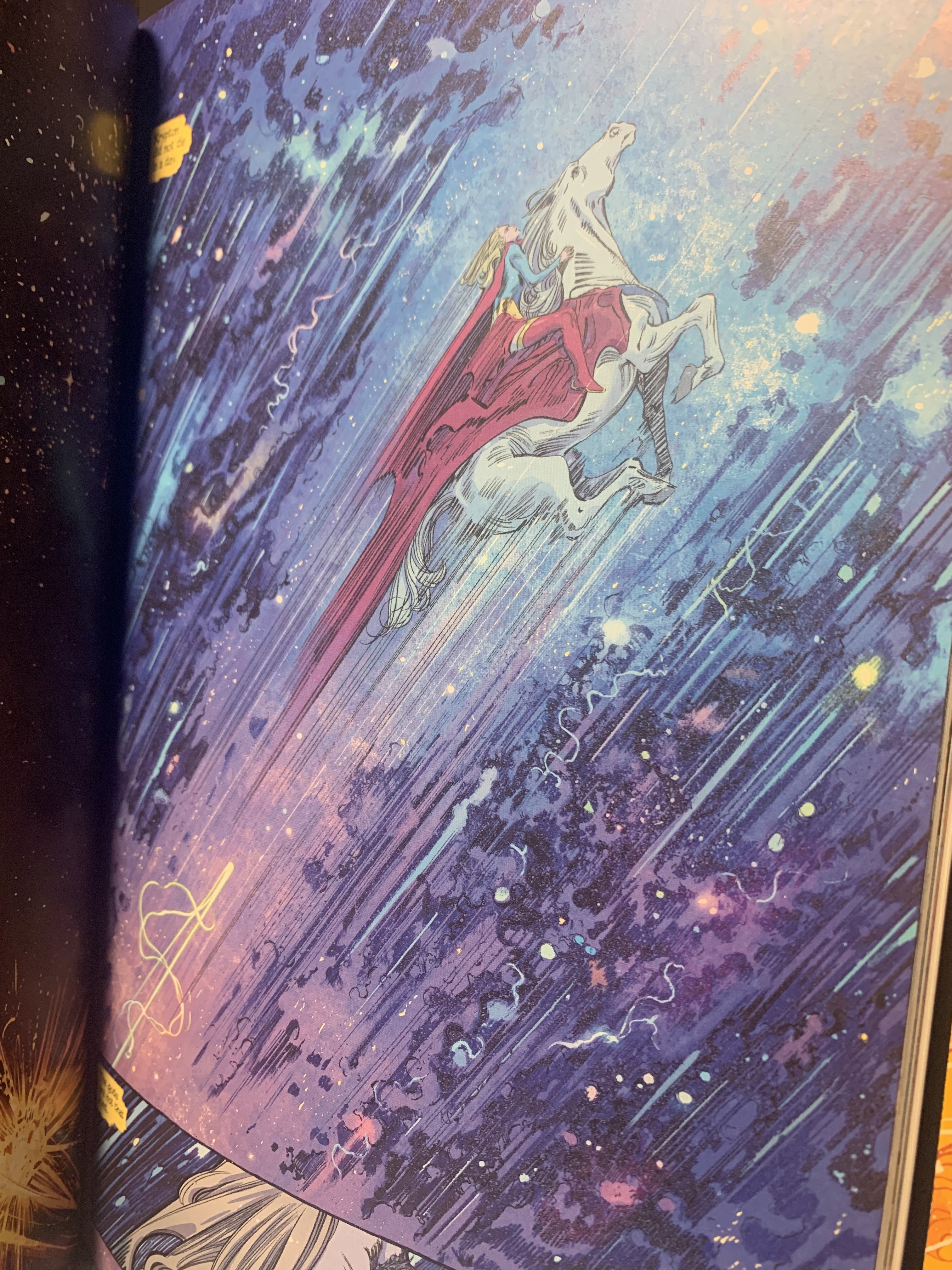
Oh, and one other reason Supergirl is so damn cool? She has a superpowered horse named Comet, too. She uses him to outrun Krem’s next attempt with the magic orb. In the climactic battle, Supergirl takes on all of Barbond’s Brigands by herself, this despite them obliterating legions of warriors and worlds. But she’s on the precipice of losing because they managed to get one Kryptonite bullet. Ruthye points out that what makes Supergirl Supergirl (and Superman Superman) is not just how powerful they are, but that their goodness inspires such fierce loyalty in others. Comet, who was essentially standing between Ruthye and the captured, captive Krem (so she wouldn’t kill him), flies to Supergirl’s rescue and dies in the process of saving her. Turns out, Comet was a man cursed to be a superpowered horse.
Meanwhile, Ruthye, expecting that Krem will underestimate her because she’s a girl, takes Krem on in a fair fight, with the vaunted sword that killed her father equidistant between them. He does underestimate her and she has him down and in prime position for the kill. She can’t do it. Supergirl returns, and reveals to Ruthye that she wasn’t on a quest to save the poisoned Krypto. Krypto is fine. She’s Supergirl after all. The quest was all about Ruthye learning right from wrong, and that spending a lifetime chasing revenge was folly. But Supergirl doubts herself, doubts having properly taught this lesson to Ruthye, and figures she’ll take on the avenging of the her dad by killing Krem. Ruthye then explains exactly how she learned from Supergirl that goodness and grace do live on, thus preventing Supergirl from going too far.
The book ends with a much older Ruthye and Supergirl releasing Krem from his 300-year sentence in the Phantom Zone prison, where he repented and now begs for Ruthye’s forgiveness. She smacks him with her walking stick and they walk off. In Ruthye’s fictionalized narrative, she, well, embellishes it that Krem was murdered by Supergirl, likely to scare off further reprisals from the Brigands.
What a book! What a great way to end my 2025 reading journey. I purchased Supergirl: Woman of Tomorrow to ready myself for the Supergirl film next year, which supposedly is based heavily on this graphic novel. Far more than merely preparing me for the film, this graphic novel made me a forever fan of Supergirl. She’s interesting, cool, bad-ass, layered, and if we’re being honest, tougher than Superman. I loved it. Bravo to all involved. King’s prose was profound and moving, and Evely and Lopes created stunning, gorgeous art and color that was a pleasure to look at when I wasn’t contemplating the words.

 Milam's Musings
2 thoughts