
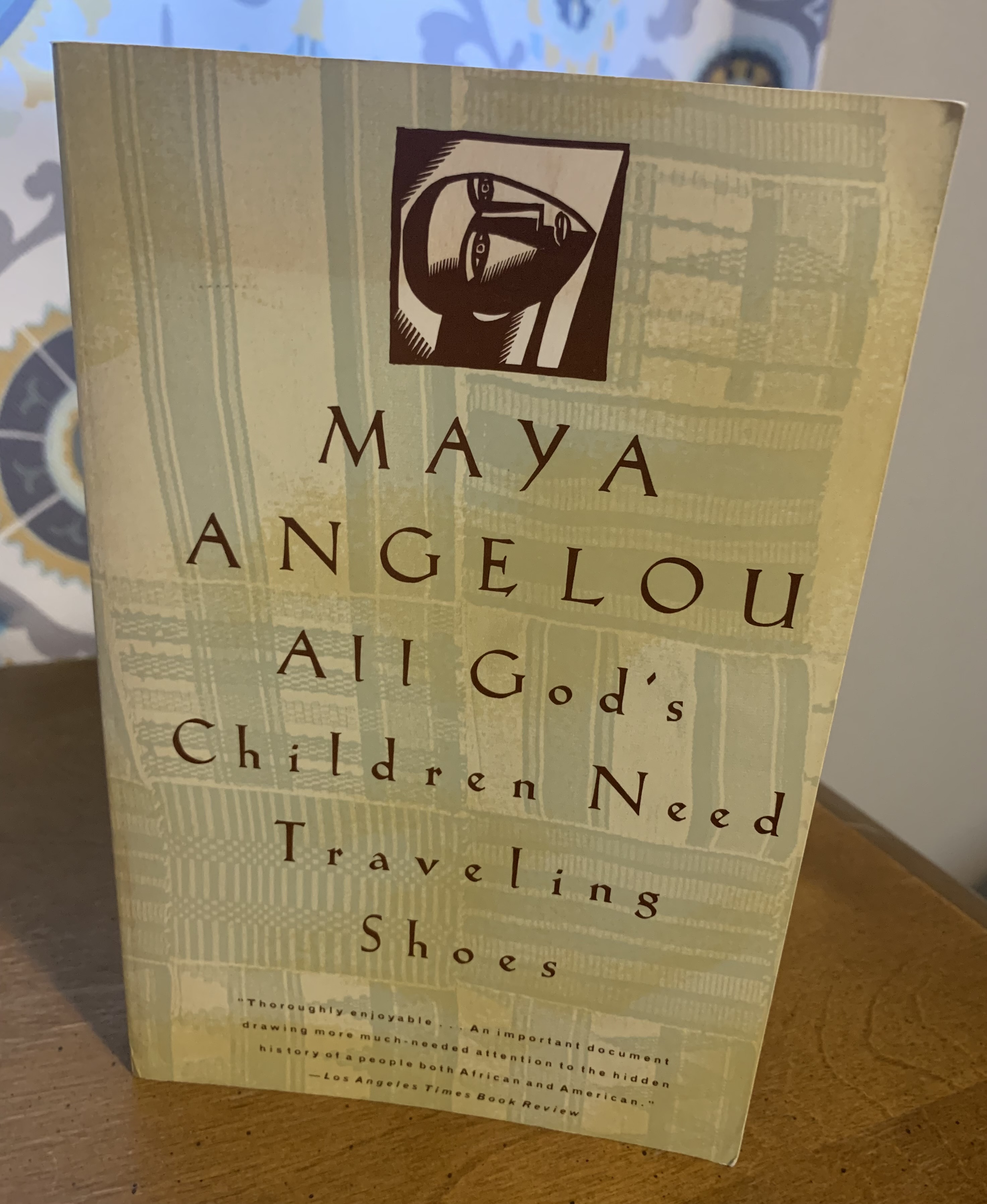
Black Africans were violently plucked from their roots — from their people, language, religion, and culture — and taken to America to be slaves. As slaves, they were beaten and whipped, raped and impregnated, separated from their families yet again, and killed. And yet. Here they stand, tattered roots, remnants of those roots, all the same. In Maya Angelou’s 1986 autobiography (the fifth of seven autobiographies), All God’s Children Need Traveling Shoes, she reconnects with those roots in Ghana, where perhaps her descendants had been forcefully plucked, and most striking, arrives at an end she had not expected: a yearning for home. That is, the United States. No matter how inhospitable one may make another’s home, it is still home.
Upon coming to Ghana in 1962 when she was 33, Angelou’s 17-year-old son, Guy, is in a brutal car accident that leaves him with a broken arm, leg, and neck. This being an Angelou book, every other line is quotable, but she quickly realized something about tragedy when hoping her son would recover: “Tragedy, no matter how sad, becomes boring to those not caught in its addictive caress.” Fortunately, her son did recover, and Angelou could continue on as one of a handful of Black Americans in Ghana, who stuck together, dined and drank together, and most certainly debated together. With only a high school education, Angelou was as surefooted as any of them in such discussions, and also, it may surprise some to learn, irascible at times.
Early on, this group of Black Americans in Ghana disabuses newly-arrived Black Americans of their panacea-envisioning visage of Ghana. In other words, just because they’re Black doesn’t mean they were going to be welcomed with open arms by Ghanaians. Those aforementioned roots became ensnared by a different culture and milieu, making Black Americans something distinctive from Ghanaians, and that distinctiveness was evident in perceptions of the former in Ghana. That isn’t to say, as Angelou points out, that the Ghanaians were unkind, just wary. Angelou reflects on where that wariness derived from, noting that it was unlikely any Black from the diaspora could really return to Africa. She continued, “We wore skeletons of old despair like necklaces, heralding our arrival, and we were branded with cynicism.” The real contrast is between innocence. Despite attempts at political bondage and economic exploitation, Ghanaians retained an “ineradicable innocence,” whereas Black Americans had to mature without experiencing the “true abandon of adolescence.” Because doing so could mean getting killed. She calls then actions that appear childish “exhibitions of bravado,” like “humming a jazz tune while walking into a gathering of the Ku Klux Klan.” The natural apex of this rift was viewing Black Americans with grave suspicion — that they were “infiltrators” — after an attempt was made on the life of Ghana’s President Kwame Nkrumah. Fortunately, that frenzied, panicked suspicion was short-lived.
The other important point about her time in Ghana — which I think would surprise, although it shouldn’t, the conventional wisdom of those who, for lack of a better way to phrase it, want to downplay the Black experience in relation to the injustice of American slavery and do so by bringing up that favored line “not all white people owned slaves” — is that Angelou recognizes that on the very ground she walks, she’s reminded of the painful truth that “not all slaves were stolen, nor were all slave dealers European.” Black Americans, like Angelou, have wrestled with this historical tension, and white people who presume otherwise are being condescending and arrogant. As an aside, speaking of arrogance, and let’s add ignorance to the mix, there was a minor “uproar” during Zohran Mamdani’s campaign for New York City Mayor when he reflected on his aunt’s experience with Islamophobia after 9/11. Clickbait-mongers acting in bad faith pushed the narrative that Mamdani was lying since the “aunt” was his father’s cousin. But as Angelou shows in her autobiography, and again, is something that people of color already knew, “aunt” or “auntie” is more a term of endearment or recognition or title of respect than an actual fact of one’s familial tree. Indeed, throughout her time in Ghana, Angelou is referred to as “Auntie Maya” or “Auntie Angelou” by the people she meets.
Despite having been the Northern Coordinator for the Southern Christian Leadership Conference at Dr. Martin Luther King, Jr.’s request, Angelou and the other Black Americans in Ghana derided his nonviolent movement, particularly when they heard about his plan to March on Washington in 1963. Angelou says, “We were brave revolutionaries, not pussyfooting nonviolent cowards.” Nonetheless, they decided to march on the American Embassy in Ghana in solidarity. The day of the march (or night, since it was actually midnight to account for the time change), Dr. W.E.B. Du Bois – yes, him, who it’s difficult in my brain to imagine alive at the same time as King – died. That only added spunk to the march. If the Black Americans in Ghana took on a mocking and ridiculing tone with regards to King, they were far more reverent and respectful toward Malcolm X, who visited the group. Angelou elucidates through retelling their conversations how Malcolm X was already beginning to rethink his earlier statements about all white people being bad; this after him doing the Hajj to Mecca. In one of my favorite parts of the book, only because it so rattled Angelou and likely influenced her thereafter, was when Malcolm X admonished her for being so narrow-minded in her thinking. He implored her to think more broadly.
As I alluded to at the beginning, after some time in Ghana, Angelou felt it was time to return to the United States. She felt that yearning, and actually began wondering if Ghana had made her “soft.” Her fellow Black Americans also tell her America “needed her” at that moment, including specifically, helping Malcolm X. Before she leaves, she does some time in Germany, where she performs in a play, and then she travels to Italy and Egypt. After the play, she goes to dinner with a German family, and not wanting to go alone, brings along a Jewish friend. She and the Jewish friend suspect that the German man who invited Angelou was formerly a Nazi. I could have read an entire book and/or seen an entire film based on the dinner scene Angelou describes. To say the tension was palpable on the page is a disservice to Angelou’s prose. Phew.
All God’s Children Need Traveling Shoes shows that sometimes traveling far reminds us of how important home is, even when it’s dysfunctional and broken. That where we are most needed is where we came from rather than where we hoped to be. And that uprooting by its logic, forceful or not, implies a replanting, and those new roots implore us all the same. I also alluded to that sense of “and yet” inherent to this work. Angelou explains, “Although separated from our languages, our families and customs, we had dared to continue to live. Through the centuries of despair and dislocation, we had been creative, because we faced down death by daring to hope.” As long as we are alive, that means we can endure, and if we can endure, we can hope, and if we can hope, that’s the foundation for a better tomorrow (even if sometimes in our revolutionary zeal we rightly become impatient waiting for tomorrow).
You don’t need me to outright recommend an Angelou book; she’s Maya freaking Angelou. But this was great. I’d love to be a proper reader and go back and read her series of autobiographies from the start to get a true sense of her evolution and maturation over the years.

 Milam's Musings
Awesome! 😎
LikeLike