
Spoilers!
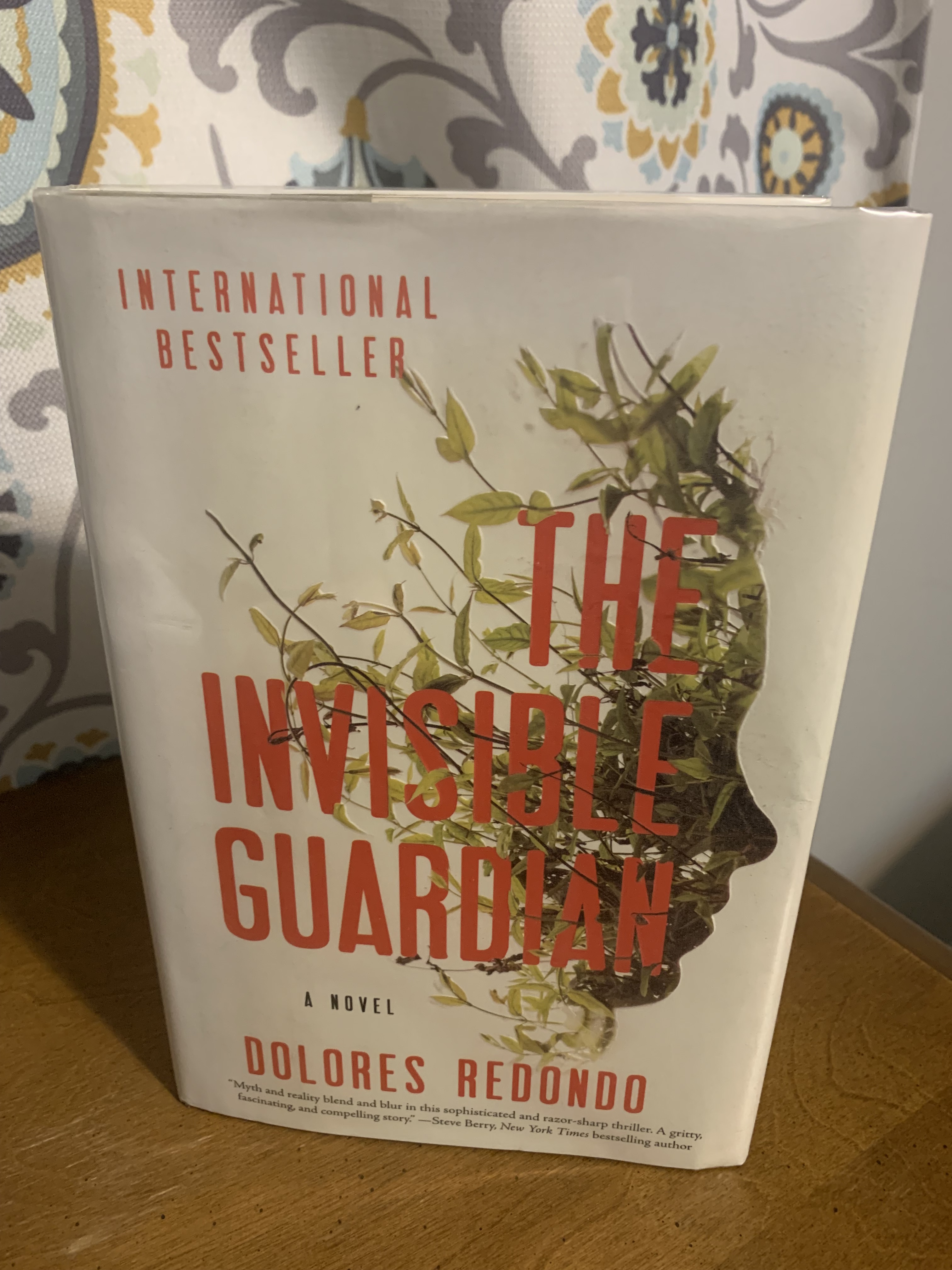
Sometimes alcoholism is a … good thing? I jest. Usually, I try my hand at a ruminating preamble before diving into my book review, but I couldn’t resist here. You’ll see why in a moment. In Dolores Redondo’s 2013 book, The Invisible Guardian, a serial killer is on the loose and Inspector Amaia Salazar, who was trained for exactly this kind of hunt by America’s FBI, is tracking him while dealing with her own familial trauma. Set in the Baztán valley in northern Spain, Redondo’s book is the start of a trilogy weaving in ghastly murders with Basque folklore and mythology.
Amaia is the youngest of three sisters, with Ros and Flora the oldest, the latter of whom carries on the family tradition of the bakery. Growing up, Amaia’s mother, Rosario, was afflicted with some sort of mental disorder, and wielded the aggression created by it against Amaia. That culminated in Amaia’s attempted murder in the aforementioned bakery when she was only 9 years old. Rosario attempted to kill her with a rolling pin. After that incident, Amaia went to live with her aunt, but still came home every Sunday for dinner … with the mother! Which is to say, the father, who doted upon Amaia, refused to acknowledge Rosario’s condition or her actions against his daughter. How awful. The aunt is steeped in Baztán culture and its myths. She’s also a purveyor of Tarot card reading.
When a young girl is brutally killed and left near a river, Amaia and her team are called in. The killer already seems to have a “signature”: leaving the txantxigorri cake (a sweet and salty cake, which is a nice metaphor for this killer’s MO) on the victim and doing other unmentionable things to “purify” them. When it seems like there is a series of these killings in Elizondo, Amaia’s hometown, she must return there to not only solve the killings and catch a serial killer, but also deal with being back in a place that holds so much unpacked trauma for her. And, of course, being the woman in charge, she has to deal with two of her male subordinates not taking her seriously and/or being bitter that she received the opportunity.
As Redondo brings us deeper into the story, we learn that the newspapers have taken to calling the killer a basajaun. The basajaun in Basque mythology is the protector of forests, a Bigfoot-like hairy humanoid, who is known as the “Lord of the Forest,” or one might even say … the Invisible Guardian of the Forest, hence the title. But the basajaun actually seems like a benevolent creature, only trying to protect the forest, rather than one trying to purify supposedly wayward human girls. All the same, that connection, or throughline, between mythology and a true crime happening in their town has everyone on edge, including Amaia herself. Local scientists and nature experts are investigating sightings as potential bear sightings, but they’re dubious bears have come into the valley. Later, Amaia even thinks she sees one of these basajauns, which, the scientists seem to agree is one? At the end of the book, though, it does seem like a bear was sighted, so maybe that’s what Amaia actually saw?! I’m not sure!
Throughout the book, Redondo throws in some red herrings for who the killer could be, including a stepfather who brutally raped and killer his daughter. That story is the opening, or subject, of the second book in the trilogy. The father tried to make it look like a “basajaun killing,” as they’re calling it, but Amaia quickly learned it was the father trying to hide his own evil deed. Then, surprisingly, Amaia zeroes in on Ros’s boyfriend (maybe husband, I forget), Freddy, a lackadaisical loser she was on the outs with, who apparently was involved with one of the victims. He then tried to hang himself. However, he’s quickly ruled out and alibied. But at this point, I was suspecting Flora, the oldest sister! She was nasty and abrasive, and I thought might have had her mother’s condition amped up to the serial killer level. She also seems to think the victims largely deserved what happened to them for acting and dressing the way they did. There’s also the fact of the txantxigorri cake and that Flora had her subordinate change out the flour so as not to tie the flour back to her bakery. Additionally, she had something of a shrine, which Amaia learned from her training with the FBI serial killers tend to have, particularly for safeguarding their trophies, at the bakery.
However, the serial killer turns out to be Victor, Flora’s estranged husband?! He also had access to the know-how for the txantxigorri cake because of his mother. Theoretically, he aped Flora’s sensibility about girls and purification from being around her for two decades. And his arc in life matches what happened with the first victim in the 1980s and the present victims. Before he met Flora, he killed a girl and likely others. Then, when he was with Flora, he became an alcoholic and stopped killing for more than two decades. He only started up killing again upon becoming sober in a bid to “win” Flora back. Which is why I said alcoholism is a good thing because, in this case, it saved this town from more child killings! Seriously though. Flora was getting close to the investigation through one of Amaia’s lousy subordinates (another telltale sign!) and put the pieces together about Victor. She confronted him, he confessed, and she killed him before Amaia could interfere.
I still think the real killer is Flora for all the tidbits I pointed out, plus the biggest one of all: turning Victor into a convenient scapegoat and then killing him. Yes, he “confessed,” but perhaps he did that out of some misguided, distorted view of love for Flora. I’m also confused at the end because we learn that dozens of bodies were found in a cave with a bite mark that matches the mark found on the girl’s body who was ostensibly killed by her stepfather, and not a match to Victor. Two things there: 1.) For the record, I have to point out that bitemark analysis or forensics is junk science; and 2.) What does this mean?! The stepfather didn’t kill the girl? That Victor isn’t the real killer? I guess I gotta read the next two books in the series to hopefully gain clarity about what the heck is going on.
Overall, I thought Redondo’s writing and story really shined when addressing Amaia’s trauma with her mother and how that was expressing itself in the course of the serial killer case, and how that even wove into the Basque mythology with the basajaun. I also enjoyed learning about a different type of mythology from another part of the world I didn’t know much about previously. It made for a great setting for a serial killer story.

 Milam's Musings