
Spoilers!
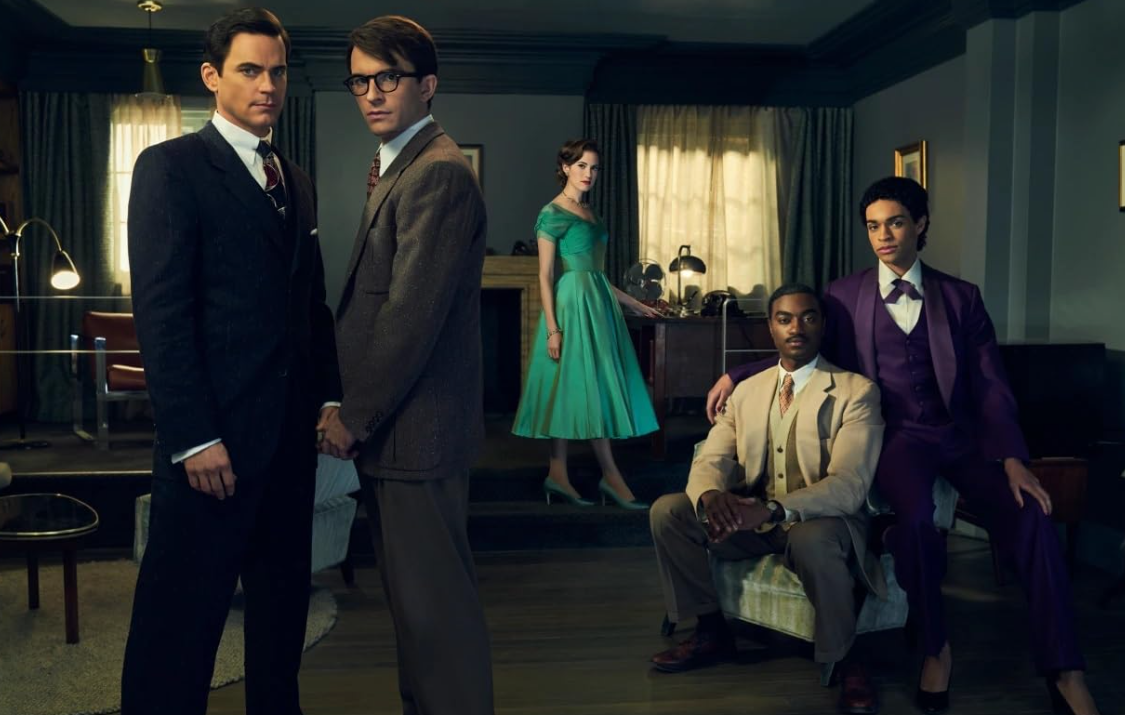
Indifference, or another way of saying that is passive acceptance, to the suffering of those seen as the “other” is the most salient force in American politics, historically and presently. Of course, sometimes it rises beyond indifference to active, ongoing cruelty and violence being perpetrated against the “other.” The latter is something one can grapple with because it’s so obvious and in-your-face; the former is far more insidious and nebulous, which is why progress can be so slow-moving for outgroups. Showtime’s 2023 miniseries, Fellow Travelers, reflects this agonizingly slow, cruel, and indifferent at times progress across four decades of American life for gay men in particular (lesbians are ensnared in this struggle, too, which would coincide with the Second Wave feminist movement in the 1960s, but the show is centered around four gay men). Starting with the 1950s Red Scare and Lavender Scare through myriad rights movements in the 1960s to Harvey Milk and San Francisco in the 1970s to the AIDS epidemic in the 1980s, Fellow Travelers is a compelling, if heartbreaking, historical romance.
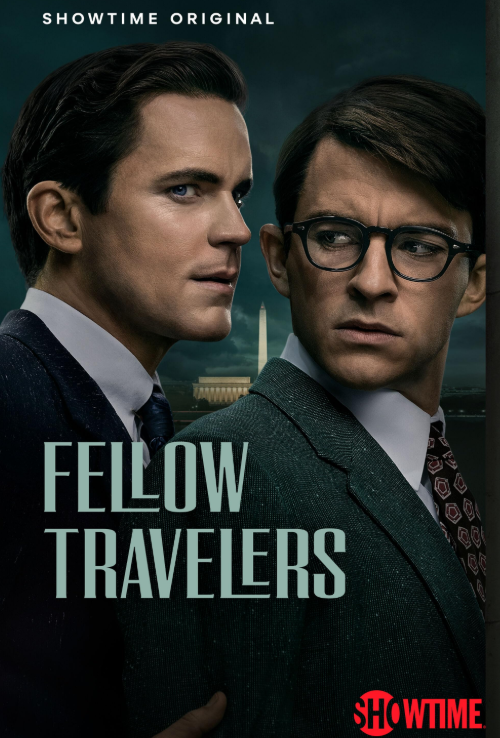
Adapted from the 2007 book of the same name by Thomas Mallon, the miniseries stars Matt Bomer as Hawkins “Hawk” Fuller, a WWII veteran and official at the State Department, unashamedly (heh) aggressive in hiding his homosexuality, and Jonathan Bailey as Timothy “Tim” Laughlin, an idealistic congressional staffer in Senator Joseph McCarthy’s office. Soon, the two meet and being a torrid tryst, with Hawk taken to calling Tim “Skippy.” Bomer plays the stoic 1950s male caricature well, with that steely jaw and stern gaze, while then playing the sort of uncaged bohemian homosexual who likes to be in control with equal fervor. But it’s Bailey who was a revelation for me. I thought he was damn good in Netflix’s Bridgerton series as the eldest brother of the titular family, and pitch perfect in the two Wicked films, but here? He was spectacular, metaphorizing into a fidgety, overzealous character in mannerism and look. Bailey brilliantly portrayed just how overmatched Tim was by Hawk, professionally and personally. Bomer and Bailey had sizzling chemistry throughout, even beyond the steamy scenes. The two fall in love in short order, but Hawk, who is seen as bulletproof because of his war record and closeness to Senator Wesley Smith (played by Linus Roache, and based on real Senator Lester C. Hunt, who opposed McCarthy), is instead destined to marry Lucy Smith (played by Allison Williams), as mores of the time dictate. And for Tim’s part, he’s too idealistic for domesticity, even if he yearns for a public-facing relationship with Hawk.
Fellow Travelers I suspect is a play on McCarthy’s assertion of Communist infiltrators — fellow travelers — within the United States government, but also reflective of gay men having to navigate secretly, especially among the ranks of the United States government. Which, to that point, McCarthy and his ilk weren’t merely trying to root out suspected Communists, but also gay men and women ostensibly because they could be blackmailed by Communists, and also, because to them, gay people are icky (they would never admit the latter as the reason for the policy, though). Even Hawk eventually has to prove his heterosexuality, as it were, to a government official after being turned in by his secretary on suspicion of being a homosexual. He learns to pass the polygraph test, though, and does. But this whole situation in the 1950s, known as the Lavender Scare, was unknown to me prior to watching Fellow Travelers. I learned about the Red Scare in school, but I’d never known about this targeting of the gay community, which is shameful. This must be how people who watched HBO’s 2019 Watchmen and learned about the Tulsa race massacre from it felt. I’m not surprised I never heard about it, though, because even in the first decade of the 21st century when I was going through high school, people weren’t readily telling gay movement history. But it matters. It absolutely matters.
The first few episodes of the series largely oscillates between this 1950s dual “Scare” time and 1986 at the height of the AIDS epidemic. That was its own moral panic, and also, a plague of indifference to the plight of gay men from the government at every level and the American people. The 1950s and 1980s are both disgraceful in that way. Tim has tested positive for the disease and is most certainly going to die from it. Hawk, who finally receives the overseas posting he’s always wanted in Italy, and has grandchildren with Lucy now, still flies out to San Francisco to visit Tim. He’s initially hesitant about touching or being close to Tim, but that abates quickly.
Meanwhile, back in the 1950s, we also have race issues still ongoing, of course. Even though President Dwight Eisenhower ostensibly desegrated public places in Washington D.C., it was not desegrated in practice, and Marcus Gaines (played by Jelani Alladin, who also pulls off one helluva stoic, combustible performance), a Black reporter, attempts to write about it. Marcus is also gay, though, but I think his priority is addressing racial concerns while hiding his gay identity. This causes a perpetual clash with his budding, and then longtime, lover Frankie (played by Noah Ricketts), a Black drag queen who is far more confident in his identity and gay rights activism. Marcus eventually gets offered a position at The Washington Post, looking to hire him away from a Black newspaper. But the editor still caveats the hiring with Marcus not being able to use the newsroom facilities because he’s Black. One of my favorite scenes in the series is later when Marcus follows a racist colleague into the bathroom and pisses on his shoes. Screw that guy.
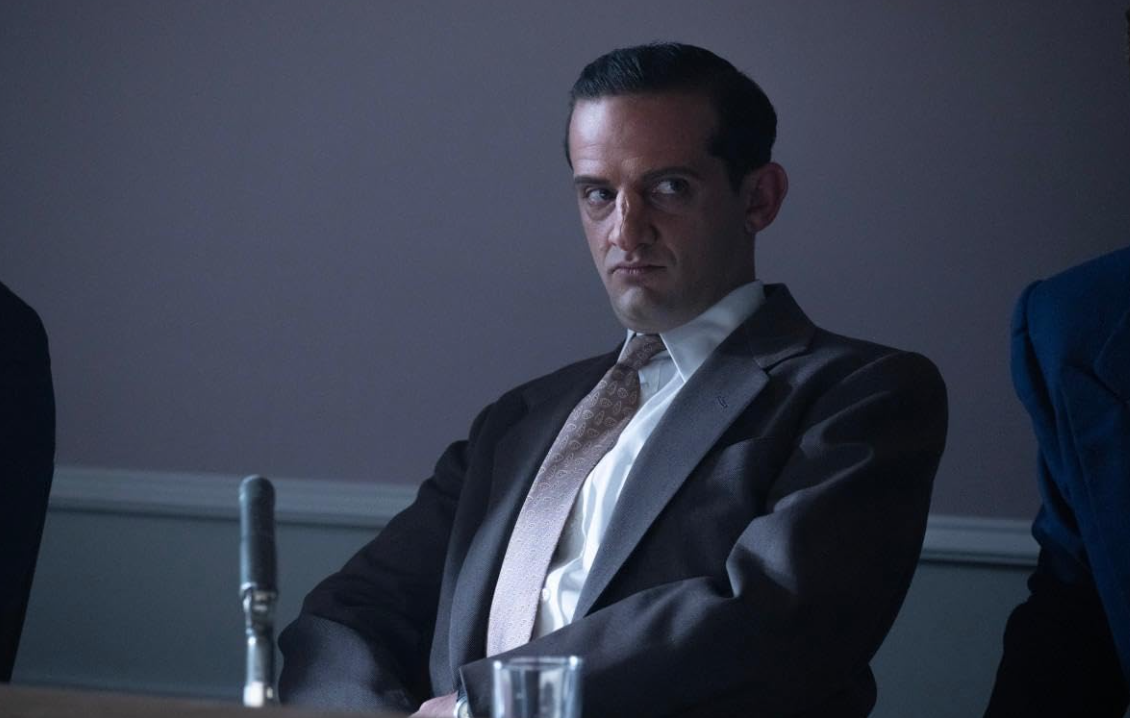
I started to wonder when Lucy knew that Hawk was gay because she had to have known, or at minimum, strongly suspect he was having extramarital affairs. We later learn she probably knew as early as 1956 after finding a letter from Tim, who was going off to join the military after McCarthy’s reign of terror collapsed. It collapsed first because Roy Cohn (played menacingly by Will Brill, who would be perfect to play Stephen Miller’s odious ass one day), who was also secretly gay, kept trying to protect his gay friend, David Schine (played by Matt Visser), from the draft for the Korean War. McCarthy’s power further collapsed after Senator Smith kills himself before revelations about his gay son can come out. Everyone’s done with McCarthy by that point and Congress censures him. He dies a few years later. Cohn would go on to die from AIDS. Back to Lucy, she later tells her daughter she put up with the way Hawk was because she liked the life they’d built — even though she was bereft of desire and affection, which proved quite lonely, so much so that she kissed another man at one of their cocktail parties in the 1950s — and it was also expected of women of her generation.
Hawk is ruthless, though; he’s willing to lie, obfuscate, and burn others to maintain his cover, social status and career. That includes in 1956, when Tim asks to be part of the Hungarian refugee resettlement office at the State Department shortly after the Soviet Union’s invasion of Hungary, and Hawk reports Tim to the government for being gay, effectively banning him from ever serving in government. Hawk’s first child was to be born at the time and he wanted to distance himself from Tim. Or the time Hawk takes Senator Smith’s gay son to a conversion therapy facility where they will do electric shock therapy on him to “turn him straight.” Ugh. For his part, Tim knows that Hawk is bad for him in that way. That he’s a hard person to love under the circumstances. At the end of the show, he’ll reason that analogous to his relationship with God, he didn’t need God to love him back, only to be steadfast in his love for God, or in this case, loving Hawk was enough, even if its requited nature was topsy-turvy (and sometimes seemed more lustful than loving).
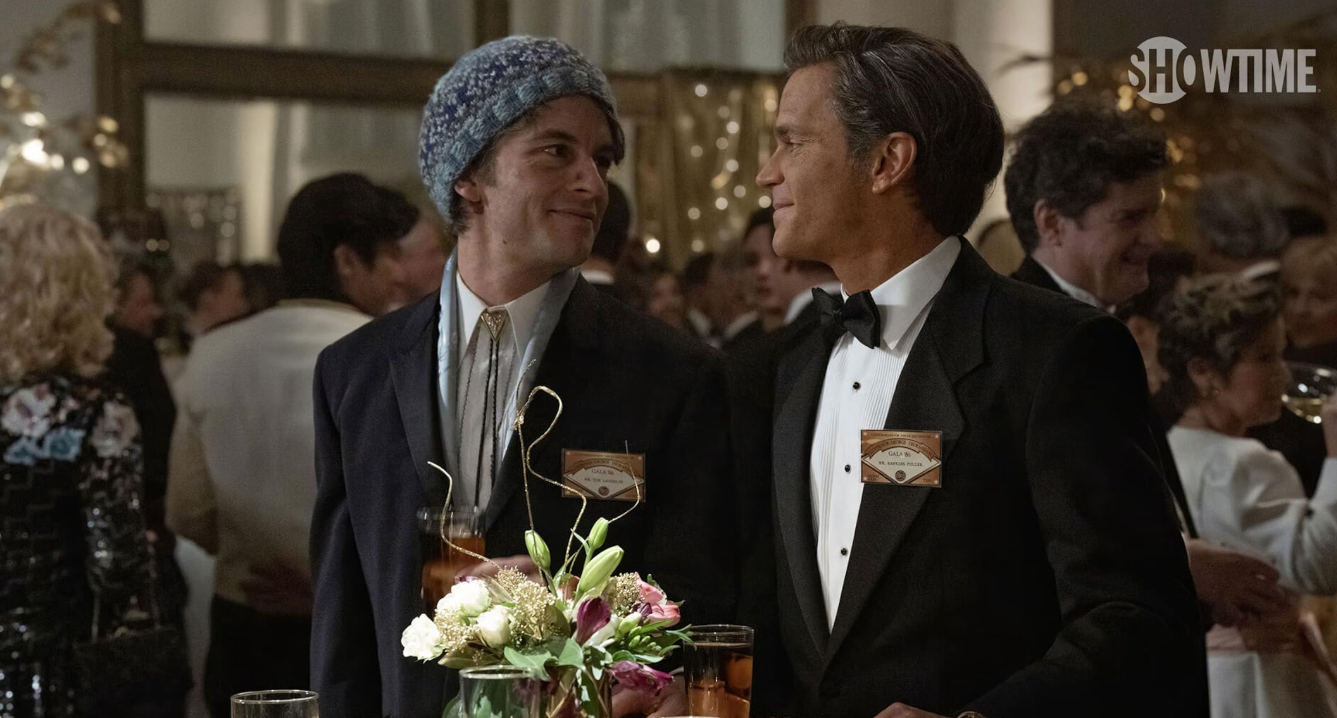
There was character growth, however. Marcus decides to fight back in a real way when gay rights activists protest the verdict that Dan White was acquitted of murder in Harvey Milk’s assassination in San Francisco because of the “twinkie defense.” Marcus even goes as far as crashing a fundraiser for California Governor George Deukmejian in 1986 to fight for the dignity of AIDS victims. Similarly for Hawk’s character growth, he allows the latter to occur, but more importantly, at that function, albeit outside, he kisses Tim. At the very end of the series, in 1987, Hawk goes to the AIDS Memorial Quilt unveiling on the National Mall where he finds Tim’s name memorialized. His daughter comes up to him, reflecting on how fitting it was for her dad’s “friend.” Hawk replies that Tim wasn’t his friend, but the man he was in love with, as tears fall from his cheeks. Very poignant, followed by a breathtaking shot of the quilt updated with more squares displayed on the National Mall in 1996 and then 2012.
Some of the loveliest, and also loneliest, scenes of the series were actually with Tim and Jackson, Hawk’s angsty son. This is in the 1960s, I believe, when Tim is protesting the Vietnam War by burning draft cards. As such, he’s on the lam from the FBI, so Hawk lets him stay in his cabin. Jackson also uses that cabin to get away from his family life, an edifice he knows is built on lies. Children are far more aware of what parents are doing than parents think! But yeah, I loved the scenes between Tim and Jackson, lovely in Tim’s wisdom given to Jackson, and lonely in that Tim and Jackson are bonding over not being loved enough or in the way they want by Hawk. Along these same lines, another lovely, and this time, heartbreaking, scene is in 1979, when we learn Jackson has died from a drug overdose. Hawk has been thrown out of the house by Lucy because he’s an alcoholic, so Hawk goes on a drug and sex binge. Tim catches up with him. During a budding threesome with another man, Hawk notices a photo of Jackson on the bedside table. He breaks down crying and begs Tim to let him die. That was tough to watch. Tim is able to compel him to keep living and that his family needs him.
For what it’s worth, Lucy does finally leave Hawk in 1986, because she knows she simply can’t compete, as it were, with Tim, even though Tim is imminently dying. (And Hawk is still an alcoholic at this juncture.) Hawk wasn’t bulletproof after all.
Fellow Travelers was a fascinating, well-produced, realistically-acted series, which hewed close to history, as far as I could tell, to make for a compelling watch. It’s a story that needed to be told, and as such, I highly recommend it to anyone. You’ll be educated and entertained in equal measure. That’s a great combination!

 Milam's Musings
Awesome! 😎✨
LikeLiked by 1 person