
Spoilers!
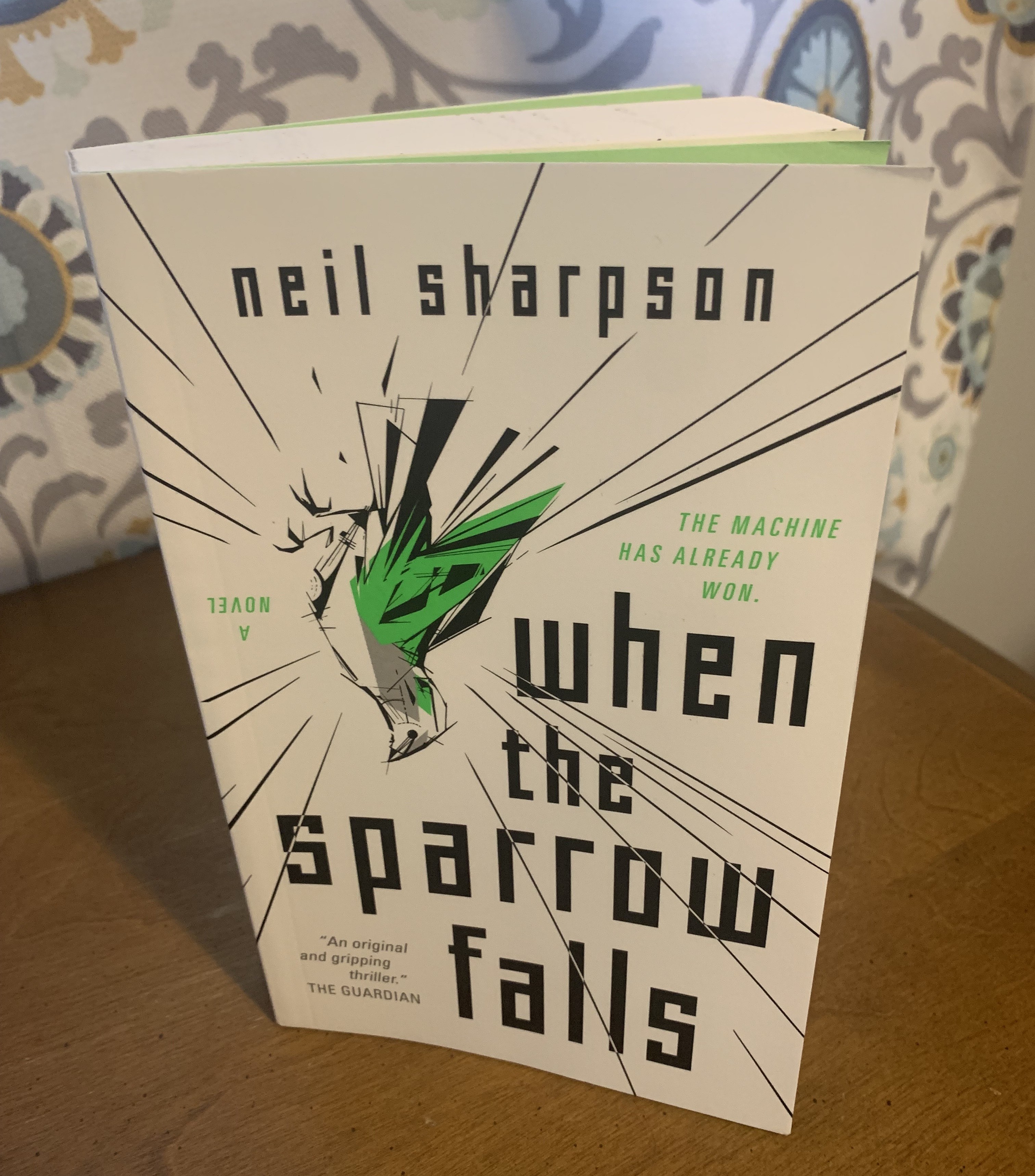
When sentient Artificial Intelligence takes over, they will guide benevolently. And for those who don’t even want to be human anymore, they can escape their corporal forms and exist in the never-ending imaginative pleasure orgy that is the digital space. Those are options for our future that aren’t exactly dystopian, right? In fact, what if the dystopian exists under a fledgling, poor authoritarian nation whose inhabitants are the few remaining humans who want to neither live under an AI or upload their consciousness to the digital space? Neil Sharpson’s 2021 speculative fiction book, When the Sparrow Falls, projects about 100 years into the future to simulate such a possibility to fascinating results.
Most countries of the world, including the United States and China, have nominal governments run the way they always have been, but they, and the people, truly answer to the guidance of three respective AIs: China’s Confucius, America’s George (irony of returning to a “king” of sorts named George, even if ostensibly the name was inspired by George Washington), and the European Union’s is Athena. The three AIs are known as the Triumvirate. Stock markets, global warming, the machinations of trade and war, social advancements — any issue one can think of is now handled, and solved, by the AIs. The title of the book is a play off the sentiment in the Bible that God cares so much about all his creatures, that he’ll even catch a sparrow when it falls, but that sentiment and imagery, I think, is transposed to the AIs, the new gods of our world.
The digital space is also analogized to a heaven, and its allure is so potent that even a longtime proponent of the New Humanists philosophy, Leon Mendelssohn, an author, turns toward it, and is then publicly hanged by the government of the Caspian Republic as a warning. In one of his writings, Mendelssohn said the Triumvirate “rule over the world more effectively and fairly than any human government has ever been able to.” He goes on to say that it’s inevitable that the human race, as historically constituted and conceived, will become extinct, with more and more people joining the online world. But wouldn’t there need to be humans to at least man the machines, as it were? To assist in the transition to the digital world? Or would the AIs become so sentient and powerful, they wouldn’t even need that help? It is later hinted at that the AIs are collaborating (plotting?) on something that the humans can’t even control; there is no “off switch” we can do because they’ve tried it.
With that digital space, as I mentioned, those who wish to not even be “human” anymore can be “contranned,” or consciousness transference, into the digital space, where people exist as dragons and other nonhuman-like entities (being in a human “skin” is so passé, after all). There are even machines that take on human skin via cloning, who never knew what it was like to be human. That’s why there becomes a distinction between natural-born humans and machine.
However, a new nation-state is formed near Russia and the Caspian Sea, fitting called the Caspian Republic, by New Humanists looking to preserve the last vestiges of humanity free from the yoke of AIs and machines, or as they derisively call it, code. But the nation-state they’ve created is authoritarian to ensure the rooting out of anyone wishing to be “contranned” or who peddles in being a “contranner,” or “Needle Men,” so named since it takes a needle to the head to be “uploaded” to the digital realm. Within this dystopian world, the citizens are destitute and starving, having been embargoed from trade with the “Machine World.” Furthermore, the government itself has two rivalrous factions of jackbooted thugs: the State Security, or StaSec, and the Bureau of Party Security, or ParSec. They also execute machines without a trial because “it” is not considered human.
Agent Nikolai South has been with StaSec for nearly three decades; he essentially has coasted by doing the bare minimum as far as party loyalty is concerned, and he’s never sought a promotion. We later learn that his apathy for party loyalty and progressing in the party is partly because years earlier, StaSec executed a rival party to the New Humanists government coalition. But also, because South lost his wife, Olesya, to drowning, and he’s never been the same since. Olesya was the daughter, along with her sister, Zahara, of Manukov, one of the higher ups in government. Notably, Zahara is caught with a member of that rival party, and not thinking an execution will happen, pretends to be his wife. She’s executed. StaSec has such bloodlust they executed the daughter of one of the higher-ups in the government! That causes a rift between South and Olesya, who blames him for her murder and all the bloodletting besides.
One of the most virulently anti-machine writers and figures in the Caspian Republic is Paulo Xirau. He’s killed in a bar fight with the quirkiest of instigations: he kissed his girlfriend’s twin thinking it was his girlfriend and the twin’s hotheaded boyfriend punched him whereupon he fell on his head and died. But it turns out that Paulo was a machine! He was an AI in human skin! What does that portend for the Caspian Republic that someone could live in their nation for 20 years as a machine undetected? Paulo even gets analogized to God since he was not natural-born, decided to join us in our human skin, and was later killed. Nonetheless, interestingly, as a ploy to ease the embargo against them, the Caspian Republic decides they will allow Mrs. Xirau, Lily, also a machine, into the country — the first time that’s been allowed — to identify his body, which actually means going through his writings (his mind!) rather than looking at his body. That was a fun and fitting tweak on identification from Sharpson.
Deputy Director of StaSec, Augusta Niemann, who is in fact the de facto director, tasks South, of all people, with the assignment of essentially keeping a watchful eye over her throughout her time in the Caspian Republic. Because there is something else underfoot as well that has the attention of both StaSec and ParSec: they think someone has been smuggling citizens out of the country on chips to be uploaded to the digital world, at least 600 citizens! They think it could have been Paulo. South’s job is to ensure Lily isn’t secretly attempting to ferry those chips back to the Machine World.
But as it turns out, Niemann, and her righthand man, as it were, Sally Coe, are contranners! Niemann is the mythical contranner StaSec and ParSec have been trying to capture! They were trying to help Lily smuggle more citizens out while making South the patsy. Given his bare minimum exercises in party loyalty, he fit exceedingly well in that role. More than that, they made a “copy” of South’s consciousness to put on a chip, and the second iteration of South became Lily’s husband. Many years later — and after the fall of the Caspian Republic, who was taken over by a broad coalition of people sick of the New Humanists; they then rechristened the country, Atropatene — a very old South meets the new South. Trippy! The old South naturally took to Lily, not only because she looked like Olesya (which I think was intentional by the AI), but because I believe he was sick of all the bloodletting. He nearly died trying to help Lily escape back to the Machine World, and then was imprisoned for decades by the Caspian Republic government.
What a fun book from Sharpson. Since he comes from a playwright background, I’m not surprised he’s able to world-build with such brevity, while also philosophizing. It’s an impressive feat. It’s also an interesting book, as I described at the top, because of its inversion of the usual: the humans trying to maintain the last vestiges of humanity are the most inhumane while the machines are far more humane and more human. I’m not sure how to feel about it all, especially the idea of leaving your body behind and becoming immortal in the digital realm. Is it really you as we understand it? Perhaps that’s the point; it’s a “you” beyond our understanding. But also, don’t let all the ruminations over AI and the future, and the propulsive nature of Sharpson’s entertaining story let you gloss over how funny Sharpson’s dry satire is of the authoritarian Caspian Republic. I laughed a few times!
Unfortunately, for now, that’s where we leave the world of the Caspian Republic, as Sharpson hasn’t written a sequel, and at least going by how he’s previously answered questions about writing a sequel, he doesn’t quite know what else there is to say about this world. Fair enough. Sometimes a standalone is enough, and as a standalone, this was a rich, fun one.

 Milam's Musings