
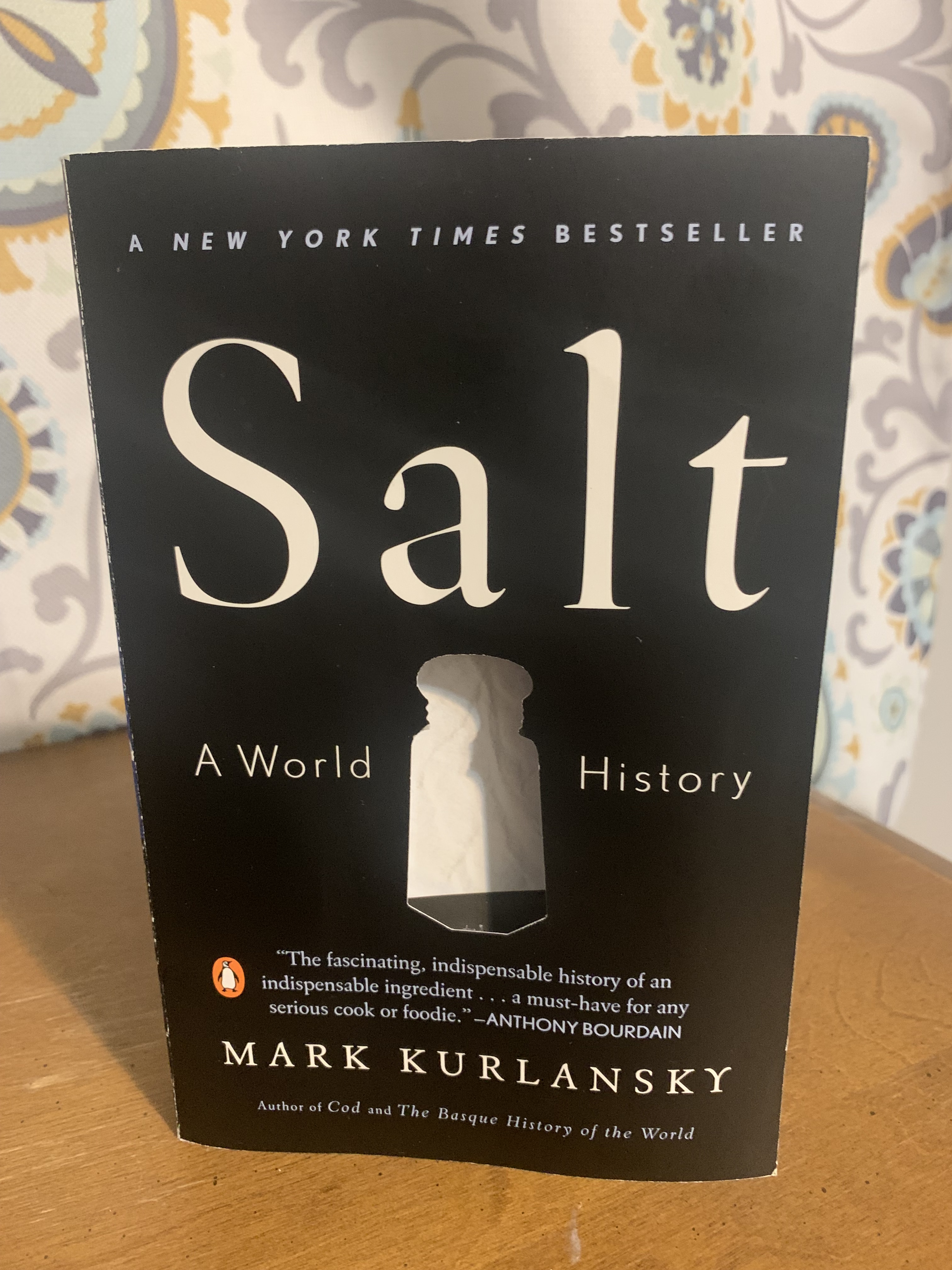
To tell the story of salt would seem as simple as, well, common table salt is, but fascinatingly, salt weaves a trail through the rise and fall of nations, empire-building and colonialism, revolution and revolt, class systems and the origin of our language, technological and scientific advancements, discoveries rediscovered, and variances in culture the world over and specifically, food culture. Who knew this little ubiquitous substance that spawned numerous industries and uses, and has been mined for thousands of years, was so compelling. Not me, at least! In the hands of food journalist, Mark Kurlansky, it is, though, and he sifts through the grains with the finest of detail with his absorbing 2002 book, Salt: A World History. I love a book that takes an angle — salt, in this case — and finds a way to tell myriad stories of human history. So much of our history can be mined, as it were, in such a manner, especially for something that necessarily became ubiquitous after being contested and monopolized for centuries.
Humans in all parts of the world have been harvesting salt by evolving methods for as long as recorded history has been recording them doing so. And just as neat, humans have been writing recipes, offering the best way to salt meat and fish in the plentiful human history prior to refrigeration. (Kurlansky presents a lot of these recipes the world over throughout the book.) Even when refrigeration was invented, or at least icing, the first experiments weren’t with fish or meat, but with a luxury item: butter, which was hard to preserve before refrigeration’s advent. Before I go too far afield from the harvesting of salt, it seems like any time the West “discovered” a method for harvesting salt, the Chinese had been already doing it for thousands of years. That “rediscovering” goes for a lot more than just salt, too. Nonetheless, one of the methods from between the sixth and ninth century, which Kurlansky said was the last great technological advancement in salt manufacturing until the 20th century, which is incredible to consider, is the pond evaporation system. Essentially, they’d trap seawater in a series of artificial ponds and wait for the sun to evaporate it. Workers would then scrape what remained of the salinity.
As I said, the salt lines run along the expanding borders of empires, though, particularly the Romans in their time and the British in theirs. To control the salt was to fund the empire and the empire’s ability for control and conquest, i.e., the military. After all, the military personnel needed salt for their rations and the livestock of the military needed salt. Arguably, then, amassing a lot of salt was a prelude to war, Kurlansky observed. Because of salt’s strategic importance, many of these countries and municipalities had salt policies and laws, state-run monopolies on the production and trade of salt, and even “salt police,” like Britain with their colony at the time, India. Speaking of India, one of the revolutions spurred on by salt was that of India trying to rid itself of the yoke of British rule, and Mahatma Gandhi came in to, among other things, stage a salt rebellion, where he illegally gathered salt (again, the British had a monopoly on it). While those close to Gandhi were “baffled” that he focused on salt, Kurlansky said, “Gandhi argued that it was an example of British misrule that touched the lives of all castes of Indians.”
The Caribbean was the dominant port for salt production and trade until 1492 when the Atlantic became the dominant body of water and trading route for the world. That’s when many of the islands in the Americas started being colonially mined by Britain, France, Spain, and so on. Or as Kurlansky put it, that’s when the Mediterranean stopped being the center of the Western world, which meant, for example, the end of Venice’s dominance. It also meant a cod boom because North America’s shores were teeming with the much-desired cod to be salted. Once the cod boom hit, Kurlansky said salted cod, which could last longer across great distances — another quirk of salt history is that it’s essentially cheaper to salt something and transport that than it is to transport salt in and of itself, at least until things like the steam engine came online —, is credited with preventing famine in many parts of Europe.
Any foray into human history bends the mind, though. How ancient humans figured out the mechanisms for extracting salt from the earth and its relationship to food, and preparing the food for edible consumption. All this long before chemistry was a word or a science or began to untangle the scientific properties of salt. What is beautiful about human history though, sans the bloodletting and conquests, of course, is that food is a common thread, and because of that thread, food preparation and the techniques therein involve learning from other cultures and taking those methods and/or improving upon them when adapting them to their culture, and eventually, you get distinct variances. This kind of cosmopolitism is lovely and it makes us all better off. But I digress. Of course, there are disagreements across cultures, too, like the introduction of iodine to salt for health benefits, like to stave off iodine deficiency issues, such as developing a goiter, but it’s proved controversial in India and China.
Then, you have the Celts, whose history is like an abandoned salt mine: remnants largely told by the Romans and Greeks because the Celts didn’t keep a recorded history (just oral). This despite the Celts being innovative in salt, mining, iron, agriculture, trade, horsemanship, and the salted ham, Kurlansky said. He added, “The Celts were innovators. The Romans were nation-builders.” To build salt works was how you built empires. Indeed, common salt, the right to salt, was a Roman idea for the plebians. The Romans would essentially offer free or reduced prices on olive oil and salt to engender good will from the people, but when necessary, they’d also wield such commodities for tax purposes. Interestingly, the Roman army was sometimes paid in salt, which is where the word “salary” comes from and the expression “worth his salt.” The Romans also gave us salad: salad comes from Romans adding salt to counteract the natural bitterness of the greens. Salad literally means salt. Salt seems to be the flavor for the origin of many of our words, including salami, which means “to salt.” Or Americans, who used to call tomatoes “love apples,” which became our basis for a tomato-based ketchup instead of fish sauce. But what I think most resonated with me from Kurlansky’s rendering of Roman history with salt and food is the line between pungent and rotten. One has to imagine that our modern noses would find much of what the Romans ate (or peoples from other ancient civilizations, or even just a few centuries ago!) would smell awful, and thus, not be worth eating. In other words, one Roman’s luxury item is likely something foul to us. Therein is another interesting quirk of human culture and mores: the way in which we ascribe luxury to something, and conversely, consider something “for the poor.” In one part of the world, an item may be considered a luxury for the royals, like in Britain, but in France, that’s what they’re giving to their poor people. I believe in this example, it was whale tongue, which Basque country was known for being the only whale poachers at the time.
With salt, though, we must return to the power struggle. Kurlansky even has a chapter called, “American Salt Wars,” where he noted that the history of the Americas is one of constant warfare over salt. “Whoever controlled salt was in power.” From the American Revolution through to the American Civil War, I had no idea how significant salt was, especially to the latter, where the Union was constantly destroying the salt mines the Confederacy had, and the Confederacy was trying to rebuild them to keep their war effort going. Ahead of the Civil War, the North already had a huge advantage over the South when it came to salt, far outpacing them in the number of bushels of salt produced: 12 million versus 2.4 million. Even the French revolution has a salty taste to it. While salt wasn’t the singular cause of the revolution, Kurlansky said it (the gabelle, a high tax on salt) became the symbol for all the injustices of government. Indeed, it wasn’t even just that the French paid a tax on salt; they were required to purchase the equivalent of 15.4 pounds of salt at a fixed high government price! Outrageous. And you couldn’t use the salt for other uses or you’d be committing faux saunage, or salt fraud. When the British came back in 1812 to war with us, America still hadn’t properly learned its lesson from the Revolutionary War because the British caused another salt shortage!
As the United States expanded westward, which at the time, meant Cincinnati, Cincinnati became a major commercial center with salt from Kanawha, Virginia, along with pigs from Ohio, Kentucky, and Indiana. Kurlansky said by 1830, Cincinnati was packing almost one-third of all western American hogs, more than 100,000 hogs per year. Being a Cincinnatian, I needed to add that sidenote of history. Continuing on …
Kurlansky also could get poetic about salt and its history. When chemists began understanding what salt actually was (an acid and a base, with common salt being the least interesting of the salts), he compared it to the Chinese belief in yin and yang, where two opposing forces need a missing part from the other to be complete. He said of salt that it is a “small but perfect thing.” And its history continues apace with the advent of canned food. Salt-based industries like salt, fish, salted herring, and anchovy all began to fall to canned food. “Salting in snow” also didn’t help. But so many other industries spun out of the quest for salt, including oil, because humans were already drilling to find salt.
These days, not surprisingly, the United States is the largest salt producer and the largest salt consumer, producing 40 million metric tons each year and earning more than $1 billion sales. However, salt production for food only accounts for 8 percent! The largest margin by far, which is apropos as we’re on the precipice of a seemingly bigger snow storm, is salt for deicing roads. All of these stats are based on the year the book came out; however, the first figure hasn’t fluctuated much, but there is an extra billion and a half in sales nowadays. As for deicing efforts, it actually fell to 43 percent by 2020. The chemical industry accounts for the other large chunk at 39 percent. Chlorine is an enormous, vital application of salt from disinfecting our drinking water to wastewater treatment and, obviously, our swimming pools.
Salt is still considered of strategic importance precisely for what I just mentioned, among other uses, and here I thought it was just a nice compliment to food! Seriously, a solid a rule of thumb in cooking is if you’re not sure what’s gone wrong with it, add more salt. Again, I digress.
From ancient recipes and technological advancements to modern inventions and applications, taking Kurlansky from the Dead Sea to the Bahamas to China to England and everywhere in between, Salt is a much more enthralling book than one might imagine a book about salt could be, again, precisely because of how vital it has been and continues to be for humans. And not just owing to how we use and interact with it on a daily basis (often unknowingly), but because our bodies absolutely need salt to function. So, in conclusion, you won’t be salty after reading this book! (I couldn’t help myself.)

 Milam's Musings