
Spoilers!
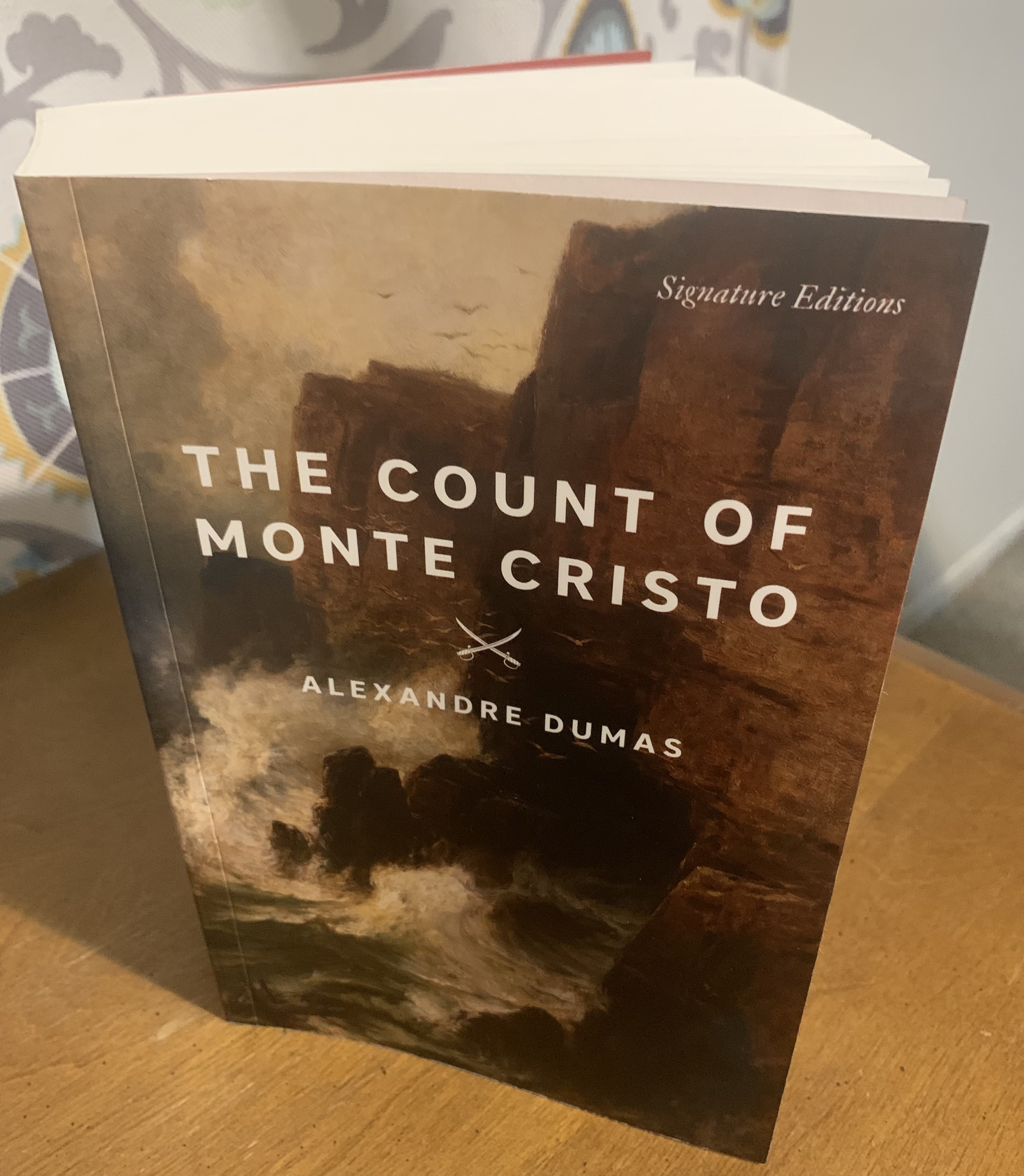
Love and avariciousness are the seeds of malfeasance among humans, and the corollary then, is true, too, that those seeds also blossom into vengeance, which has the advantage of unyielding patience. Although, even those who strike out with vengeance as if they were the hand of God, they will soon be reminded that they fall short of that honorific and omniscience. Alexandre Dumas’ sprawling 1846 classic, The Count of Monte Cristo, evinces these machinations of humans, all set amid the turmoil of 19th century France. Agatha Christie before Agatha Christie, Dumas’ book reads cleverly and intricately plotted, relatively modern, with far-ranging adventure and an assemble cast across multiple decades, such that it’s mighty length isn’t as daunting as one may think. I was invested from the beginning until the end, and I can see why Dumas’ book has such great staying power. It’s ultimately deeply fun and interesting! And is perhaps the greatest revenge story ever told in book form.
The context of early 19th century France is compelling and zany in hindsight, and one I’m admittedly a novice to. However, the short of it is, that while France overthrew its monarchy with the French revolution toward the close of the previous century, it would take another century before it rid itself of its yoke completely, whether in the form of an emperor (Napoleon) or king. For a time after Napoleon’s initial rule, he was banished to the Island of Elba. Less than a year later, Napoleon mounted a comeback, though, and retook his place as emperor. That lasted 100 days-ish, hence the historical moniker Hundred Days for this period. After losing famously at Waterloo, Napoleon was banished again (further away this time) and Louis XVIII was restored to the throne. This is the historical, political, and social context in which Dumas’ dramatic story unfurls. For in one beat, it is traitorous to be a Bonapartist, and in the next, traitorous to be a royalist. Those who gravitate and seek power tried to ride these successive waves. And for our unlucky protagonist, he was nearly buried beneath them.
Edmond Dantès, a sailor destined to be a captain, is betrothed to the beautiful Mercédès, and has a doting father he loves. He’s back home to Marseilles, France after his latest voyage to officially celebrate the wedding and see said father again. Everything seems to be going his way! If only the captain of that voyage, who shortly thereafter dies, wasn’t helping Napoleon return to power, and only if those within Dantès’ orbit didn’t have jealousy and greed so animating their hearts. Danglars, a jealous junior officer to Dantès, and Fernand, who pines for Mercédès, conspire (also with the somewhat unwitting Caderousse, a tailor who is Dantès’ neighbor) to sabotage Dantès by making it seem like he’s a Bonapartist, who sought the Island of Elba in order to bring Napoleon back to power. With him out of the way, Danglars can get the status he feels is owed to him and Fernand the girl. Fortunately, at first, it seems like Gérard de Villefort, the royal prosecutor, recognizes the obviousness of the set-up and that Dantès is innocent. However, come to find out, de Villefort’s father, Noirtier, is a Bonapartist actively working to restore the former emperor to power. Dantès had a letter given to him at the Island of Elba he was to give to someone he knew not. Gérard reads the letter and realizes it was addressed to his father! That’s when he decides to bury Dantès in a dungeon on Château d’If. This despite entreaties from the ship’s owner, Morrel, who was a lovely and earnest friend to Dantès, to save him.
The man who had everything before him — a future as a captain, a beautiful bride, and he was still only in his early 20s — now has it all stripped away under a political climate germinating subterfuge he couldn’t possibly have foreseen or forestalled. In short then, if Dantès was to ever return, his enemies list features: de Villefort, Danglars, and Fernand (I don’t believe he saw Caderousse as a true enemy, perhaps only an oblivious drunk). He would come to add Mercédès to that list because after 18 months of waiting for Dantès’ return, she acquiesces to marrying Fernand and they have a son named Albert.
But I’m jumping ahead. While in his dungeon at Château d’If, Dantès befriends his fellow dungeon mate, Abbé Faria, an Italian priest who is considered mad by the prison officials. This is because he keeps talking about a secret treasure he know is hidden on Monte Cristo. Dantès and Faria spend a lot of time together, literally, after creating a passageway through the stones separating them, with the future idea of escaping from the prison. In the meantime, though, Faria teaches Dantès everything he knows from language to culture to yes, the secret of the treasure. Unfortunately, Faria doesn’t survive in prison, but his death becomes the much better catalyst by which Dantès can escape. He pretends to be Faria’s corpse and swaps beds with him. The prison just takes dead bodies, weighs them down with a canon ball, and tosses them into the ocean. Miraculously, Dantès survives this, which he probably sees as providence for what would become his revenge scheme.
All in all, Dantès spent 14 years in a dungeon. In that time, his father died, largely alone and of hunger. I already mentioned what transpired with Mercédès and Fernand, but it’s worth mentioning that he changes his name to Count de Morcerf (for reasons I’ll talk about soon!) and is part of the French parliament. Danglars is a Baron and an exorbitantly wealthy banker. As for de Villefort, he only rises in esteem as the royal prosecutor. His once powerful dad is paralyzed and can only speak with his eyes.
Using the secret treasure that was indeed true, Dantès becomes a multi-millionaire, but more than that, he’s also a Renaissance man, capable of speaking multiple languages, exceeding at a variety of fighting techniques and activities, and charming his way through social circles. It helps that he buys the “count” title and fashions himself the titular Count of Monte Cristo. But also for his purposes to make a convincing backstory, he sometimes disguises himself as Abbé Busoni, an Italian priest clearly modeled after Faria; Lord Wilmore, a wealthy Englishman; and Sinbad the Sailor. In other words, for all intents and purposes, Dantès did die at Château d’If. To give some modern comparisons, the Count of Monte Cristo is like part-Batman, and part-Hercule Poirot in terms of his near-supernatural power of observation and deduction. As for his puppeteering ways, I don’t know of his any apt comparison other than, well, God, but I already mentioned the folly of that comparison.
Owing to the impossibility that Dantès would still be alive, and the cover persona he’s crafted, the Count of Monte Christo is able to ingratiate himself into the new lives of everyone who harmed him, and for that matter, of those who did right by him, like Morrel, the ship owner. Indeed, in his Sinbad the Sailor disguise, he quite literally prevents a now-near-bankrupt Morrel from killing himself (blood washes away shame) and restores their fortunes and the famed ship he once nearly captained. Later, he is friendly and helpful toward Maximilien, Morrel’s son. Also through his this Sinbad the Sailor guise, he befriends Luigi Vampa, an Italian bandit, who proves useful. While in Italy, the Count of Monte Cristo becomes friends with Albert and his friend, Franz. Luigi and his gang “kidnap” and “imprison” Albert resulting in the Count of Monte Cristo “rescuing” him, but it’s all a ruse to further ingratiate him to Albert and grant him entry into his home to then eventually meet Fernand again. Albert is supposed to marry Eugénie Danglars, and Franz is supposed to marry Valentine de Villefort. Essentially, the marriages reflect the furtherance of power, money, and status, and are contracts between the fathers more than romance between the brides and grooms. It seems the only person who knows who the Count of Monte Cristo truly is is Mercédès, albeit, she’s not revealing as much. For his part, de Villefort does get suspicious at the beginning, but the Count dispels those suspicions easily with his various disguises.
Bertuccio, the Count of Monte Cristo’s servant, has quite the story to tell that complicates these seemingly polished, bright new lives of his enemies. It also thrusts us right back into the political turmoil of the time. So, Bertuccio’s brother, who fought for Napoleon, was assassinated. I believe still during Napoleon’s 100 Days, Bertuccio implored de Villefort to bring the assassin to justice. Villefort would not (he filibustered into the restoration), whereupon Bertuccio sought his own vigilante justice against Villefort. The day he was to kill Villefort, he saw Villefort bury a box in his garden. He then stabbed Villefort and pulled the box from the ground. A baby was inside! Villefort lived, and Bertuccio raised the baby with his sister, I believe. Unfortunately, that kid, who Villefort sired with Madame Danglars (!), so-named Benedetto, was a criminal type. His criminality culminates in him and his buddies trying to steal money from the sister and in the confrontation, she catches on fire and dies. Oof.
The first meeting of the Count of Monte Cristo with Villefort was utterly fascinating, a philosophical repartee that found the latter outmatched. Indeed, one of my favorite sections of the book is a monologue the Count delivers to de Villefort. In this monologue, he is telling de Villefort that he’s been raised up to be one of God’s marked beings allowed to mingle with mere mortals. He says, in part, “The dominions of kings are limited either by mountains or rivers, or a change of manners, or an alteration of language. My kingdom is bounded only by the world, for I am neither an Italian, nor a Frenchman, nor a Hindu, nor an American, nor a Spaniard—I am a cosmopolite.” How liberating a thought! What his downfall was before — the political environs of the place he lived — he’s now extricated himself from any such whims or follies by becoming a cosmopolitan, and better yet, with a background of his own making. That enables the Count to then become this puppeteer of other men’s fates. He is their fate! Or as he says at another point, “If one’s lot is cast among fools, it is necessary to study folly.”
You see, though, even the Count cannot foresee and plan for everything. He actually is not God. The Count didn’t worry about Valentine being caught up in his vengeance because Villefort’s whole family ought to be ruined, so he thought. That is until he learns Maximilien loves and pines for her! And she returns his love. They conspire to get her out of the marriage to Franz. Two big threads are weaving through Valentine that are the Count’s doing. First, he’s furnished Madame Villefort with poison because he knows she’s interested in killing Valentine and all who are in her way to an inherited fortune for her son, Edward. Again, the Count didn’t yet care if Valentine died. Secondly, stopping the marriage of Valentine to Franz to hurt Villefort. As regards the former, Madame Villefort first kills Valentine’s grandparents (parents to her real mother). Then she seems to try to kill Noirtier, but instead kills his servant. During all of this, the doctor Villefort calls upon actually suspects Valentine of being the poisoner. That is until Valentine is then targeted. Thankfully, due to the close relationship she has with Noirtier, he’s been fortifying Valentine’s resistance to the poison, long enough for the Count to get involved and save her life. As to the latter, the Count knew that it was Noirtier who assassinated Franz’s father. When Franz learns of it, he calls off the marriage.
Benedetto returns to the picture, thanks to the Count, who pays him to pretend to be the son of an Italian man named Cavalcanti, with Benedetto now going by Andrea. Danglars is so taken with him, that he wants Andrea to be the one to marry Eugénie. We later learn more about what Benedetto was doing in the intervening time after killing his adoptive mother and before arriving back in the picture. He was in prison with Caderousse! Caderousse is how the Count learns about the plot that sent him to prison, but Caderousse can’t seem to help his criminal ways. Upon finding and learning of Benedetto’s new lot in life, he wants to rob the Count of Monte Cristo’s house! He doesn’t know it’s Dantès’ home, of course. In the course of that burglary attempt, Benedetto murders Caderousse. This murder is revealed by the Count of Monte Cristo right as Eugénie is to marry Andrea. Andrea absconds and is on the lam. That’s all good with Eugénie, who goes on the lam herself with her friend (lover, but not wanting to say that in the mid-1800s?!), Louise d’Armilly, rebelling against societal expectations. She wants to be free! And let’s not forget, had the marriage gone through, half-siblings would’ve married each other!
What about Fernand and Albert, though? What a story that is, which envelopes Haydée, the Count of Monte Cristo’s Greek “slave.” She was the daughter of Ali Tebelen. Fernand, as a general, worked with Ali, but betrayed him to the Turks, I believe, for 3 million crowns (about $146,000, probably a lot more back then, though!). He then sells Haydée and her mother into slavery, which is eventually where the Count of Monte Cristo saves her. When this plot is revealed (thanks to the Count, anonymously, of course) in a newspaper, Albert is ready to duel with one of his friends, a journalist, but the journalist proves to him it’s true. Fernand hid behind his nobility. Given Fernand’s position in parliament, parliament holds a hearing about the allegation where Haydée testifies against him. The Count brought Albert to Normandy to make it seem like he knew nothing of Haydee’s testimony. Albert, though, wants to duel the Count believing he was still puppeteering everything. When Mercédès reveals to the Count she knows he’s Dantès, she implores him to not kill her son. He acquiesces and is ready to die! But Mercedes plays Albert, too, revealing the true story behind the Count of Monte Cristo, and Albert forgives him. No duel happens, but one almost then happens with Fernand after he confronts the Count of Monte Cristo, who reveals his true identity to Fernand. That freaks Fernand out, so he returns home and kills himself. Albert and Mercédès leave to eventually return to Marseilles (well, Albert then goes on to fight with the army in Africa).
Danglars, thanks to more maneuvering by the Count of Monte Cristo, is virtually bankrupt now. With Eugénie on the lam, and knowing that his wife, Madame Danglars, definitely cheated on him with Villefort, but also another guy in the government, he decides to run, too, but not before stealing money. Meanwhile, Valentine is presumed dead after another poisoning. Villefort threatens Madame Villefort to kill herself by her own wicked poisoner hand by the time he returns home from the trial of Andrea for killing Caderousse. That’s where, however, Andrea reveals that Villefort is his real father! When Villefort owns up to it and his disgrace, he rushes him wanting to now save his wife from death, take their son Edward, and leave France. Instead, she’s already done the deed and worse still, took Edward with her. That not only drives Villefort mad, but particularly Edward’s death, makes the Count of Monte Cristo wonder if he’s gone too far. That is, if he’s committed evil in his pursuit of vengeance and righting past wrongs. To even the scales, as it were, when he has Luigi and his gang kidnap Danglars and take most of his fortune from him, the Count has Danglars repent and ask for forgiveness, so that the Count may also be given forgiveness by God.
Where I’m not sure the Count can be forgiven is that, yes, he saved Valentine’s life, as she was never dead, but he let Maximilien grieve for a full month before revealing the truth to him! Ah! That’s brutal. But that also has a purpose. The Count of Monte Cristo wrote the two a letter, where he essentially acknowledges that he once thought himself the equal to God, but he’s been humbled by everything that transpired. He now knows that “God alone possesses supreme power and infinite wisdom.” He also tries to explain the “secret of his conduct” to Maximilien by telling him there is neither happiness nor misery in this world; there is only the comparison of one to the other. That’s why now Maximilien having experienced the deepest grief, and willingness to die even, for Valentine, he is now best positioned to experience supreme happiness. He ends by saying that all human wisdom is contained in the two words “wait” and “hope.” For Dantès, he went from a Job-like experience in the dungeon to unimaginable wealth and status, which he used in many ways to ensure good in the world, but yes, also to make bad men suffer. After all, he tells Albert and Franz in Italy that he’s seen all manner of execution and doesn’t see the satisfaction in it. Reading between the lines, and what he would do to his enemies, it was better to elongate the torture and ruin them mind, body, and soul. As for hope, Dantès had given up ever having love in his life again, but he found it again, unexpectedly, through Haydée, who becomes a de facto daughter to him. The end of the book is the Count of Monte Cristo sailing off into the sunset, quite literally, with Haydée, as Valentine and Maximilien wave from the shoreline of Monte Cristo.
I’m so glad I gave into people on the internet randomly hyping The Count of Monte Cristo recently and decided to read this gargantuan classic. It was well-worth my extensive investment. I loved it. I was enthralled by the cast of characters, even within Dantès’ own machinations and disguises. And I was riveted by how damn clever Dumas’ plot was, charting out the revenge and bringing it all together. Again, it felt like Christie before Christie (and much more in-depth). I would highly recommend The Count of Monte Cristo to any reader; it’s far more accessible than its size or status reveals. Like I said at the beginning, when you’re ultimately telling a fun story, it doesn’t matter if it was written in 1844 or 2026 because it’s going to be a good time.

 Milam's Musings
Awesome book! 📚
LikeLike