
Spoilers!
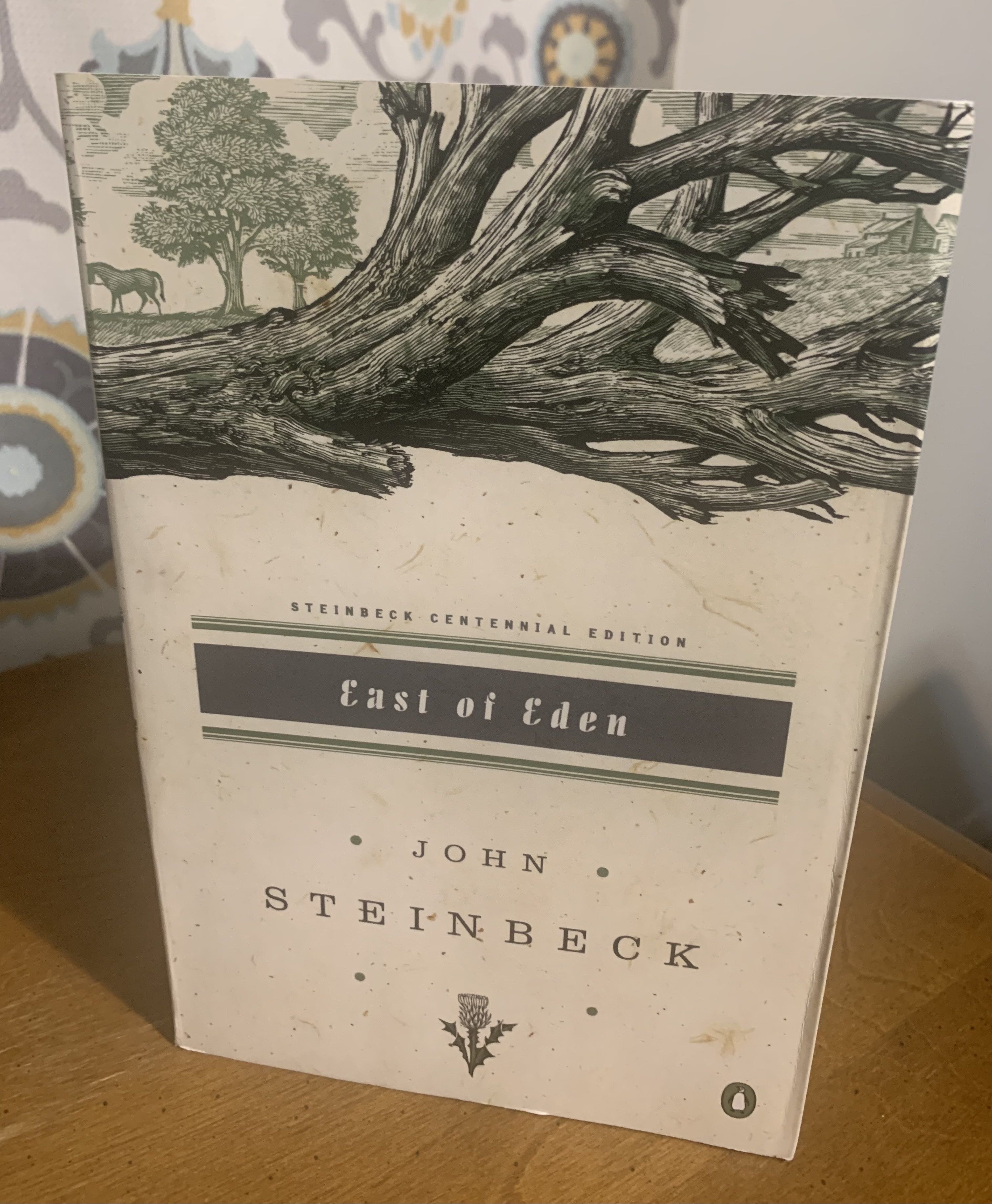
Heritage, whether of the familial type or the Biblical original sin type are renderings we accept to explain good and evil. Such deterministic thinking grinds humans down beyond their complexities and choices. Only through choice — some conception of free will — are we liberated and free to become who and what we are. This is what John Steinbeck seemed to believe in his writing. His 1952 book, East of Eden, is essentially an early 20th century retelling of the Cain and Abel story. To use the Hebrew word at the core of Steinbeck’s book, timshel, or thou mayest, there is such infinite possibility within such a framework. Steinbeck’s East of Eden beautifully glorifies such possibilities, ranging from the choice to be good, the choice to simply “not be evil,” and of course, the choice to intentionally inflict evil upon the world. Personally, I think the great mass of humanity is slotted in the middle category, allowing us to evolve to this point without being overtaken by those willing to do evil. And also surely by virtue of the selflessly heroic who inspire and remind the great mass to at minimum, not pull the “evil” lever.
The narrator for Steinbeck’s ode to choice is John, the grandson of Olive Hamilton, of the Hamilton family, which settled in the Salinas Valley of California. Samuel Hamilton and his wife had nine children, of which Olive was one. Each, despite a similar upbringing on a “rusty” waterless farm, went their own ways, charting their own paths. Similarly, and eventually coming to the Salinas Valley, are the Trasks. Adam and Charles’ father served very briefly in the Civil War and had his leg amputated. He parlayed that limited experienced into a stolen valor-type of fame and fortune. That fortune was then given to his two boys, Charles and Adam, upon his death. Charles is depicted as someone with something just missing in his thinking and emotions. He’s brutal to Adam, nearly killing him at one point. But after Adam is forced into war against Native Americans by his dad and becomes a tramp throughout the United States, he eventually returns home to their Connecticut farm to live with Charles.
That’s when Cathy comes into the picture. Cathy is like Charles; she’s off in a way that seems noticeable before anything dangerous actually occurs. Then, at 16, she kills her parents in a house fire, and fakes her own death to make it appear she was murdered. She becomes a whore, in Steinbeck’s verbiage, but the “whoremaster,” falls in love with her — as tends to happen to people in Cathy’s orbit, or clutches, as it were — and then, I think out of a certain level of fear and upon learning her backstory, nearly beats her to death. She crawls to the farmhouse of Charles and Adam. Adam, like the whoremaster, is immediately smitten. Shortly thereafter, Adam and Cathy marry. After giving Adam her opium medicine, she sleeps with Charles, who it’s implied impregnates her. I think they both recognized a psychopathic kinship within each other.
Once pregnant, not knowing about the tryst with Charles, Adam decides to use his inheritance to move to the Salinas Valley with Cathy. He has dreams of a great big farm and garden. You could analogize it to the Garden of Eden. That’s how our two families then intersect; Adam wants to know about digging a well, and Samuel Hamilton is the ingenious and gracious, but penniless inventor, who will help him. Adam also takes a Chinese servant in named Lee, who was born in the United States and speaks exceptional English and is well-read, but still obscures his knowledge and know-how behind pidgin, racist expectations, and stereotypes. But Samuel quickly realizes it’s a put-on and takes to Lee. That’s when I knew I’d love the philosophical, patient, and compassionate Samuel!
Adam’s Garden of Eden plans are dashed when Cathy’s evil endeavors bear fruit. After having twin boys, she’s ready to leave Adam and go back to being a whore. When he stands in her way, still oblivious to the widening rift between the image he has in his mind of Cathy and who the Cathy who stands before him is, Cathy shoots him in the shoulder with his own gun. He nearly bleeds to death. Lee becomes a de facto single father to the twins, who Adam still hasn’t named, so ashamed and confused is he. When Samuel forces the issue, and the three sit down to name the twins, they settle on Caleb and Aaron, which is then shortened to Cal and Aron. Like Charles and Adam before them, Cal thinks there is an inexplicable meanness about him, and that Aron is the obviously softer, better one, who is more beloved by their father.
This is where we also get the direct analog to Cain and Abel and explicit mention of the title of the book. Steinbeck, through Lee and his Confucius scholars, retells the narrative of Cain and Abel. Cain, jealous of God’s seeming affection for Abel over him, kills Abel. When God learns of it, he casts Cain to the land of Nod “on the east of Eden.” Following the Biblical narrative then, since humans are partly descendants of the first murderer, Cain, the story of humanity is the story of the dwellers east of Eden. Indeed, we’ve diverted from the perfection of Eden. But in Steinbeck’s view, the very fact that murder occurred, along with goodness in the very early days of humanity, evinces “thou mayest.” Choice! This revelation shakes Samuel to his core. He remarks, “It is true that we are weak and sick and quarrelsome, but if that is all we ever were, we would, millenniums ago, have disappeared from the face of the earth.” We have the choice, in essence, to rule over our sins: to choose to rise above them. To live in spite of them. To do good in spite of them. To not be ruled by them. It’s a powerful message Steinbeck has hit upon. Again, the crux of it is, humans always have the choice between good and evil, and even within that dichotomous structure, there are gradations and the possibility of forgiveness. Moreover, from that evil can spring freedom and liberation, at least in its contrast, like Adam eventually freeing himself from the cloud of Cathy (he confronts her at the whorehouse, and upon seeing her for what she truly is rather than the image he had constructed). Even consider the fact that most sociopaths aren’t violent! Most still choose to abide by the norms of society even if they don’t feel empathy the way others do. So, even sociopathy is not a predetermination for evil. Cathy still had to choose her evil. This is all very compelling, and not just from a literary standpoint where it would obviously be less dramatic to read a book of characters shaped by predeterminism rather than their choices, but also for the philosophical implications. The choices Adam, Charles, Cathy, Samuel, Aron, and Cal ensure a much richer, more dynamic, and dramatic reading experience. And for the record, it’s not so much scary that humans knowingly choose poorly and harm others; instead it’s dismaying since they could have chosen otherwise. However, the corollary to that is that some people choose to do extraordinary feats of goodness for others, which is inspiring. As a species, we are in a constant tug-of-war between progress and regression.
As is clear, Steinbeck’s story makes one ruminate on the nature of being human, good and evil, and free will versus determinism. But Steinbeck also adds other philosophical musings throughout the book. He waxes poetic about the Salinas Valley, where he was born, or the dawning of the 20th century and the fears men had, or certainly, of the misguided notions men had as they died in the trenches and under machine gun fire during WWI. Of the Salinas Valley, he notes how the men who came upon those barren hills did so with “divine stupidity or great faith” to do it. But he bemoans how such courage and dignity as autonomous individuals has disappeared from the world. He adds what happens as a consequence: “… because men do not trust themselves any more, and when that happens there is nothing left except perhaps to find some strong sure man, even though he may be wrong, and to dangle from his coattails.” You could argue that is a modern phenomenon, too, but I digress. Or of the dawn of the 20th century, Steinbeck talked about the men who cursed what had been lost, “strawberries don’t taste as they used to and the thighs of women have lost their clutch.” He adds of such men, “And some men eased themselves like setting hens into the nest of death.” Such men who cannot extricate themselves from the yoke of nostalgia are dying a slow death, and I think that’s intertwined with the coattails problem. But again, I digress. Steinbeck’s best monologue comes on page 131 of the Penguin Books 2002 edition. “Our species is the only creative species, and it has only one creative instrument, the individual mind and spirit of a man.” Indeed, human ingenuity is our most inexhaustible renewable resource. It is everything, albeit both our progress and regression. Because when the human spirit is broken or when man endeavors to control the individual minds of others, ruin occurs.
Charles dies before Adam can reconnect with him, and he leaves additional money he accrued to Adam and his wife (lol). That’s when Adam went to the whorehouse, as I mentioned. Adam has his best moment in the book when he’s forced to confront Cathy (owing to her irascibility rather than his intention). He tells her she knows all about the ugliness in people – in fact, she’s blackmailing scores of powerful people who have visited her whorehouse – but he reminds her she doesn’t know about the rest. “You don’t believe I loved you. And the men who have come here with their ugliness.. you don’t believe those men could have goodness in them. You see only one side, and you think … that’s all there is.” This is important because again, it’s illustrative of human complexity. It’s not merely a binary of good versus evil. The great masses are in the middle!
Like father like son, once he’s older, Cal learns of his mother not only being alive and having shot his dad, but running a whorehouse (after she killed the previous madam) and he has a revelation of his own. Cal’s worry was not so much the original sin heritage, but that of inheriting his mother’s meanness. Was his meanness predetermined by her blood? No. He realizes upon confronting her that if he’s going to have any meanness, it’s going to of his own doing – his own choosing! However, like the Cain and Abel story, Cal saves up his money (from selling beans during WWI) to give Adam $15,000 as a gift. (This was a gift to make up for his father losing money on an iced lettuce venture, which was quite smart, if he kept at it!) Adam rejects it, not only because he doesn’t care about money, but on principle, he can’t accept money gained while boys are dying in Europe. This rejection, this unloving, unravels Cal. His meanness comes out when he takes Aron to see Cathy at the whorehouse, which has the intended effect of unraveling Aron. He lies about his age (he’s 17) and joins the war effort. When two days have gone by and Adam hasn’t seen Aron, he inquires about him, to which Cal, like Cain, says, “How do I know? Am I supposed to look after him?” Cain said to God, “Am I my brother’s keeper?” Cal is ready to kill himself, or at least thinks about it, but Lee convinces him not to by essentially going to Adam, who by this point has suffered a major stroke and is near death, and demanding Adam absolve Cal of this sin, as it were. To free and liberate him. Lee even points out that Cal, like Cain, is marked with guilt. In one of the most beautiful endings to a book I can recall, Adam whispers, “Timshel.” Adam has absolved his son.
East of Eden started a little slow for me, owing to that Genesis-like quality of table-setting, but once it revved up with Adam and Charles, Cathy, Samuel, the Biblical references and Lee-inspired philosophical musings, I was hooked. More than 74 years later, Steinbeck’s ode to choice is still resonant and relevant. Steinbeck knows how to write a gripping sentence that will, as Samuel says, take you by the throat and shake you. But he also knows how to write compelling characters; Cathy was terrifying and unnerving! Just as terrifying and unnerving as she was, Samuel was sweet, warm, and good. As a book noted for being a classic, I think it’s always worth rendering this verdict: is it accessible? Absolutely, and well-worth spending your time with.

 Milam's Musings