
Spoilers!
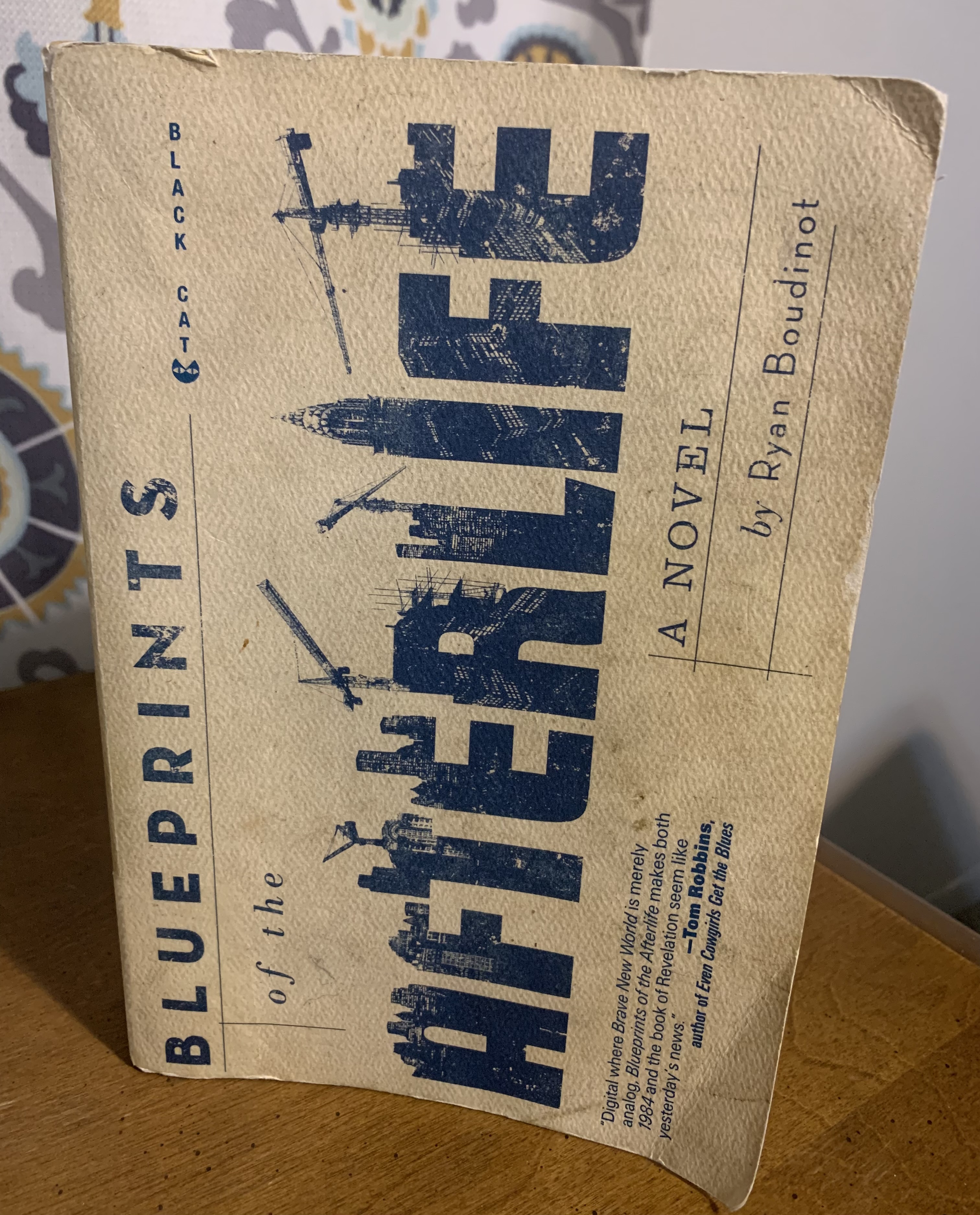
Fiction that dances the line between near-future science fiction and speculative fiction is fun to read precisely because one can envision its plausibility. In Ryan Boudinot’s 2012 book, Blueprints of the Afterlife, he imagines a future rebirthed after a war between humans and clones, and where transhumanism reaches a symbiosis with the human body that goes far beyond the basic augmentations and compliments of today. More than anything, though, Boudinot’s book, while dark and ominous in many ways, is a zany lens through which to examine these issues. It’s an intentionally loose, goofy book because when you think about nanotechnology merging with human consciousness, clones, living more than 150 years, etc., it is all kind of goofy in that absurdist way life is when examined. Boudinot captures that dynamic and tension of what it means to be human in such a world particularly well.
Until Boudinot’s book, I had no idea that the original name for Seattle, owing to its Native American heritage and roots, was “New York Alki,” meaning, New York “by and by.” Boudinot takes that concept literally in his dystopian future a couple hundred years from our present, where the aforementioned war with clones (along with the usual calamities, like nuclear war, environmental degradation, and a sentient, vengeful, fast-moving glacier) renders much of the eastern United States, including New York City proper, uninhabitable. This period is known as the era of Fucked Up Shit, or FUS. In the post-FUS world, humans decide to rebuild New York City — a literal clone of New York City down to the new inhabitants taking the apartments, names, and lives of the previous inhabitants — in Puget Sound and calling it New York Alki. In Oakland, they’re rebuilding Boston as Little Boston.
This is a world also dominated by Bionet, or biological Internet, which was essentially created on a lark by two tech bros in the mid-1990s at the height of the Dot-com bubble in San Francisco. Bionet is the nanotechnology concept, but even more ingratiated into our bodies. If you have a heart attack, your body will call 9-1-1. All your medical files are on the chip implanted into you. Once chipped, hormones, enzymes, and antigens can all be downloaded and/or uploaded. Need a pain reliever? Call Bionet and the pain reliever begins coursing through your bloodstream. The next evolution was neurology. Not just the ability to speak other languages, but be your own Wikipedia. Beyond that, they want to plug these chips into your subconscious so it’s not just a neat trivia trick. The truly sinister part is that hackers, or DJs, can take over someone’s chip essentially. Almost like a real-life version of The Sims, they can then control the person down to their bodily functions, sex, food intake, and so on. If they get bored, they just leave the person on a repeating program. Some willingly allow the DJ to do this and others didn’t even realize they were being controlled by a DJ (bad-ass vigilante monks help release unsuspecting people from the DJ’s control). Regardless, this state is known as an “embodiment.”
But again, let’s not forget the zaniness. Corporations we’re familiar with now, like Coca-Cola, Verizon, Sony, etc. are still around in this near-future, and when the clone war happened, they realized they needed to “arm America.” So, the characters in this story walk around with guns made by Coca-Cola; a character talks about “pulling out his Coca-Cola.” Then there’s Woo-jin, who opens the story, and someone I’m still not sure if he was a human or a clone, but his whole deal is that he’s a gold medalist dishwasher. Yes. That is, until he comes across a dead body, then the same dead body again, and then again, making him realize he has a higher calling (writing a book about the importance of love and being loved). The dead body was Abby, who was embodied by her boyfriend and that superimposed her into three different timelines, I think? Abby thought she was doing a digital archive restoration for a woman in her 150s, who has nearly 700 clones named Federico with all manner of occupation and talents to cater to her needs. Or there’s Skinner, who fought on behalf of humans as a “Christian American” in the clone war and is also very, very old, and his wife, a former sniper. They leave their home in Phoenix to meet their daughter (who birthed a clone of her dead brother?!), but before they leave, they “hibernate” their house by essentially hermetically sealing it to stave off the abhorrent heat. Oh, and during the war? The corporations strike again. You know how there are “companies” in the military, i.e., units? Again, Boudinot takes that literal here: there are Boeing and Pfizer companies that people fight within.
And if I’m going to keep on this zany trail, I gotta return to the sentient glacier. So, this glacier started in Alaska, destroyed Anchorage, and kept moving into Canada, whereupon the Canadians tried to apologize to the glacier for destroying the world in an effort to stop it, but to no avail. Americans didn’t care that the glacier destroyed Canada because they were preoccupied by a reality TV show. Then, the glacier made its turn into the United States, taking down Detroit, Philadelphia, Cincinnati, some of the southern states, and then eventually being destroyed upon reaching California. I have no idea where this sentient glacier fits into the near-future concepts. That said, it was a fun digression, and I would totally read a full book about a sentient glacier.
This post-FUS life now, sentient glacier notwithstanding, is the “afterlife.” Marc, the dad of one of the aforementioned 1990s tech bros (Nick) wrote the blueprints for New York Alki. Stewards of life, which are alien-like beings (basically akin to Green Lanterns) who have helped guide humanity throughout its development, decided the time is to usher us into this kind of afterlife period. To reach the next plane of existence, it was necessary to cleave off a huge chunk of humanity and start over. To create a near extinction-level event. Once we did that, we could become a steward race.
The other tech bro is Luke Piper, who throughout the book has been interviewed by someone about his relationship to Nick (Luke has a sexual tryst with Nick’s mom, by the way), finding the blueprints, and so forth, and the interviewer largely seems incredulous about the story. I’m not sure when Luke is being interviewed, what it portends for the rest of the story, or what it means at the end of the book when the interviewer goes, “Are you ready to see what the real world looks like now?” Has Luke been in a simulation this whole time? Has anything he described transpired? Was it a very realistic video game? Or if it was real, as Luke described it, then what does it mean to “see what the real world looks like”? Was Luke like Ted Williams, who is mentioned in this story, cryogenically frozen, and now he’s seeing the real world from some future point (but he’s still crazy)? I have no idea!
Boudinot put a lot on the table — zany, meditative, philosophical, ominous — jumping from Woo-jin to Luke to Abby to Skinner that I’m not entirely sure what is real and what isn’t in Blueprints of the Afterlife. Perhaps that is the point. But taking the story at face value, a story where humans coexist with clones after a devastating clone war, among other calamities, and we have a symbiotic relationship to the chips inside of us, it’s not a future I would want to live in, that’s for sure! Nonetheless, it made for an interesting, wild ride of a read. Once I digested the zaniness Boudinot was going for, I was locked in and binged the heck out of this book. For the science fiction nerds out there, while some of the elements may seem familiar to you, I feel confident in saying you haven’t read anything quite like this one from Boudinot.

 Milam's Musings