
Spoilers!
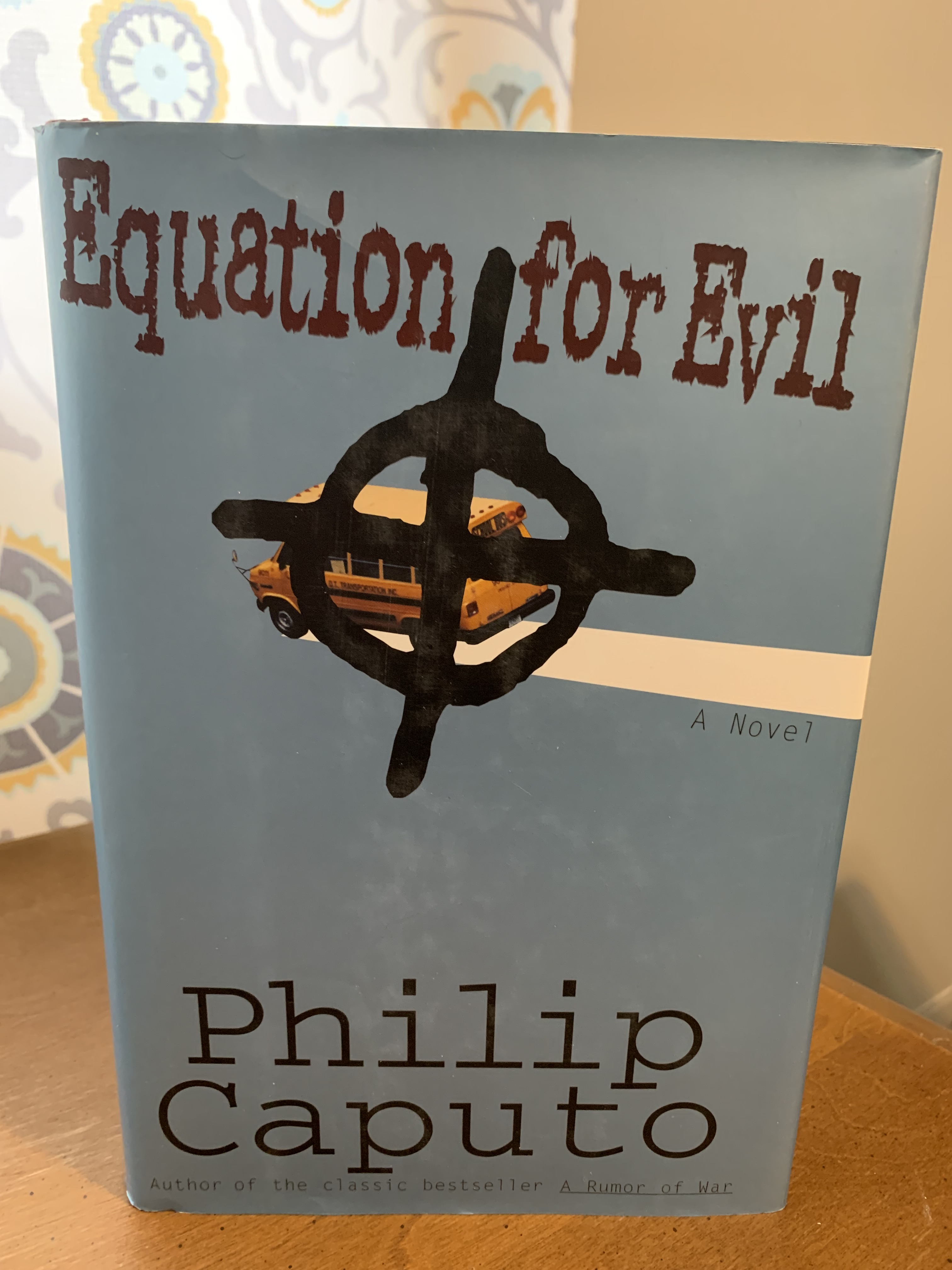
Rare is the book that spends its considerable length unearthing the why of violence instead of the who. Philip Caputo’s 1996 book, Equation for Evil, is a philosophical foray into the whydunit of evil, and its corollary, the “whycontinue” of its survivors. Caputo has more to say than that, though, writing in a time even before the ubiquity of the internet and social media causing short-attention spans, about how quickly even the most atrocious, public violence abates from the airwaves. We move on to the next thing or the irrelevant thing. Equation for Evil, which starts with the systematic targeting and killing of 14 schoolchildren and then, the “moving on” from that awfulness, seems awfully prophetic of Sandy Hook in 2012, where 20 children was systematically murdered and society writ large moved on (it’s always worth remembering that the survivors, the families, and activists did not “move on,” however). Perhaps there is something to be said for not being able to understand the “equation for evil” and thus, the fruits of evil no longer holding our attention, at least in the immediacy (obviously, true crime fascinates for a reason, though).
Set in 1993, providing the context of the Los Angeles riots aftermath and the unfolding Waco tragedy, California Bureau of Investigation Agent Gabriel Chin, a man of Chinese descent and itchy about transgressions therein (a considerable subplot of the book is the combustible racist attitudes of the early 1990s), and noted psychologist, Dr. Lee Heartwood, are brought together to figure out the “whydunit” of the school bus massacre. Why did Duane Boggs kill 14 of 26 kids on their way to a gold mining field trip? He also wounded four additional children and their adult teacher. In other words, Heartwood is doing a “psychological autopsy.” By putting together an investigator and a “headshrinker,” Caputo is a little ahead of the game of where entertainment culture would go, in my estimation. The 2000s police procedural concept saw the proliferation of such pairings, although often leaning more toward the “mentalism” aspect more so than psychology. Nonetheless, it quickly becomes apparent to Gabriel, with Heartwood more skeptical, that there had to be an accomplice with Boggs. Perhaps this accomplice was, in fact, the mastermind. Logistically, it doesn’t seem possible for Boggs to have pulled off the ambush of the school bus. Moreover, once they delve into Boggs’ character and intellect, it’s clear he just didn’t have the mental acumen to pull it off.
That’s when Gabriel and Heartwood eventually link up with Mace, a college student at the nearby state university who happens to be interested in psychologically and begins to insinuate himself into the investigation under the guise of learning from Heartwood for his thesis. In other words, Caputo doesn’t only make a whydunit out of Boggs, but a whydunit out of Mace, the actual mastermind behind the killing in a sort of Mansonian-influencing way. I like that he didn’t toy with whether Mace was the accomplice/mastermind or not (Boggs’ half-brother was considered a suspect, but ruled out fairly quickly). It was more about, how are we going to continue accruing evidence to convict him of what we only strong suspect, and how are we going to catch him before he inevitability tries again? It became a psychological chess match between Heartwood and Mace, with Gabriel more than happy to do a lot of the actual criminal investigating and vintage shoe leather police work.
Meanwhile, two subplots continue to thread around this chess match. First is Joyce DeLuca, the teacher wounded and on the mend, who wonders why she survived and how to make sense of the inanity of the evil perpetrated against her and the children. Between Caputo referencing Chekhov’s gun and DeLuca actually partaking in target practice, I thought for sure she’d factor into shooting Mace during the climax. Spoiler alert: nope. That said, I think she ultimately comes to an “answer” of sorts about how to respond to what happened to her: to keep going. Because what are else are you going to do? You defy the pointlessness of it all. You spit in the face of it and keep going. Secondly, Caputo offers interlude chapters showcasing the madness of the media (interesting since Caputo is a former journalist! Of course, I think there’s something to be said for the difference between the kinda gadflies that amass for something like this versus real journalists, but I digress …) and the aforementioned point I was making about how quickly our attention moves on from abhorrent actions. And more insidious perhaps is that the citizens of the neighborhood where it happened taking what the TV says as gospel for what occurred. “I heard it on TV,” is repeated to Gabriel by those he talks to early on in the investigation. It’s enough to make Howard Beale sick!
The story with Mace is that he was abandoned by his mother while his father was serving in the Vietnam War. He was adopted by Mormons who he detested. Later, as a college student, he was accosted by white supremacists who caused him to lose one of his eyeballs. He essentially believes society needs evil, or disorder, or chaos, in order to have, well, order. It’s not all that different from the white supremacist viewpoint: create disorder out of a fabricated race war and then be the order that builds upon the ashes. Mace just doesn’t want to get his hands dirty. He thinks he’s a brilliant puppeteer, first with Boggs and then later another guy who he hopes will firebomb a Buddhist temple gathering all religions and races in the area in memoriam of the school massacre. Like any narcissistic who thinks he’s outsmarting the police and Heartwood, Mace thinks he can not only insinuate himself into the investigation, but continue to stay one step ahead. Alas, they’ve been on to him virtually since the beginning, and as I said, quietly amassing evidence until the climactic showdown where they confront him with everything. Heartwood is the one who primarily “interrogates” Mace by elucidating his psychology; he presents the psychological autopsy of Mace to Mace! Mace realizes that they have him, so he does something he doesn’t think they’ll expect: he bolts out of the room, retrieving the gun he came in with, and then threatening to kill himself if they don’t let him exit. Heartwood doesn’t think he’ll actually kill himself, owing to Mace’s narcissism. What he didn’t expect was that Mace would shoot Heartwood, which he does. Gabriel then shoots Mace in the leg and arrests him. Heartwood dies two hours later, shockingly, which is fittingly revealed in the postlude, as someone channel surfs through their TV, where among the news of Mace’s arrest and Heartwood’s death, they watch Jeopardy, a sports game, and so on. Fitting and disturbing.
Caputo’s book was well-constructed, differently constructed than the usual crime book given it started with the crime and worked backwards, and I came to like Gabriel and Heartwood as they played a cat-and-mouse game with Mace, this despite Gabriel and Heartwood both having bad first impressions. I’d be curious to read more of Caputo’s work, which is a great reaction for a first time reader of his work to have.

 Milam's Musings