
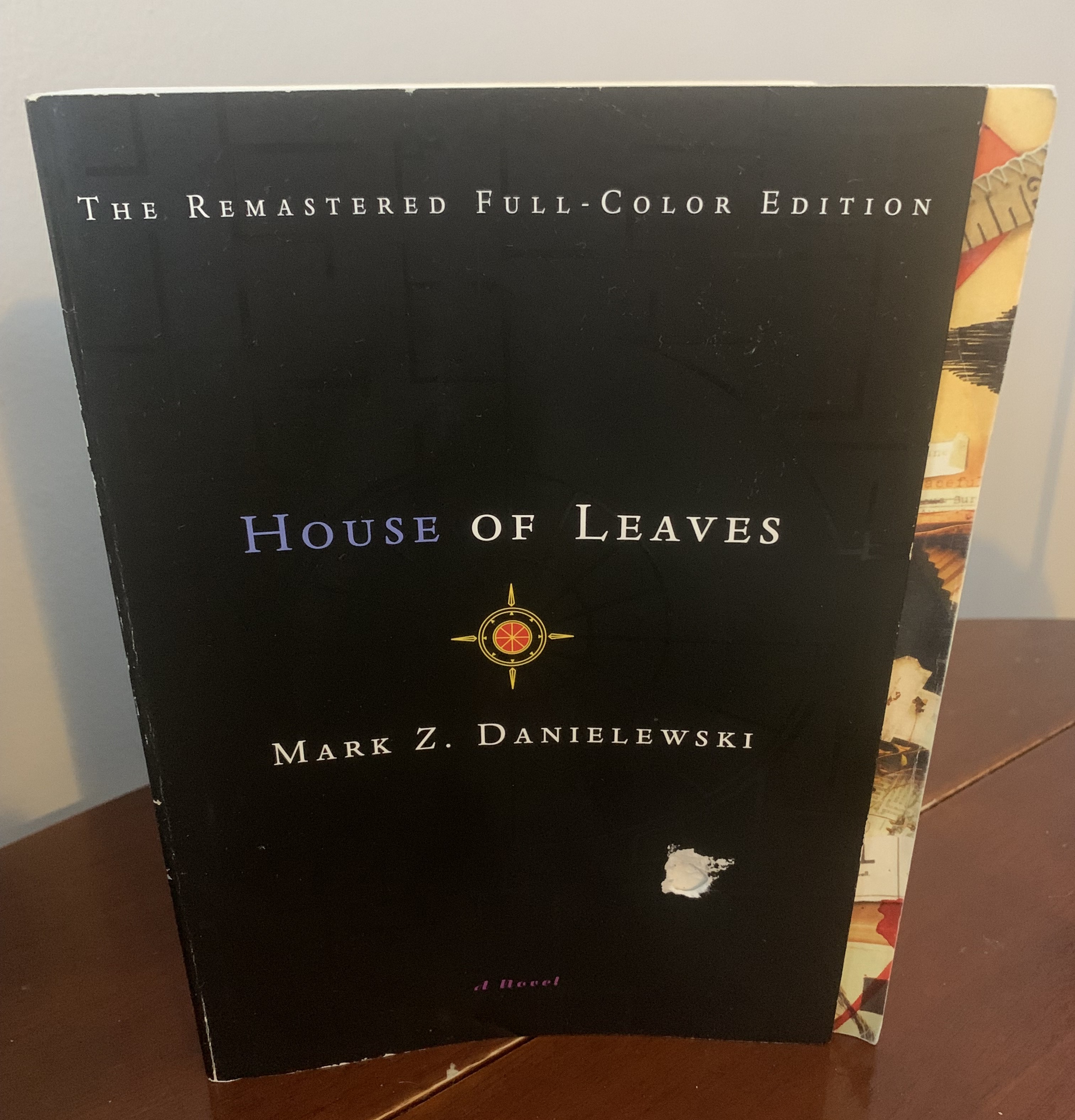
If something is infinite, is it, in effect, nothing? Could a house so constructed constitute a house? If its center is infinite, how can it be contained as such within the traditional four walls, floor and ceiling? To account for the paradox, is it the house of god without worship (although exploration makes a worshipper out of all of us)? If God is infinite, is God nothing? Or perhaps that’s thinking about it all wrong: perhaps something infinite is everything; God is infinite; ergo, God is everything. After all, to make sense of the infinite, God said let there be light. Thus, darkness, then, is synonymous with the infinite and only light brings contour and shape to the infinite darkness of existence. One final rumination in this preamble: the ultimate infinite (can there be a hierarchy of infinites?) is that which is in our mind, unassailable by the limitations of space or time. Mark Z. Danielewski’s debut 2000 novel, House of Leaves, is a mind-bending, skin-crawling foray into the labyrinthine-like horrors of the infinite darkness that seeks to encroach upon our minds. The unfilmable book (and indeed, untranslatable into E-book or audiobook) seems unreviewable, but here I am, standing athwart the precipice of nothingness attempting it. House of Leaves is unlike anything I’ve read — no, unlike anything I’ve experienced, intensely visceral, immersive, meditative, and contemplative, it’s a remarkable execution of towering vision and creativity from Danielewski. Far from a mere gimmick or a stunt, House of Leaves lures you in with the madness, and maintains you with the poetry inherent to the madness — to the human experience.
The story is a story within a story within a story. Or to quote Churchill during WWII, it’s a “riddle wrapped in a mystery inside an enigma.” The precipitating layer is The Navidson Record, a film presented as a documentary covering the lives of Will Davidson, a Pulitzer Prize-winning photojournalist and his family, wife Karen, and children Daisy and Chad. There must be some intentional irony on Danielewski’s part to write a book about a movie when his book itself is unfilmable. Nonetheless, this documentary, owing to the weirdness of everything involved, spurns thousands of articles and debate, from geologists to psychologists to academics to even Stephen King’s musings. The next layer is Zampanò, an old man who writes the story of The Navidson Record while citing extensively such articles, quotes, and insights into the documentary. And finally, there’s our main character, Johnny Truant, who takes on the herculean task of recreating Zampanò’s story after his death from a mosaic of meanderings and paperwork. Throughout Zampanò’s story, Johnny uses the footnotes to tell his own story and descent into madness. Technically, there’s even another layer beyond Johnny, as the editors of what Johnny turned in needed to have various clarifications and translations offered through their own footnotes.
So, the house. Newly moved to Virginia, Will and Karen think their new house will be the genesis of their renewal. Instead, it becomes the catalyst for their undoing. it starts with Will realizing the inside of the house is a fraction of an inch bigger than the outside, which is obviously not possible within any known laws of physics. He enlists the help of his twin brother, Tom, and Billy Reston, an engineering professor at the local university who is also a paraplegic, to investigate. But this is merely the crumb fallen from the infinite pie that is the house. Soon, they’ll find a hallway that leads to more corridors and doors, and a giant staircase that, again, is not physically possible. As they’re investigating, we get this haunting line, “His flashlight finds the floor, but no walls, and for the first time, no ceiling.” They had two miles of fishing line to help them find the way back to the “normal” part of the house and they ran out. They think the ceiling reaches 200 feet up.
What’s particularly daunting and disturbing about how the house presents itself is that:
- It changes size and scope perhaps depending on the psychology of the person who enters it, i.e., the distance of the hallway expands or diminishes, same with the staircase, etc.
- It stays at 32 degrees Fahrenheit or lower.
- There is no dust.
- There are no vents, ductwork, lights, anything normally constituting a house. In other words, from the space itself to the walls, ceiling, and floor are completely black.
- No sounds.
- Compasses do not work.
- The house “purges” itself of anything left behind.
Hauntingly, we get this line about the house and its machinations, “It knows nothing of whim.” Which is to say, it is bleak as hell and will ensure you yield to it. I should also mention there has been auditory testimony from anyone who has entered that portion of the house of a “growl.” Some wonder if that growl is a manifestation of the house’s machinations (as it shrinks or expands), or if there is an actual “monster” in the house.
When Will realizes the enormity of what they’re dealing with, he calls upon professional hunter and explorer, Holloway Roberts, and two other explorers, Wax and Jed. These explorers quickly make it to the staircase, but despite hours of toiling to reach the bottom on their first attempt, they could not. In the overall fourth exploration, Holloway seems to lose his mind hunting for the aforementioned monster in the maze, or labyrinthine, of the house. He is so paranoid and crazy, that he ultimately ends up shooting Wax. Jed heroically tries to save Wax by bringing him up the stairs. When Will and Reston are able to rescue Wax, Jed is shot dead by Holloway. While all this is going on, Tom is keeping watch by the top of the stairs all alone in the dark and cold, amusing himself with jokes and telling “Mr. Monster” he’s not scared of it. Later, we learn Holloway shoots himself. “In that place, the absence of an end finally became his own end.” Oof. To put it another way, as Zampanò quotes one person, “For whoever sees God dies.” Perhaps Holloway bore witness to God. Or perhaps something even worse, “Behold the perfect pantheon of absence.” Some suggest that hell is not so much a literal, physical space with a being known as the devil reigning over it, but rather the absence of God. The Navidson house could exemplify that perfect, horrific absence.
Will, Reston, and his family are able to make it out of the house after it seems to, for the first time, fight back against them, for lack of a better phrase. But not before Tom is killed after heroically saving Daisy by passing her to Will out of the kitchen window. Despite all that, and despite Karen taking the kids to New York City, Will decides to go back to the house. The academics and such believe his passion for the art of filmmaking and documenting is too great to yield to the madness and unknowability of the house. Passion means suffering. We also learn that Will is still suffering from the trauma of his professional high, the Pulitzer Prize-winning photo he took. It was of a Sudanese child with a vulture waiting in the wings to eat her. It rightly haunts him because the age old ethical dilemma of a photojournalist in such circumstances: get the shot, or help. Are you voyeuristic? Are you exploitative? Worse, are you complicit in the child’s death? Will never arrives at an easy answer or understanding of his role that day with that photo. Nor is he able to find any answers or come to an understanding about the house. All throughout these explorations, they’ve been collecting samples. He has those samples tested and some of the material is considered extraterrestrial and interstellar, perhaps predating the existence of the earth and even our solar system. To add another layer of madness to all this, when Will makes his last exploration into the belly of the abyss, he brings a book with him. That book? The House of Leaves. It’s the last thing he does as he’s swallowed by the blackness and the shapelessness of the house: reading the book by burning it, bringing to him some momentary light, fleeting as it is. Karen is able to overcome her fear of the house, and claustrophobia, to rescue Will, though, who doesn’t come out unscathed (frostbite, hip replacement, lost an eye, and so on).
So, about Johnny. I’m not sure what to make of him. His footnotes are often stream of consciousness philosophizing, and a foray into his unfurling madness the more he deals with Zampanò’s writings and his proximity to the house (an academic couple argues, indeed, that proximity to the house causes great distress and other maladies, even from afar). He also has unpacked trauma relating to both his mother’s own foray into madness and abandonment, as well as his stepfather’s violent abuse. Thanks to a friendship with another addict, Lude, Johnny takes a lot of drugs, and partakes in a lot of one night stands (some of which I’m not sure we should take as reliable; Johnny doesn’t strike me as a reliable narrator) before ultimately becoming a hermit in his apartment, afraid to leave, but also afraid of the darkness. There is even a throughline between Johnny and the house. The initial hallway discovery is called “The Five and a Half Minute Hallway.” When Johnny’s mother left him, it took five and a half minutes (where she may or may not have attempted to kill him to save him from the burden of living??). This edition of the book also includes The Whalestoe Letters, which is the institute his mother was staying at where she corresponded with Johnny through his foster home travails, abuse, adulthood, and her own madness and untimely death.
One of my favorite sections of the book was when Karen ostensibly (although, again, observers and academics are dubious she actually talked to these people) gauged the reaction of various intellectuals, specialists, and authors to the house, from Stephen King to Stanley Kubrick to Hunter S. Thompson. I, for one, thought Danielewski did a great impersonation of them, as it were. But also the book is amusing in its satire of the silliness at times of academia; how extensively this one source material, The Navidson Record, was mined by all manner of professionals and academics and intellectuals. Everyone had to have a piece of the infinite. And some of the academic paper titles are hilarious, thus providing a balm to all the horror. Such satire also works as a preemptive salvo against readers of Danielewski’s own book, who have surely mined it for all sorts of easter eggs, references, and meanings in the past quarter century of its publication. To that point, I could argue it would take me many more words and many more hours to ascertain some of the deeper layers of what Danielewski was doing, but then, he seems to advise against such folly. That’s good enough for me!
Nonetheless, I can’t resist wondering what a “house of leaves” means exactly, especially in relation to all of this confounding information about the house. There’s a French pastry referenced in the book known as mille-feuille, which means “a thousand leaves.” It’s a layered pastry, and I think this begins to hint at the infinite nothingness of the house: it is layers and layers of these “leaves,” so to speak. And it’s a delicate pastry, too, which perhaps speaks to how the mind of one who enters it can alter it. Another consideration is that a “house of leaves” is a metaphor for the world we inhabit. The end of the book features a series of poems. One is untitled (and a fragment), but ends with: “and this great blue world of ours/seems a house of leaves.” That is reminiscent, or echoed in my head at least (echo itself is a big theme throughout the book, by the way), or could work as an addendum, or response, of Kobayashi Issa’s “And Yet” haiku: “this world of dew/is a world of dew/and yet, and yet.” After all, in spite of what Will, Reston, and Karen encounter, they still maintain their love and their friendship. Will still maintains his passion. Will and Karen actually get married! Faced with an infinite unspooling of blackness — our mortality against the size and scope of the universe? — these characters still maintained their grounding, or were able to find it in the end, at least.
I first purchased House of Leaves at my local Barnes & Noble more than 20 years ago. I was browsing without any particular book in mind when I happened upon it. I flipped through it, quickly noting its uniqueness; it already looked unlike anything I’d ever read before. I bought it on that basis alone. I attempted to read it during study hall my freshman year of high school. I’m not sure how far I made it in, but I know I never finished. Ever since, again somehow more than 20 years ago, House of Leaves has been my Melvillian “white whale” read, — a book I’ve long had in the back of my mind hopeful I’d finally return to — which itself echoes some of the madness and the thrill (and fear) of exploration inherent to the story of House of Leaves. I included House of Leaves in my to-be-read jar for 2026 and selected it last Sunday. And now, I’ve finished it. It’s a great feeling! I’m glad to have finally entered Danielewski’s labyrinthine of a book, engaged with it seriously (and with the whimsy, too), and to have emerged from beyond the confines of the maze. But, well, aren’t we always captive to it? So long as we have minds and understand our existence on this “great blue world of ours.” It’s a house of leaves; we might as well jump into the pile.

 Milam's Musings
I was in my late teens or early twenties when I first read this, the exact right time to think it was the coolest ever. Over time I’m left to wonder, is it actually anything other than weird for the sake of weird? And is there anything wrong with that? If nothing else it’s stuck with me more than hundreds of other books I’ve read and mostly forgot about. And that’s not nothing.
LikeLiked by 1 person
Good point — even if it’s a gimmick, it’s one that lingers.
LikeLiked by 1 person