
I’ve been a fervent libertarian for all of my political life (since about 14 or 15). I didn’t have any of those flirtations with conservativism or liberalism (as conceptualized and popularly used in the United States, that is) and certainly nothing else, like socialism or communism, that other adherents to libertarianism had before converting over. Just as fervently, I planted myself firmly in the “left libertarian” side of things, or what is sometimes called “bleeding-heart libertarianism.” Or perhaps yet another way, cosmopolitan libertarianism. That is, fusionism, whereby libertarians and conservatives would work together to root out the lurch toward leftism in the U.S., was not something I ever subscribed to, especially its more insidious manifestations, i.e., ascribing to the perpetual outrage machine of conservative-influenced culture war issues, racism, anti-trans, and anti-immigration beliefs (you’ll often hear from such types, we can’t have open immigration so long as we have a welfare system). That fusionism arrived at its natural apex in 2015, as it coalesced around the most authoritarian threat to purported libertarian ideals in my lifetime, Donald Trump. In contrast, the libertarianism I ascribe to eschews such culture war issues and embraces cosmopolitanism and the belief that diversity is our strength.
Libertarians had the easiest job possible in 2015, and for the past 10 years, which was to oppose Trumpism and the authoritarianism he spearheaded. However, because of those more salient insidious features of fusionism, Trumpism trumped those libertarian principles. Charitably, you could say such ostensible libertarians entered into a Faustian bargain that Trumpism was worth the uglier parts in favor of a more libertarian-leaning judiciary or whatever other win could be gleaned. But it was never worth it. However, because of the unique threat (emphasis worth adding there since those libertarians who neither went all in on Trump or all in against Trump still failed to recognize his unique threat) Trump has posed the past 10 years, getting into the weeds on libertarianism policy prescriptions, or even a broad agitation for limited government, has fallen to the wayside in favor of the overriding concern for encroaching authoritarianism and maintaining the constitutional order (itself built upon libertarian ideals). Fusionism has enabled not only Trumpism and its accompanying lurch to authoritarian, which is to say, an increase in government power far worse than the leftist kind since it’s more personalist and arbitrary, but also will surely have the downstream effect of delegitimatizing the genuine argument for limited government long after Trump is gone. Of course, I would argue that the past 10 years are precisely the reason for limiting the scope of government’s involvement in our lives, particularly as it concerns the imperial presidency.
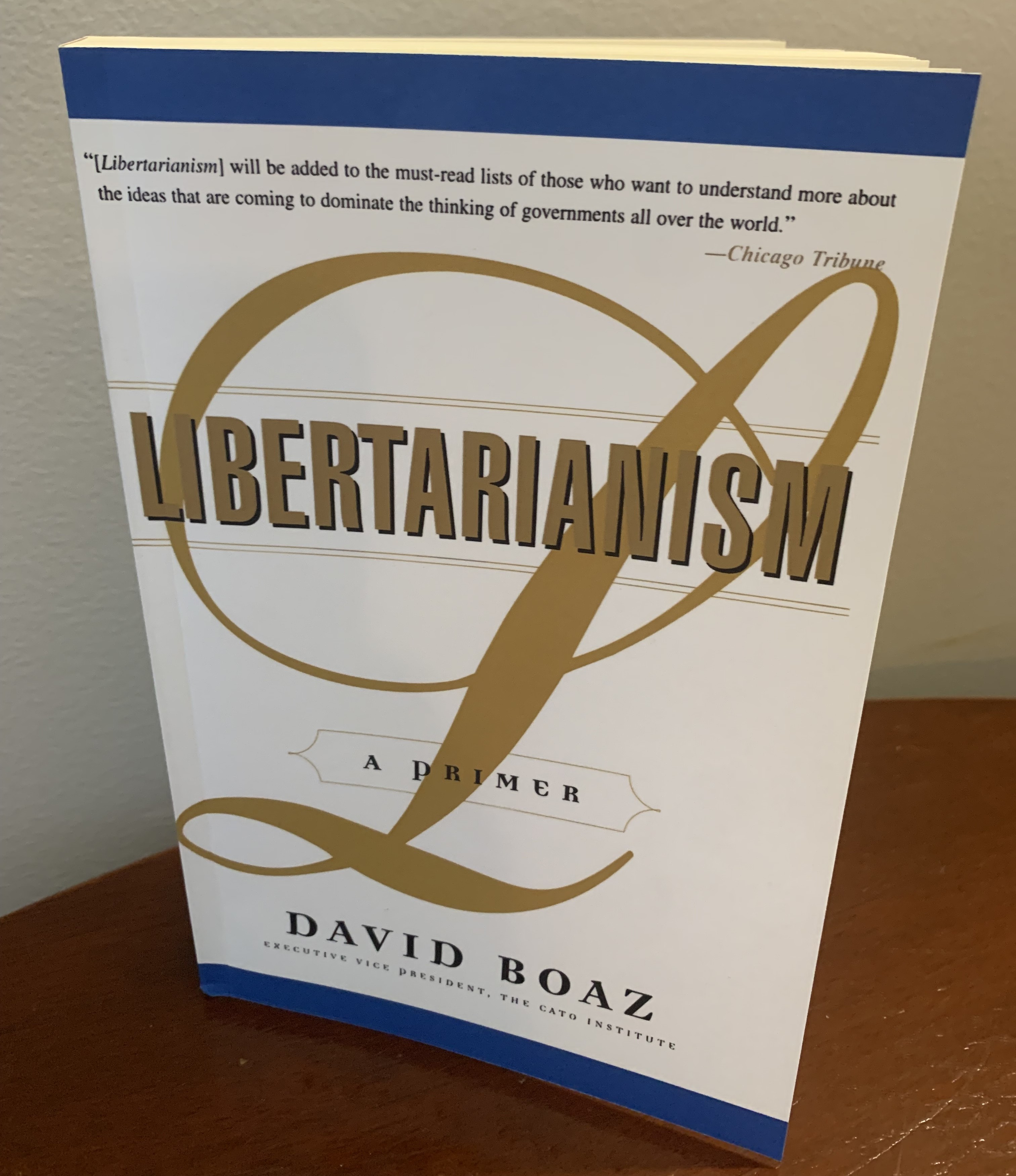
All that to say, then, it was a nice return to form — nerding out again about libertarianism’s prescriptions, as it were, for society and government — to read David Boaz’s 1997 book, Libertarianism: A Primer. I picked up Boaz’s book shortly after his unfortunate passing in 2024, mostly to show my support for the type of libertarianism Boaz represented, a kind I’m proud to align myself with. Now, obviously, I’m not Boaz’s intended target since I’m already a flag carrying (my Gadsden flag would instead have inscribed upon it, “Don’t tread on anyone“) member of the small “l” libertarian movement so as to differentiate from the often-odious these days Libertarian Party. Nonetheless, it was a nice refresher, and a nice balm to the world as currently constituted, no pun intended. Which is to say, the world that libertarianism envisions is beautiful, wherein the individual is respected as a free agent to do as he or she pleases without government interference so long as they are not harming another individual, as well as letting the free market and human cooperation flourish, the two engines best tailored to meet the demands of a diverse, dynamic, cosmopolitan world. The logic of free markets and individual rights has always made sense to me, but the aesthetic beauty of it all is resonant, too. And I think this kind of libertarianism has a lot to offer in response to Trumpism. Indeed, we already see it in waning support for immigration restrictions and tariffs, and rallying around the core issues of free speech and the rule of law. Libertarians do not have to agree with liberals, radical leftists, or even avowed socialists and communists on political issues to find common cause among a growing cohort of Americans who demand, “No Kings” in America. That is always the starting point; if we can’t agree on that much, we have far bigger problems than disagreements over routine political problems.
For the purposes of Boaz’s book, I’m going to set aside the Trump question, at least for now. So then, it is amusing, if dismaying, how salient a book written nearly 30 years ago still is in terms of the debates Americans would continue to have well into the 21st century: health care, education, crime, abortion, drugs, housing policy, the environment, and so on. In fact, there are only two areas of Boaz’s book that do not exactly age well. First, Boaz, like other contemporary thinkers of his time, assumed the crime rate would continue to go up. Fortunately for us, the crime rate plummeted for a variety of theorized reasons. That said, Boaz, unlike his contemporaries, did not call for a more robust police apparatus or other draconian policies to deal with the rising crime issue. Indeed, Boaz cites the militarization of the police as a particularly pernicious problem and calls rightly for the end of drug prohibition, a major cause of crime and violence. Secondly, Boaz starts and ends his book in a way many libertarians have: by assuming the age of libertarianism was just around the corner. (See the 2011 book from Matt Welch and Nick Gillespie, former editors of Reason magazine, The Declaration of Independents, for another example.) Boaz and other libertarians like to think the majority of Americans are unwittingly libertarian in sensibility and just haven’t found the right outlet for it beyond the two major parties. I’m not so sure of that, given if the great mass of Americans truly had such a sensibility, then they wouldn’t keep electing politicians diametrically opposed to such ideals. Furthermore, the 21st century has not been kind to the libertarian cause between the post-9/11 growth of government, particularly in its domestic security apparatus, and the rise of authoritarianism with Trump. (An area where Boaz was correct in his predictions is that Social Security would start running a deficit by 2012 (it started running one in 2010), and Medicare by 2006 (it started running one in 2004). The projected deficit for the latter was also spot-on, north of $400 billion.) In any event, Boaz’s book in 1997 is as relevant now as it was then because it’s making an overall argument about the role of government in society: it ought to be limited, and at least going by our founding document, the U.S. Constitution, it is intended to be limited. However, over the years, often after the advent of a major war, the federal government has amassed considerable power and spending money (by taxing us) to do far more than what is enumerated to it by that Constitution, often under the guise of fulfilling the Preamble’s “promote the general welfare” line.
I don’t want to do my own primer on libertarianism, otherwise I’d have written the book, but offering two ways of looking at the complexity of modern life and the millions and billions of interactions on a global scale will suffice for now. First, those interactions are made up of individual people cooperating out of their own self-interest. Adam Smith, an 18th century economist Boaz regularly quotes, is instructive here, “It is not from the benevolence of the butcher, the brewer, or the baker that we expect our dinner, but from their regard to their own interest.” In other words, I trade with you because I want what you have more than I want what I’m willing to trade with. Yes, there is competition in the market because Person B will want me to trade for his product over Person A, but both are trying to appeal me by making a product I want. But myself, Person A, and Person B are all benefitting from being in the market and trading. This obviously scales up to a global scale, i.e., if I, as the owner of a business, prefer the goods made in Malaysia that I can sell for cheaper in the United States, then I will trade with a businessowner in Malaysia. The businessowner in Malaysia will surely take that. And no, trade imbalances do not matter, contrary to what the current president thinks. I have a “trade imbalance” with Barnes & Noble because I buy their books and they buy nothing from me. But that doesn’t mean I’m worse off. Just as we understand that the butcher and the baker endeavor to create a product others want out of their own self-interest to carve out a living by making money for said product, we forget about this self-interest when it comes to public service, i.e., those who become part of the government. Surely, they are not acting in self-interest. But of course they are, just as anyone else is! That brings us to the second point and James Buchanan’s brilliant public choice theory, for which he received the 1986 Nobel Prize in Economic Sciences. The public choice theory provides a better framework for understanding the machinations of government once it’s understood that government agents are self-interested instead of acting out of the goodness of their own heart. (Public choice explains far more than the actions of some within government, to be clear.) Self-interest produces mutually beneficial results in the marketplace, but corruption, bad policy, and often negative, unintended consequences in the public sphere. The problem with the latter is one of concentrated benefits (to the government agents, their lobbyists and the benefactors of the policy) and diffused costs (all taxpayers), as Boaz explains. People often assail the free market for being a dog-eat-dog world over a finite pie. But that is precisely what happens in the public sphere: a lobbyist-eat-lobbyist world over a finite pie (taxpayer dollars), which then causes strife among the citizens as some groups are favored and others disfavored. Much of what animates voters is not these wonky policy discussions or waxing philosophical over the proper role and function of government, but culture war issues. Boaz rightly argues that those culture wars issues are exacerbated by the improper size, scope, and actions of government. If government removed itself from various spaces, it would lessen the tensions around those issues. (Also, in the free market, there is no finite pie; we’re wealth-creators and there are as many “pies” as our brains can conjure up. Or to put it another way, Bill Gates having a net worth of $107.7 billion does not make me poorer.)
What do libertarians like Boaz think the government ought to do? Well, what is enumerated in Article 1, Section 8 of the U.S. Constitution, but in a more bite-sized way, to protect individuals from harm or fraud perpetrated by other individuals. In that way, the rule of law is important to the libertarian framework and the contract-base of the free market. Unfortunately, as he quotes Thomas Jefferson, “The natural progress of things is for liberty to yield and government to gain ground.” Which is where I would make the argument that government is not a necessary evil therein, but I digress. No, Jefferson’s point is apt. Despite the unbelievable rise in the standard of living and life expectancy of the Western world after the Industrial Revolution, the turn of the 20th century saw a reversal to the old order of big government involvement (and to the death of millions when you start talking about Hitler, Stalin, Mao, Mussolini, etc.). Boaz wonders why that was the case. He argues perhaps people became too comfortable and took the new order of liberty for granted. Arguably, the same happened in the late 1990s and especially in the Trump years. To put it in the terms of political scientist Francis Fukuyama, Americans got bored, so they elected a madman president, twice, to disrupt and tear down the order that has provided Americans with unprecedented peace and prosperity for decades. (A quick point on that. Boaz addresses how it is that we could have such a period of peace and prosperity if the government is too large and to meddlesome. He argues that our peace and prosperity is largely due to circumnavigating the largesse of the government, not because of it. That might seem like a sleight-of-hand argument to some, but I do weigh heavily upon human ingenuity. America has just has such a robust civil society, which encompasses more than charities and mutual aid societies, that it’s difficult to stymie writ large, and which, it should be noted, is also a bulwark against a full-on authoritarian takeover.)
What I appreciate about libertarianism, too, is that it’s actually a very humble framework. For one, unlike other political philosophies, it is not promising a panacea, only that libertarianism offers the best way forward for peace and prosperity that honors the dignity of each individual. Secondly, it is humble in that it doesn’t assume the ability of a cadre of people to plan an economy or the overall state. Without even getting into the problem of concentrating so much power into so few hands, libertarianism says the spontaneous order of the free market and individuals cooperating together has produced this unprecedented wealth and abundance. Nobody centrally planned it, just as nobody sat down and centrally planned out our language or our laws. Libertarianism is a philosophy that rightly acknowledges how much any one person or group of people calling themselves the government can’t possibly know or foresee, and are appropriately hesitant to give such people power in response. This also goes back to the advantage of the contract-based marketplace. As Boaz notes, “Contracts enable us to make long-term plans and to carry on business over a wide geographic area and with people we don’t know.” It creates a system of trust. To go from a society where largely that circle of trust only extended to members of our own family, or perhaps the village in which we resided all our lives, to a global scale, is as, Boaz says, “one of the great advances in civilization.” Contrast that with the current Trump administration, where businesses and leaders the world over don’t know what the president is going to do from one day to the next (indeed, he declared global tariffs at 10 percent on Friday, and raised them to 15 percent by Saturday).
A few other miscellaneous notes from Boaz’s book that don’t fit neatly into a narrative structure:
- The point of the economy is not to create jobs, although this is certainly the preoccupation of politicians at the behest of voters. Boaz says the point of the economy is to produce things that people want. After all, as he quotes economist Richard McKenzie, we could create 60 million jobs tomorrow if we outlawed farm machinery. But would that be a good idea? Of course not. Consider, especially as people worry about artificial intelligence eliminating jobs, that about two-thirds of all jobs created at the beginning of each century since the start of the Industrial Revolution were eliminated by the end, yet three times as many people were employed. As an example, in the 1880s in the U.S. and Britain, 60 percent of the workforce consisted of agriculture, domestic service, and jobs related to horse transport. Today, only 3 percent of the workforce are in those occupations. In other words, new jobs we couldn’t even conceive of in 1880 were created, and we also produced more (food) with less (that aforementioned farm machinery). Will that be the case with AI? It remains to be seen, but history and economics says yes.
- Boaz mentions a few items he would cut to reduce government spending, and I think liberals will be heartened to know the first three he listed are ending corporate welfare, farm welfare, and halving the defense budget. (My hottest of takes is that if there is any fusionism to be had, libertarians have more areas of agreement with liberals than we do conservatives.)
- On the other hand, liberals will certainly disagree with the notion of privatizing education, or at minimum, offering school vouchers. At the very least, can we agree it is absurd that our education system is based on a 200-year-old agrarian society model that we no longer occupy?!
- There is considerable consideration given to environmental issues by Boaz, but I’ll just say here, that richer, capitalist countries take better care of the environment than poorer, socialist countries.
- While Boaz acknowledged that he couldn’t possibly touch on every policy issue in the book (it’s only a primer, after all), I do wish he’d devoted some space to immigration. The same principles that underwrite why it’s fallacious for the government to interfere in free trade is the same argument for allowing immigration. Add in that the government shouldn’t interfere with who I want to hire nor should the government stop me from migrating to where I want to, so long as I’m a peaceful individual.
Overall, the true starting question for how to think about our relationship to the government is this question: Who owns your body? If it’s you, then why should the government be able to stop you from doing all manner of activities that it currently does stop you from doing, on the threat of imprisonment, when you’re not harming anyone else? The same applies to the property in which you justly own. Even if there will surely be disputes that arise from all such a starting position initiates, that is for courts (and sometimes even private arbiters) to undertake versus making it an edict for a country of 342 million people.
I would be curious how people of any political persuasion answer Boaz’s questions in the Appendix (“Are You a Libertarian?”)
Do you agree with the following:
As long as I respect the rights of others, I should have the right to:
- Read whatever I want to — even if it offends others in the community.
- Choose the medical treatment I think is best — even if it’s risky.
If you said yes, like I did, that doesn’t mean you then endorse a “particular religion, moral code, pornography, or hate speech.” It merely means none of those areas are the proper domain of government.
Let’s go again.
As long as I deal with others honestly, I should have the right to:
- Earn more money than others even if I don’t contribute money to charity.
- Leave my wealth to my children even though other children will be born with less.
A bit more controversial, especially for my leftist friends, but again, I would say yes to both because it’s my money.
The body ownership question applies to a great many other questions Boaz presents in his “Are You a Libertarian” quiz, but suffice it to say, I would find it utterly bonkers for the government to tell someone they have to serve in the military (and face potential death), or to be told they could not buy the foreign car they want, or engage in a homosexual relationship, or pay subsidies to farmers (often big corporate farmers at that). And yet, in all those areas, the government has previously and/or continues to constrict or coerce individuals.
Life is all about trade-offs. Unfortunately, with government, we tend to not see those trade-offs as clearly (see: Frédéric Bastiat’s broken window fallacy). Whether it’s conservatives or liberals, Republicans or Democrats, the far-right or the far-left — and it should be noted, humans are far too complex and dynamic to easily fit into those categories — the one throughline they all tend to share is agitating for some level of government involvement in our personal lives and our economic lives (and as Boaz cautions us, separating the personal from the economic is a false choice since my economic choices are personal and many personal choices involve economics), those unseen trade-offs and negative unintended consequences be damned (although now we are in an age where cruelty is the point, so perhaps those consequences are intended).
I’ll close with two more points. First, the world, despite our current situation with Trump and democratic backsliding and other issues beyond our borders, is far better now along many metrics than it has been for most of human history. People ought to recognize that and not take it for granted, either. Secondly, a better world still exists, one that is more respecting of individual rights and our inherent dignity as human beings. It will take ridding ourselves of the yoke of authoritarianism and its attendant cruelties and corruption, but also, once we’re back to the baseline disputes about the size and scope of government, recognizing that the answers to our social problems reside within us: our human ingenuity, cooperation, need for community, and the division of labor that gives rise to beautiful spontaneous order. Unleashed and uninhibited by concentrated power dividing us, there is nothing human ingenuity cannot solve.

 Milam's Musings