
Spoilers!
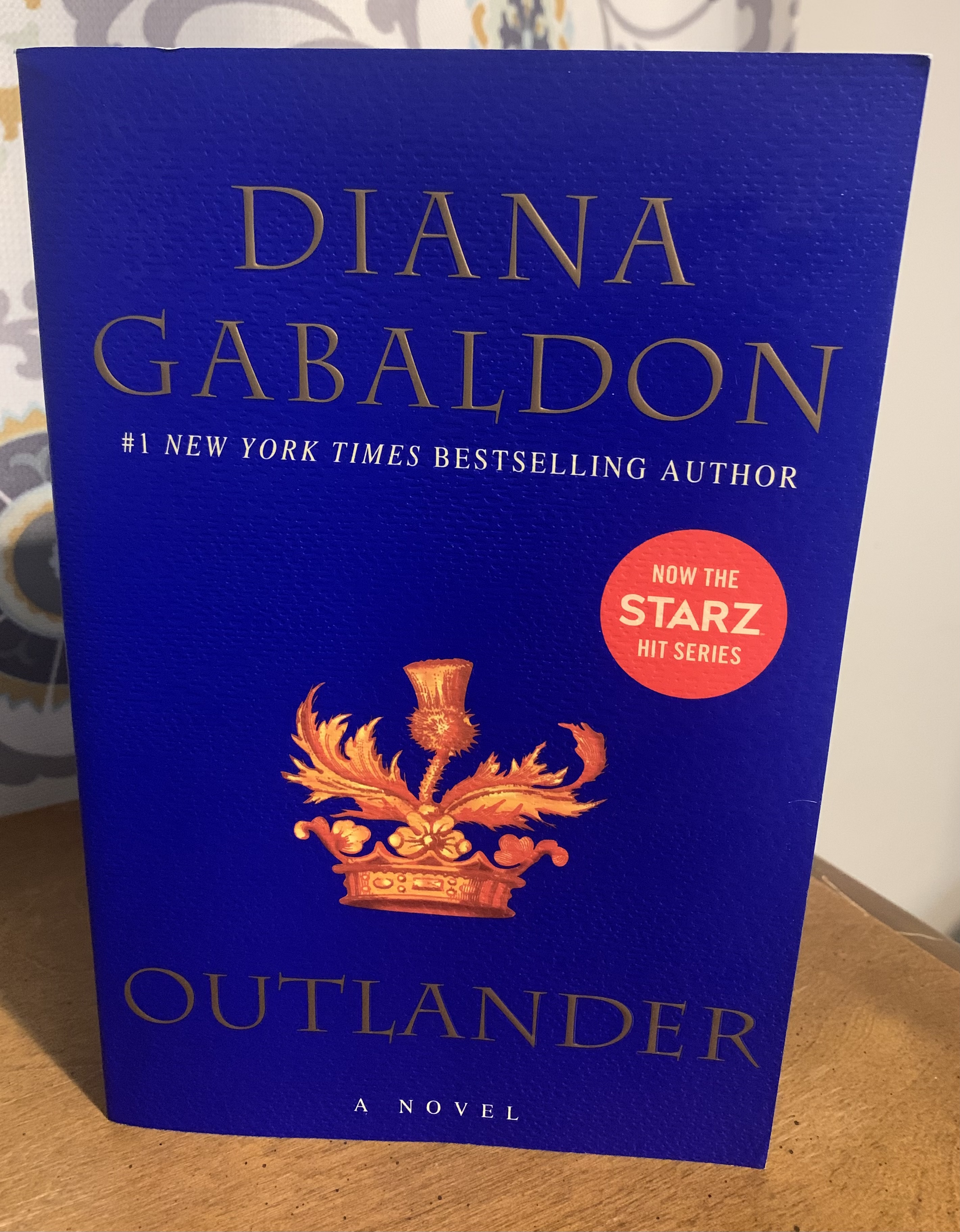
They say true love comes once in a lifetime, but what if you could find another true love in a different lifetime? That’s what happens in Diana Gabaldon’s 1991 book, Outlander, which kicked off the 10-book series and was later adapted into a Starz TV series. Gabaldon’s historical fantasy novel situates its characters on the precipice of the Jacobite Rising of 1745 to restore Charles Edward Stuart’s father, James, to the throne in England. But that is mostly historical context; the real thrust (heh) of the story is more romance than historical, more steamy than fantasy. It was an enjoyable read, albeit, perhaps one not likely to thrust me into the rest of the series.
Claire Randall, an English combat nurse coming off the heels of WWII and exploring the Scottish Highlands with her husband, Frank Randall, appropriately a history professor, travels through time after touching a Stonehenge-like stone upon a hill. The stone takes Claire back in time to 1743, where she so happens on Captain Jack Randall, Frank’s ancestor and a Redcoat. Unlike his reputation in 1947, the 1743 real-life version of Jack Randall is that of a psychopathic sadist. Luckily for Claire, she’s rescued by a highlander who brings her back to their clan, which turns out to be the Clan Mackenzie. The Clan includes Jamie, a beast of a man who fits the image you’re probably imagining upon reading the word “highlander.” The notable fact about the Clan Mackenzie, other than Jamie, is that they are likely to join in the Jacobin Rising.
Thanks to some of Frank’s history monologues and explaining genealogy to Claire, as well as her own industriousness and ingenuity, she’s able to get by in 1743 after realizing she’s in 1743. Nonetheless, Claire is seen as a Sassenach, or English person, or as the title indicates, an outlander. Indeed, the Chieftain of the Clan Mackenzie worries that she might be a spy. Randall, who is still chasing after Claire, and for that matter, Jamie, too, also sees Claire as a potential spy, or at least, a troublesome unknown.
Claire’s first interaction with Jamie is to put her nursing to the test by healing a musket ball wound to his shoulder. That’s only the beginning of the issues Jamie will face throughout this book (and that we learn of from his past); the poor lad takes quite a beating, but he has the “heart of a lion,” as his family and friends state. Or more accurately, I think, he’s analogous to Job, which is his favorite book of the Bible, not so coincidentally. Over time, and then through necessity to ensure Claire does not fall into the hands of Randall and the Redcoats, Claire and Jamie fall in love. He has also taken to affectionately calling her Sassenach. They are wed. Yes, despite Claire not being of this time and being wed to Frank, she weds Jamie as a way of surviving her “new time.” There are even witnesses to ensure they consummate the marriage, which they do many times. Despite this, Claire still has in the back of her mind to make it back to that Stonehenge-like stone to make it back to her time. At one point, when she attempts to, she’s abducted by Randall, and consequently rescued by Jamie, who then beats her severely for disobeying him (Jamie told her to stay in a certain hiding spot for her safety and instead, she tried to make it to the stone). Of course, Claire eventually forgives him for beating her severely and acting as you’d suspect a man in 1743 would. Ugh.
The short of it, again, is that it’s 1743. A half-dozen times or more, Claire is either threatened with rape or rape is attempted upon her. Then, after becoming friendly with a woman known as Geillis, who is thought to be a witch by the local village, the two are arrested and put on trial on suspicion of being witches. Geillis decides to sacrifice herself to save Claire, where Claire learns that Geillis has a smallpox vaccination like she does. In other words, Geillis must also be a time traveler. (Geillis was also trying to ensure the Jacobite Rising by stealing money from her husband and eventually killing him.) So, to reiterate, Claire’s been threatened with rape verbally and physically, almost burned as a witch, and in general, it’s 1743, which while not 2026, I would still take 1945 over 1743! There’s no antibiotics, no vaccines, no germ theory, no indoor plumbing, and so forth that I could go on about. In addition to all that, it’s not as if Claire and Jamie would live comfortably, inasmuch as one lived comfortably in 1743, because Jamie is an outlaw and a fugitive. They’re constantly on the run and face certain capture, rape, and death.
Okay, I set the table. Despite all of that, because of her love of Jamie, Claire decides to stay in 1743, even after Jamie takes her to the stone and is willing to let her go. She doesn’t return to Frank and 1945, and instead runs back to Jamie. Jamie takes her to Lallybroch, his estate left for him, where they meet Jamie’s sister, Jenny, who is a great character able to stand up to her stubborn bear of a brother. Like with the Clan Mackenzie castle scenes at the beginning of the book, a lot of domesticity ensues, including Jenny having a baby. While on the road at one point, Jamie is arrested by the Redcoats and sent to an infamous prison slated for certain hanging. Claire, with the Clan Mackenzie helping her, as well as Jamie’s loyal godfather, Murtagh, works to break him out. During the attempted breakout, Randall shows up, because of course, and threatens to rape Claire (there’s that is again!) if Jamie doesn’t offer himself up instead. So, Jamie does, and gives his word not to offer any resistance. It should be noted that when Jamie was much younger, he was brutally flogged by Randall, flaying his back something awful. What he does to Jamie in the dungeon of the prison is much worse: he does flog him once more, yes, but Randall also repeatedly rapes him. The things Jamie goes through in this book are unimaginable.
After leaving the prison, Claire runs into Sir MacRannoch, who tried to court Jamie’s mother and therefore, he has enough affection for her son to help Claire, along with Murtagh again, to save Jamie from hanging. They do, but Jamie is near death. As they escape to a monastery in France, Claire kills a young Redcoat, which she feels guilty about. She also begins to worry that she’s deleteriously affecting the future. It seems like Jamie will die at the monastery from his many grievous injuries and infections, but with the help of Claire and the monks, he survives. At the end of the book, they have sex in a hot spring under the Abbey and Claire, who thought she was barren, realizes she’s pregnant.
What happened to Randall, though? One of my biggest book gripes! Randall is the despicable villain of the book, who perpetrated such awfulness to Jamie and threatened as much to Claire, that as a reader, you’re waiting for that triumphant moment of his comeuppance. It does not come. When MacRannoch helps Jamie escape the prison, he does so by bringing his cattle into the prison to cause chaos. The cattle trampled Randall to his death. That was his comeuppance and it happened off the page! We heard about it after the fact. That’s one of my biggest book pet peeves. While I am not sure there’s any level of comeuppance that can bring justice to torture and rape, at least have it attempted and on the page!
Outlander was a book with such a fascinating premise. What if you accidentally time traveled 200 years into the past? And while there is no safe time for a woman to travel into the past, it’s particularly dangerous to do so at a time when there is repeated uprisings against the English crown and amid the warring clans of the Scottish Highlands. But a lot of the book was instead focused on the romance and the day-to-day domesticity of Claire’s new 18th century life. I’m fine with the romance angle because you expect that to happen and I think that is what adds to the “fantasy” of it all (a hot highlander with big muscles protecting you and willing to die for you and constantly bedding you) — surely why these books are so popular and enduring! — but it’s hard for me to accept someone willing to stay in 1743, even accepting the irrationality of love and lust. And like I said, there were long stretches where I was waiting for the next big story beat to happen or to return to the fascination of the time travel aspect. Some of the best scenes were toward the end at the Abbey with Claire contemplating time travel, God, sins, what we owe others, and so on. If the book had more of that, and was perhaps a couple hundred pages shorter, I would have liked it better, Claire staying in 1743 notwithstanding.
In other words, I just don’t know what to make of Outlander! After all, Gabaldon’s 628-page book compelled me enough to read it, but I also can’t say I was enthralled the entire time. Perhaps that was because I wasn’t enthralled by Claire and Jamie’s romance, particularly after Jamie beat her severely. Gabaldon did a heck of a job making me sympathize with Jamie, especially as juxtaposed with Randall, but I couldn’t see beyond that beating. So, ultimately, here’s where I’ll come down on the book. I’m glad I read Outlander, and it made me intrigued about the real world history, but I don’t think I’ll continue on with the series. However, I also think a great many people who enjoy romantasy will enjoy this book that was romantasy before the term was popularly coined.

 Milam's Musings