
Spoilers!
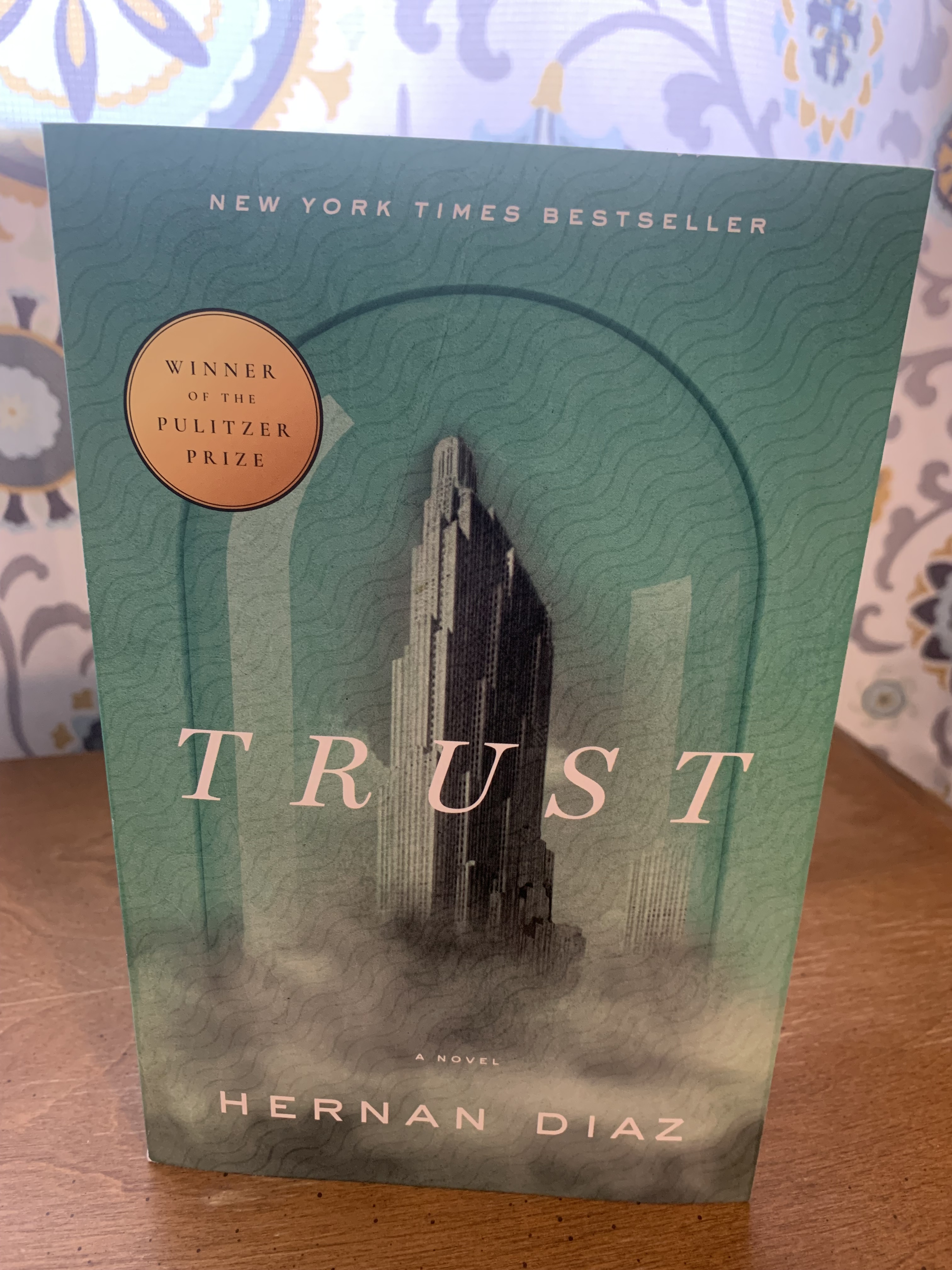
Who we are is edifice upon edifice erected within museums and mausoleums — that which we want others to see, that which we want ourselves to see, and that which is. Untangling that is the work of relationships, of living, of growth. In the case of the so-called “Great Men” of history, it’s the work of historians and academics (accepting, of course, that such a throughline of history makes explanatory sense). Hernan Diaz’s 2022 Pulitzer Prize-winning book, Trust, digs through the edifice of history and the artifice of the characters within it to uncover the truth that could have brought it all down upon itself. It’s not so much that truth itself is flimsy or illusory; it’s that which tries to obfuscate it that is. Diaz’s book, a cleverly designed work of fiction within fiction, is one of the best books I’ve read this year, or any year.
Trust is told through four fictional books by different “authors” about the same couple: a rich financier and his wife in 1920s and 1930s America.
Bonds is the first book by Harold Vanner and it centers on the fictional Benjamin Rask, a somewhat reclusive, introverted mathematical genius that somehow manages to stay one step ahead of the stock market and other financiers to ride out the tumult, particularly the 1929 crash that led to the Great Depression. His wife, Helen, a prodigy in her own right, uses the money on philanthropic and artistic endeavors until she goes mad with melancholy and is institutionalized. No amount of money or threats from Rask can save her from inevitable decline. Vanner’s (Diaz’s) depiction of Helen going mad is haunting: “Her face was a desolate ruin. A thing broken and abandoned, exhausted of being. Her eyes did not look at Benjamin but seemed to be there only so that he could peer into the rubble within.” Wow. Rask implores the doctors to try their experimental convulsive shock therapies, but Helen dies. In Vanner’s telling, Rask and Helen comes across as a good match, if not exactly a loving marriage, it’s one where their need for solitude match up well. Still, after Helen’s death, Rask is never quite the same.
My Life by Andrew Bevel is an unfinished and unpublished autobiography by the author of his life as a financier and his wife, Mildred. It’s Bevel’s attempt to correct Vanner’s fictionalized version of his life, most especially, as he states, the characterization of Mildred having gone mad and dying in such a manner (him foisting experimental treatments upon her). Rather, she died of cancer. Unlike the Rask of Vanner’s novel, Bevel is far more outward-facing, at least in his verbose and grandiose defenses of himself. He typically couches his financial machinations within the realm of the “public good.” (I could spend another 1,000 words talking about the irony of Andrew railing against government regulation into the market while also welcoming government tariff measures without a hint of cognitive dissonance.) Since it’s an unfinished and unpublished account, Diaz leaves parts in this section where Bevel intended to add more detail or “color,” like about his wife’s homely touches to their mansion. In Bevel’s telling, Mildred is not so much a prodigy as she is an infantilized side character amid his sweeping financial success. He supported her philanthropic efforts and musical interests despite not understanding them. He ostensibly doted upon her and yet, reserves most of his details for his personal success and defending himself against a public who has come to see him as a vulture and for having “lost a step.”
A Memoir, Remembered by Ida Partenza is a fascinating memoir told 50 years after she worked as a secretary and ghostwriter for Bevel on the aforementioned My Life. We learn how much Bevel wanted her to embellish and indeed, color, the details of his and Mildred’s life, so much so that he superimposed a memory of Partenza’s — retelling mystery whodunits to her father at the dinner table and him trying to guess the killer — as something he and Mildred did. But her memoirs also serve as an interesting window into her relationship with her Italian anarchist aloof father, who most certainly did not approve of her working on Wall Street. Over time, Partenza takes on the side quest of learning more about Mildred for surely Bevel is not telling the whole story about her. She finds Futures, which is Mildred’s diary during her last days at a Swiss sanatorium before her untimely death. In Futures, we learn that it’s Mildred who was the whiz behind Bevel’s success. Indeed, their relationship was more a business relationship than it was a marriage, with Bevel as essentially the face of the stock market success since Mildred could not be, owing to the societal mores of the time. How convenient then that in Vanner’s fictionalized version, “Helen” is rendered a woman who lost her mind, again owing to stereotypes of the time that a prodigal and brilliant woman is not possible, rather she must be mad, and in Bevel’s telling, Mildred is relegated to the shadows and the daintiness of flowers, or the philanthropy, the expected “hobby” of the financier’s wife.
I was enthralled by how these four “books” came together to bring one narrative forward, and how Diaz was able to write from the perspective of each author with such a distinctive voice. And of course, there’s overarching narrative within the fiction of the fiction. Yes, we’re getting the fiction of the Bevels and the true story of the Bevels, but there is also the overall story that Diaz himself is trying to impart from his vantage point. In other words, while we’re enthralled by the way Diaz weaves through each edifice and artifice until arriving at the truth, he’s also telling us something. What is Diaz telling us? Returning to Vanner’s depiction of Helen going mad (“a desolate ruin”), what one can infer knowing what happened with the true Mildred, I think there’s something to be said for women turned to hollow husks by the mores of the time that demand they be nothing more, rise no further, certainly not to the skyscraper-as-extension-of the Great Men of history. Worse still is that when these “great men” are made by even greater women, as Bevel was by Mildred, he’s deluded himself into thinking women ought to be sidelined (the aforementioned ways in which we erect artifices even to ourselves). In one passage of his autobiography, Bevel bemoans women entering the stock market boom of the Roaring Twenties. He talks about them going from 1.5 percent of the speculators to nearly 40 percent, commenting, “Could there have been a clearer indicator of the disaster to come?” Financial successes (of Mildred’s making): the result of an ingenious man; financial woes: the fault of stupid women who are better served reading Ladies’ Home Journal rather than the Wall Street Journal. The truth is, the Great Men of history theory of analyzing history predominated (and sometimes still holds sway) because a.) it wasn’t thought possible for women to change history; and b.) women often weren’t allowed to change history. All the riches of the world does not mitigate the ruins (Helen, or Mildred) left in its wake. The truly hollowed husk is Bevel; the edifice of his ego is too insurmountable to allow him to notice it, though.
Diaz’s book, as it traversed four different “books,” had impeccable flow: taut, but with depth, and compelling, even when Bevel waxes pedantic about finance. Everyone owes it to themselves to read Trust. I feel I cannot entirely do my reading experience or my thoughts about it justice.

 Milam's Musings