
Spoilers!
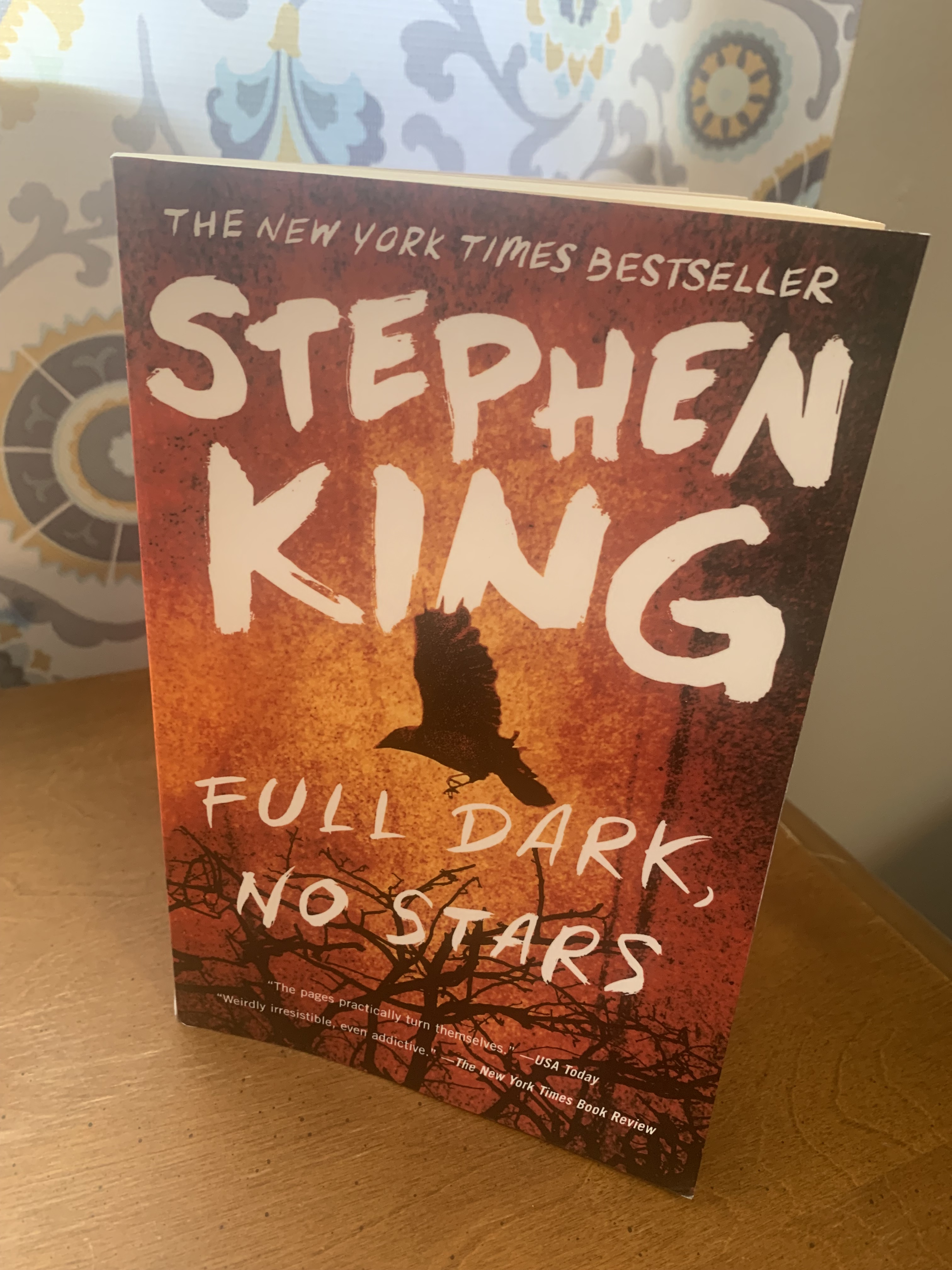
What makes fiction reading so interesting, and often times harrowing and horrifying, is reading the stories of ordinary people thrust into extraordinary circumstances — very real scenarios in our world of human monsters — and seeing how they react. Stephen King agrees! At least according to the Afterword of his 2010 collection of short stories, Full Dark, No Stars, where he writes, “If you’re going into a very dark place, then you should take a bright light, and shine it on everything.” Across four stories, “1922,” “Big Driver,” “Fair Extension,” and “A Good Marriage,” King brings us into the dark and imbues his protagonists with the light to find their way, and us, the Constant Reader, back out. Also, as King says, and his writing has long attested to, including here, he believes fiction should be propulsive and assaultive; it should “get in your face.” Agreed, as I like a story that makes me feel unmoored and uneasy. King’s short story collection is certainly propulsive and assaultive, but with enough light on the darkest corners of humanity to try to make sense of it all.
“1922” is about a Nebraskan farmer, Wilfred, in the summer of 1922 who doesn’t want to sell his wife’s, Arlette’s, 100 acres she inherited from her father to a large commercial hog company. So adamant is he about this, that he convinces his son, Hank, on the threat of them having to move to Omaha and away from his girlfriend, Shannon, to help him kill Arlette. While she’s drunk and asleep, Hank puts a burlap sack over her head and Wilfred slits her throat multiple times. It’s messy and chaotic. They then dump her body into a well they don’t use anymore; after which, they dump an old cow down on to her and fill it with cement. The story is told through a confession-style letter by Wilfred eight years after the fact. King didn’t say it in his Afterword, but I was already thinking this was King’s modernish retelling, or attempt at telling, Poe’s “The Tell-Tale Heart.” In this case, the heartbeat is symbolized by ferocious, tenacious rats that haunt Wilfred. He sees them everywhere. He’s certain they’re the mere minions of Arlette enacting her revenge. Fortunately for Wilfred, it being the time and place he’s in, nobody (save the hog company’s lawyer) suspects him of killing Arlette or that his story of her absconding from the farm is dubious. Hank takes the newfound confidence (or liberation, as it were) at having helped kill his mother to actually abscond from the house to chase after Shannon. You see, he got Shannon pregnant, which caused her father to send her away to a Catholic boarding house where the child would be born and adopted out. Hank intended to, well, abort that plan. Through Arlette’s ghost whispering to him, or rather prophesizing to him what is to happen, Wilfred learns that Hank became a bank robber to fund his impending fatherhood, and then when he helped Shannon escape the Catholic boarding house, the pair became something of a Bonnie & Clyde until a diner owner shot Shannon to death and Hank turned the gun on himself. In the end, Wilfred loses the farm he so staunchly, and with deadly defense, protected, and ends up in a hotel in Omaha after all, where he thinks he’s bitten to death by rats. Instead, we learn he bit himself to death. Oof.
“Big Driver” immediately reminded me of the rape-revenge film from 1978, I Spit on Your Grave, which incidentally was remade the same year King’s collection came out. But there’s a lot of films in that subgenre, and King’s main character, Tess, cites them and is inspired by them: 1972’s The Last House on the Left (which also was remade in 2009) and Jodie Foster’s The Brave One from 2007. There’s something weirdly cathartic, I suppose, about watching these types of films. One of my favorites is 2017’s Revenge. Anyhow, I’m jumping ahead. Tess, a successful author of the Willow Grove Knitting Society books, is asked to make a somewhat impromptu, last-minute trip to a library in Massachusetts to do a Q&A and autograph session. She agrees, enjoying the drive. After the innocuous event, the librarian, Ramona Norville, provides Tess a shortcut to avoid Interstate 84. She takes it, but drives across a bunch of wood with nails jutting out of the pieces seeming to deliberately have been left in the roadway causing a flat tire. A long-haul trucker stops to help her change the tire, and then in that propulsive, assault King way, the trucker turns malicious instantly, threatening to rape Tess. He knocks her out and she comes to being raped. He leaves her for dead in a culvert. She’s not, though, and manages to find her way to a nearby bar to call for 24/7 limo service she’s previously used. She makes it home to her feisty cat and decides that she’s not going to divulge what happened to her. It may be deleterious to her career, and she’s ashamed. Thanks to an employee named Betsy at the bar, she learns her vehicle was taken to that bar (the trucker did actually change the tire). Through an ensuing conversation with Betsy, Tess further learns that her rapist goes by “Big Driver” and owns a trucking company with his older brother. More sleuthing uncovers that Ramona is his mother and most assuredly steered Tess toward her rapist son. Inspired by the aforementioned movies, Tess decides to become a vigilante and seek revenge upon the Big Driver. She shows up at Ramona’s house first and kills her after a confrontation. Then, she shows up at what she thinks is Big Driver’s house, but learns it’s the brother’s house only after killing him. She feels guilty about that because what if he didn’t know? Then, she continues on to Big Driver’s actual house where she surprises him watching TV and kills him, too. All three deaths happened fairly easily. Afterwards, she almost considers killing herself, but the voices in her head convince her to search for evidence ascertaining the older brother’s guilt. When she finds her purse in his house, she assuages her own guilt. The loose thread in it all is Betsy, but Betsy reveals that she, too, was raped (by her stepfather) and won’t tell anyone about what Tess did.
“Fair Extension” is the shortest of the four novellas and the only one I believe set in King’s fictionalized Derry, Maine. Dave Streeter is dying of cancer. While out driving, he finds an airport vendor (airport vendors in King’s life inspired this tale), George Elvid, whose last name I only just now realized is an anagram for the devil. The devil offers extensions, whatever sort of extensions one is seeking. For Streeter, he’s seeking to live longer, obviously. However, in order to provide the extension, the devil needs not only 15 percent of Streeter’s income annually, but to transfer the “weight” of Streeter’s misfortune to someone he knows. It can only be someone Streeter hates, which turns out to be his “best friend,” Tom Goodhugh. Streeter, who has a loving wife and happy, successful children, rationalizes his hatred of Goodhugh by the fact that the latter took his high school girlfriend. She was also pregnant with Goodhugh’s child. Since then, and thanks to Streeter’s influence at the bank, Goodhugh is a millionaire, still good looking, and his three children are on the verge of success. After Streeter’s deal with the devil, his cancer goes away, of course, but also, his two children make it big. For Goodhugh though, the Job-like tragedies begin to pile up. First, his wife dies of breast cancer. Then his business goes belly up after someone embezzled money. His 20-something child, Carl, has a heart attack and suffers permanent brain damage until he chokes to death years later. His oldest child, Gracie, loses her husband to a drunk driver, her child is born dead, and she suffers from pyorrhea, losing all her teeth. His other son, Jake, who was on a fast-track athletic scholarship nearly kills his girlfriend and goes to prison. You would think all this misfortune would cause Streeter to reassess his deal with the devil and indeed, regret it. Nope, not only does he enjoy everything that befalls Goodhugh, he’s there every step of the way to offer superficial support. Even after all that the good that has happened to Streeter and all the corresponding bad to Goodhugh, the story ends with Streeter yearning, and wishing, for more.
“A Good Marriage” is one of those fascinating true crime stories I think about all the time: what would you do, as the spouse (or mother, sibling, etc.), if you learned your significant other was a decades-long serial killer? The public always assumes such family members must have known. But would they? If the sociopathic serial killer can deceive the public, the media, and the police for decades, why not those closet to them? As I was reading about Darcy’s “good marriage” to Bob Anderson, who she learns after 27 years of marriage is actually the serial killer self-nicknamed as “Beadie,” I thought, surely King was influenced by the real life serial killer, BTK (blind, torture, kill). Just like fictional Bob, Dennis Rader tortured, raped, and killed his victims, including children; with Rader there was a 13-year hiatus (not necessarily from the killings) and with Bob, 16 years, often coinciding with them taking up domesticity; they were both Boy Scout leaders; Rader was married to his wife for 34 years before his arrest in 2005; and finally, Rader also taunted the police, like fictionalized Bob, which was likely the former’s undoing. Anyhow, when Tess learns of Bob’s evil deeds, and then just as suddenly, Bob learns that she’s learned of it, she play acts like she won’t tell anyone and he (likely just as deceivingly) said he wouldn’t kill again. Instead, Darcy decides she’s going to kill Bob. It’s the only way to protect their two children, one who just founded a successful advertising business and the other who is about to be married. She concocts the tried-and-true homicide-masked-as-accident scenario: pushing Bob down the stairs. Only a semi-retired detective, Ramsey, who previously interviewed Bob in the 1970s, suspects the truth, but he’s not about to turn Tess in. If anything, he’s glad she did what she did.
There are a lot of thematic throughlines with these four stories. The ones that come to mind include:
- All the stories are centered around revenge. In three of the stories, righteous revenge (Arlette, Tess, and Darcy’s is a revenge of a kind, mostly on behalf of Bob’s victims) plays a central role, with “Fair Extension” being far more nefarious revenge.
- Wilfred wrote his confession in a letter, and Tess originally did before deciding against it.
- An inner person or persona helps them either guide their bad decisions (Wilfred with his “Conniving Man”, and Bob blames his serial killer ways on his Beadie persona) or cope and/or rise up in vengeance (Tess as the “Courageous Woman” modeled on Foster, and Darcy talks to herself; in fact, Ramsey calls Darcy a “courageous woman”).
- Wilfred certainly takes note of how dark, quiet, and desolate the country is in Nebraska, while Streeter and his wife gaze upon the stars and their good fortune at the end of “Fair Extension.” I’m taking this as the “full dark, no stars” imagery.
- Both Tess and Darcy, for different reasons, do not want to tell anyone else what happened to them in Tess’s case, or what they know in Darcy’s. However, in “Big Driver,” Betsy knows and won’t tell, and in “A Good Marriage,” Ramsey knows and also won’t tell.
- Not necessarily a thematic throughline, but still something I noticed was that Tess has the Willow Grove Knitting Society and Darcy among her friend group has a knitting club.
King is the best (evergreen statement). His writing always ropes me in because of his insistence on fiction that is propulsive and assaultive (with that sly humor and silliness King is known for). If I had to rank these four stories, and again, I love a great revenge story, I’d go:
- “Big Driver”
- “A Good Marriage”
- “Fair Extension”
- “1922”
That isn’t to say I thought “1922” or “Fair Extension,” for that matter, were bad. I think the unique take on the devil-grants-a-wish of it all with “Fair Extension” is that Streeter had no regrets and wanted more. I enjoyed that mischievousness, as awful as it was. I liked the premise of “1922,” although King didn’t go out of his way to make Arlette likable like he did Tess and Darcy (not that she deserved to be brutally murdered, mind you!). But I wasn’t as enthralled by the story as it unfolded. It was perhaps a smidge long, and if it leaned more into the haunting Poe aspects of it all rather than using the second half for a Bonnie & Clyde inspired downfall, I think I would have enjoyed it more. That said, the rat stuff made me squirm, so points to you, King.
I’d have to look at King’s other short story collections to see how this overall collection compares, but I had a good time in the dark with the master of it.

 Milam's Musings