
Spoilers!
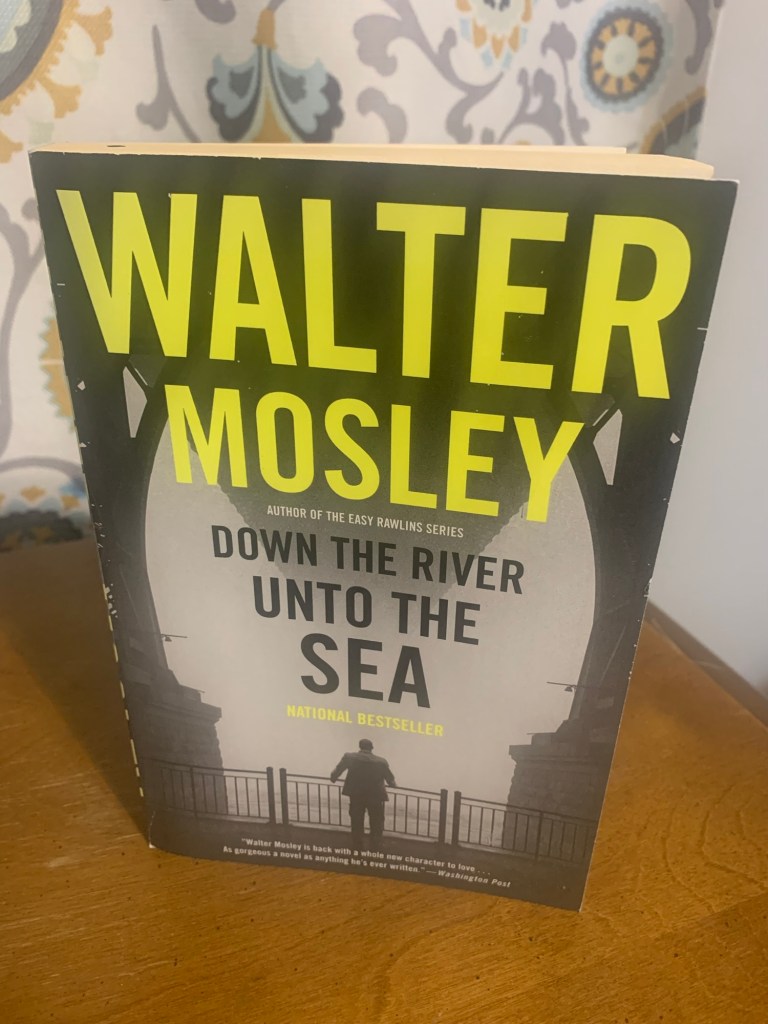
After recently finishing a Stephen King book where he — relatively rarely — explained how he likes crafting fiction books that are propulsive and assaultive, I next read another master of it. Walter Mosley’s 2018 book, Down the River Unto the Sea, is both propulsive and assaultive in the best way, with that side of hard-boiled, pulsating energy only he can bring. This is the first in Mosley’s Joe King Oliver series. King is a former cop-turned-private-detective, who has both apparent and seething scars.
King is fallible. His fallibility is his penchant for women beyond the purview of his marriage. When he’s sent to make an arrest of a woman suspected of grand theft auto, he instead sleeps with her. However, unbeknownst to him, it was a frame job from the beginning by dirty cops. They make it seem like King used his power as a police officer to rape her — which to be fair, even if it was ostensibly a consensual tryst, that power imbalance still applied — and he’s subsequently arrested. Once at Rikers Island, King is in one scuffle after another, including with the guards. That’s where he gets his aforementioned more visible scar. Unfathomably, the charges are dropped and King is released. But the damage is done; King’s career and marriage are both over, and the psychological trauma he experienced in jail (far more than the physical) lingers for a decade after. Indeed, the story picks up 11 years later, where thanks to King’s cop friend, Gladstone, he’s able to start his own private detective business. Better yet, his now 17 year old daughter, Aja, who adores her father, works as his secretary. Their relationship brought the honey to this beehive of a story.
His next client is a woman interning for a defense attorney. This defense attorney was representing a notorious cop-killer who goes by A Free Man and was part of the Blood Brothers of Broadway, a supposedly violent radical group cut from the same cloth as the Black Panthers. A Free Man is on death row and his defense attorney decides to back off. This woman wants to know why, and furthermore, wants King’s help to exonerate A Free Man. She thinks dirty cops were involved in his prosecution, which itself came after many members of BBB were killed, maimed, or arrested.
Dirty cops. That’s the catalyst King needs to find overlap with addressing the demons in his head and the real life dirty cops who framed him, while also solving this client’s case. Using his connections from his time as a police officer, as well as his own cunning and ingenuity, which includes makeup skills and yoga (yes), King unravels both plots. It also helps that he has a sociopathic lifelong criminal named Mel, who feels like owes King, helping along the way. Mel is the equivalent of Mouse from Mosley’s Easy Rawlins series.
Honestly, I’m not entirely sure I could recount both schemes (to frame King and persecute A Free Man), as it became somewhat convoluted and hard to follow, but the short end of it is, the dirty cops were doing the bidding of a higher up crime kingpin type who even Mel fears to an extent. Or at least, is cautious of. The twist I expected also came where King’s friend, Gladstone, is implicated in the frame job. He gaslights that he actually saved King’s life. (The charges against him were dropped, by the way, because they couldn’t risk his case going to open court, although it doesn’t necessarily explain why King wasn’t killed in prison or otherwise, but perhaps that proves Gladstone’s point?) This seems to satiate King’s desire for suicidal revenge, though. (For now?)
Becoming more of a vigilante and less of the cop he once was, King and Mel help A Free Man escape prison and leave the country with bribe money King took from the scary kingpin guy’s middleman.
Mosley’s kinetic writing knows how to grab you by the throat and lock you in. Even more impressively, Mosley is an expert at writing pinpoint characters with both compelling fallibilities and profound, abiding moral compasses. He’s unlike any modern author in this genre I’ve read. More Mosley, please.

 Milam's Musings