
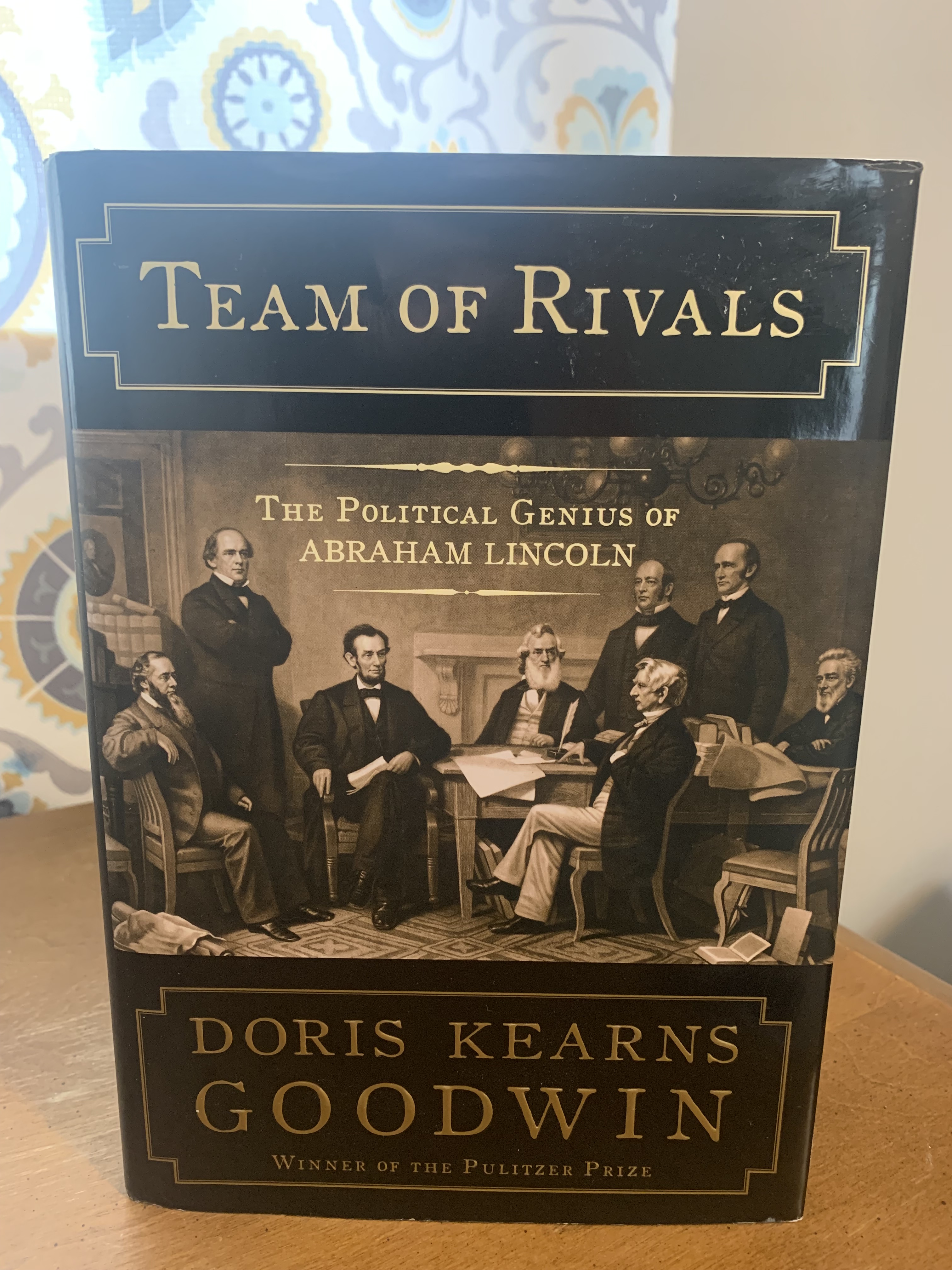
Edwin Stanton, Abraham Lincoln’s Secretary of the War Department, upon Lincoln’s death from an assassin’s bullet, said, “Now he belongs to the ages.” The ages can make a great man mythic; indeed, it may make it tempting to imbue such a man with too much of history’s propulsions. However, in the capable hands of historian Doris Kearns Goodwin in her 2005 book, Team of Rivals: The Political Genius of Abraham Lincoln, Lincoln comes alive with sagacity, humor, levity, thoughtfulness, magnanimity, appropriate shrewdness, foresight, and intellect. He’s very much a man, one often depicted with sad eyes and an unabating melancholy about him, but also someone capable of an uproarious laugh. No, Lincoln need not be a mythic figure or a god to be great. He need only have been himself to belong to the ages, and our country and the world, are better for it. Team of Rivals is a captivating look at the most tumultuous time in American history, with comprehensive attention to the broad scope owed to it, while also rendering the intricate machinations of Lincoln’s Cabinet, the “team of rivals,” as enthralling as the Civil War battles. Just as importantly, again to ensure Lincoln, the “Great Man” of history is a man, Goodwin also captures the milieu of 19th century Washington D.C., as it ebbs and flows along with the victories and defeats of the war. There may not be a period or a person more studied, but in a bevy of such books, Goodwin’s surely must stand as tall as the man himself, distinguished by its warmth, care, and detail.
Goodwin’s story begins with the rise and development of its principle players: Lincoln, William H. Seward, Salmon P. Chase, and Edward Bates (the aforementioned Stanton comes later). In so telling their development and rise, Goodwin also tells the inexorable way the United States seemed destined to erupt into Civil War over the slavery question, a question the Founders purposefully avoided answering inasmuch as they could, while also hoping to contain it. The 1850s in particular was the last attempt to forge a peace before the lurch into violence, but it would prove wholly futile. Since Goodwin smartly includes what the social life was like in the mid-19th century, it’s also worth noting how significant male friendships were. When many men were leaving the farm and their homes to venture to the cities, they were lonely, and therefore, developed deep and affecting friendships with other males. So much so that they would unabashedly express such platonic love and longing in letters to each other. All four men below had lifelong male friendships. Lincoln, for example, was close to Joshua Speed, who he met when looking for board in Illinois, and they slept in the same bed for four years. (It was common in those days to “rent out” a half of your bed.) Finally, I’d be remiss if I didn’t point out the importance of newspapers to 19th century America. It’s fascinating to think back to a time when one city could have six flourishing newspapers, or where most Americans readily read the newspaper or had it read to them if they were illiterate. And then, remarkably, they talked about the issues of the day. In other words, before the advent of ubiquitous sports or entertainment, politics was the top line item that occupied people’s nonworking time. Imagine: conviviality based around political discussions! Perhaps even more remarkable than that is how standard it was for an orator to deliver a three or four hour speech. The longest presidential addresses since 1900 come from our current president, and even then, he’s gone for between 100 and 108 minutes, which is considered unnecessarily long these days, and he’s far from any sort of talented oration. (Clinton’s State of the Union address in 2000 at 88 minutes was considered long then!)
What’s notable about all four of these men is that they opposed slavery. Now, there would be gradations in and a certain degree to which their “radicalism” propelled them or correspondingly halted them, or the manner in which they thought it best achieve the end of slavery, but on that fundamental question, this “team of rivals” was in agreement. What’s interesting, as Goodwin points out, is that I think each successive generation wonders what will be the great turning point of their epoch. What will be the catalyst to set the great men of history apart from their contemporaries? If there are no such opportunities, it leaves men adrift and will have a “crippling effect” as novelist Thomas Mann, Goodwin quotes, says. This thought was having a crippling effect on Lincoln: he wanted to be great. To put it in Lincoln’s words, his generation had been left a “meager yield after the field of glory” was harvested by the founding generation. That generation was tasked with the herculean effort of proving the “capability of a people to govern themselves.” After his son, Edward, died in 1850 from tuberculosis, Lincoln sunk into a depression and was prepared for death. The balm to his depression was that he had not yet done something worthy of living beyond his grave. Thankfully for Lincoln and his peers, as Goodwin says, the “wheel of history turned.” Lincoln and his contemporaries would have to prove the self-government question all over again. (This makes me wonder if our own age will turn in such a fashion. I’ve certainly expressed the sentiment that we need our own founding — a second rebirth of freedom acquainting us again more intimately with out founding ideals and those of Lincoln’s time.)
Lincoln’s story is fairly well-known at this point starting with his humble log cabin beginnings. His father didn’t like him to read because, as a farmer and laborer, he thought that’s what men ought to do. Still, voracious a reader Lincoln was. Given where he started in life, largely becoming self-taught in Shakespeare and other literature and the law, Lincoln has to be considered one of the smartest presidents we’ve ever had. He would become a lawyer (I think sometimes derisively referred to as a “prairie lawyer”), plying his trade in Illinois, where his noted humorous stories became legendary while he was on the circuit with his fellow lawyers. That also laid the groundwork for when Lincoln would run for public office. Speaking of, his efforts weren’t always successful. He lost his Congressional seat, and later, lost to his arch-rival, Democrat Stephen Douglas, in a Senate race after their famous 1858 debates. That’s why his nomination at the nascent Republican Party’s Chicago National Convention two years later seemed “out of nowhere” to some. But Lincoln, more shrewd and intentional than people liked to give him credit for, had orchestrated vast machinations behind the scenes to ensure his ascent. Or at least, make it more likely. I should also note, Mary, Lincoln’s wife, was into politics as well at a time when it was considered “unladylike” to be so interested.
Seward was a well-liked New York Governor and Senator, who also had the gift of gab and oratory. At times, he vacillated between radical and conservative when it came to the slavery question. For the South, though, he was most certainly depicted as a radical, especially after he made a speech talking about the “irrepressible” issue of slavery. That read as a threat to those in the South. Like Mary, Seward’s wife, Frances, was also well-read and an intellectual when it came to politics, even more so, in fact. Indeed, Frances was more radical than her husband on the question of abolition! She constantly felt as if her husband did not go far enough. I’d love to read an entire book about this remarkable woman.
Chase, Ohio Governor, who also spent considerable time in my area, Cincinnati (where he was known as the “Attorney General of the Negro”), had perhaps the most insatiable desire to be president of any of them. Not surprisingly then, he was also the most deluded and narcissistic of the bunch. He could never see the error in his ways or judgements he made. Nevertheless, Chase was a commendable, ardent abolitionist, if a bit like a weathervane when it came to aligning himself with the party best suitable to putting him in the White House. Like Lincoln and Seward, Chase also had a gift with words, although perhaps most so in letters than speech. All three of his wives died, so he doted most upon his daughter, Kate. As a result, she was classically trained and educated in a variety of subjects and languages. That positioned her well to be a quasi-“first lady” to Chase and campaign manager for his political endeavors.
Bates was Missouri’s elder statesmen, who called St. Louis home, and largely had eschewed political life for the comforts and joy of family life. It was a necessity because the man had 17 children with his wife Julia! Unlike the other three, though, Bates was a slaveholder and supportive of the Compromise of 1850 (more on that in a moment). He was also adamant that whites and Blacks could not live together, and warned against “African mania.” Bates was not alone in this thinking; the vast majority of those who wished to ensure the abolition of slavery still didn’t want to live with Blacks or certainly afford them the additional rights of suffrage, to sit in a jury box, and so on. In these early days, Bates and Lincoln were more closely aligned than some may have thought: Lincoln, after all, supported colonization, i.e., sending freed Blacks to Liberia or Central America.
Obviously, there were not primaries in the 19th century. Delegates met at the convention and put forth their chosen person for the party’s ticket often at the behest of certain party bosses or leaders in the states they represented. The four men primarily vying for the newly formed Republican Party’s presidential nomination were Lincoln, Seward, Chase, and Bates. Lincoln actually did the work unlike his three counterparts: he campaigned and delivered speeches in Iowa, Ohio, Wisconsin, Indiana, and Kansas. His aides behind the scenes did the party boss type of work and cajoling. To be sure, Seward had the help of Thurlow Weed, the party boss in New York, assisting him. However, what neither Seward nor Weed saw coming was Horace Greeley’s “betrayal.” Greeley was the editor of the influential New-York Tribune, and felt pushed aside by Seward and Weed. He even expressed as much six years prior in a letter, but Seward and Weed didn’t take it seriously. Chase, owing to his inflated sense of self, failed to do any real on the ground political work. He figured the delegates “who voted their conscience” would vote for him. As for Bates, he barely left his St. Louis home, much less the state of Missouri. Bates also failed to thread the needle on being part of the “Black Republican Party” as the South derisively called it and courting and catering to the border states the Union needed in a looming conflict with the Confederate states. All of which came together to make Lincoln the Republican Party’s nominee for president in 1860. Goodwin sums it up well and it’s worth reproducing in full, “There was little to lead one to suppose that Abraham Lincoln, nervously rambling the streets of Springfield that May morning, who scarcely had a national reputation, certainly nothing to equal any of the other three, who had served but a single term in Congress, twice lost bids for the Senate, and had no administrative experience whatsoever, would become the greatest historical figure of the nineteenth century.” (This summation is also why some analogized Obama’s ascent to the presidency to Lincoln, also owing to Obama’s oratory gifts.)
After Lincoln won the presidency, he asked each of his rivals for the presidential nomination into his cabinet: Seward as his Secretary of State; Chase as his Secretary of the Treasury; and Bates as his Attorney General. It was astute, and with great forethought that Lincoln did this, hence the subheading of his “political genius.” Because not only could he maximize the talents and deliberations of these great men, but he could keep them close to him like the old adage goes (but in a political sense). To be clear, throughout his first administration, Lincoln not only had to manage the war, but the egos involved in his Cabinet, particularly that of Chase, who still had hopes of procuring the 1864 nomination for president. As such, he often criticized Lincoln openly. But Lincoln was adept at this, too, always finding a way to thread the needle of their egos and to ensure he came across as friendly and magnanimous as ever. Contemporaneously and historically, some thought Seward acted as a “shadow president” to Lincoln. That was based on the outdated depiction of Lincoln as a feeble fool, but that couldn’t be further from the truth. Indeed, Lincoln and Seward became great friends in the ensuing years, and Seward a great counsel for Lincoln’s thoughts and drafts of important speeches. At one point, though, nine Senators tried to oust Seward from Lincoln’s Cabinet since they couldn’t go after Lincoln directly. Seward was even ready to relent by handing in his resignation to Lincoln. Once again, however, Lincoln deftly maneuvered to avoid doing that, and it helped that Chase also tried to tender his resignation, which Lincoln didn’t accept either. A political crisis was averted. Lincoln’s sidesteps many of these throughout his first term, arriving at a solution that largely pleases everyone involved. Chase would ultimately threaten to resign four times; on the fourth feigned attempt, after Chase tried to elevate someone to a Treasury position without merit, Lincoln accepted his resignation (to Chase’s shock, of course). But again, reflective of Lincoln’s magnanimous nature, when Chief Justice Roger Taney (of Dredd Scott infamy) died, Lincoln selected Chase to replace him. He hoped in so doing, it would abate the burning desire Chase had for the White House. (Spoiler alert: it still didn’t.)
Returning to the slavery question, the central problem in tension with the idea of containment was whether new territories within the United States would enter the Union as slave states or free states. Could slavery be allowed to expand? This became a salient question again after the Mexican-American war in 1848, of which Lincoln was a critic much to the consternation of his peers and the press, and the resulting Compromise of 1850. Then, four years later, the Kansas-Nebraska Act of 1854 galvanized Lincoln. The Act de facto repealed the Missouri Compromise of 1820, which had effectively “contained” the spread of slavery. One of the most telling, and galling, moments that made the disillusion of the Union seem inevitable was the different reactions to Congressman Preston Brooks’ violent caning of Senator Charles Sumner, a fierce abolitionist, on the Senate floor in 1856 (Sumner had insulted Brooks’ cousin, Senator Andrew Butler, for his support of slavery.) Quoting historian David Donald, Goodwin notes that the different reactions in the North and South to Sumner’s brutal beating (castigated in the North and celebrated in the South, with some editorials calling for Seward’s beating next!), “made it apparent that something dangerous was happening to the American Union when the two sections no longer spoke the same language, but employed rival sets of cliches to describe the Brooks-Sumner affair.” I sometimes fear we’re in a similar epoch where certain sections of America no longer speak a shared language, and indeed, react differently to violent events, such as Jan. 6. A year after the Sumner beating, the Supreme Court handed down one of its most appalling decisions ever with Dred Scott, arguing, among other things, that the U.S. Constitution did not extend citizenship to people of black African descent. If all that wasn’t enough, John Brown’s raid on Harpers Ferry occurred in 1859, furthering the sense to the South that they were facing an existential crisis (notably, Robert E. Lee captured Brown).
Because of these tumultuous times, and always trying to be mindful of the public winds, Lincoln wanted to make it clear that when the Civil War began, the Union was not fighting to abolish the institution of slavery, but rather to conserve the Union. To have made the slavery question the impetus for war would have forestalled any patriotic fervor to the war cause, in the estimation of Lincoln and others. Frances was radically on the side of the war being about slavery. She felt even if the war lasted years and incurred the “immense sacrifice of life” it was worth it to abolish slavery. “No compromise will be made with slavery of black or white. God has heard the prayer of the oppressed and a fearful retribution awaits the oppressors.” Let’s go!
Unfortunately, that excitement was short-lived, as the Union soon learned how formidable the Confederacy was and likewise; after all, it’s a tale as old as time that people expect wars to be swift and largely bloodless. It didn’t help that in the initial phase of the war, Lincoln made blunders with the generals prosecuting the war, primarily General George McClellan, who I found such a detestable figure. He was an arrogant blame-shifter, who if Lincoln called upon him (meaning, visited his home), McClellan kept the president waiting! Worse still, he was horrifically cautious about advancing on the Confederates with his much larger Union army. That was a theme that played out again and again, often then allowing the rebels to escape after a battle did end. McClellan is a stark contrast to Lincoln in that a.) Lincoln readily took blame, even for things he didn’t need to, but he rightly surmised that the “buck stops with the president”; and b.) Lincoln was patient, which looked like overly cautious to some, to be fair, and his timing impeccable, but when he did take action, his follow-through was as legendary as his deliberations. When Lincoln was able to put General Ulysses S. Grant, future president, in charge as general-in-chief of the Armies of the U.S., he found his man of action and a far more humbler, down-to-earth figure. Similarly, the former Pennsylvania Senator Simon Cameron was Lincoln’s pick for the Secretary of War, but Cameron was outmatched by the role and responsibility, and probably either complicit or ignorant of corruption ongoing in the necessary war build-up with respect to contracts. That’s where Stanton came in, which Lincoln selecting him for the role again reflects his magnanimity. Years ago, as a young lawyer, Lincoln traveled to Cincinnati to try a patent case, only for Stanton to completely humiliate him. But Lincoln knew Stanton was the man for the Secretary of War job because of his industriousness and indefatigableness. Lincoln was right. Once more, the brilliance of the “team of rivals” concept was for Lincoln to maximize the gifts of the people within his Cabinet, even if they didn’t always agree with him or he them.
As the war had it ups and downs, Lincoln worried about the Copperheads in Congress, so named for the Peace Democrats, who were against the war because it had become a “war for the Negro.” It’s an interesting question if subsequent elections had been more kind to the Copperheads what would have become of the war and the United States. One of the more vocal Copperheads was Ohio Congressman Clement Vallandigham. A Union general took it on his own volition to arrest Vallandigham and essentially charge him with incitement and treason. Lincoln supported the arrest, but commuted the sentence from death to banishment to the Confederacy. Vallandigham would escape and go into exile in Canada. Obviously, Lincoln’s political opponent being arrested was controversial, same as attacks on some of the newspapers. He also suspended the writ of habeas corpus. It’s arguable if such actions were justified given what Lincoln and the United States were facing under war conditions, or if liberty must prevail precisely under the most dire of circumstances. I tend to err on the latter side.
Again, one of the more intriguing insights Goodwin details is how “society” — that is upper class rich society; think of it in the Bridgerton way — still functioned and continued during the war, often at the White House itself, whether through Mary Lincoln or Kate Chase. The latter had become the face of society during this time. For her part, Mary was also instrumental in restoring the White House to a kind of societal glory that it hadn’t seen in decades. It sorely needed updating despite protestations of Mary’s exorbitant spending and how ostentatious it appeared during wartime. Mary also, it should be noted, had the pressure of being from the West and having family members enmeshed in the Confederate cause. I bring all this up, though, to say that after reading about Union failure after Union failure, phew, it felt good to read about the victories at Gettysburg and Vicksburg on July 4, 1864! I was as jubilant as Lincoln and everyone else in Washington D.C., and on July 4th, no less. What’s particularly fascinating is that it’s not just that “society” was such a predominant thing even during wartime in Washington D.C. and at the White House, but that the public, by custom, still had such easy access to the president. Thousands of citizens regularly poured into the White House to shake hands with Lincoln. So much so that Lincoln feared he’d give a sloppy signature on his 1863 Emancipation Proclamation after shaking so many hands earlier in the day. Could you imagine not only such ease of access to the White House but the president now?
Lincoln’s penchant for perfect timing also included his advocacy for the 13th Amendment abolishing slavery in the United States. He knew the time wasn’t ready and the coalition still had to be held together to “ensure victory in the war.” His genius was moving in conjunction with “propitious circumstances, not waiting to be dragged by the force of events or wasting strength in premature struggles with them.” By the time of the Republican Party’s next national convention to select its presidential nominee, so much had changed in four short, but bloody years, that the party platform included, “That as Slavery was the cause, and now constitutes the strength, of this Rebellion … we demand its utter and complete extirpation from the soil of the Republic.” It may have obvious that Lincoln, especially as a wartime president, would be nominated and elected to a second term, but it certainly wasn’t a sure thing. The mid-19th century wasn’t known for two-term presidents, and again, Lincoln feared the Copperheads may have a surer footing after so much devastating war. But for someone without any prior administrative experience, Lincoln’s true skill was understanding the people he served. He was aided in this not just by all the times he had spent mingling with people, but also specifically mingling with Union soldiers. Lincoln regularly visited the frontlines, often to the chagrin of Stanton, who worried about his safety. Lincoln even walked through Richmond after it was captured. Those excursions to the frontlines weren’t just a feeling out process for Lincoln, but a balm to the soldiers, and indeed, a balm to Lincoln’s spirits.
Lincoln’s three conditions for peace (where again, Lincoln was doubted, with radicals worried his empathy would get in the way of a decisive close to the war): 1.) The restoration of the national authority; 2.) No receding by the Executive of the United States of the slavery question; and 3.) No cessation of hostilities short of an end of the war. Initially, Jefferson Davis, the president of the Confederacy, seemed amenable to “peace,” but he kept referring to it as peace between “two countries.” No. The Confederacy was an empire created for the express purpose of maintaining and expanding slavery. There was no future in which Lincoln ought to have or would have accepted its continuation and recognition as a separate country. Eventually, the war came to an end after Lee’s surrender. Lincoln was adamant about not continuing the violence. He hoped that some of the political and military figureheads would just abscond from the United States, so they wouldn’t continue to be a vexing problem (wishful thinking on Lincoln’s part, similar to the colonization plan with freed Blacks).
Reading the last few pages of Goodwin’s book recounting Lincoln’s assassination was harrowing. You know it’s coming and yet. I had spent the last week, and particularly the past two days, immersed in this 19th century world with Lincoln and his peers. I didn’t want to lose him. It hurt to lose him, especially before he could do the meaningful work of leading the country through reunification and Reconstruction. Instead, we were saddled with Andrew Johnson. John Wilkes Booth, who was an actor and brother to a famous Shakespearian actor Lincoln quite enjoyed, was a Confederate through and through. He was even in the crowd for Lincoln’s speech upon Lee’s surrender. The original plan Booth concocted with other conspirators was to kidnap Lincoln to ransom him for the release of Confederate prisoners of war. After Richmond fell, the plan turned to assassination. Two others were with Booth in the crowd that day, David Herold and Lewis Powell. Powell was to kill Seward to ensure Seward’s oratory skills wouldn’t make a martyr of Lincoln, whom Booth was to kill. Herold was tasked with killing Johnson. On the evening of April 14, Powell gained entry into Seward’s home. Seward was still convalescing from a carriage accident. Soldiers and Seward’s family attempted to intervene, but Powell was able to wound a great many, including Seward. Seward survived, however, thanks, it is thought, to a device in his jaw from his carriage accident. Meanwhile, Herold did not follow through on going to Johnson’s hotel room, but Booth did enter the presidential box at Ford’s Theater and shoot Lincoln (Lincoln’s body guard wasn’t on duty that night). He died nine hours later. Lincoln’s peers thought that was the worst possible outcome for the South, owing to Lincoln’s empathy and vow to not use more violence against the political and military leaders of the Confederacy. Ultimately, I think, Johnson assuming the presidency proved a boon to the South, the premature end of Reconstruction, and the permeation to this day of the “Lost Cause” narrative. Ugh.
Goodwin’s Epilogue was also brutal to read. While I’m glad Seward survived (he would go on to be instrumental in the purchase of Alaska), mostly everyone else had terrible endings. The bold Frances died six weeks after the attempt on her husband’s life. Seward’s daughter, Fanny, died a few months later from tuberculosis at 21 years old. Stanton’s cabinet career ended in acrimony, but then later, President Grant nominated Stanton to the Supreme Court (Lincoln was petitioned and considered Stanton for the Chief Justice position years earlier). Three days later, though, Stanton died from an asthma attack at 55. Bates, who was rather unremarkable throughout most of Lincoln’s administration compared to his peers, also had a peaceful ending like Seward at least. Chase, as mentioned, tried to be nominated in 1868 for the presidency and was once more spurned by his home state, Ohio. He died a few years later at 65. Kate, who had been the “belle of the ball” during Lincoln’s years in D.C., had a scandalous end to her marriage to a millionaire (who people suspected she only married to fund her dad’s presidential run!) and died in poverty at 58. Oof. As for Mary Lincoln, she was besieged by grief after Lincoln’s death, but her son, Tad, kept her going. Then, he, too, died at age 18 from “compression of the heart.” Even worse, Mary and her oldest son, Robert, became estranged after he sent Mary to a state hospital for the insane. She died a “virtual recluse” in Springfield at age 63. War is hell. Assassination is hell. Death is hell. And their reverberations extend long beyond the initial event.
Goodwin’s deeply researched, comprehensive look inside Lincoln’s “team of rivals” Cabinet, the ups and downs of the Civil War, and most importantly, the character of Lincoln as a man, proved insightful, funny at times, owing to Lincoln’s own need for levity during trying times, and a balm in our present days. Which is to say, reading about Lincoln, notwithstanding how calamitous the Civil War was, or Lincoln’s untimely end, is inspiring and moving. Indeed, as Lincoln said in his first Inaugural Address, imploring us to the “better angels of our nature,” I believe in that and I believe our country still capable of heeding those words so long ago. A man of the ages still has something worth imparting to us. Goodwin did a profound job of bringing Lincoln to life and carrying those lessons forward.

 Milam's Musings