
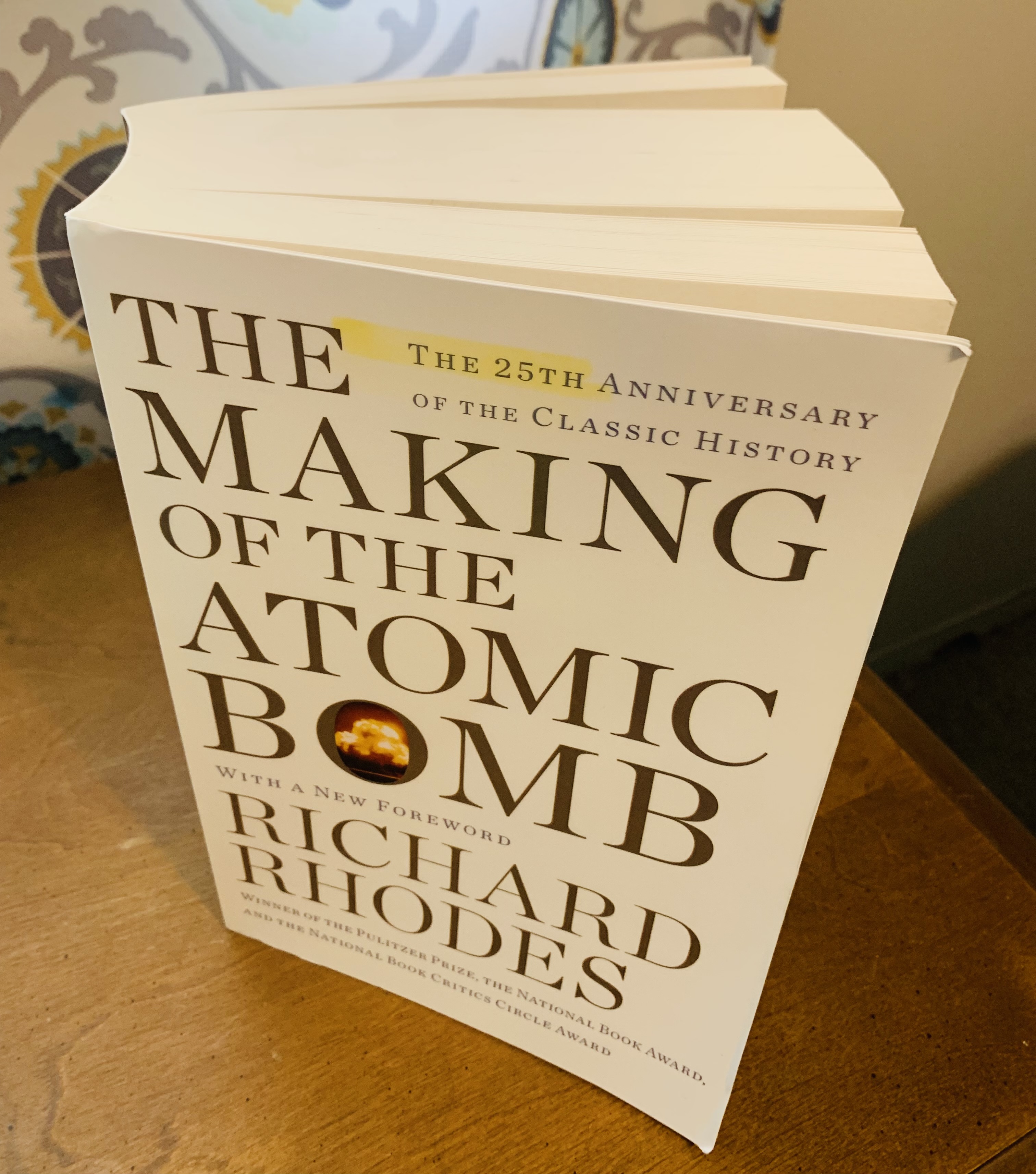
Scientific advancement may make us gods to our ancestors, but it makes us men with too much power in our time — power we take for granted at our peril, or worse still, conceive of as a fait accompli. Indeed, from gods we’ve become bystanders to our own undoing. Richard Rhodes’ 1986 Pulitzer Prize-winning book, The Making of the Atomic Bomb, is a harrowing clarion call to consider the destructive power we wield, both ingeniously conceived and rashly utilized, and the tension always present between our advancement and the precipice of our own destruction. To think, the bombs we possess now are not only far more numerous than the two atomic bombs dropped on Hiroshima and Nagasaki in 1945, but orders of magnitude more destructive. Reading the first-person accounts from survivors of those two atomic bombings Rhodes includes at the end of his book, the imagination ceases to conceive of such power and what it could to do to cities, to societies, to human beings, and to nature. With his book, Rhodes set out to answer whether there were alternate paths we could have taken to where we are now with nuclear weapons: the ever-possible potential for nuclear apocalypse. That is not a question for scientists or science necessary. As Rhodes remarks, the scientific method doesn’t filter for benevolence. Or to quote Robert Oppenheimer, as Rhodes does, “It is a profound and necessary truth that the deep things in science are not found because they are useful; they are found because it was possible to find them.” Human ingenuity is going to uncover the secrets of the universe. What happens next is a question for humans, not science.
Author H.G. Wells, writing in his 1914 novel, The World Set Free, presaged the coming atomic age: atomic bombs before scientists had even fully understood the atom’s properties and constituent parts, much less how to split and weaponize it. Leo Szilard, a Hungarian physicist, was inspired by Wells’ novel to “save the world” from such doom. In fact, he thought atomic bombs would usher the world into a quasi-one world democratic government and lasting peace. The thinking being, such atomic weapons would render wars too costly and thus, futile. While the concept of atoms has been around since the Greeks, it wasn’t until the 19th century that it started being debated as to whether atoms were a useful, but not real substance, or useful and a real substance, and then by the 20th century, particularly with Albert Einstein, whether the atom was immutable and mechanical or something that did change and could be divided, or split. Before this time, I think it’s safe to say that scientific determinism ruled the day, but thanks to Einstein and relativity, as well as Werner Heisenberg’s uncertainty principle, that killed determinism since we can’t predict where a particle is going to be in time and space. While Einstein’s theory of relativity helped to kill scientific determinism, Einstein still believed in a certain level of behind-the-scenes determinism. Indeed, the advent of quantum mechanics led to Einstein’s famous quote that he is “convinced God does not play dice with the universe.” In 1932, British scientist James Chadwick discovered the neutron, which he would win a Noble Prize for, and in so doing, made it possible to examine the nucleus and jumpstarted nuclear physics. Another British scientist, Francis Aston, a few years later in a 1936 lecture, analogized our coming understanding of the atom and unlocking its “almost infinite power” to our ancestors who warned about the “danger attending the use of the newly discovered agency, fire.” Man was going to release and attempt to control such power … because it’s there. But, he added, “We cannot prevent him from doing so and can only hope that he will not use it exclusively in blowing up his next door neighbor.” Of course, that became its first use, but not its exclusive use.
What makes atomic weapons, or nuclear weapons, a categorical difference both in kind and degree from conventional weaponry is not merely the fact of its destruction — vaporizing anyone in its immediate vicinity, burning, maiming, and blinding those even 2 miles out, and inducing radiation and death years after the fact of its explosion — but also in the paradox that, as Rhodes notes in the Foreword of the 25th anniversary edition, individual nation-states claim the right to hold and use nuclear weapons in defense of national sovereignty, but they are a common danger to everyone on the planet and as such, transcend national borders. This is a salient point right now as the United States, which has for years sought to prevent Iran from acquiring a nuclear weapon, began bombing the country nearly a month ago ostensibly in that effort (I’m dubious of the claims that Iran had the capacity and capability of making a nuclear weapon that was in any way an imminent threat necessitating our response). In other words, the United States, which not only has more than 5,277 nuclear warheads, although not all of those are operational, but is thus far the only nation-state to deploy nuclear weapons on another country, claims the moral standing to dictate which countries can and cannot obtain a nuclear weapon for their defense. When Iran is attacked, it also further shores up North Korean rationale for acquiring the bomb. Overall, nine countries possess nuclear weapons, with an additional six hosting them in their countries. The present-day politics around the development, possession, endorsement, and use of nuclear weapons is just as fuzzy as it was in the 1940s. It seems particularly shortsighted that some in the United States thought they could maintain a monopoly on them for as long as they did (about four years).
An interesting dynamic about the development of the bomb, which echoes the paradox mentioned above of national border transcendence, is that its creation was a function of national border transcendence among the scientists. Along with the aforementioned Hungarian Szilard (including other Hungarians), scientists who either contributed to the science that would lead to the bomb or directly worked on the bomb included people from Denmark, Italy, Britain, France, Germany, New Zealand, and America. Also of note is that a few women were also among this scientific elite helping to move science forward. However, the Germany of the 1920s, wounded from the first global war and seeking a scapegoat in the Jews, counted physics (and really, intellectualism and modernism writ large) as part of the Jewish conspiracy, and so, began forcing Jewish physicists out of their positions. Many began fleeing to Western democracies, including Britain and the U.S. Heroically and throughout the Nazi takeover and ordeal, the Danish scientist Niels Bohr used his clout and connections to save his Jewish neighbors. But it’s worth emphasizing how Germany self-inflicted a brain drain out of old hatreds and prejudices. From once being the epicenter of scientific advancement, Germany became a place to be avoided, which was a boon ultimately to the United States (and the rest of the world). Overall, 100 refugee physicists immigrated to the U.S. between 1933 and 1941.
But I don’t want to skip too fast past the first global war. It has lessons Rhodes felt important to impart as one considers the second global war. Yes, war is hell on the battlefield, but it also generates upheaval on the home front and stymies scientific progress, including killing scientists who are on the frontlines, among its many hellish consequences. While those scientists from around the world, including Bohr, who cracked the lid on quantum mechanics that disrupted Einstein’s thinking on determinism, were discovering the properties of the atom, the first World War wrought its destruction and first brought into question, at least in the 20th century, the confluence of science and warfare and the moral ambiguities therein. As the nation-states waged war, the propaganda that would find its way to salience in the next conflagration appeared here: While wielding science makes war deadlier, it also enables its end, or at least, such is the propagandistic pretense. In the case of WWI, the scientists helped create poison gas. Some argued, though, what’s the difference between blowing someone up with artillery or machine gunning their limbs off versus poisoning them? Regardless of where one falls on such questions, the point remains that scientific advancement has made war deadlier and efficiently so. As Rhodes concludes, “Whatever its ostensible purpose, the end result of the complex organization that was the efficient software of the Great War was the manufacture of corpses.”
Discovering the atom and its constituent parts is one thing; it’s a whole other marvelous feat of human ingenuity to discover how to make matter radioactive by artificial means. We could control matter. Then, Italian scientist Enrico Fermi (one of my favorite “characters” in the book, owing to his surefootedness) discovered slow-neutron radioactivity, thus paving the way for the bomb: counterintuitively slow neutrons are better at being absorbed by the nuclei than fast neutrons, and this absorption causes a split. Rhodes uses an illustration of a circle (the nuclei) coming apart to demonstrate what happens. When uranium was split in two by neutron bombardment, it was difficult to believe (also because the element doing the bombarding was less weighty than uranium). This splitting of uranium was nuclear fission. Even by the mid-1930s, Rhodes remarks on how the three most original living physicists of the time had spoken against the harnessing of nuclear energy: New Zealand physicist Ernest Rutherford dismissed it as moonshine (meaning impossible); Einstein compared it to shooting in the dark at scarce birds, and Bohr thought it remote in direct proportion to understanding. And yet. The nuclear fission breakthrough occurred in January 1939; the two atomic bombs dropped on Japan occurred little more than six years later.
That last point brings me to a useful interlude. I opened by analogizing scientific advancement as godlike: our ancestors would marvel at what we’ve done. In a similar vein, I marvel at what Rhodes has accomplished with his book. To grasp even an iota of the science around making a nuclear bomb, much less the ability to then convey that into a relatively understandable way to the public, is no small feat. He had to gain a basic understanding of physics, chemistry, metallurgy, engineering, mathematics, logistics, and so on. Entire books could have been written about any one of the scientific disciplines that came to bear on the creation of the atom bomb. Just as importantly, of course, Rhodes also had to wield his research and writing prowess on the scientists, military men, and politicians throughout to understand the science of discovery, the philosophy of their thinking, and the character informing their decisions and machinations. Where the magic in Rhodes work steps into godlike from my vantage point as the “ancestor” is even despite reading this book, that classic profit meme formulation comes to mind:
- Nuclear fission discovered (in addition to myriad other important discoveries along the way).
- ???
- Weaponized, practical nuclear weapon.
Much of the science still went far beyond my understanding, so it’s possible the missing link exists within the pages of Rhodes’ book, but particularly the time scale is what confounds. Again, barely six years to marshal human ingenuity and labors to create such a weapon, and really, as we’ll see, a much shorter window when it comes to getting the U.S. government on board the project that would become the Manhattan Project.
That makes for a nice segue back to the story. Szilard, who was another favorite “character” of mine from the book, owing to his tenacity and moral righteousness, was the one who kept pushing and leveraging his connections, including with Einstein, to impress upon the U.S. government, particularly then-President Franklin Delano Roosevelt, the importance of building the bomb before the Nazis did, and also because he believed in that loftier aim of world peace brought upon by the bomb’s creation. In the early months of 1940, it was clear to the scientists involved that nuclear weapons were weapons of mass, indiscriminate destruction, and the only “apparent defense would be the deterrent effect of mutual possession.” However, at the outset, the Navy didn’t take the practical applications of nuclear fission seriously. And I don’t blame them, honestly! See my aforementioned “???-Profit!” meme. The ethical dilemma for some scientists involved, though, like Bohr, was the insistence to also be secret about it so that the science behind nuclear fission wouldn’t become known to the Nazis (of course, the sudden freeze in scientific publications by such notable names in the name of secrecy was itself revealing of some sort of secret!). For his part, Bohr believed what made science special and possible was its free speech, its openness, and being united globally.
What would the outcome of the war had been if people like Szilard and American engineer Vannevar Bush weren’t agitating the U.S. government to step up its involvement and to ensure not only technological advancement, but the necessary funding and logistics to build the bomb? After the U.S. did begin taking it seriously, Szilard was part of an initial group called the Uranium Committee, which Bush’s National Defense Research Council absorbed. Much of the work then moved to the Office of Scientific Research and Development, or S-1, once it was in the development phase. Of course, the U.S. wasn’t the only one with scientists agitating for their respective government’s help in making a bomb. In England, it was the MAUD Committee. The U.S.’s NDRC, led by Harvard president and distinguished scientist in his own right, James Bryant Conant, began liaising with the British. Germany, as feared, was also trying, particularly with the help of scientists like Heisenberg, who Bohr was sad to learn, or at least suspect, was collaborating with the Nazis. I’m not sure how to interpret Heisenberg’s meeting with Bohr in occupied Denmark (again, another heroic mark in Bohr’s favor that he went back to his home country to help). Was it to nefariously glean what Bohr knew about nuclear fission or was it innocuous? Regardless, later evidence would suggest that the Germans were not nearly as close to acquiring a nuclear weapon as feared. The Nazi government also did not have the resources necessary to fund it the way the American government did; that is a two-fold fact of diverting resources to the extermination of the Jews in the Holocaust and opening up a two-front war with the Russians. That said, fears that the Germans could acquire it wasn’t unfounded. After all, they had access to the world’s only heavy-water factory (thought to be a necessary component for nuclear fission and its resulting chain reaction) and to thousands of tons of uranium ore in Belgium and the Belgian Congo. And they had scientists like Heisenberg, who if other scientists could theorize and experiment their way to nuclear fission, so could they. Nonetheless, Rhodes marks the end of Germany’s race to the bomb as February 1944, where, in one of the neater side plots of the story, a Norwegian commando, Knut Haukelid, helped to destroy Vemork, where the heavy-water production was ongoing. Japan also sought the nuclear bomb, which I didn’t know before this book. In October 1940, those inside Japan thought they had access to uranium and therefore, a bomb was possible. More than 100 scientists were working on the problem. It ultimately collapsed though, with focus shifting to radar, which was seen as more crucial to the war effort (some scientists on the Allied side also thought so, and to be fair, it was important and significant throughout the war). Finally, the Soviet Union in 1939 also turned their attention to making a bomb, but then Germany invaded two years later and radar became more paramount.
Once the U.S. government was all in on the bomb, which didn’t come to fruition until a few years later, much to Szilard’s frustration, they needed to a.) stop compartmentalizing to some extent and bring more of the scientists and logistics together; and b.) decide where that would be. Oppenheimer was brought in to lead the primary laboratory that would develop the bomb. Interestingly, Oppenheimer initially considered Chicago as a location, or Columbia University in New York, or much to my amusement, even Cincinnati! They eventually decided on Los Alamos in New Mexico, which ultimately made the most sense in terms of the space and secrecy that the overall military director of the Manhattan Project, Leslie Groves, desired. Groves was likely necessary to make the logistics happen, but I didn’t like him constantly going after Oppenheimer and Szilard on suspicion of them being spies (Communist in Oppenheimer’s case and a German spy in Szilard’s, or more likely, on account of Szilard being Jewish). That said, one of the few laugh-out-loud moments in Rhodes’ book occurs when Groves learns he’s being redirected to the project. General Brehon Somervell, his superior, told him, “If you do the job right, it will win the war.” Groves said while it’s nice to imagine you’ll say something befitting a historic moment such as that, he records his reaction merely as, “Oh.” Overall, 10,000 people came to work at Los Alamos. Something I didn’t know until this book, however, is that Los Alamos was just one site of the Manhattan Project. The University of Chicago did turn out to be a vital location, where Fermi was initially, where they worked on building the first nuclear reactor. Uranium enrichment occurred at the Oak Ridge laboratory in Tennessee. The Hanford Site in the state of Washington built massive nuclear reactors, which created the necessary plutonium for the bomb. Again, the logistics are astonishing to consider. Indeed, I think it was said of the Hanford site that in three years time, the U.S. Army Corps of Engineers created the equivalent of the entire automobile industry. And that was just one of the sites!
Throughout the latter stages of the book, Rhodes provides information on WWII developments, showcasing how those developments shaped the race to develop the nuclear bomb. That makes for a compelling juxtaposition to what is already occurring in Dresden, a German city, and Tokyo: unimaginable carpet bombings, or firebombing. Dropping enough incendiary bombs on these cities, which had plentiful civilians, including children, that then resulted in mass devastation because of resulting fire storms. In a time before precision bombing was actually precise, “area bombing was invented to give bombers targets they could hit.” By definition, area bombing is the indiscriminate killing of civilians. Ostensibly, such bombings by American and British forces was to reduce the industrial capacity for Germany and Japan to wage war and to lessen their “morale.” But it was also just ugly, destructive death from above. The scenes from Dresden are horrific to read. For example, a 19-year-old survivor describes how the asphalt melted, with people stuck in the asphalt. “Their feet had got stuck and then they had put out their hands to try to get out again. They were on their hands and knees screaming.” War is hellish beyond measure. At least 45,000 Germans died from the firebombing, the majority old people, women, and children. The carnage from the firebombing of Tokyo was also awful. The bombing killed 100,000 men, women, and children, with a million more injured. All of which occurred in a six-hour period. A bombardier who flew over the area is quoted as saying of what he witnessed that it was “the most terrifying thing I’ve ever known.” And yet, nuclear bombs, and what occurred in Hiroshima and Nagasaki, is still categorically different for the reasons I stated before. Consider, what makes Tokyo seemingly more horrific is the short window of time in which people perished compared to Dresden. In Hiroshima, the window of time went from six hours to instantaneous, and then cruelly and horrifically, years later.
Which brings me to another interlude that Rhodes thought particularly evidenced the “increasing bloody-mindedness” of the war. The scientists were discussing the possibility of poisoning the German food supply with radioactive material bred in a nuclear reactor. When such a plan was brought to Oppenheimer’s attention, he remarked that such a plan ought to not be attempted “unless we can poison food sufficient to kill a half a million men.” Rhodes finds this remarkable given Oppenheimer belief in ahimsa, which means “do no harm or hurt.” (Oppenheimer learned Sanskrit because of his affinity for the Hindu teachings. His famous quote after the successful testing of the nuclear bomb, known as Trinity, comes from the Hindu scripture, the Bhagavad Gita, “Now I am become Death, the destroyer of worlds.”)
Unlike many others, Bohr was already thinking ahead to what nuclear bombs could portend for the post-war world, particularly their proliferation through an arms race. He proved quite prescient. (Szilard, like Bohr, was also far more prescient about the use of the atomic bombs causing a nuclear arms race.) Winston Churchill especially, but also FDR, just weren’t getting it. Rhodes once more remarks upon the unique power of the atom bomb entering into the equation of international relations. Where before no “hierarchical authority defined [each country’s] relations with one another,” the “ultimate power” in the form of the atomic bomb appeared. He surmises that Churchill couldn’t use such a deus ex machina, as it were, as a battle rallying cry to galvanize the British people. Regardless, Rhodes continues, no longer would nations vacillate between peace and war (notwithstanding “smaller client wars”); major war among nuclear powers would be “self-defeating.” There is no winning a nuclear war. “The pendulum now would swing wider: between peace and national suicide; between peace and total death.” Oof. Unfortunately, the “statesmen” of the day weren’t up to Bohr’s task. It was simply never going to be the case that the U.S. would divulge its bomb secrets to the Soviet Union and enter into some sort of de-escalation before the escalation began.
Rhodes’ description of the bomb’s machinations turns poetic, as such macabre facts often do. “Before the radiation leaked away, conditions within the eyeball briefly resembled the state of the universe moments after its first primordial explosion.” Humans created something considerably hotter than the surface of the sun upon explosion and that resembled those first milliseconds of fiery expansion at the Big Bang. It’s remarkable and terrifying in equal measure. However, the most harrowing, stomach-turning part of Rhodes book is the relentless eyewitness testimony from survivors after the atomic bomb was dropped first on Hiroshima. The fireball raised surface temperatures within a mile of the hypocenter above 1,000°F instantly. Again, I have to emphasize that we have bombs 84 times more powerful than that now. Thousands of them. I’m not going to recount the eyewitness testimonies here, but suffice it to say, each shared a common theme: the permeation of the dead and dying, as if the survivors had woken up to the end of the world. And for them, it most certainly was.
Ultimately, the atomic bombing of Hiroshima is estimated to have killed 140,000 men, women, and children, with five-year deaths related to the bombing bringing the total up to 200,000 people. The second atomic bomb dropped on Nagasaki wasn’t as deadly, but it still resulted in the initial deaths of 70,000 men, women, and children, and then overall, 140,000 people after the next five years.
I’ve been quite outspoken through the years in my opposition to the use of the atomic bombs America dropped on Hiroshima and Nagasaki. Like the gas deployed in WWI and the propaganda of it being necessary to save lives and hasten the end of a war, I’m not persuaded by similar propaganda that those two bombs were necessary to end the war. Before either were dropped, Japan was already making overtures to the Soviet Union for a negotiated peace. The sticking point was FDR’s apparently flippant inclusion that became Allied policy of seeking Japan’s “unconditional surrender.” Japan was ultimately willing to surrender, but desired to keep their Emperor in place. That was unacceptable to us, and yet, when we did eventually accept Japan’s surrender after the two bombs, Japan was able to keep their Emperor in place, albeit symbolically! Furthermore, as Rhodes documents, then Secretary of State James Byrnes made the two-fold argument that we needed to use the bombs because a.) we spent $2 billion on them and needed to justify the expenditure; and b.) it could be a way to make the Soviet Union more manageable. I think it’s a truism that if we create something for the express purpose of being a weapon of war, then it’s going to be used as a weapon of war before long. Such was the case with the atomic bombs. We were going to use them regardless of what Japan did or did not do. It’s also worth noting, in contrast to Byrnes, Dwight Eisenhower, who was the Supreme Allied Commander in Europe and future U.S. President (after Harry Truman, who okayed the usage), was against dropping the bombs. He also thought the snag was the Allies seeking Japan’s unconditional surrender, and that he didn’t want America to be the first ones to use such bombs. Alas.
My final interlude: I’ve talked about the destructiveness of the nuclear bomb and its uniqueness in that category. However, what is particularly galling about them in the American context at least, is the precedent set by FDR that the decision to use them is essentially at the sole discretion of the president. One person. That is scary as hell. The fact that the current American president, a certifiable madman, has thousands of nukes at his disposal to use at his whim is horrifying beyond measure.
Rhodes’ book is an impressive feat of reporting and unearthing the machinations, logistics, and ingenuity that went into the creation of the world’s first atomic bombs and their use during WWII. While I didn’t have the brains to understand much of the science, and it could get into the weeds at times, I was thoroughly fascinated. The cast of characters, largely scientists trying to do right by the beauty of discovery more than with an eye toward destruction, is extensive, and at times, hard to keep track of, but compelling in their expressed nuances and differences. I personally don’t know how one could read Rhodes’ book and not walk away thinking we cannot, and should not, accept the existence of thousands of nuclear weapons. Indeed, that we should work toward a day where no nation has such weapons. We’ve been standing near the precipice of total destruction for 81 years now, with many flares up and near-misses, accidents and threatening belligerents, but it seems more out of luck than intention that we haven’t taken leave of that precipice yet.

 Milam's Musings