
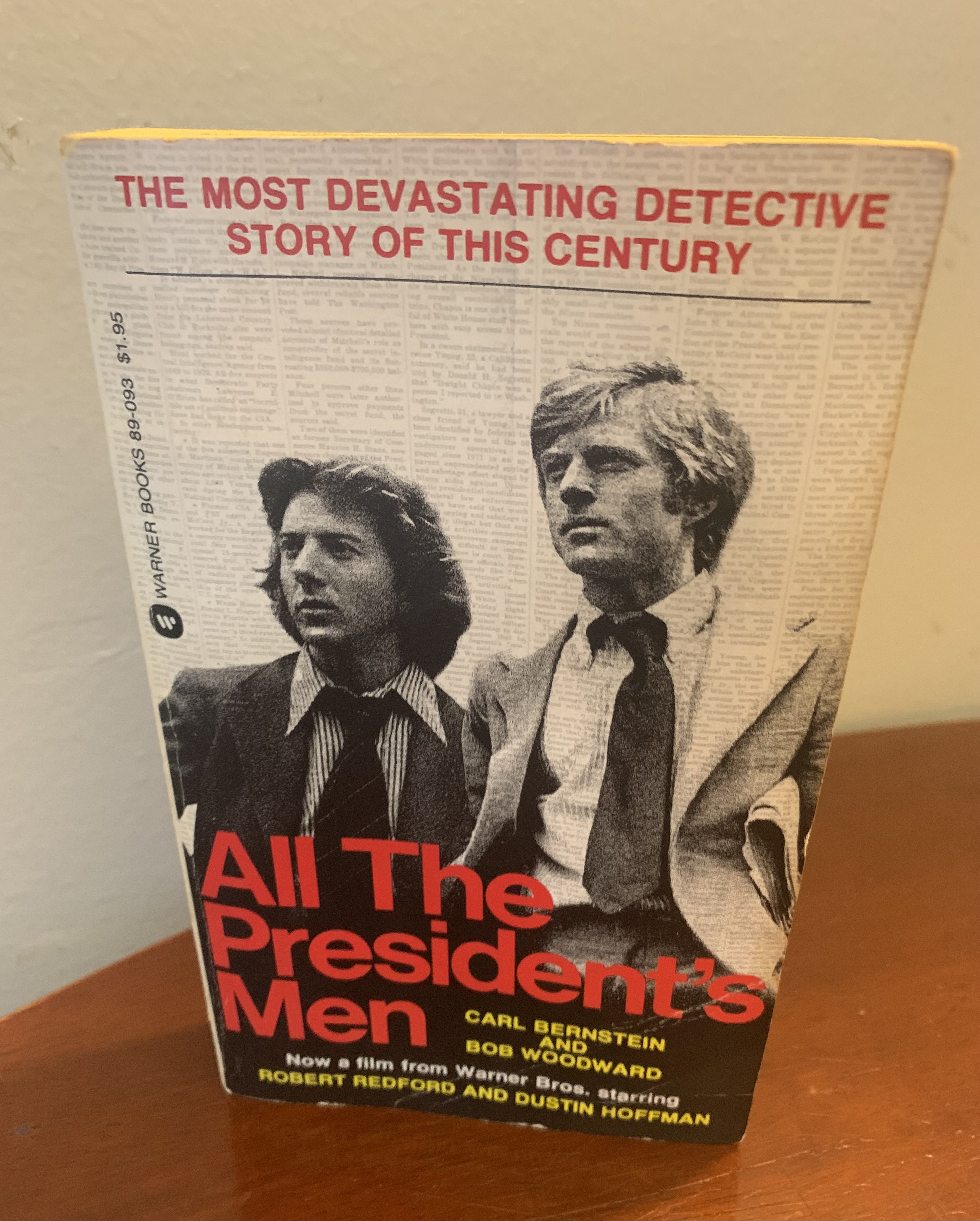
Today, I finished a book about a quaint time in American history when the president — despite his protestations to not be a crook — resigned after news reporting, Congressional investigations, and court proceedings made his continued tenure untenable. If only. And if anything, “all the president’s men” and Richard Nixon do look quaint by comparison to the felon currently occupying the White House and his “men.” I’m referring to Carl Bernstein’s and Bob Woodward’s seminal 1974 book, All the President’s Men, which was adapted by Warner Brothers two years later starring Robert Redford and Dustin Hoffman (I have the movie tie-in edition). Not only is the book insightful for understanding the machinations of Watergate as a crime and resulting criminal cover-up, but for insights into how journalists do journalism at a major national newspaper, warts and all. Or at least, how it was done in the 1970s — some basic principles still apply 52 years later. Bernstein and Woodward, self-admittedly hardly paragons of virtue in all their dealings, nevertheless did contribute mightily to bringing down a corrupt president. To me, there is hardly any more praiseworthy feat for a journalist: speaking truth to power and holding power accountable. In this case, the most powerful person in the country, and the world, the president. All the President’s Men, as a result, reads like a compelling detective caper; it just so happens to be real life history as it unfolded.
At the time of Watergate, Bernstein and Woodward, or “Woodstein,” as their colleagues took to calling them, were relatively new journalists at The Washington Post, and they couldn’t be more different. Woodward was a Yale-educated registered Republican; Bernstein was a college dropout with a far more rebellious streak. The latter personality boded well for even having the imagination that the president could be implicated in wrongdoing. All the President’s Men is candid about how they felt about each other initially: neither wanted to work with the other. Woodward thought Bernstein was always elbowing his way into a byline, and Bernstein thought Woodward was a prima donna. However, both were assigned to the Watergate burglary (Woodward only 9 months into his Washington Post career). That said, they established an important precedent from the outset. If either one of them objected to a story, or it didn’t feel it was sourced well enough, it wouldn’t go into the paper. It’s also worth noting that one of the more remarkable considerations about Bernstein and Woodward is that both are still actively involved in covering presidential politics; indeed, Woodward, 83, is about to release his 25th book, Secrets, a memoir about how he cultivated his high-level sources. For his part, Bernstein, 82, while not as book prolific as Woodward (which is interesting since it’s noted that he’s a better writer than Woodward), he remains a regular political commentator on CNN.
I think there is also some important context for the present-day cynical reader and political obsessive. Prior to Richard Nixon, and I suppose to some extent you might have to go further back to prior to President Lyndon B. Johnson’s deepening involvement in Vietnam, the American people afforded the Office of the Presidency a level of irreproachable myth-making. That extended to the occupant. And being almost cowed by the awesome power of the presidency included the very journalists tasked with covering it known as the White House Press Corps, but it extended to publishers, editors, and whole swaths of the journalism industry. In other words, the press’s relationship to the president was not adversarial but often cozy, credulous, transactional, and even subservient. Nixon, his “men”, and their conduct changed everything. For the better as far as that adversarial relationship is concerned, if you ask me. The press should always have an adversarial posture when it comes to those in power. That doesn’t mean being unfair or dirty; it means actually being prudent and skeptical when it comes to covering their conduct. Here’s one microcosm of how different it was back then: One of the Washington Post editors didn’t want Bernstein and Woodard to report Nixon’s hands shaking during a White House press conference. Why not?!
The Watergate break-in happened on June 17, 1972, wherein five men, four of them Cuban exiles formerly working with the Central Intelligence Agency, were arrested for attempting to wiretap phones and steal documents at the Democratic National Committee’s headquarters at the Watergate Hotel in Washington D.C. What seemed, even to Woodward initially, as a low-level burglary, would ultimately bring down a president. The first signal to Woodward that it was a bigger deal than when he first heard about it was that it involved the DNC. Particularly bewildering was why the burglary, in service to Nixon’s re-election campaign, happened at all. He was ahead of all announced Democratic candidates in the polls by no less than 19 points! But paranoia and shooting himself in the foot is a consistent theme with Nixon. A committee known as the Committee for the Re-election of the President, or CRP (or CREEP, lol), was created to ensure Nixon’s re-election, but it was soon connected financially to the burglars. Always follow the money trail. Doing so eventually leads to the White House and President Nixon. But that was later. What All the President’s Men also shows is how slow the Watergate scandal took to unfurl and penetrate not only the American public’s consciousness, but also other news media, Congress, and the courts. What Bernstein and Woodward did was laborious work, true shoe-leather type journalism, where they were constantly working the phones with sources or sifting through documents. And even then, even if with building innuendo and implication with the White House, Nixon would go on in the 1972 Presidential Election to win in one of the biggest landslides in modern presidential history (Nixon only lost Massachusetts!), bested only by Ronald Reagan’s 1984 win. That only emboldened the White House and the president’s men that they were untouchable. (It’s also some solace that Nixon was that popular and now is that disgraced. I hope it portends something about the topsy-turvy nature of politics and public sentiment …)
Again, the book is as much about Watergate as it is about reporting dynamics. In the Washington Post newsroom of the 1970s, the ethos was, “Yesterday was for the history books, not newspapers.” In other words, what have you done for me today? That was what drove Bernstein and Woodward, sometimes in error and to blur the lines of journalistic ethics, to produce new revelations for their stories. The newsroom itself was competitive (heck, Bernstein and Woodward were clearly competitive with each other!), but also, they wanted to stay ahead of The New York Times, Time magazine, and The Los Angeles Times, which slowly began covering Watergate in earnest, too, even scooping Bernstein and Woodward. It’s also just interesting the perspective of the editors they worked with — Benjamin Bradlee, Executive Editor; Howard Simons, Managing Editor; Harry Rosenfeld, Metropolitan Editor; and Barry Sussman, District of Columbia Editor — who had to trust that their “boys” were getting it right. That’s why they implored them to have more than one source to back-up a claim, although even that method wasn’t foolproof.
By September 15, 1972, seven people were indicted by a D.C. grand jury related to the break-in: the original five burglars (including James McCord, security chief for CRP), along with Howard Hunt, a former consultant to the White House, and G. Gordon Liddy, financial counsel for CRP and former aide on John Ehrlichman’s staff (Ehrlichman was the Assistant to the President on Domestic Affairs). At this point, the White House posture was that this was a narrow, low-level crime that didn’t connect to the White House. Indeed, that the mastermind behind it all was Liddy. Bernstein and Woodward were not so sure; they thought it connected to H.R. Haldeman, the White House Chief of Staff. He was the true “fixer.” They went with a story about it, which was later undermined by one of their own sources, Hugh Sloan, treasurer of CRP and former aide to Haldeman. That embarrassment for the newspaper and its “boys”, along with the aforementioned landslide presidential election, cast a months-long pall over the Watergate coverage.
One of Woodward’s continued, and deepest anonymous sources, was a man known by Deep Throat, so named by Simons after the pornographic film. Bernstein and Woodward had additional sources in the FBI, at the Justice Department, in Congress, and other characters associated with the principle actors in Watergate, but Deep Throat was the main person. This is where the “detective caper” aspect really came into play. Woodward and Deep Throat had a system for alerting the other to desiring to meet whereupon they would clandestinely meet (taking multiple cabs to ensure they weren’t followed) in a parking garage. Deep Throat was such a valuable and accurate source for Woodward that the FBI thought surely someone from within the FBI was leaking. As it turns out, and was revealed in 2005, Deep Throat was Mark Felt, the Assistant Director of the FBI. Incredible.
To be fair to the American public, especially being cognizant of how each article from Bernstein and Woodward was incrementally uncovering the depth of the Watergate scandal across months, the Watergate story is hard to follow in the sense of there being a lot of characters involved (I was often flipping back and forth from the narrative to the list of characters and their titles), along with there not exactly yet being a big splashy takeaway. In other words, so long as nothing directly connected to the White House or the president, it wasn’t going to penetrate to the extent one might hope. Arguably, the only reason it began to is because of the cover-up! If Nixon and his men hadn’t tried so hard to cover-up everything they were doing with Watergate and beyond to sabotage, illegally and barely-legally, the Democrats and the press, maybe none of this reaches Nixon and he’s not then pressured to step down. But as Deep Throat relayed to Woodward in the defining quote from the whole affair — and one perpetually applicable to the current administration — “They are not brilliant guys, and it got out of hand.”
As I alluded to at the top, Bernstein and Woodward admit and reflect (although perhaps not enough) on their sometimes misguided and unethical approach with sources and their articles. A low-level example to me is reading drafts of their articles to certain sources, often when seeking comment. That seems odd to me. But worse is threatening potential sources and burning him, as it were, like one FBI agent. Or trying to read material you’re not privy too off a desk (more of a gray area here). Their biggest two mistakes, though, are not being thorough enough when vetting information (instead of playing coy with “codes” or misrepresentations), which resulted in the Haldeman embarrassment, and surprisingly, being lazy. To the latter, and jumping ahead a bit, only toward the end of the saga did they think to interview Alexander Butterfield, Deputy Assistant to the President and aide to Haldeman, who ultimately provided testimony leading to the “smoking gun” of the Nixon tapes.
After the burglars plead guilty, McCord came back to Judge John Sirica to say they were paid to take the fall and remain quiet. He broke. In so doing, he opened the connection that led to John Dean, Counsel to the President; Jeb Magruder, Deputy Campaign Director and Deputy Director of White House Communications; Robert Mardian, former Assistant Attorney General; John Mitchell, former Attorney General; and Haldeman. It’s also shocking to me that after McCord’s testimony, Woodward asks for an interview with the president for the first time, even going so far as to suggest giving the president questions in advance so as “not to spring something on him.” Gag. Again, it just wasn’t common then, I suppose, to confront the president directly. Such was the intimidation afforded to the Office of the Presidency. Although, it’s not only that office; it’s power in general. A tiny subplot in the story is when Woodward tries to interview Henry Kissinger, Assistant to the President for National Security Affairs, and Kissinger throws a hissy fit calling Bradlee at the Washington Post to complain — Woodward was inquiring about whether Kissinger had wiretapped his own two aides. When Kissinger wanted the information he gave to be “on background,” meaning, the information could not be directly attributed to him, Woodward rightly pointed out that someone can’t give information and then retroactively claim it was on background. Woodward asks the Washington Post’s chief diplomatic reporter if allowing Kissinger to retroactively go on background is common. The reporter says it is with “Henry.” Gag again.
Unlike the early months of the Watergate scandal, after McCord breaks, events begin unfolding a lot more quickly, especially when Dean begins blowing the lid off of what he knows. Even then, we’re talking about the spring of 1973. Nixon didn’t resign the presidency until August 4, 1974! Politics moves slow. Nixon was also never going to be subpoenaed or indicted. The thinking was that you couldn’t do that to a sitting president. Once more, as we’ve learned in our time, the president is considered above the law. Obviously, Nixon resigned before the political remedy (impeachment) seemed imminent, though. The book essentially ends after May 1973 with Butterfield’s revelation and then Nixon’s January 1974 State of the Union speech, where he implores Congress to put Watergate behind them. He further added, “And I want you to know that I have no intention whatever of ever walking away from the job that the people elected me to do for the people of the United States.” That didn’t age well. (Bernstein and Woodward released the 1976 book, The Final Days, that went more in-depth on Nixon’s last year in office.)
Overall, despite reservations and gag moments I might have about the myth-making around the White House and the presidency, as well as some of Bernstein’s and Woodward’s ethically dubious journalistic practices, there is no doubt how groundbreaking and important their coverage of the Watergate scandal was. It’s not hyperbole when I reiterate that they contributed to bringing down a corrupt president, which forever changed the nature of the relationship the press has to the president (sometimes not always as adversarial as I would like, however). A free press is critical to critical coverage of those who wield the most power at the highest level of government. Anything less than is not befitting a free people in a democracy. Bernstein and Woodward are heroes by that measure and All the President’s Men is their definitive documentation of their origin story.

 Milam's Musings