
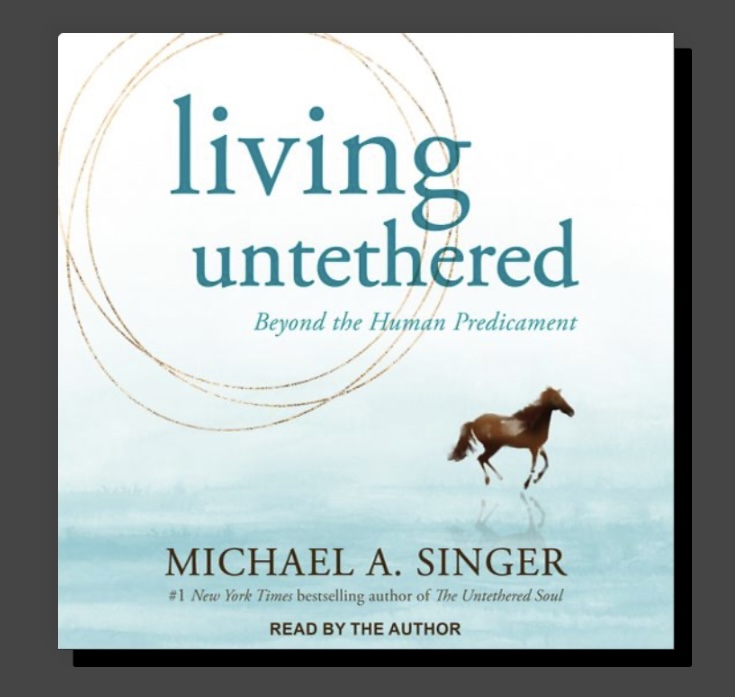
I’m a bit amused already before starting this review because I just finished writing a review about a body-hopping book, and I here I am writing about a book that essentially asks, Who are you in there really? Michael A. Singer’s 2022 book, Living Untethered: Beyond the Human Predicament, is a spiritual journey about acceptance, or nonresistance to reality, that takes its influences from Christianity, Buddhism, and cognitive behavioral therapy (I’m not sure if the latter is intentional, but I interpreted it as such). Rather than a spiritual journey to discover our true selves, Singer’s book is more about realizing you are the self. The inability to differentiate subject from object in our interactions with reality is the cause of our perpetual consternation and struggle throughout life. While I didn’t necessarily agree with everything Singer put forward — and in general with books of this nature, they struggle to justify a book-length format — I thought there was enough interesting tidbits to make it a worthwhile audiobook, for which Singer also provides the narration.
In day-to-day living, it can be difficult to remember who the self is, or where the self begins, and how that self ought to engage with reality. Singer’s thesis is that every struggle we experience, at the micro and macro level, can be traced back to this difficulty. Indeed, that we are tethered to extrapolating the self beyond the self that is within us. As a very basic example that he starts with, we think of our body as the “self” within us, but it’s not! The self within me is incorporeal: it is not a certain height and weight, with red hair and eyeglasses. My body has also certainly changed since I was 10-years-old, and yet, the “self” within me at 35 is the same “self” that was in me at 10. Nevertheless, we tend to think of the self as what the body presents as. We are the one looking, but the more closely we identify with something, such as our body, the more we see it as our inner self. As Singer states, if my hand was cut off tomorrow, the “me” that is looking at my new body hasn’t actually changed even though my body has. From this then, we can see that as we navigate through life, we tether ourselves in myriad ways to that which we’ve identified with and come to think of as the “self,” whether it’s a certain bodily look, societal status (wealth and fame), family makeup, job, and so on. The spiritual journey entails untethering one’s self in order to realize one’s true self and live more fully therein.
We experience the world in three ways. First, the outside world through our senses, and those experiences can be positive, negative, or just passing through. Of course, the interesting aspect of that is that we do not directly experience the world; rather, we experience an extraordinary, rapid facsimile of the world that our mind extrapolates and reimagines from the senses. Second, our thoughts, both willful — the voice in your head or something visually created — or automatic, which pop into our head throughout the day. What Singer calls “witness consciousness” is where I made a direct connection to CBT because it’s essentially the practice of watching those automatic thoughts pop in and go. Instead of dwelling on those negative thoughts that pop in, acknowledge that they are there and let them keep passing through. You are not your thoughts. Quite literally: such thoughts are not you — the you within — and shouldn’t tether us to pain and struggle. Third, through our feelings. Obviously, there’s overlap and reinforcement with these three pathways, i.e., seeing a sunset with my eyes might give rise to a thought and/or feeling.
Where the consternation tends to come in isn’t even so much from that which we’ve experienced in the aforementioned ways, but our attempt to then control how we react and deal with what we’re experiencing. That is where the real danger in “tethering,” as it were, comes from. Because we conflate the self with the object, we make everything (both happy and negative experiences) personal when it shouldn’t be. As Singer sees it, it would be folly to provide solutions for the “how” of reacting; instead, we should be addressing the root of why we’re reacting or engaging in the world in such a manner at all.
Singer offers three practical techniques for untethering, or freeing, yourself. First, the power of positive thinking. Even though we are not our thoughts, there is still something to be said for becoming that which we think. However you conceptualize it, if you’re perpetually negative, then that becomes what you are in practice. Second, the power of mantra, where you use a specific word or phrase to calm the spiraling one can do with thoughts and feelings. If I recall, the example of a mantra Singer provides is, “I am fine.” Repeating it throughout the day, or especially during moments of stress or potential spiraling, can be positive. And the third practice is witness consciousness previously mentioned.
As a lead-in to his thesis, Singer explained the vastness of the cosmos to demonstrate how extraordinary it is that we exist at all and correspondingly, how fleetingly insignificant an object moment — such as bad weather or an annoying driver — is on the scale of the cosmos. Instead of being derailed by those cosmically minute moments, we should be appreciating the grandness of design and appreciate the present (a Buddhist concept is to embrace the “now”). Where Singer lost me to some extent is I get wary at any indication we are veering into a sort of spiritual nihilism and/or spiritual relativism. That is, when thinking about things on the level of the cosmos, it would be easy to extend the thought experiment to “nothing matters.” Space is so vast and cosmic time so inconceivable, why should anything really matter at all? That’s not what Singer is saying or implying, but I think it’s worth warning against going down such a path. Likewise with relativism, why should my problems matter on the cosmic scale? After all, it took 13.8 billion years for my atoms to become so constituted, so, why am I frustrated by a bad day at work or in something stupid I said to someone? While that’s almost precisely the point Singer is making, it’s a thin line between surrendering yourself to reality and discounting any negative feeling or experience you have as irrelevant. In other words, I think there is room to have a spiritual journey of surrendering your ego to reality while also not surrendering your ability to feel and experience reality, if that makes sense.
What I most appreciated about Singer’s book is when a simple idea — there is a “you” in there that is not tethered to any object that you typically identify it with, including your body — gets conveyed in a new way to me that resonates deeply, as this idea did. Life would be more enriching and fulfilling if the self wasn’t always conflated with objects that only serve to cause us pain and suffering. And in that way also, I’m certainly an adherent of doing what we can to lessen the ego of the “self.” Because there is something of an ego in conflating the “self” with so many objects in reality. Lessening the ego is a surefire path to better living, too.

 Milam's Musings