
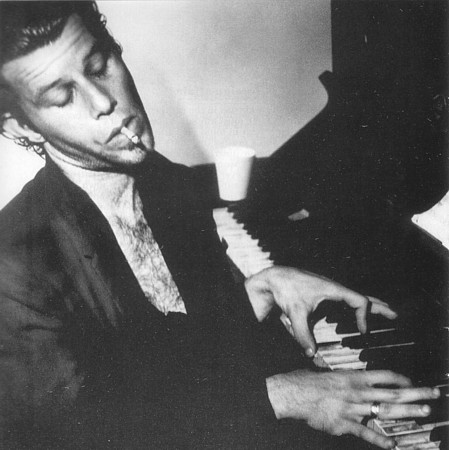
When I’m working, I tend to oscillate between podcasts and music. The podcasts are for when I’m putting the pages together and don’t need to focus as intently as when I’m writing and/or editing. When doing the latter, I put on music. Yesterday, I switched to seeking out a Tom Waits song after listening to one of my favorite Christmas songs, which is also by him, “Christmas Card from a Hooker in Minneapolis.” when I came across the live version of, “Tom Traubert’s Blues: Four Sheets to the Wind in Copenhagen,” from 1977.
It’s always funny to me when I stumble upon something I like, and then I Google it, and turns out, oh, that’s just one of Waits’ most famous and notable songs.

Anyhow, as usual with Waits, the first thing you notice about any song of his you listen to is that gravelly, deep and distinctive voice. I get lost in the timbres of it sometimes, like allowing the tide of his vocal cords to wash over me in a visceral, aesthetic experience more than anything else. But, as happens when I have hours to work through in the office, I listened to the song numerous times, over-and-over again. Once I do that, then I start hearing and appreciating other aspects of the song. For one, how beautiful and melancholy it is, including the instrumentals supplementing Waits’ vocals, including his own from the piano.
The final thing I do when listening to a song on repeat is to pay attention to the lyrics. Looking at the background on the song, Waits essentially went to Skid Road in Los Angeles and from talking to every man there, they were there “because of a woman.” That seems like a romantic, hyperbolic flourish for songwriting purposes, but go with it. The Copenhagen subtitle of the song comes from his travels to Denmark and feeling lost. But also, what I gather from the Wikipedia page on the song is that the origins of the song, the muse for it, seems to be like a mosaic or how The Joker changes the origins of his scars. So, in that vein, I would argue the song is about the lonely scars we have and it doesn’t actually matter, per se, how they got there.
The constant refrain of, “Waltzing Matilda,” is so somber and tears at me. Waits said it’s like being alone on a street corner in a foreign place, but you can take that as either literal or metaphorical. I feel like crap, so I’m “waltzing Matilda,” kind of thing. Later in the song, it becomes clearer that Matilda is more metaphorical for this, as she’s “killed about a hundred.”
Consider these lyrics:
No, I don’t want your sympathy, the fugitives say
That the streets aren’t for dreaming now
Manslaughter dragnets and the ghosts that sell memories
They want a piece of the action anyhow go
Waltzing Matilda, Waltzing Matilda
You’ll go Waltzing Matilda with me
Agh, the “ghosts that sell memories.” The streets aren’t for dreaming. Maybe one day, sometime in the past, the streets were a sign of freedom, making it to the big city from some far off rural place, but the streets are of a different kind now, taken over by fugitives and ghosts.
And you can’t talk about this song without talking about, “And it’s a battered old suitcase to a hotel someplace / And a wound that will never heal.” Lost and abandoned and with gaping wounds. That hits me right in the … wound. Add in Waits distinctive vocals and the somber backup instrumentals, and what a sad, sad song this is.
Also, on the level of being a live performance, this has to be one of the better ones I’ve heard. Some of the best songs just need to be live, and no studio version can touch it because with the live version, you get the emotion on the face of the singer. Untouchable.
This is a rich, visceral song, like a poem come to life to waltz, or stumble, into a dark pit somewhere.
What do you make of it? Are you a Waits fan?

 Milam's Musings
Tom Traubert was a real man and Tom Waits knew of him through his friends, Chuck E Weiss and Rickie Lee Jones. Waits collaborated with Jones in writing her hit song “Chuck E’s In Love”.
Traubert was a year ahead of myself and Chuck Weiss at Smiley Jr. High School in Denver, circa 1960. Tom was one of the East Denver Pochucos who always wore engineer boots and shirt collar turned up with slicked back duck tail hair. Rumor had it that he carried a hand made zip gun in his boot. Nobody messed with him because of his reputation as a bad ass.
After I moved to WA in ’69 my sister, who still lived in Denver, told me in the late 1970’s that Tom Traubert was killed in a bar room knife fight.
Waits alludes to that in the song’s verse that mentions a dagger and bloody shirt torn open.
LikeLiked by 1 person