
Spoilers!
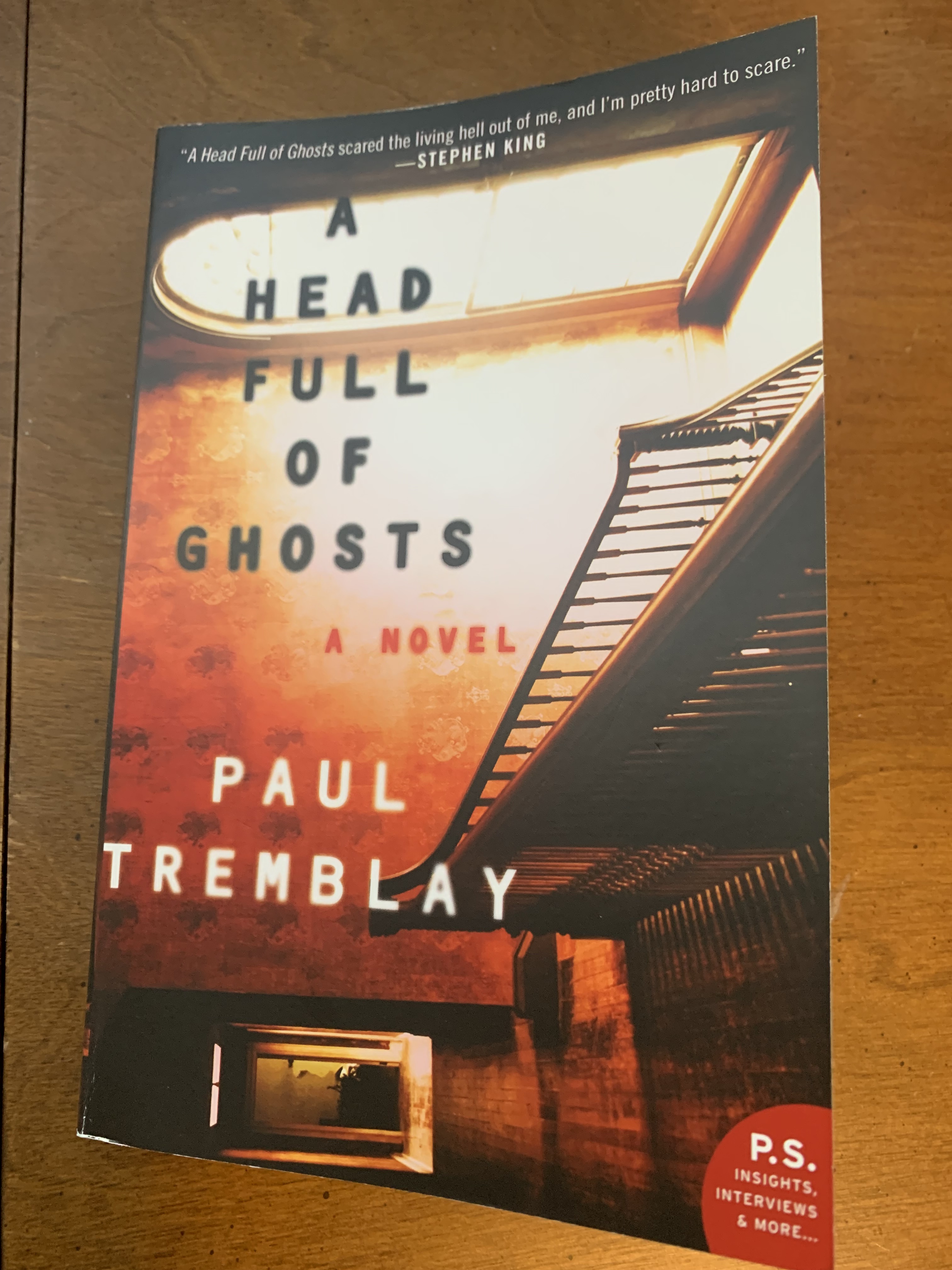
When you get right down to it, don’t we all have a head full of ghosts? A head containing a degree of trauma, bad memories, regrets, and for a small percentage of us, varying mental maladies. For a family in the throes of desperation and destruction, one person’s head full of ghosts is another person’s exorcism is another person’s exploitative hit reality TV show is yet another person’s retrospective hit blog is finally another person’s retrospective best-selling nonfiction book. And it’s also Paul Tremblay’s 2015 book, A Head Full of Ghosts, about the fault lines in a middle class family, the voyeurism inherent in popular culture, particularly reality TV, or rather, the unreality of reality TV, and the malleability of memory and narration.
Merry is the 8-year-old sister to 14-year-old Marjorie, who seems to be experiencing a mental breakdown. Their parents’ marriage is rocky as they deal with raising the two girls compounded by the father’s unemployment and inability to find his identity again, at least until religion steps in. Merry likes stories; she likes making up stories (!) that involve herself and her sister. That is until her sister’s breakdown becomes too malevolent, mean, dangerous, and threatening. Their father, with his newfound religious beliefs, comes to believe Marjorie doesn’t need a psychiatrist — she needs an exorcist. The religious person they turn to has a connection to a TV studio and there is an implied quid pro quo for the religious person’s campaign, all of which turns into the reality show, The Possession, chronicling Marjorie’s exorcism in “real time.”
In the present day, 15 years after the previous time period, Merry meets with Rachel to tell the story for Rachel’s book. We also have a blog deconstructing and analyzing The Possession, and how it borrows generously from The Exorcist, Paranormal Activity, and other exorcism films and literature to tell the story of Marjorie’s exorcism. Come to find out, the blog is written by Merry under a pen name, which she is able to parlay into a writing gig with Fangoria. There are layers here! First, Merry experienced whatever happened in her family’s house with Marjorie 15 years previous, but we, as readers, must filter that through two prisms: a.) she was 8-years-old at the time, and her impression and memories of the events have been clouded by watching The Possession and other popular culture, she freely admits; and b.) she’s a storyteller, who is already admitting to being unreliable to the extent of not revealing her real name on the blog; she claims it is to gain the Fangoria job (or any other job) on her own merits, not her name, which that’s fair on the face of it. Secondly, Merry experienced the making of The Possession in real time while also experiencing the aforementioned, also filtered through her 8-year-old mind. Third, 15 years later, she’s opining about The Possession, a show she partook in and was about her own experience. Rachel asks how she can create such distance from something she experienced in order to deconstruct it. My answer to that in a moment. Fourth, she’s being interviewed by Rachel about the events that took place in the house 15 years prior. In other words, Tremblay has brilliantly created layers of doubt as to what is real and what is unreality, as it were.
My thinking is aligned with Merry on one crucial point: Marjorie was never possessed by a demon necessitating an exorcism. Whether her father — or the priests involved — believed that to be the case, I’m not sure, as he obviously had every motive to ride the wave of a reality TV show to pull their family out of a money pit, and we know of real-life stories where parents exploit their children in exchange for fame and fortune. I think Marjorie is supposed to present as as something experiencing schizophrenia to us. She talks about hearing voices. Her behavior is unpredictable, and she can be a danger to herself and others, if she’s not properly medicated.
However, my answer to Rachel’s question about how Merry can distance herself from the events 15 years previous in order to deconstruct The Possession for a blog is two-fold. First, it is Merry, not Marjorie, who has the “head full of ghosts.” Obviously, at first blush, that seems a fitting description for what’s happening to Marjorie, given the voices in her head, so, sure. But as the final girl (heh) of her family’s story — and there’s something to be said for reliability or unreliability when Merry’s the only one who can tell their story! — it is Merry who is experiencing a head full of ghosts. That of her dead family, the trauma of the experience, and quite frankly, the obsession she has with The Possession, having watched it dozens of times and then analyzed it extensively. Secondly, I suspect that Merry also “died” 15 years ago. Obviously, not literally, but perhaps spiritually. Or maybe her personality. Whatever the case, the way she acts in the blog, with Rachel, and in re-watching The Possession, she strikes me as an 8-year-old who never became the 23 she actually is, at least mentally.
And why is that? Well, given how cold the cafe becomes where Rachel and Merry meet for the final interview, I’m starting to wonder if it was Merry who was possessed after all. Or perhaps that the demon jumped from Marjorie to Merry in the end on the day of the purported exorcism. Because shortly after the exorcism, at least in Merry’s telling, Marjorie convinces Merry to steal her father’s potassium cyanide — apparently, emails with a religious psychopath in Kansas revealed the father’s intention to kill his family via poisoning — and sprinkle it into the family’s spaghetti at night. That way, Marjorie and Merry can knock out their parents and run away to safety together. Instead, Marjorie eats the spaghetti, too, and she and the parents die. Quick note on the spaghetti I just realized: In her deconstruction of a scene from The Possession, Merry identifies the safe shot technique in horror films, wherein viewers are presented two safe shots of something occurring — in the case of The Possession, a priest pulls a comforter up over Marjorie’s body twice without incident — to lull us into a sense that danger won’t happen as we expected, only for the third time to be the scare moment. For example, on the third time the priest pulls the comforter over Marjorie’s body, she bites his wrist. The third time we are introduced to the spaghetti in the book is when the poisoning happens! Ha. Well-played, Tremblay, well-played.
What a delightfully twisted, spooky, intriguing read through layers of reality and unreality, popular culture and criticism of that popular culture, and a mind-bending jaunt through horror and the consumption of horror. As someone who has always find demonic possession to be one of the scarier forms of horror, I was certainly tensed and creeped out at times by Marjorie. But I was also intellectually stimulated by Merry’s deconstruction of The Possession. Yet, I still don’t exactly know what went on in that house, and what to believe. That’s the mark of a fantastic read, in my humble estimation. I recently read Tremblay’s 2018 book, The Cabin at the End of the World, which was also a thinker, with plenty of creepy, intense moments, too. Just as this was a deconstruction of the possession genre of horror, that was a deconstruction of apocalyptic horror. Both also often used the vantage point of a child, and dabbled in unreality and unreliable narratives. Tremblay is just fantastic, and I’ve enjoyed both books of his I’ve read now. I did slightly prefer this one more because it moved at a faster clip, where The Cabin at the End of the World sat in the rumination and terror of it all more often. I would highly recommend both, however!

 Milam's Musings
I heard the audio version of this book, and whoa it was creepy.
LikeLike