
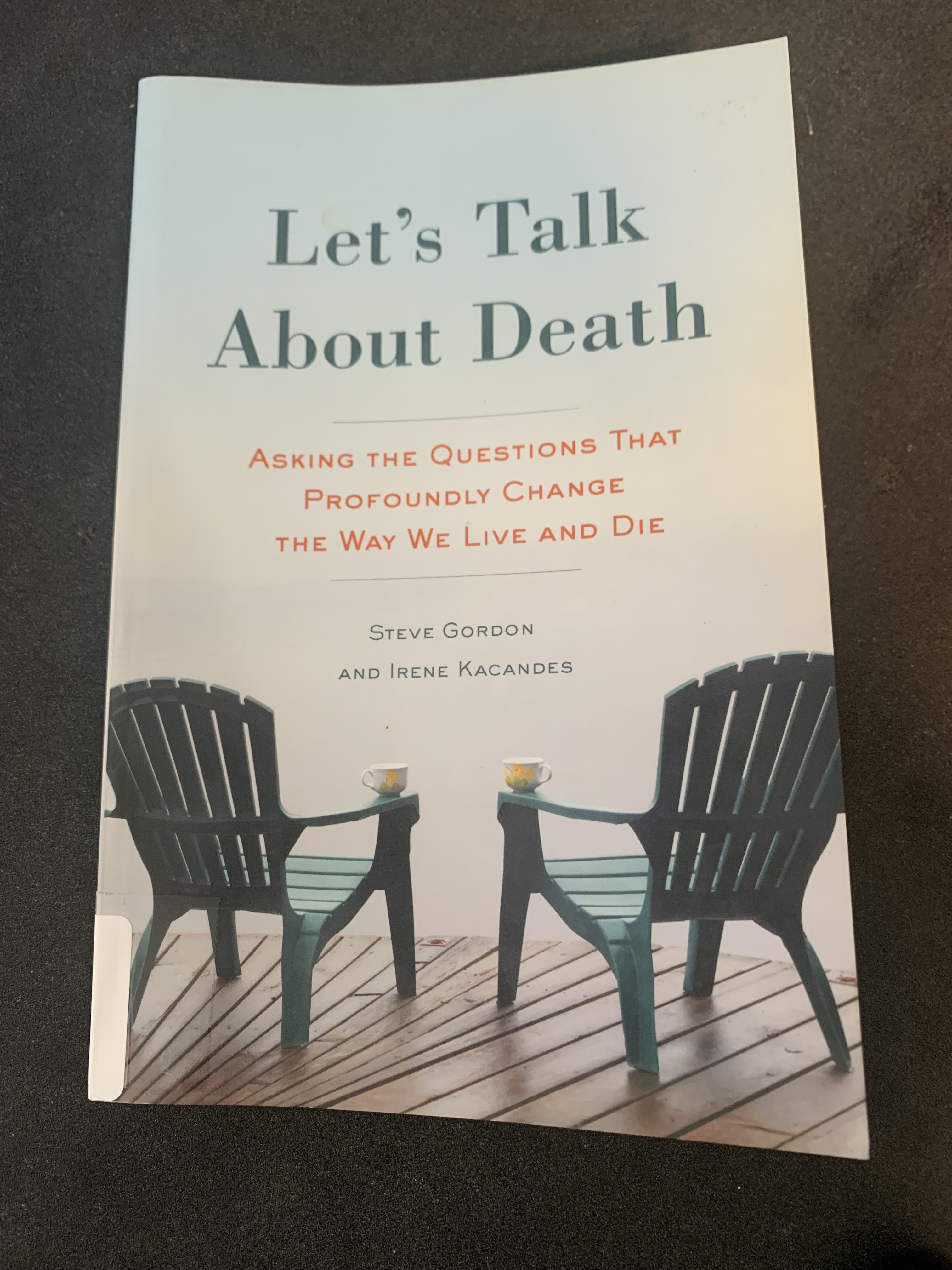
Death comes for us all, and yet. Within that yet is an array of denials, including even when someone seems on the runway to death, attempts to stave it off, anticipatory grief, and rituals — all of which serve to keep death under wraps, to not talk about death until death decides to talk to us, somehow always surprising us, long runway or not. Of course, there is always going to be a chasm between intellectually understanding something like the paradoxical inevitability and mystery of death, and what we actually do as it regards the thing being intellectualized. That is also the potential paradox of efforts to make discussing death less taboo, especially in American culture: does it help when the time comes? Perhaps a better way of framing it, though, is that in lessening the stigma around discussions of death, we more fully realize our potential for better living, and indeed, living with death instead of being in an adversarial relationship with it. All of these thoughts come to mind after reading Steve Gordon and Irene Kacandes’ 2015 book, Let’s Talk About Death: Asking the Questions that Profoundly Change the Way We Live and Die. Gordon is a former journalist-turned-masseuse for those nearing the end of their lives, and Irene is a literature professor at Dartmouth College. In 2001, Irene’s mentors and fellow professors, Susanne and Half Zantop, were brutally murdered by two teenagers. That led her to Steve, who was willing to share in his newspaper the lives of the Zantops instead of their grisly end. So developed a kinship around death and dying — and more fully living — for the next 14 or so years. In 2011, they took up an email correspondence about these issues that lasted until early 2015. Those email exchanges became Let’s Talk About Death. There is something so beautifully quaint and lovely about a deep, engrossing email exchange between two people who are trying to work through their thoughts and feelings about a topic, sometimes in cordial disagreement with the other, with such vulnerability and openness. I remember fondly a few of my own email correspondences with others over the years, and Steve and Irene’s made me yearn for a return to that medium, or rather, the exchange of ideas in such a manner. You’ll notice, the subtitle of the book is framed around asking the questions versus answering the questions, which again goes at the vulnerability and humility reflective of their email exchange as opposed to proclaiming to have answers. I appreciate that. Given that dual inevitability and mystery around death, I’m not sure a level of certainty can ever properly be attained; rather, again, we can glean life lessons about how to live with that duality.
An illustrative example of that aforementioned chasm between intellectualizing death and facing death is found in one of Irene’s emails. As they do often throughout their exchanges, given their backgrounds and interest in the subject, Irene and Steve routinely reference authors and thinkers on the subject who help to elucidate their own thinking. Irene turns to Swiss author Bernard Crettaz, who founded the Society for Thanatological Studies (the study of death). He also created an exhibit about death explaining how various cultures around the world deal with death. Finally, he created the Café mortel, where people gather to discuss death and dying. (Steve and Irene would even model this in New Hampshire a couple times.) In other words, Crettaz not only epitomized intellectualizing death, but living with death and trying to ease its stigma. His wife, Yvonne, then died unexpectedly, actually right before the death exhibition was to begin. He was completely unprepared for her death. Here were two people in Crettaz and his wife who studied death and were well immersed within it, and yet. Crettaz didn’t even know Yvonne’s wishes upon her death. Like Irene, I find that fascinating, and reflects the chasm I brought up. It may be a chasm that is uncrossable.
There is so much to unpack when it comes to discussions about death and the way our society and culture handles it. The various threads to unspool include ethical questions about the justice or injustice, or fairness or unfairness, of death; pain management during end-of-life-care; the multi-faceted caregiver experience; that long runway to death compared to sudden death; and of course, mourning and grief, which contrary to Irene, I do not find to be synonyms or interchangeable. I personally see mourning as that immediate, well, shock or surprise or in Crettaz’s case, unpreparedness, to death, and responding to that. Such shock, surprise, and unpreparedness will abate in the long-term, and with it, mourning. But grief? Grief is forever. Like death, it’s more learning to live with it than in an adversarial relationship therein — not something to be conquered or brought to an end (akin to closure). But I digress. The point I was getting to is a place of agreement with Irene: when it comes to the long runaway of death, particularly when dealing with cancer, we talk about those with cancer “battling” it. We become militaristic in our vocabulary. But it is a peculiar framing when you consider it since cancer is a disease. It is not an actual battle. Yet, Steve, who agrees with Irene, has doubts because one of his clients facing cancer did appreciate the militaristic terminology because it enabled her to keep going, to keep her appointments, to stay alive. Irene, who would be diagnosed with breast cancer at the end of the correspondence between she and Steve, still rejected the idea of “battling.” She says, “I realize now that in addition to my general aversion to any metaphors of war, such frameworks define the participant only in terms of the disease.” She is not “just” her cancer, and indeed, does not want to continue treatment if her life becomes her disease.
Steve grew up Catholic, but while spiritual, is more disaffected with institutional religion than Irene, who is an Eastern Orthodox Christian (sidenote: in ruminating on what happens after death, Irene talks about how Jesus’ encounter with death destroyed death, but does that apply to those who do not believe in him?). In addition to Steve’s occupation and Irene’s closeness to the Zantops’ murders, Irene also has three family members on that long runway: her brother-in-law afflicted with numerous tumors of the body; her mother-in-law, who I believe was simply quite old without any further afflictions; and her father, who had severe dementia. At the beginning of her correspondence with Steve, she thought her father would die first. Instead, the brother-in-law did, followed by her mother-in-law, and then her father. Then, as mentioned, her own breast cancer diagnosis. Throughout it all, I think she found more comfort with their deaths, inasmuch as that’s possible, precisely because of the dialog with Steve and thinking through how to live with death.
A lot of my biggest takeaways early on about how to “live with death” and thoughts around those various strains of talking about death came from Steve’s side of the correspondence. For example, on the question of justice and injustice when it comes to death, Steve makes the blunt point that someone’s death didn’t happen to us, and thus, we are not a victim of the death. He doesn’t see the victim label as constructive to growth and understanding. Irene, though, shifts the ethical lens to fairness and unfairness, particularly when thinking about deaths in other parts of the world from disease, famine, and genocide. Where is the fairness in those deaths? I’m not sure Steve provided a robust response to Irene’s query, but I do think there is something to be said for the unfairness of preventable deaths. If we have it at our disposal to prevent deaths, and those deaths still occur, then it follows that there is an embedded unfairness to it, right? Or injustice, if you prefer that term (here I go using two disparate terms interchangeably!). To give some due space to Steve’s response, he argues the dichotomy between just or unjust presents a false choice. He makes a fair point that a child experiencing disease and imminent death is too young to appreciate “living with death” and while adults may ascribe courage to a young child “enduring” the onset of death, Steve says that’s the product of innocence. It, of course, seems unsatisfying, especially to the parents of the child when their grief is still raw and with many sharp edges, to think of the child’s death as neither just or unjust but an extension of life: that death will happen; it just is. But Steve argues perhaps moving beyond the just or unjust framing could help with softening those sharp edges. I would refer again, though, to the uncrossable chasm.
Why are we in such denial about death? Is that the chasm again? We intellectually know we will die. Everyone dies. But we don’t want to face it, whether in our own mortality or that of our loved ones. Steve offers this profound Hindu story for Irene’s consideration. “Virtuous King Yudhisthira (the son of Yama, the Lord of Death) is asked: ‘What is the most wondrous thing in the world?’ And Yudhisthira replies: ‘The most wondrous thing in the world is that all around us, people can be dying and we don’t believe it can happen to us.'” I think that’s partly the stigma. American culture has pushed death and the business of dying to the peripheral of society, filling up nursing homes and hospice centers with the elderly, or not talking enough about the at-home caregiver experience, or not giving much thought at all to the “business of dying” until it arrives. I’m going to die. It could be today or 60 years from now (what’s fascinating to consider is that, at some point, I will enter the year of my death unbeknownst to me). Expected, like after a terminal cancer diagnosis, or unexpected. Peaceful or violent (some wonder, as Irene does about the Zantops, if theirs still produced peace at the very last second after the violence). What does such knowledge portend, or offer as a lesson, for me now? In the present? To live more fully, of course. But that, again, is easier intellectualized than actualized, especially when humans are distracted by, or confronted with, the day-to-day minutia of living.
The caregiver experience, which is as underdiscussed as death itself is, envelopes a great many Americans, both the loved ones of the dying and the strangers (at nursing homes, hospices, and hospitals) who do it for a living. Steve, I believe, is the one who talks about the anticipatory grief the caregiver experiences knowing the person is on that long runway to death, but the person dying also experiences “vicarious grief,” as they worry about what their death will do to the caregiver (and of course, while living, they worry about being a burden on the caregiver). I didn’t note whether Steve or Irene said it, but I thought this quote on the subject of caregiving was profound, “One lesson I learned from this case study is that caretaking itself can become as traumatic as any illness.” Even if the person survives and continues living, as people can be caregivers for someone expected to recover of course, the experience can still be traumatic and taxing. Irene, who wasn’t the primary caregiver for her father (her mother was), talked about how perplexing it was to essentially be grieving the death of her father while the person who still looked like her father was alive. But for all intents and purposes, the father she knew was dead, already killed by the disease. For the mother’s part, in addition to 60 years of marriage, upon her husband’s passing, she had spent 9 years caregiving for him. That had become her life. Now, what of it? As my own parents get older, I’ve obviously begun thinking about the caregiving process and their deaths. Would my mom be able to be a caregiver to my father, a much larger man? Would my dad be capable of caregiving for my mother? Which of the siblings would be most likely to become a primary or secondary caregiver to one of our parents? (It’s funny how that works, too. Somehow, unspoken, if there are multiple siblings, it’s always one particular sibling who steps up the most.)
Interestingly, given the field I work in (the recovery of organs and tissue for transplant), Steve and Irene have a few different discussions about transplant, and even just being around corpses. Of course, my field and a many others by necessity are around corpses, but most normal people are not, and may choose not to be. There are a number of rituals, like from Irene’s Eastern Orthodox Christianity tradition, that see sitting with the corpse as a form of respect and dignity given to the recently deceased before they move on (in her tradition, they move on to a deep sleep until the Second Coming rather than going straight to God). Growing up and into the present, I’ve been to a number of funerals where the body was displayed in a casket. Excuse the double negative, but it’s never not a bizarre experience. Not necessarily because of a discomfort with the presence of a dead body, but because of the ritual makeup of it all. That we do that, I suppose. A couple years ago, I watched my first tissue recovery of an older gentleman. That was the first time I observed a corpse being handled prior to its final resting place. In this case, to recover tissue (skin, ligaments, bones, etc.) that would go on to help heal a great many people. It was a profoundly beautiful and moving process once I oriented my brain toward the end goal.
I recently read and reviewed Brené Brown’s 2012 book, Daring Greatly: How the Courage to Be Vulnerable Transforms the Way We Live, Love, Parent, and Lead, and I think the most illustrative reason we tend to stigmatize or compartmentalize discussing death is because of the vulnerability around it, which Steve talks about in the chapter on grief. Vulnerability makes us uncomfortable. Displaying pain and loss (another way of saying displaying our vulnerability) makes us uncomfortable. Interacting with people displaying such raw vulnerability in the form of grief makes us uncomfortable, hence the stereotypical phraseology around talking to people with grief and the walking-on-eggshells approach (if an approach even occurs at all). From my experience in my field in talking with donor families who have lost a loved one, my humble suggestions would be to lean into your own vulnerability and discomfort so as to be accepting of someone else’s. Lead with empathy and compassion and openness. Say the name of the loved one. You will not break the grieving person. What may break them, though, or at least, add to their pain, is your silence and aversion to vulnerability.
Again, there are so many threads to unspool when it comes to discussing death that I didn’t expect Steve and Irene to cover it all in their correspondence. Also like they felt in their correspondence, I felt as if I’ve meandered quite a bit. As Irene was often saying, I’m hoping I’ve made sense up to this point. Nonetheless, let me humbly add one of my own threads of discussion. I’ve given a lot of thought over the years to those who die alone. Without a familial caregiver to step in. Unremarked upon after their passing. Perhaps even buried in an unmarked grave. When I was a newspaper reporter, one of the saddest requests I regularly received was from the county coroner asking us to publicize notice of someone’s death because they had not been identified. To die not only alone, but unidentified is profoundly sad to me. Steve and Irene talked about forming a group or leveraging a group that would come and sit with the body in that ritualistic way described above (along with the other rituals, like washing and clothing them). But what if (and excuse my ignorance if such organizations do exist) there was a group that gave due respect to those who die alone, unremarked upon, and unidentified, whatever that looks like? Even if they may not have a name attributed to them, at least there will be people with them in death.
Also, in all this talk about death and “living with death,” one of the most baffling experiences to me is living with the immediate aftermath of death. Again, as much as I intellectualize destigmatizing death, there is still something jarring about experiencing death — as I did with my grandpa as a teenager and wrote about here — and then immediately attempting to “go on,” as it were. In the case of my grandpa, our family was around his bedside as he died. After his death, we left the hospital and went to IHOP. I cannot get the jarring nature of that turnaround out of my head. I understood on a basic level that we needed to eat, but how could we when someone just died? And yet, that is a microcosm of what indeed happens: we keep on living after someone dies because death is life and life is death. We live with death. Every day.
Steve and Irene’s book achieved its humble aim at “asking the questions that profoundly change the way we live and die.” It generated a lot of thoughts I’ve had about living and dying, both long-term and recently after moving into the organ donation field, and certainly added to those thoughts in a positive way. Their correspondence across a great many topics related to death was engrossing and meditative. It also had the benefit of adding more books to my to-be-read pile that they recommended each other. Ultimately, since we all die, anyone could benefit from reading this book, but I think caregivers of the dying will particularly benefit as well.

 Milam's Musings
Once again, thank you Brett for another thorough and thoughtful (and thought-provoking) essay. I look forward to reading the book.
LikeLiked by 1 person
Thank you for reading, M.E.!
LikeLike