
Spoilers!
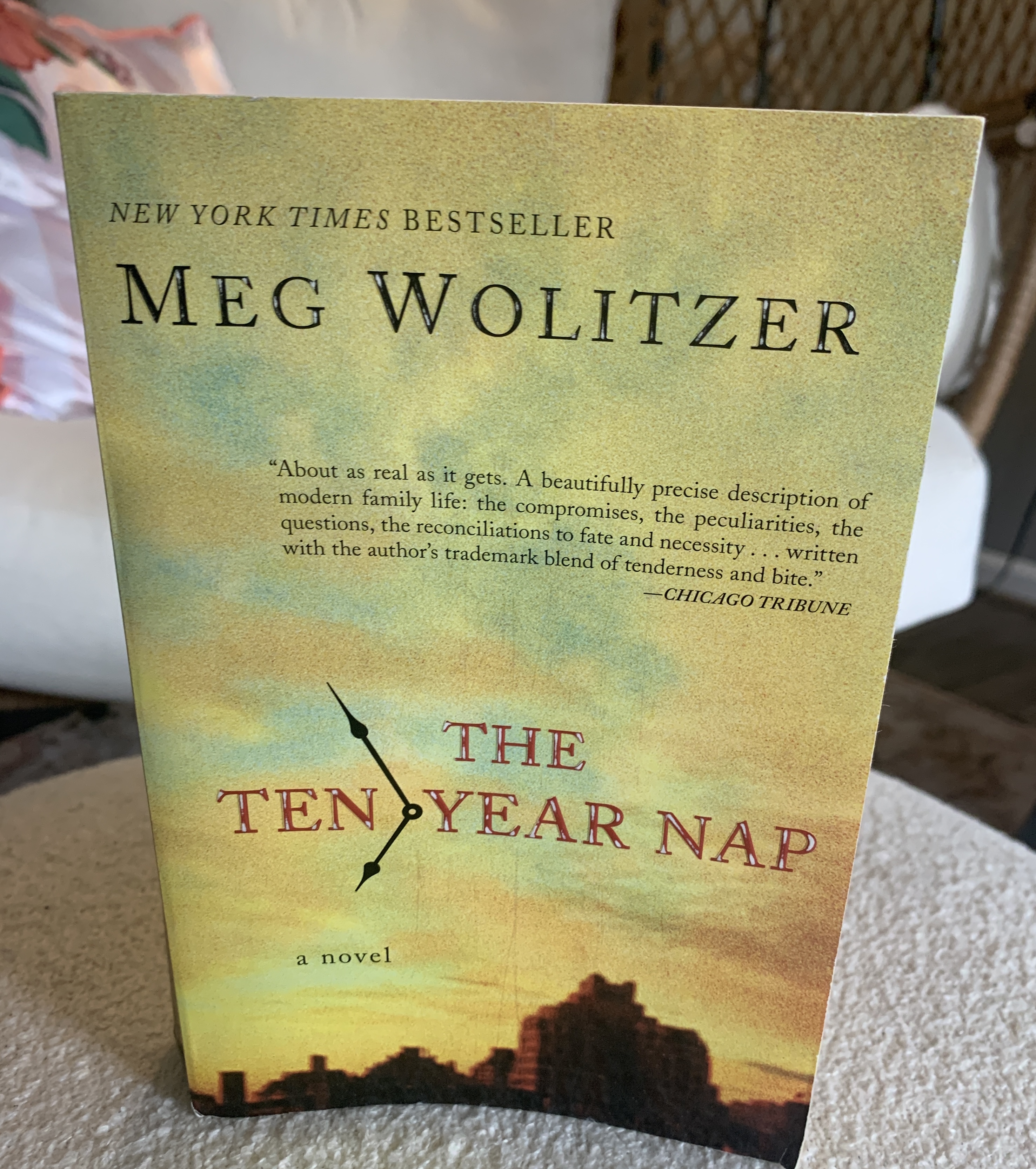
To ask someone, What do you do? is really a question about who are you because inevitability, what you do becomes inextricable from who you are. The tension between potential — that boundless word when associated with our youth, obfuscated in its ephemeralness by time — and domesticity has long enthralled me. Even my premise there of an axiomatic tension is itself revealing because is there a tension? To take a different path than potential once promised, and into domesticity, as it were, is that tension-creating? In Meg Wolitzer’s 2008 novel, The Ten-Year Nap, it certainly creates tension in the four 40-something moms, all of whom for one reason or another, are stay-at-home moms (as much as they detest that phrase). Motherhood is beautiful and chaotic, an agonizing Sisyphean dichotomy between almost unbearable attachment and necessary detachment. The machinations of one’s marriage also changes paths, as one’s potential did, and realigns in new ways as time warps and erodes. Wolitzer’s book is an incisive look at domesticity — the ways in which we live and navigate our lives — in all its complicated rawness. To use another one of those words that perhaps sublimates potential over time, balance, becomes the new questing: how do we achieve it, and what even is it exactly? Wolitzer’s characters arrive at an approximation of what that is, not with any sense of comforting closure, but a steady propulsion, nonetheless, which is perhaps a fine definition of domesticity: steady propulsion. Wolitzer’s book is one of my favorite reads of the year, or any year, owing to its realness about motherhood, marriages, and friendships, and in its realness, its resonance.
Before I dive into the characters, I’d be remiss if I didn’t remark upon how much Wolitzer’s book grabbed me from the start with its opening. The first line reads, “All around the country, the women were waking up.” That seems like a feminist clarion call, or a great catchphrase for the feminist movement. Instead, what it is here is literal: the alarm clocks going off and the women (of the novel) starting their day. The intrusive barrage of the alarm clock is like the siren song of domesticity except without the duplicity: it’s nakedly open about what it’s “singing about”. Wake up! Get the gears of modernity moving! With this opening, Wolitzer begins to tell the story of our first mother, Amy, and we learn so much through the opening alarm and her trying to rouse her 10-year-old son, Mason, out of bed and to get ready for school. Again, a very normal domestic picture painted here, but through the brushstrokes of Wolitzer’s adept, assured hand.
So, yes, Amy. Amy is married to Leo, both of whom worked and met at a law firm. As mentioned, once Mason was born, she stopped working and just never went back. They’re financially stretched rather thin, especially because Mason goes to a private school, and in fact, are stretched thinner than Amy realizes. That’s also because Amy prefers not to know about the finances. Amy’s mother, Antonia, we learn was on the precipice of the women’s rights movement (second wave feminism) in the early 1970s. In this flashback, we also learn that Antonia caught her husband, Harry, kissing his secretary in Montreal during a Christmas work party. The marriage persisted, albeit fundamentally altered. Antonia, like Amy does with her three friends at the Golden Horn coffee place and through yoga, meets with other women to talk through women’s issues. Even more rudimentary, they invite a woman to their house who allows them to examine her cervix in order for them to understand themselves better. After that first meeting, Antonia begins writing popular historical fiction about strong women.
Harry is virtually the only male point-of-view we get in the novel, even though all of these woman are married. With his small, but poignant, chapter, Harry is depicted as wistful about life and his three girls. He longs for the domesticity not afforded to him, and the ensuing closeness with his daughters that might engender.
As for Leo, his marriage to Amy isn’t great right now. In addition to the financial strain, they’ve stopped communicating as much, and Amy senses that when she communicates about her day, Leo isn’t listening or retaining anything (contrary to her ability to do so about his days). And, they’ve stopped having sex. Amy feels undesirable. Meanwhile, at work, Leo has a “work wife.”
Even though Amy has a core friend group of her best friend Jill, along with Roberta and Karen, when Jill moves out of New York City to the suburban neighborhood of Holly Hills — partly, it seems, due to the fear of terrorism brought upon by 9/11; an undercurrent throughout Wolitzer’s book is the political climate of the early 2000s, both in the wake of 9/11 and in the quagmire of Iraq and the resulting dismay of the state of the country, which felt resonant nearly 20 years later! — Amy becomes infatuated with another mom, Penny, because she’s having an affair with a British man named Ian (we get a brief interlude with Ian’s Aunt Lesley, who is the secretary to British Prime Minister Margaret Thatcher in 1981, with all its promise of a woman finally in power). It’s not so much that Amy is living vicariously through Penny’s extramarital affair, but that it’s a disruption of her usual domesticity. It’s exciting in that way. After Amy convinces Leo to take a trip to an expensive resort town with Penny and her husband, Greg, Ian, in his foolishness, decides to quite literally crash the gathering in a parasailing accident. That incident ends the affair after Ian is hurt, and because of Penny’s reaction — to avoid Ian in the moment of his unknown injury — it also ends the fleeting friendship Amy and Penny had. But it also serves to open up a new path, ultimately, for Amy and Amy’s marriage to Leo. She finds out that Leo’s been writing off things like the trip as “client business” to help their financial situation. This unmoors Amy from her view of Leo as an honest guy. She buries this information for a month instead of communicating it with him. However, when they do finally discuss it, it opens up the conversation about Amy returning to work. They also discuss their (lack of a) sex life. He feels fat, middle aged, and unsexy; the “work wife” is a lesbian, so of course he doesn’t want to sleep with her; and he resents that Amy never took an interest in their finances until now. At the end of the book, Amy has returned to work at a small law firm, and they seem to be on a better footing as a couple. At the very least, they are communicating more.
Jill is married to Donald, who I think is in finance. They couldn’t conceive, despite the usual slate of punishing treatments that turn sex unsexy, so they adopted a little girl from Eastern Europe named Nadia (so named after the formidable Romanian Olympian gymnast Nadia Comăneci, who also receives her own small interlude about how “work” for her doesn’t make sense; rather, she’s cleverly playing to escape the poverty of Romania and everyone keeps calling it “work”), who Jill fears is intellectually disabled. Worse still for Jill, she doesn’t feel the motherly attachment to Nadia that she thought she would. Certainly not in the same playful, doting way that Donald has. Yes, she’s still a devoted mother to Nadia, but in a more removed, stilted way.
Nadia’s mother, Susan, killed herself when I believe Jill was in high school. Susan was into Broadway before her older, rich husband, Bob, convinced her to be a stay-at-home mother.
For her part, Jill loves history, especially Civil War history, but failed with her dissertation and then failed working for ostensibly a feminist inspired Hollywood studio. She had won an award for someone who demonstrates the most promise (another way of saying potential!). Making all this more troubling for Jill is that she feels it’s more difficult to confide in Amy than ever, not even just because of the geographical distance now, but because of Amy’s infatuation with Penny. Jill’s jealous! Amy and Jill reconcile this later in the book, with Amy apologizing for being so self-involved and focused on Penny. Nadia does get tested, confirming what Jill suspected, but what she didn’t suspect was how endearing Nadia’s singing voice would be to a woman at the famed Juilliard School, which propels Nadia forward on that path. To close the loop on Jill, she returns to the school where she won that “most promising” award, and learns what came of the other women: stay-at-home mom; VP of marketing for a hotel chain, physician with the U.S. Navy, anthropology teacher, librarian, and sportswear designer. The takeaway, I think being for Jill, the promising path isn’t promised and isn’t inevitable. You never quite know where someone may end up.
Roberta is married to Nathaniel, with children, Harry and Grace. She used to be a figurative painter and then puppeteer, which is how she met Nathanial, who still does it on the side, but his main job to pay the bill is as a cameraman for CBS. She’s the most overly political one of the friend group, which makes what she ultimately does all the more brutal to read about. So, she travels to South Dakota for a reproductive rights group and assists a teenage girl, Brandy, in getting an abortion, just like Roberta had one as a teen. Brandy is also an artist and is enchanted by this New York City woman with her promise of connections to get Brandy’s foot in the door, and importantly, out of South Dakota. Initially, Roberta thinks she’ll use Amy’s connection to Penny, who works at a museum, but when that friendship flames out, she just … ghosts Brandy. I felt so bad for Brandy! But that ghosting is all too human as well.
Nathaniel’s puppeteering inexplicably takes off in his early 50s when the head of programming at CBS happens upon him playing around with his puppets. Roberta, who used to play the secondary puppet character with Nathaniel, is resentful that Nathaniel is going to offer that gig to his friend, the one who has been hustling on the weekends with him. Nevertheless, this opportunity allows them to improve their financial situation so much that they can move to a nicer place in Harlem, a place that also affords Roberta the opportunity to have an expansive art studio. Her art never takes off, though, and instead, she begins working at a local women’s charity. It’s serviceable. I feel like out of all the women, Roberta still had the most unresolved tension at the end of the book.
Wolitzer also provides an interlude with Roberta’s parents, Al and Norma, in Illinois. They unconventionally, for the early 1960s, are equal business partners in a centerpiece business. They don’t really take Roberta‘s work (or play?!) as a painter seriously. Brandy’s mother, Jo, also has an interlude showing her satisfaction with working at a casino supporting Brandy as a single mom and swearing off men forever, even though she’s only 40 years old.
Finally, there’s Karen, who has twins, Caleb and Jonno, with Wilson. He’s a banker, who makes a lot of money. While big into math and statistics, she left her analysis job when she had the twins. She claims she didn’t leave her job for the twins or Wilson though, but more so so as a sort of generational vindication for her hard-working Chinese parents and relatives. (Funny enough, we also get a brief interlude with her mom, Chu Hua Tang, who, along with the dad, worked in a restaurant in 1970s San Francisco. The mom basically thought Karen was lazy for always having her nose in a math book instead of working.) Karen loves her husband, their marriage, and their life. While she goes for job interviews for the fun of it, she’s not actually interested in working and doesn’t care what anyone thinks. Wilson feels the same. Karen and Wilson epitomize that “steady propulsion” domesticity I mentioned. Karen experienced the least amount of tension in the book as a result.
Wolitzer’s book felt like a true rendering of the delightful mosaic of human experiences, from motherhood to womanhood to marriages, and that balance between children and spouses, work and children, past potential and present reality. Inevitability, we tend to derive a lot of our identity and sense of self-worth from what we do. Again, what we do becomes who we are. After all, as one of the moms thinks about, it’s a very American thing to begin conversations with, “What do you do?” in order to make a flash judgment of someone. But of course, work is not all of what we are and/or can be. By the same measure, surely the same is true of motherhood or one’s marriage, right? Which is why I think Amy, Jill, and Roberta, at least, felt that tension to do something. To have a sense of propulsion. As if they had awakened from a 10-year nap.


