
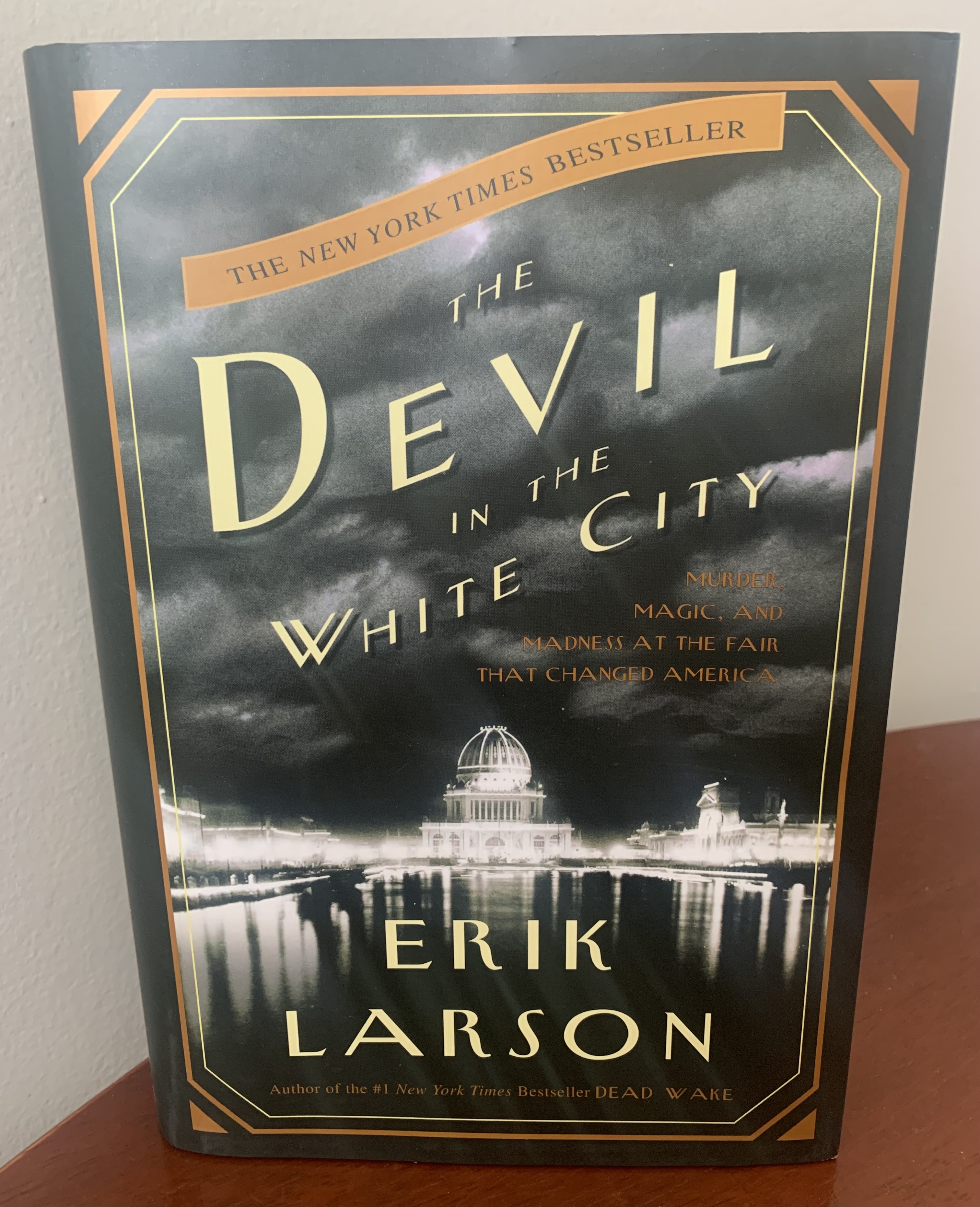
In the late 1800s, America was emerging into something resembling more the country we know today, and that particular story is not so black and white, as it were. Erik Larson’s 2003 book, The Devil in the White City: Murder, Magic, and Madness at the Fair That Changed America, describes how the best minds of America reached for the skies to dazzle while the worst plunged the depths of evil taking advantage of the chasm opening up between the old and new worlds. So much of what we know of today — the Ferris wheel, the first mass use of light bulbs, Juicy Fruit, Shredded Wheat cereal, spray paint, the City Beautiful movement, and indeed, the all-too familiar intrigue of serial murder — found its roots in the splendor and squalor of this time. While all eyes were turned toward the gleaming White City, an all too sane and calculating madman was killing young woman ensnared by the gravitational pull of that city and his charm. Astonishing in equal measure and direction, Larson’s writing brings to life an America yearning to be bigger and greater than ever before while a predator moves about the Windy City. Larson’s poetic prose shows a writer in full command of his craft. Nobody quite does historical nonfiction like him.
Before the age of globalization and mass media, the way the world learned of other cultures, new inventions, products, architectural designs, and so on was often to host grand world fairs or expositions to display human ingenuity. The expositions also tended to coincide with some major anniversary pertinent to the host country. After Paris held an exposition in 1889 where Gustave Eiffel unveiled his famous — and at the time, tallest — Eiffel Tower, America endeavored to not only a host a bigger event — Paris had what was considered the world record for a peaceable single day attendance — but to “out Eiffel Eiffel.” The American fair was sought to celebrate and coincide with the 400-year anniversary of Christopher Columbus “discovering” America in 1893. Appropriately then, the fair came to be known as the World’s Columbian Exposition. Numerous American cities proposed to host the fair, including New York City, Washington D.C., and even St. Louis, but the most forthright contender was Chicago, the “Windy City,” aching to be thought of as more than a hog-infested industrial backwater. The Exposition became as much about showing off America to the world as it did about showing off Chicago to America. Chicago won. One of the most remarkable aspects of the Exposition, among others, is the unbelievably short time frame the architects assembled to build the fair had to do so. First, they had to turn Jackson Park in Chicago into a suitable site in which to build, given the topsoil issue that had long plagued builders. Secondly, Frederick Law Olmsted, the landscape architect behind Central Park in New York City, had to make the landscape look beautiful and only could do so after construction was complete on the buildings. If I recall correctly, Olmstead particularly agitated for Jackson Park because of the prominence, and ability to play off of, nearby Lake Michigan. Third, obviously, they needed something that would out Eiffel Eiffel and it couldn’t simply be a taller or bigger tower; been there, done that. Daniel Burnham and Wellborn Root, who owned an architectural firm in Chicago, were primarily in charge of designing the fair, and cajoling the other famed architects of the period to assist. The main feature of the design would be the enormous 14 neoclassical buildings with their “staff” (temporary facade) painted white, hence “White City.” This collection of buildings would be known as the Court of Honor. And perhaps the most remarkable fact is they did so knowing that after the fair’s six-month run in 1893, everything would largely be demolished. While that seems ephemeral in nature, as alluded to, its legacy has long outlasted its facades.
Because of the fair, hoteliers expected a lot of travelers to Chicago, which spurned on development, especially in the nearby suburb of Englewood. Englewood is also where Dr. H.H. Holmes, alias to his real name of Herman Webster Mudgett, became an architect in his own right and in his own evil way. He built a hotel for guests ostensibly, but it was also his secret lair for killing women, with a giant kiln designed in the basement. If Holmes wasn’t a sociopathic killer, he still would have been an awful human being because his time in Chicago (and every other city) is marked by swindling laborers, insurance, loan, and real estate fraud, and theft and deception with women (I began to lose track of how many legal or ostensible marriages he was in!). Larson early on doesn’t mince words with how to describe Holmes’ machinations in Chicago. He says of Holmes being impressed by Chicago that it was surprising because nothing impressed Holmes. “Events and people captured his attention the way moving objects caught the notice of an amphibian: first a machinelike registration of proximity, next a calculation of worth, and last a decision to act or remain motionless.” From the start, Larson’s depiction of Holmes, this predator moving into the Windy City, made my skin crawl. One of his first acts was to swindle Dr. Holton’s widow, who now owned a local pharmacy after his passing, to sell the store to him. Holmes most certainly killed her thereafter. The story he concocted was that she left and settled in California. Many young women now began patronizing the store because of the “young, handsome, and apparently unmarried young doctor now behind the counter.” It’s also worth noting that Holmes did have accomplices in Englewood, among them Charles Chappell, Patrick Quinlan, and Benjamin Pitezel, a carpenter, who would become Holmes’ downfall. A district attorney, though, described Pitezel as Holmes’ “tool, his creature.” Larson also describes Holmes as a creature, raising his head in “equally intent anticipation,” as the White City’s blueprints formalized. Holmes would go on to say, “I was born with the devil in me. I could not help the fact that I was a murderer, no more than the poet can help the inspiration to sing.” The other macabre fact of the day was that doctors routinely pilfered gravesites for corpses to use in medical education and for medical students. This made it easy for Holmes to dispose of bodies under the guise of the accepted norms of the day regarding donating bodies to science. As an example of how it worked, he lured a woman named Julia right out of her relationship with her husband, Ned, who was working at the pharmacy. Julia had a young daughter named Pearl. He almost certainly killed both of them. Shortly thereafter, LaSalle Medical College of Chicago received a skeleton. Oof.
Speaking of death, the White City seemed doomed from the beginning, owing to the shortened timeline, pressure, expectations, turbulent weather, labor unrest and strikes, disease (a chorea epidemic was ongoing in Europe and Chicago had tainted water as it was) the simmering incoming Panic of 1893, the proliferation of committees and red tape decision-makers undercutting Burnham, and ultimately, the premature death of Root from pneumonia, who people thought was the true genius behind the Burnham and Root pairing. On the labor point, the fair became a central rallying crying for the adoption of the minimum wage and an eight-hour work day. In addition to low pay, the workers also faced potential death from skull fractures and electrocution that Burnham didn’t want to mar his fair. Eventually, Burnham relented and established a minimum wage and to pay time and a half for extra hours and double time for Sundays and key holidays, including Labor Day. I believe the deal only applied to the carpenters and ironworkers.
Ahead of the dedication for the fair, Francis J. Bellamy, an editor for Youth’s Companion, thought it would be a “fine thing if on that day all the schoolchildren of America, in unison, offered something to their nation.” He wrote a pledge and sent it to the Bureau of Education, which then mailed it to every school. It began, “I pledge allegiance to my Flag and to the Republic for which it stands …” I had no idea of the Pledge’s origins until now. It’s incredible the staying power Bellamy’s Pledge has had on American society and the controversy it’s generated throughout our history. Meanwhile, George Washington Gale Ferris — Larson had appropriately been coy in revealing the name lest he give away who and what was to out Eiffel Eiffel — submitted his proposal for the Ferris Wheel: 250 feet in diameter, a bit more than 300 hundred feet tall (higher than the Statue of Liberty, only erected six years previously), and with 60 people filling each car for a total of 2,160 people. It must have seemed, and by Larson’s telling, it did seem, insane at the time. How could this possibly safely stand, especially in the Windy City of all places? But it did, and it became wildly popular. In the week beginning July 3, Ferris sold 61,395 tickets for a gross return of $30,697.50. With the Exposition Company taking half, Ferris made an operating profit of $13,948, or about the equivalent of $400,000 in 21st century money.
Fairgoers were paying 50 cents for admittance to the fair. That would be needed due to the exorbitant cost to construct and operate it: $22 million, or about $660 million today. Not only was Burnham feeling the pressure to recoup the costs of the fair and make a profit, but to break Paris’ attendance record. He enlisted the help of Frances Davis Millet, a painter, to market and encourage Americans to visit the fair. Millet is also the one who invented the spray paint technique to quickly paint the Court of Honor buildings white. (Millet would go on to die in the sinking of the RMS Titanic.) What became known as “Chicago Day” on October 9, 1893, broke the attendance record. In that single day, 713,646 people paid to enter Jackson Park, with another 37,380 visitors using passes, for a total of 751,026 people, the most anyone had attended any single day of a peaceable event in history. The Paris record was 397,000. Chicago shattered it. To put that into perspective, during a time when there were about 65 million Americans, the equivalent of today would be if nearly 4 million Americans (out of a population of 320 million Americans) attended a single-day fair.
Notable attendees to the fair included Houdini, Nikola Tesla, Thomas Edison, future president Woodrow Wilson (then a Princeton professor), current president Grover Cleveland, Susan B. Anthony, and future president Teddy Roosevelt. Frank Haven Hall, who already invented a machine capable of printing in Braille (which he didn’t patent on the belief that nobody should profit from serving the blind), created a new device that made plates for printing books in Braille. He then ran into Helen Keller, who thanked him. Interestingly, Larson says Mark Twain came to Chicago to see the fair, was sick for 11 days in his hotel room, and never ended up seeing it.
Another notable individual working the fair at the time was the young Sol Bloom, who worked on the sideshow acts within the Midway Plaisance, introducing the term “midway” to describe the area of the fair where such sideshow acts are. One of the acts was an Algerian version of the belly dance. He forever changed America’s perception of the Middle East: he improvised for the press a song the pianist could play as the belly dancers did their dance. It came to be associated with a cobra emerging from a basket — yes, that tune. He failed to copyright the song that would have surely netted him millions. Again, it’s fascinating to me how such cultural landmarks, as it were, erroneous as they may be, become embedded and longstanding.
Back to the macabre. While Holmes was doing his dark deeds, there was another insidious presence lurking throughout the Windy City. Patrick Eugene Prendergast assassinated beloved five-term Chicago Mayor Carter Harrison III in his own home. The shooting occurred only a few days before the close of the fair in what was hoped to break the record set on October 9. Instead, it turned into a memorial for Harrison. Prendergast thought he was owed a job in Harrison’s office and was frustrated when it didn’t come to be. Meanwhile, Philadelphia Detective Frank Geyer, who became nationally known in America, was on the hunt for uncovering Holmes’ true misdeeds a few years after the fair ended. While Holmes was already arrested for insurance fraud (finally), it was Geyer, along with the help of various detectives in cities across the United States, as well as in Toronto, who tracked down the demise of the Pitezel children, Alice, Nellie, and Howard. Holmes even stopped over in Cincinnati with the children, moving from hotel to hotel to confound anyone looking into his activities. Supposedly, he took the children to the Cincinnati Zoo. He would bury Alice and Nellie’s bodies in Toronto, where Geyer found them. Howard remained missing until Geyer found his remains in Irvington, a neighborhood in Indianapolis. Holmes had also killed Benjamin, their father and his one-time accomplice. Geyer pegged Holmes right away as a sociopath before that term was in use (I like the phrase they used instead “moral imbecile”); he could tell that Holmes was attempting subterfuge and dominance through charm and his seeming obsequiousness. Holmes even tried to further control the narrative of his proclaimed innocence by writing and publishing a memoir. To no avail. America was aghast. He was hanged and killed.
Why was the White City a vision of the future for cities and what spurned the City Beautiful movement? Well, it was in stark contrast to the “Black City,” so named for Chicago proper because of the smoke and garbage. In the White City, which also had its own police force and fire department, there were clean public bathrooms, pure water, electric streetlights, and a sewage-processing system that yielded acres of manure for farmers. Other remarkable things included the first zipper, electric kitchen, automatic dishwasher, Aunt Jemima’s, Cracker Jack, and Pabst Blue Ribbon. More macabre, fairgoers also saw the first electric chair. Years after the fair, into the unfolding 20th century, it did seem ephemeral, though. Few who helped make it happen were around anymore. Olmstead died from dementia without his wife even attending his burial. As mentioned, Millet died in the Titanic disaster. Burnham died 47 days later. Even Ferris didn’t fare so well after the novelty of his Ferris wheel wore off. He sold his ownership of the wheel, and his wife, one of the first people to test the wheel as a passenger, separated from him. Shortly thereafter, he died of typhoid fever at only 37 years old. His wheel was dynamited for scrap. Notably, Bloom made out well, though, becoming a Congressman, who was one of the crafters of the charter that founded the United Nations. But as Larson shows throughout his riveting book, the World’s Columbian Exposition spurned much in the way of innovation, design, culture (even if some of it silly), and a new mindset about cities, their possibilities, and the power of them for engendering civil virtue. But the World’s Columbian Exposition is also inextricably bound up with the stories of Prendergast and Holmes. Which, again, is the story of America: the glitz with the violent blitz, the intentionally beautiful with the unexplainably awful. America is a land of wild contradictions and within those contradictions is a sight to behold, for good and for ill. Larson writes it as poetically as such a subject deserves, capturing both the grandeur and intimacy of the time.


3 thoughts