
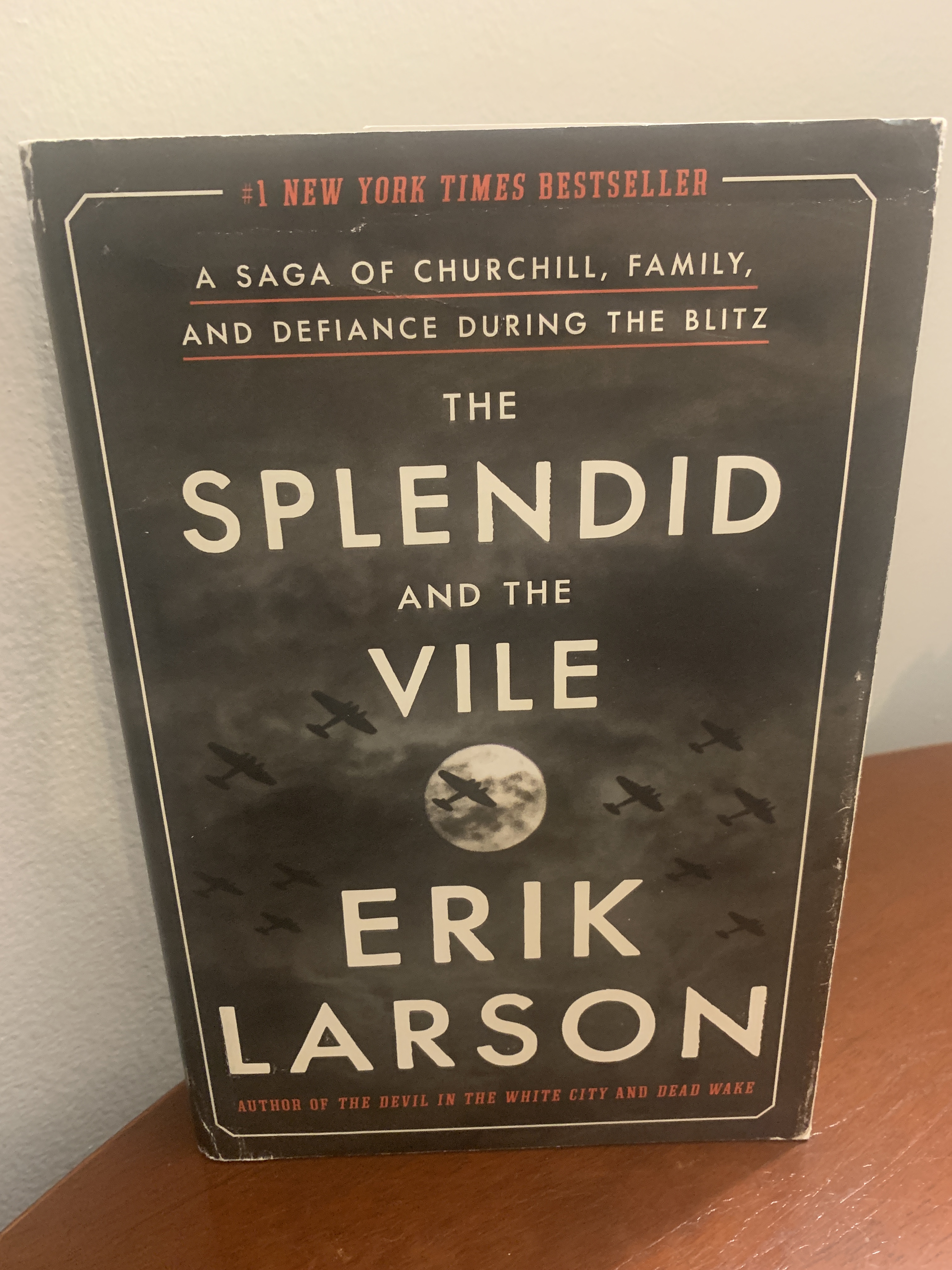
Like any nerd who reads history, of course I’m as infatuated as the next person by the Great People of history — that’s why biographies are fun to read! — but what makes history come alive and truly hum, as if I’m a visitor observing the unfolding events, is when the historian elucidates the Great People and Events through the secondary characters and their day-to-day lives. That’s what makes Erik Larson’s books so engrossing to read. I recently reviewed his 2002 book, The Devil in the White City, and last year, his 2011 book, In the Garden of Beasts. Now I turned to another WWII book of his, 2020’s The Splendid and the Vile: A Saga of Churchill, Family, and Defiance During the Blitz, an area of the war I don’t know as much about, but for which I was I’ve always wanted to learn more. This was also a fitting follow-up (coincidental) to Philip Roth’s 2004 book I most recently reviewed, The Plot Against America, with a fictionalized alternate history where Charles Lindbergh’s 1940 presidency changes the dynamic of Winston Churchill’s first year as British Prime Minister facing down Hitler. The peculiar dynamic of the Blitz against London (and surrounding cities) is how much of daily life persisted in defiance of the bombs and incendiaries falling. By necessity, it must, after all. That is the why of it. Jock Colville, one of Churchill’s private secretaries, who kept an extensive diary he later published (omitting some of his romantic hopes he deemed frivolous, but which Larson rightly thought illuminating), talked about how surreal it was to see bomb’s falling into the heart of one’s capital city, “one’s home.” And yet, there was an odd beauty to it, too. The night sky, with the stars and the rising moon, coupled with searchlights, bombs bursting, and distant fires created a contrast of “natural splendor and human vileness.” Hence, the name of the book, this dichotomy and those ensnared by it and orchestrators of it.
As I said, what makes Larson’s book sing and so accessible to read as a work of nonfiction is that, yes, we are with Churchill through his irascibility, his soaring oratory, his tears, his copious cigars (one inexplicably described by Colville as 24-inches!), his proclivity for naps, baths, and brandy, as well as his growing-ever-more-dire letters to American President Franklin D. Roosevelt when America was still maintaining neutrality with an isolationist fever predominant among the public, but we also gain a sense of the milieu from his lively daughter, Mary; his aforementioned private secretary Jock Colville; and Churchill’s two close confidants during the war, Lord Beaverbrook, who threatened resignation 14 times in less than a year to get his way, and Frederick Lindemann, “The Prof.” Larson also provides color from the other side through an ace bomber with the Nazis, Adolf Galland; the eccentric and evil Luftwaffe (German air force) leader, Herman Göring; and the vile Nazi propagandist himself, Joseph Goebbels. Moreover, so as not to be voluminous like other works covering Churchill and this period, Larson deliberately focuses on the first year of Churchill’s tenure as prime minister, which happened to coincide with the German threat of invasion and onslaught against London: May 10, 1940, to May 10, 1941. This tight focus allowed for Larson to show excerpts from Mary and Colville’s diaries, intimate moments with Churchill, or talk about Churchill’s son, Randolph’s, unyielding gambling, drinking, and philandering.
Churchill’s early “epiphany” upon assuming office was that the way “through the war” was the United States, saying, “I shall drag the United States in.” Indeed, what became clear from the outset as Churchill also assumed the great power and responsibility to fortify Londoners, and all of England’s, mettle against the Nazis — including the always-looming threat of invasion — is how clear-minded and steadfast he was about needing the help of America and FDR while also knowing how delicate the “ask” was. In other words, as mentioned, he knew how sensitive FDR was to the American public’s opinion about getting dragged into another European war, but also, in order for Churchill to bring to bear the courage of Londoners, he couldn’t be seen — and England couldn’t be seen — as in desperate need of America’s help, even if they were. Of course, from this American’s perspective and with the assistance of hindsight and distance, it’s maddening that we needed to be pulled in, and that FDR had to be so sensitive of public opinion, lest he lose his bid for a third term in 1940 to Wendell Wilkie. For all sorts of reason that didn’t have anything to do with what would eventually bring us into the war in earnest, Pearl Harbor, we ought to have already been involved as a belligerent: the Holocaust; Nazis conquering neighboring states, often brutally killing and oppressing civilians in the process; and the fact that one ally, France, had already fallen, and another, England, was on the precipice of the same fate. but I digress.
Thankfully, the Nazis were losers. Dangerous losers, but losers nonetheless. What I liked about Larson showing perspectives of the Nazis throughout the book is to see how they thought England would be brought to heel through the Luftwaffe and the mere threat of invasion. Indeed, Hitler in August 1940, was already preparing the grandstands in Berlin for the victory parade that would mark the end of the war. The war would go on for nearly another five years until Germany’s surrender in May 1945. Hitler killed himself. Goebbels killed his six youngest children, and then him and his wife killed themselves. Göring was captured, interrogated, and sentenced to death, but also killed himself the day before his execution. Losers. (The other Adolf, Galland, the bomber, survived the war actually and was taken prisoner; he was later released and lived until 1996!) Why didn’t Hitler greenlight Operation Sea Lion, the invasion of England? Because of the inherent difficulties of conquering England by land with an inferior navy and because of his true desire to turn to the East and conquer Stalin’s Soviet Union. The Nazis underestimated England, but directionally different, to some extent, England overestimated the power and brains of Nazi Germany, and somewhere in the middle is where England persisted.
An additional helpful two-fold look into the lives, particularly of ordinary Londoners — after all, Mary and Colville, owing to their proximity to Churchill, didn’t exactly have the most ordinary outlook during the war, albeit, the bombs and fires touched everyone, as it were —, was the Mass-Observation diarists enlisted to discuss their observations of London during the Blitz, including the desire to have sex because who knew what tomorrow would bring, and Home Intelligence, which gauged the mood and morale of Londoners throughout the bombing campaign and with every new magic of oratory Churchill offered. Although it must be said, one of the most amusing things to me is that Churchill would give what we now consider some brilliant line of oratory or overall speech and the contemporary people, like a Colville, would not recognize it as such! If anything, though, Churchill’s speeches were doing what they intended: endearing him and England’s cause to Americans and FDR. As an example of what I mean about Colville, Churchill addressed the House of Commons in August 1940, about one of two ways the U.S. would help England’s efforts to stave off the Nazis short of active involvement, the Destroyers-for-Bases deal, where the U.S. would transfer 50, almost seemingly worthless, destroyers to England in exchange for 99-year rent-free leases to establish U.S. military bases in British territories (clearly a better deal for the U.S.). He pitched the deal to the House of Commons not as a lopsided deal, but as a way of enmeshing the interests of England and America. Likening this enmeshing to the Mississippi River, Churchill continued, “Let it roll on full flood, inexorable, irresistible, benignant, to broader lands and better days.” But the real soaring line that history remembers came when Churchill referenced the achievements of the Royal Air Force, or RAF, in defending England: “Never in the field of human conflict was so much owed by so many to so few.” What a line. Colville’s response: “the speech seemed to drag,” adding that that particular line didn’t strike him very forcibly at the time. Alrighty then!
The second way in which the U.S. became involved, aided by FDR’s reelection to an unprecedented third term in 1940, was the Land-Lease Act, which allowed the U.S. to become what FDR called the “arsenal of democracy”: providing England and other Allied nations with food, oil, and war materiel. The Allies needed America’s incredible industrial and economic output, and crucially, without expecting the Allies to repay it. By this point in the delicate dance Churchill was playing with FDR, Henry Hopkins, FDR’s right-hand man, was in England surveying the bombing and most importantly, getting a sense of Churchill’s character to report back to FDR. Indeed, at a dinner in Glasgow, Hopkins turned to Churchill and uttered quite the understatement: “I suppose you wish to know what I am going to say to President Roosevelt on my return.” As Larson noted, Churchill was “desperate to know how well his courtship of Hopkins was progressing, and what indeed he would tell the president.” Hopkins proceeded to quote from the Bible’s Book of Ruth: “Whither thou goest, I will go; and where thou lodgest, I will lodge: thy people shall be my people, and thy God my God.” He added his own flourish at the end, “Even to the end.” I had goosebumps reading that originally and again while typing it here. I also was teary-eyed. That singular moment from the American Hopkins to the beleaguered Churchill, the grizzled, cigar-munching face of England, represents the best of America and the American spirit. Perhaps it especially resonated with me at a time when America is not so great, not so suffused with this spirit, especially toward our allies, including Britain. I also love, by the way, how many times Larson mentioned that Churchill wept, including after Hopkins quoted the Book of Ruth. Great leaders, like Churchill, have the courage to openly weep. It is not weakness or unmanly. It is deeply human and endearing.
But I return now to Colville’s dichotomous sense of the splendor and the vile. It’s difficult to truly imagine what it would have been like to endure and witness the bombing of one’s own city, relentlessly, night after night. To have it as part of your routine to live with nightly blackouts (so the German bombers couldn’t easily find targets) and going to nearby, indubitably squalid and crowded, bomb shelters. Larson provides one of the most striking quotes from the book early on, as Londoners prepare for the onslaught they expect to come. Writer Rebecca West described how beautiful that summer was, which only heightened the anxiety since that would surely make it easier for Hitler’s bombers, noting her fellow citizens sat with “their faces white with strain” looking at the roses. “Some of them walked among the rose-beds, with a special earnestness looking down on the bright flowers and inhaling the scent, as if to say, ‘That is what roses are like, that is how they smell. We must remember that, down in the darkness.'” Wow. Take Coventry, a city about 107 miles outside of London, as an example of what one awful, atrocious raid by the Nazis could do: 568 civilians killed, with another 865 seriously wounded. The onslaught lasted for eleven hours, with 500 tons of high explosives and 29,000 incendiaries dropped, outright destroying 2,294 buildings and damaging 45,704 more. Mass burials had to be done thereafter. Again, it’s unimaginable. But I think a lot of British, including Mary, were “thrilled” in a sense to find out that when they were tested by being bombed, they didn’t wither and flake. To be sure, much fear, terror, and sadness abounds, and surely, grief at the incalculable losses of human life, art, history, homes, and so on, but I thought that was an interesting dynamic, too. Humans love to be tested, to know what their guts are worth when everything is on the line. For Mary’s part, specifically, there was one night where she and her friends — she only just turned 18 — are dancing at one club, with the hopes of going to another nearby club when that club is brutally bombed. They go to a different location and keep dancing! She felt a bit ghastly about that, and yet, there is something to that ability to “carry on.” Overall, between September 7, 1940, with the first large-scale attack on London, and May 11, 1941, when the Blitz largely abated (Germany turned its focus to the Soviet Union), nearly 29,000 citizens were dead and another 28,556 seriously injured. Again, that’s just London. Throughout the entirety of the United Kingdom across 1940 and 1941, there were 44,652 civilian deaths and 53,370 citizens seriously injured. Of the dead, 5,626 were children. While America lost 2,402 Americans in the December 7, 1941, Japanese attack on Pearl Harbor, with another 1,178 wounded, it’s difficult to imagine what the political temperature of America would have been with the losses London alone endured.
After finishing The Splendid and the Vile, the best comparison I can think of is to Doris Kearns Goodwin’s powerhouse 2005 book about Abraham Lincoln I read and reviewed earlier this year, Team of Rivals, in two important senses. First, just as I felt like I was there with Lincoln and his team throughout the machinations of the American Civil War, I felt like I was there with Churchill and his team and his family throughout the onslaught of the Blitz. Secondly, just as I felt like I came to know who Lincoln was as a person beyond the hagiographical, I felt the same about Churchill. I was invested. And a bit sad when the book ended that my time with Churchill had also ended. Once more, I especially feel this at a time where we have a dearth of true, courageous leadership — and I’d be remiss if didn’t mention how much I admire Churchill’s willingness to blend soaring optimism with realistic candor when talking to the citizens of England. To belabor the sentiment, I wish we had that now. We need that now to usher us into a third American founding. But I digress.
Every Larson book I’ve read has been accessible in the best way by bringing the reader into the day-to-day lives of its towering figures and historical moments — to bring history alive and in full bloom. The Splendid and the Vile is no different and is all the better for it.


