
Spoilers!
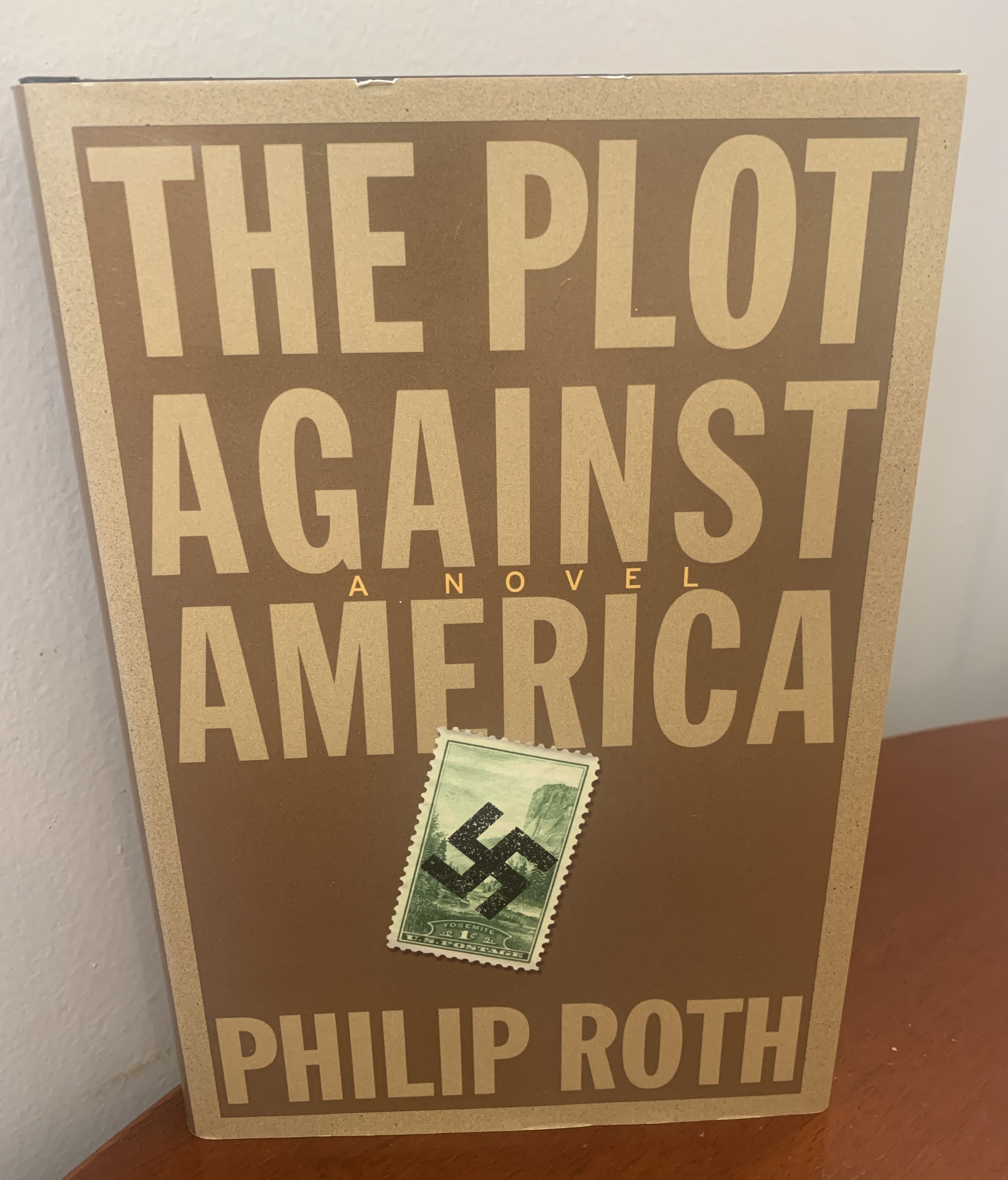
History as it’s unfurling is harrowing, unpredictable, all of which is then rendered inevitable once it becomes studied history. Which makes alternate versions of history so compelling to consider: what if history unfurled in a different way? Philip Roth does this by imagining an America that turned far more outwardly antisemitic and fascist during WWII in his epic 2004 novel, The Plot Against America. As Roth notes about history in his book, “The terror of the unforeseen is what the science of history hides, turning a disaster into an epic.” That is what Roth has done, influenced by real historical figures and their actions. It was never inevitable that America would be on the right side of the Nazi question … until it was. Roth’s book is important as an almost prescient clarion call to what happens when we find ourselves in the “terror of the unforeseen,” while also achieving the aim of any great work of fiction: being enthralling. Roth’s book takes its place among my favorite reads ever.
Charles Lindbergh, the famed aviator, ultimately parlayed (and later nosedived) his fame and celebrity into a crusade against U.S. involvement in WWII — going so far as to meet with Nazi Germany and accept their Service Cross of the German Eagle for service to the Reich — all of which was buoyed by virulent antisemitism. In Roth’s alternate history, instead of President Franklin D. Roosevelt winning an unprecedented third term, he’s defeated by Lindbergh on Lindbergh’s campaign to keep America out of the conflict. It was particularly brilliant how Roth had Lindberg campaign: by flying his famed Spirit of St. Louis to every city and hamlet in the country winning over voters with his isolationist message.
In Newark, New Jersey, the fictionalized Roth family of Philip’s father, mother, older brother Sandy, and Uncle Alvin, are aghast at what Lindbergh’s election victory could portend for Jews in the United States. Because it’s not just passivity in the face of Nazism and Hitler’s dominance over Europe (and later, the Soviet Union), as well as acquiescence to Japan’s ambitions in the Pacific, that Lindbergh is offering, but the ominous threat of a pogrom similar to what the Nazis are undertaking in Germany, Poland, and elsewhere.
Philip narrates the story, as an 8-to-9-year old boy, which is a great way to tell this story because of how unnerving global war and individual persecution must be from the perspective of one so young. Indeed, Philip and his friends make a game of war at the beginning of the novel, as children may do to make sense of it, detached from the reality of the thing, but as the book progresses, he becomes more and more alarmed and psychologically bombarded with the hard truths revealed by “Lindberg’s America.” So much so, that twice he tries to run away from home and become an orphan by choice. The worst of these psychological bombardments is seeing the veil of imperviousness we put over our parents lifted. For Philip, that’s realizing his dad, no matter how stubborn and righteous, is incapable of protecting his family in this new America, and when he sees his mother cry and breakdown — this previous stalwart of the Roth household. Add to that, his brother, his hero, is confounding, especially when Sandy is subsumed into the newly-created Office of American Absorption’s “Just Folks” program. The ostensible goal of the OAA’s program is to take Jewish boys, like Sandy, from their homes in the metropolitan cities and resettle them for a period of time with exchange families in the South and Midwest to Americanize them. Even the ostensible goal is abhorrent to me, but of course, the more insidious goal, as Roth’s parents recognize, is to separate the Jewish family, the Jewish community, and the Jewish vote. Sandy embraces it, though, leaning into his time in Kentucky with a Kentucky twang and extolling the virtues of tobacco farming. So brainwashed has this 14 year old become, he calls his parents “ghetto Jews,” resulting in the dislodging of my jaw as it met the floor. Alvin, for his part, orphaned and raised by Philip’s father, is even more righteous than him against Nazi Germany. Propelled by his anger, he runs to Canada to join a commando unit taking the fight to Germany and promptly gets his leg blown off. When he returns to the house, Philip has to deal with this other hero of his being diminished and neutered, but he takes up the task of “nurse” with aplomb and dedication, nonetheless. And finally, perhaps most jarring of all for the whole family is that it was bad enough Lindbergh defeated FDR, but it’s even worse that he’s done so with the help of a prominent Jewish rabbi named Lionel Bengelsdorf, who campaigned on Jews accepting Lindbergh. The terribleness is unabated as Bengelsdorf, 63, then marries Philip’s aunt on his mother’s side, who is 30-something.
As mentioned, Lindbergh’s big move is to keep the United States out of WWII, so he signs the “Iceland Understanding” with Hitler and the “Hawaii Understanding” with Japan that essentially we won’t stop their imperial ambitions. Lindbergh remains popular, despite one of the most popular syndicated columnists and radio personalities of the time (and a real-life figure who despised Lindbergh and the Nazis), Walter Winchell, raving against him. Eventually, Winchell would seem to mount a campaign against Lindbergh, only to be assassinated, which further adds to the tumultuous climate of the time.
The crazy-making part of this alternate history Roth has created, which echoes our current historical moment, is the Bengelsdorfs of the world who ally themselves with the powerful who want to destroy them thinking — to use a phrase from our moment — the “leper will not eat their face,” as well as the contingent of people who downplay the seriousness of the threat and what could come. The ones who are sounding the alarm, like Winchell, are considered fanatics and indeed, alarmists. Even the rather banal New York Times in this timeline, denounces Winchell’s remarks against President Lindbergh. Roth zeroes in on this crazy-making dynamic when the family is at Mount Vernon, George Washington’s home (they are on a trip to D.C. and decide to see Mount Vernon, too), and Lindbergh does a flyover to the elation of the crowd — in other words, from his election on, Lindbergh’s antisemitism and acceptance of Hitler and the Japanese Emperor have not been dealbreakers with these Americans — and what is at play when he says from Philip’s dad’s perspective, “We knew things were bad, but not like this. You had to be there to see what it looked like. They live in a dream, and we live in a nightmare.” For the past 10 years, that dichotomy could be etched on the epitaph of the American experience under Trump.
During FDR’s tenure as president, the German American Bund was routed by his administration and the FBI. After Lindberg assumes power, though, the German American Bund sees a resurgence, which echoed to me the many far-right elements’ excitement upon Trump’s first term in office, and then later, the revisionist history around January 6 during his second term. Also like now, the Lindbergh administration starts being staffed with figures who never should see power, like Henry Ford, the famed automaker, who became an outspoken antisemite. Perhaps the most outwardly odious moment, aside from the Iceland and Hawaii Understandings, is that Lindbergh invites Joachim von Ribbentrop, Hitler’s chief foreign policy adviser, to the White House for a dinner and party. Again, the Roth family is aghast, while Bengelsdorf and Philip’s aunt giddily dance with him. It’s those kind of reversals of how we understand right and wrong that add to the crazy-making both for Roth’s family in this fictionalized world and in real life now.
The climax of the book sees Lindbergh go on another one of his flying excursions with the Spirit of St. Louis only to disappear. Shortly thereafter, Vice President Burton K. Wheeler (real-life political figure who allied himself with Lindbergh) assumes the presidency and declares a state of martial law in the United States and closes the borders with Canada and Mexico. He’s also threatening to invade Canada, thinking perhaps they’ve kidnapped Lindbergh in an elaborate plot to bring FDR back into power and draw the United States into WWII. Throughout the country, hundred of Jews are attacked and killed, including the mother of one of Philip’s friends, who relocated to Kentucky (at his say-so to his aunt to prevent his family from going). Philip’s father and Sandy make a harrowing drive from Newark to Kentucky as this is all unfolding to bring the kid home. I will say, as now, what brings solace to dark times are the unwavering Americans who maintain that proper understanding of right and wrong. In this story, the new Italian family living in the same building as the Roths help them, as do the tobacco farming family Sandy stayed with. The leopards, though, come for Bengelsdorf, who is arrested by the FBI on suspicion of being “among the ringleaders of the Jewish conspiratorial plot against America.” Indeed, the title of Roth’s book echoes the twin dynamics here: the aforementioned conspiracy-minded belief in the Jewish “plot against America” that ushered Lindbergh into power, and from the perspective of those opposed to him, he is the “plot against America.” Soon, Lindbergh’s wife, the former First Lady, Anne, is involuntarily committed to Walter Reed Army Hospital for “extreme nervous exhaustion.” More arrests come, including of Supreme Court Justice Felix Frankfurter, New York Governor Herbert Lehman, and New York City Mayor Fiorello La Guardia. Then, FDR himself is arrested “for his own protection.” Amid all of this, the great orator and statesmen, Winston Churchill, tries to rouse Americans out of their slumber and delusion, “It is no longer a matter of the great American democracy taking military action to save us. The time has come for American citizens to take civil action to save themselves.” So damn good.
[Interlude: Philip keeps abreast of all of this from what he overhears from his parents, brother, uncle, and other relatives, of course, but also by sneaking into the local movie theater where they play the newsreels. How fascinating that moment in time was where people would sit in a movie theater watching the news. Could you imagine what that experience would be like today?!]
Thanks ultimately to a rousing speech by the former First Lady, the crisis is averted with President Wheeler, as the Congress asserts itself by allowing FDR to run as an emergency presidential candidate unseating Wheeler. (Philip’s aunt has her own theory of Lindbergh’s disappearance that essentially the Lindberghs were stooges, or props, to do the bidding of Nazi Germany because Hitler has Charles Lindbergh Jr., who was presumed kidnapped and killed by German immigrant Bruno Hauptmann, back in 1932. Hitler’s ultimate goal, of course, was to exterminate America’s 4 million Jews, but in this telling, Lindbergh, much to Hitler’s chagrin, was slow-walking everything. That was the real reason for von Ribentrop’s visit: to investigate if Lindbergh was doing what he was supposed to be doing. Philip largely discounts the theory, and I do as well because its apologia for the Lindberghs acting the way they do; it extricates them from their own autonomy and repellant decision-making.) Then, history continues apace as we know it, with the Japanese attack on Pearl Harbor and the U.S. entry into the war. What’s interesting to think about is that this 24-ish month interlude, as it were, with Presidents Lindbergh and Wheeler, likely delayed and stymied our efforts to build the atomic bomb!
The solace provided in the climax by Roth is heartening: that Americans did come to their senses domestically and globally, and that the Lindbergh matter almost feels like a weird fluke inflection point in the pages of history rather than a complete rerouting of history’s unfolding. That same solace is not at play with us; it would have been if Trump lost in 2024. Alas, he did not, and the claim to a fluke inflection point in 2016 is no longer applicable. But what Roth’s book really demonstrates is how the destiny of events is often shaped by the worst among us for the dumbest of reasons. Or as Roth more eloquently reflects upon it, “… how the shameless vanity of utter fools can so strongly determine the fate of others.”
In his Postscript, Roth provides the true accounting of the historical figures in his book. There were two items that stood out to me. First, that Winchell largely died in obscurity after being syndicated and listened to by a third of the country, or about 50 million people, at the time. Second, that Winchell, who was an early voice against Nazism, would go on to share common cause with Wheeler after all: both became McCarthy proponents during the McCarthyism era. Ideology warps us into strange bedfellows sometimes.
History is so dynamic, so fluid, so nuanced, that while the science of history makes it all feel inevitable, as Roth said, the reality of its machinations in real-time could have gone another way if such and such were to have happened instead. Would the America First movement, of which Lindbergh and Wheeler were prominent speakers for, have gained more momentum if Pearl Harbor didn’t happen and promptly lead to its disbanding? We’ll never know, thankfully, but we can imagine what it would have looked like through Roth’s book and alternate history of “Lindbergh’s America.” I would recommend any lovers of history to read this book and go down the many rabbit holes history’s course managed to navigate.


One thought