
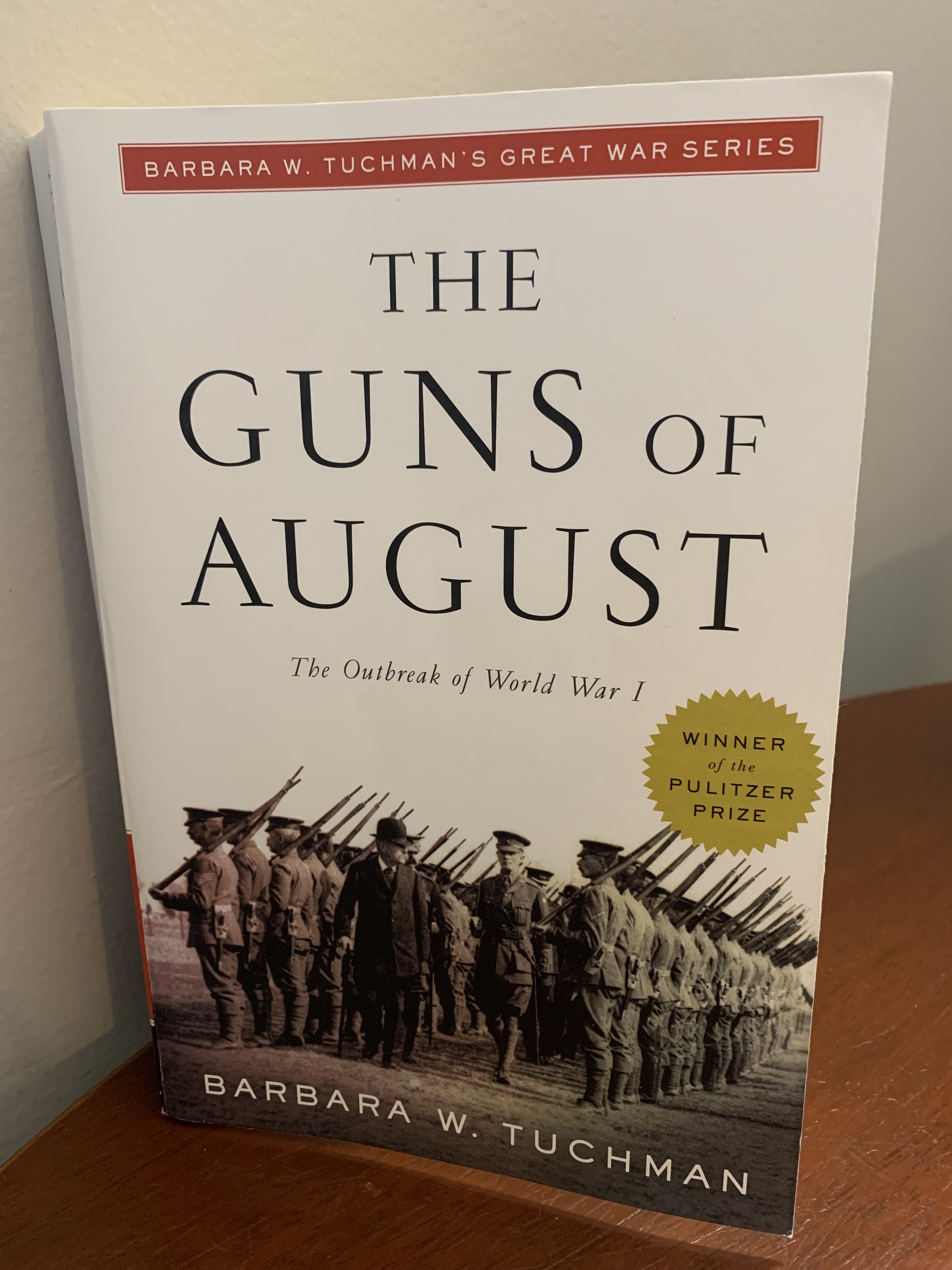
There is perhaps no greater folly than the spirit, or to use a French word, le cran, that arises in men’s hearts to die for their country. This folly is the path wars are forged upon, and a great many lives ended or marred forever. Not to say anything, either, of the survivors and the world remade in its blood. Even if the cause is just, at least by the standard of its opposition, or rather, what it would mean for the opposition to succeed, cultivating this spirit is dangerous, and regardless, it ought to remain salient in the minds of those who make war how hellacious war, any war, is. Barbara W. Tuchman’s seminal 1962 Pulitzer Prize-winning book, The Guns of August: The Outbreak of World War 1, captures the maddening sense of inevitability of this folly as it morphed into the worst war the world had known up to that point — particularly at a time when people thought the advent of industrialization and globalization would help to blunt the sharpening of knives, as it were — while rendering all too real the ways in which it could have been avoided. As Tuchman memorably wrote about the sunset of Edward VII of England’s funeral in May 1910, “… but on the history’s clock it was sunset, and the sun of the old world was setting in a dying blaze of splendor never to be seen again.” The sunsetting of one century into the next, of riches, innovations, and progress beyond the imaginations of most humans who have ever lived ought to foisted upon us a splendor grander than the one we left behind rather than more horrific. And yet, such is the folly of man when nationalism girds his heart and mind against such imaginings. Indeed, Tuchman, who has more affection for the closing lines in her Afterword than she does her famous opening, remarks upon the nearsightedness the spirit of war brings: an inability to imagine an extended duration. The first month of the war, August 1914, was instrumental in not necessarily foretelling who would win the war ultimately, but as Tuchman says, that it would go on. “The nations were caught in a trap, a trap made during the first thirty days of battles that failed to be decisive, a trap from which there was, and has been, no exit.” What this inflection point in 1914 also shows is how progress itself often presages folly and madness as bored men seek new ways to accumulate glory. Even if it means death and the ruin of nations.
There has been so much written about WWI, you don’t need me to do a full rundown, and I’m quite unlikely to do it justice. Nevertheless, the basic bones of what led to the aforementioned inflection point in 1914 is that Germany saw war, not peace, as desirable, and conquest, not harmony with other nations, as the fulfillment of her national destiny. In reality, this meant Germany building up its Navy, which caused England and France, longtime enemies of each other, to forge an alliance. Their alliance engendered resentment among the Germans — the Germans, mind you, who were also bitter that Berlin was not like Paris, that German culture was not so lauded — and was something of a feedback loop to Germany further expanding militarily to ward off being encircled. And while the Russians hated the English, owing to their own rivalrous colonial ambitions, the French ensured the three countries formed an alliance, again, only furthering Germany’s fear of encirclement now from the West and the East.
But why was Germany like this? During this time, two schools of thought existed: British journalist Norman Angell’s perhaps ambitious hope that the 20th century made nations too interconnected, and thus, war nonprofitable and inane (to be fair, even though war broke out, it was still nonprofitable and inane!); and Prussian military historian Friedrich von Bernhardi’s notion that war was a “biological necessity,” where nations must progress or decay. Bernhardi said, “Conquest thus becomes a law of necessity.” That’s how Germany could will itself to attack France, and in so doing, go through neutral Belgium. The thinking, which was first developed in 1899, was that envelopment was a better strategy than a frontal attack. Engaging France in this way would also ensure a short, decisive victory and war. Not only did the advent of the 20th century’s industrialized nation-state, and interconnectedness with other states, not mitigate the outbreak of war, but it also enabled the war to be ground out in the trenches, i.e., the nation had more resources to prolong war-making. For their part, the French, owing to the humiliation they felt after the defeat at Sedan in 1870, were also ready to hit Germany in the offensive, albeit somehow without breaking Belgium’s neutrality, as that may scare off the English help they would need. For different reasons, but for the same motivating factor, in this way, the French were also animated by will and guts, or le cran. Interestingly, the French were adamant about hitting the Germans through the left and central flanks (on the way to Berlin), and were not yet worried about the right flank through Belgium. Miscalculations will abound among all sides, such as the French miscalculating the size of the Germany infantry, or the Germans not realizing when the British Expeditionary Force actually landed, or the Germans not using their Navy sooner, or of course, the German General Alexander von Kluck’s turn away from seizing Paris in his effort to, as he thought, finish off the retreating French, hence, again, how these countries arrived at a years-long trench warfare stalemate. To be fair, though, war on paper and war in reality is quite a different beast. As Tuchman notes, “Human beings, like plans, prove fallible in the presence of those ingredients that are missing in maneuvers — danger, death, and live ammunition.” As for the Russians, they also sought to prove their mettle after losing to Japan in the Russo-Japanese War of 1904-1905. (It’s worth mentioning, by the way, that Japan used the “cover” of a European war to exert more influence over China, another presaging of what was to come in the Second World War.)
The powder keg moment, if you will, is what we all learned in middle school: a Serbian nationalist assassinates the Archduke Franz Ferdinand, heir to the Austro-Hungarian throne, thrusting Austria into a war with Serbia. Germany assured Austria that they could count on Germany’s “faithful support” if Austria’s “punitive action” against Serbia brought her into conflict with Russia. The Russians are always such a fascinating part of any story of war, including the present day. Their reputation tends to outpace their reality. Which is to say, in this context, Helmuth von Moltke, who led the German Army through this tumultuous first month, didn’t want to reverse his mobilization toward the West to attack France by going toward the East against the “Russian steamroller.” In reality, the Russians just weren’t ready for war, which would be shown quickly at the Battle of Tannenberg. But the real takeaway from this thinking is Moltke’s line about changing the course of mobilization, “Once settled, it cannot be altered.” Tuchman cites that as yet another folly of men who make war to be seduced by its seeming inevitability extricated from their own machinations. She adds that those in charge of the railroads in Germany argued mobilization efforts could have been altered toward the East, if necessary. Turkey also allies with Germany, although they are moving too slow for Germany’s liking (the same is true of French attitudes toward both the English and the Russians).
Reading through a history of war, it is bewildering some of the assumptions those waging the war make. For example, the Germans provided an ultimatum to the Belgium government: let us enter your soil to fend off an attack from France, or you will become our enemy. As if Germany would have allowed such encroachment of their soil! Nevertheless, as his troops departed the first week of August, the Kaiser said, “You will be home before the leaves have fallen from the trees.” Or for a more ominous quote on the eve of the war that would change the world, there’s Sir Edward Grey, the Foreign Secretary for England, who famously said, “The lamps are going out all over Europe; we shall not see them lit again in our lifetime.”
What more is there to say? Miscalculations, misallocation of spirit, myopic imaginations — war is a piling of follies. War, as all human endeavors, and therefore, history itself, turns on the accumulated choices made by humans, both those who seek to conquer and those who seek to defend. The victors write the history, as it is said, but so, too, do the scapegoats and losers in an attempt to save face. In this is the obfuscation of rendering “how it really was,” which is the aim of a historian like Tuchman. But through a bevy of primary sources and cross-referencing, along with a poetic, wry prose, Tuchman is able to get as close to that which animated the first global war as any book I’ve read on the subject.


