
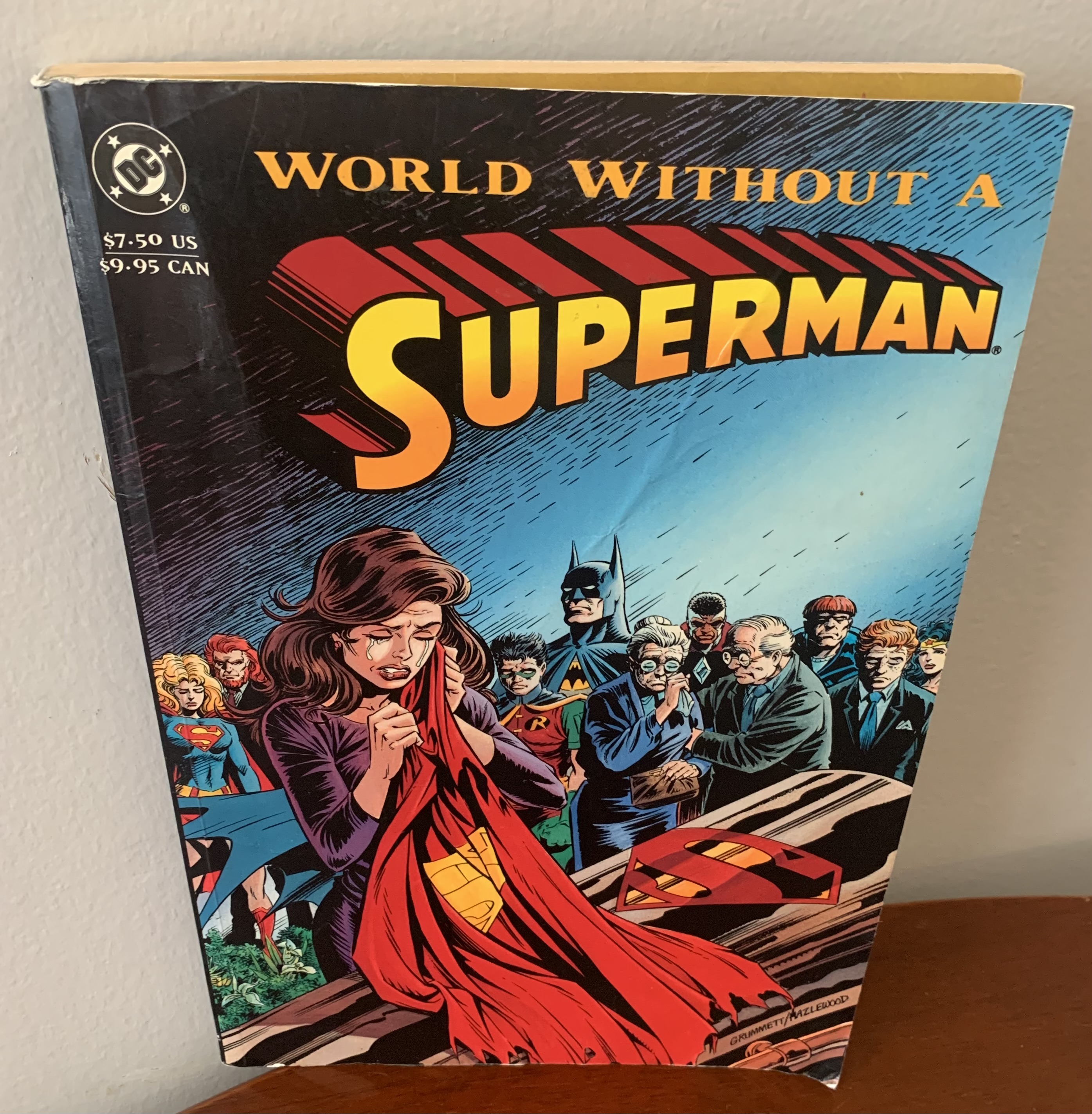
Imagine a world where Superman existed: this seemingly indestructible, incomprehensibly powerful being, who uses his power for the good of all other beings on Earth. He is so powerful, but so good, that all the other heroes of the day look to him for guidance and motivation. This being, despite his alien origins, represents the best of humanity and something to aspire toward. Then, that being is killed. The loss would be incalculable and inconceivable. But DC Comics tried to imagine that world. One of the collections in the arc after Superman is killed by Doomsday is 1993’s World Without a Superman that deals with the direct aftermath of his death. The graphic novel is curated from a number of stories printed that year by writers Dan Jurgens, Karl Kesel, Jerry Ordway, Louise Simonson, and Roger Stern. Just as Superman is the best of humanity, World Without a Superman shows his death to represent the best impulses of humanity, while also drawing out the worst unfortunately. For me, though, the most heart-wrenching aspect of the story is the reaction from Jonathan and Martha Kent as they grapple with their boy’s death, particularly under the cloak of secrecy — Superman’s death means Clark’s death, too, but nobody outside of those two and Lois Lane can know they are one and the same.
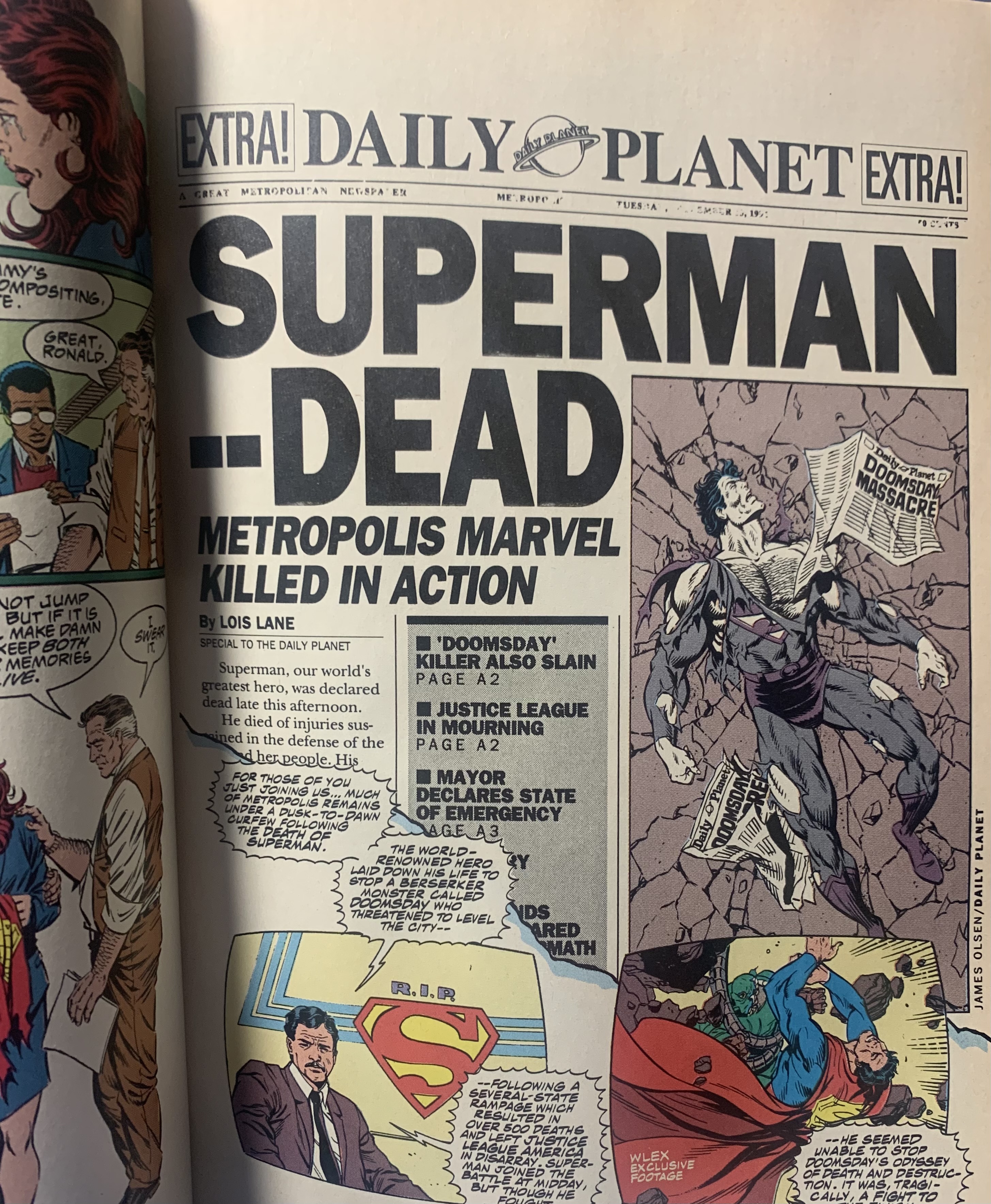
Naturally, after Superman is seemingly killed by Doomsday, with the latter also succumbing to injuries from their building-destroying fight, the other superheroes, Lois, and the wider world are incredulous. Superman can die? Surely, he only seems dead because we have no way of accurately measuring his health metrics owing to his invulnerability. Try as they might, though, Superman shows no indication of brain activity, a pulse, or breath. He is dead. Right away, the government wants his body to scrape enough DNA to make a Superman clone. Lex Luthor II (sporting an incredible mane of red hair), who is somehow in bed with (quite literally) Supergirl, is the most distraught, not because of his love for Superman, but out of the pure hatred manifest in the desire to be the one who killed Superman. Doomsday robbed him of the opportunity. Newspapermen and television news are eager to have Jimmy Olsen’s incredible shots of Superman’s final moments. Ostensibly, they say it is to honor Superman, but Olsen understands it as exploitative. The Gangbuster, who was retired and is watching his girlfriend’s kid, is aghast when the kid doesn’t seem to care about Superman’s death. The kid quips, “Most of us kids at school thought he was a weinie anyway.” That’s a nod to the idea in the 1990s that Superman was no longer cool. Perhaps that also spurred on the idea of doing something bold, like killing Superman, to remind everyone how necessary Superman is to the world of comics and to the world outside of comics. And we even get a moment with the Linear Men, created a couple years earlier by Jurgens, who police time in the comic universe. A newly-minted Linear Man wants to save Superman, but he comes to realize doing so would grant Superman immortality, and where does such time intervention end? What about saving Martin Luther King, Jr? And so on. Before he allows time to restart and Superman to die, the Linear Man says, “You are nothing less than a miracle. But I am obligated to do the right thing.” Which is what Superman would want. I thought that interlude, if you will, was necessary and quite well-done. Another great vignette was the Justice League superheroes responding to the many letters Superman received from regular people with all sorts of requests. It was neat to see Wonder Woman, Flash, Green Lantern, and the others carrying on Superman’s legacy in that way. As Wonder Woman remarks, “For once, rather than combat threats, we want to help bridge the gaps that separate us all.”
Jonathan nearly succumbs to death himself with a heart attack. While his life is being saved by medical professionals, he has visions of trying to rescue Clark from demons ushering him into the light. Superman, though, seems intent on not cheating death, which surprises Jonathan, who thinks perhaps they taught Clark to be an earthling too well. But even Superman can’t cheat death (okay, he can; it is comics, after all).
Overall, this is but one piece of a much larger arc in the death of Superman, with this serving as a prelude to Reign of the Supermen, when there are four different Superman figures vying for the public’s attention as the new guardian of Metropolis, but I enjoyed it as an effort to pause and reflect on what it would mean to lose Superman and how the different characters in that world would react, both for good and for ill.


