
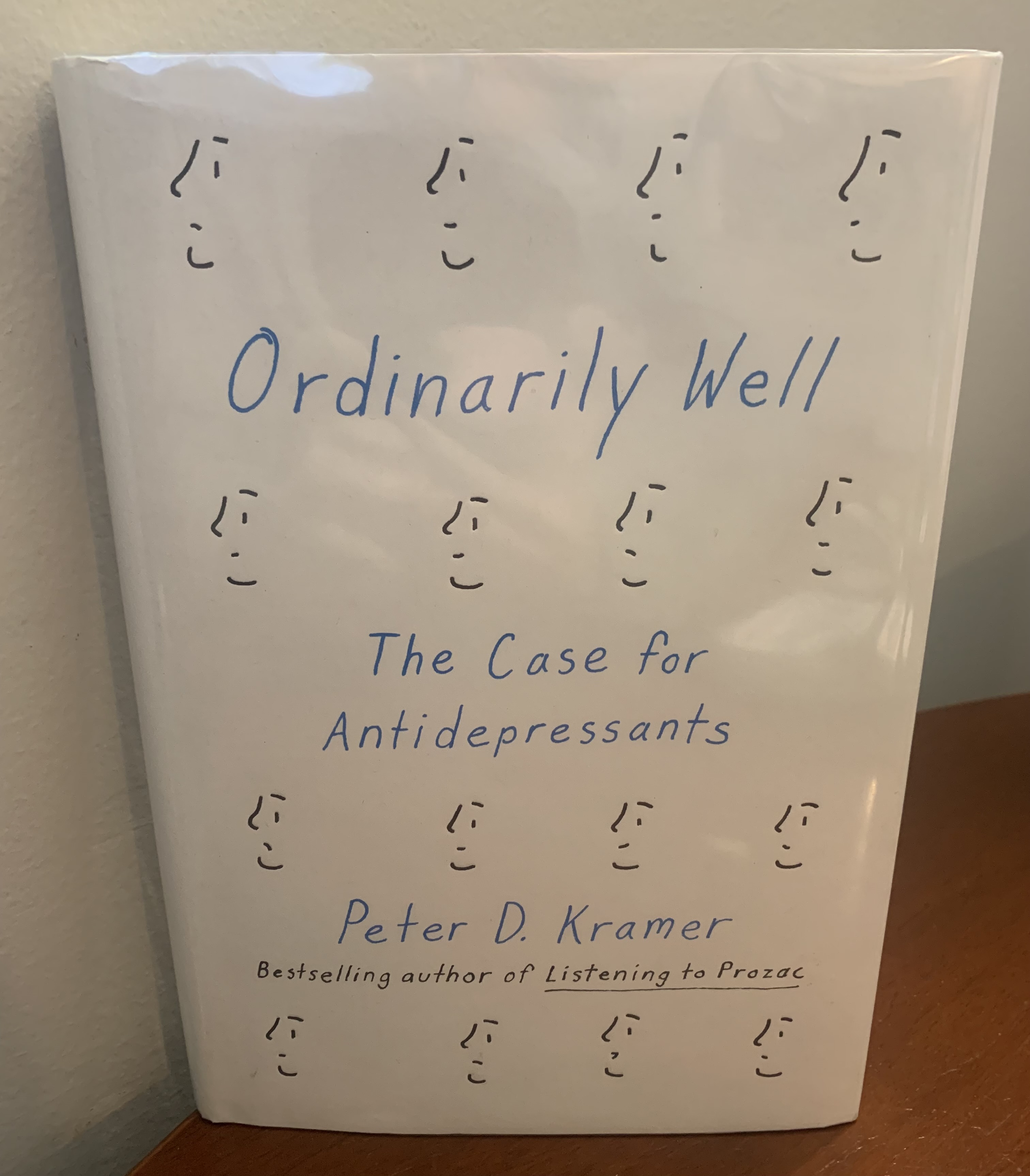
Antidepressants are not a miracle drug — although they certainly can seem like a miracle to someone in the throes of depression and suicidal ideation — but rather they return someone to being ordinarily well. That is, antidepressants aren’t initiating a faux-high, but returning someone from a dark low to normal living and the ability to cope therein. But antidepressants for most of my lifetime have been derided as unnecessary, dangerous, and perhaps most bizarrely, useless, i.e., no better than dummy pills (a placebo). Peter D. Kramer, a psychiatrist, writer, and professor, seeks to dispel these arguments against antidepressants in his appropriately titled 2016 book, Ordinarily Well: The Case for Antidepressants. While his book is rather dense with discussions about the scientific literature (as well as the arc of the antidepressant controversy over the years) — statistics, various biases that, well, bias a study, confounds and comparators, meta-analysis, and so on — Kramer never loses sight of why he’s even making this argument: his patients and the betterment of theirs lives brought upon by antidepressants, or again, it’s perhaps more accurate to say, antidepressants provided the basis to return to ordinary living.
I take an antidepressant. My antidepressant is venlafaxine (75 mg), which is commonly known as Effexor. I’ve been taking it since the middle of 2021. I was previously taking a different SSRI, which I forget the name of, but which wasn’t working. What makes SSRIs particularly great comparatively as “second-generation” antidepressants is that they have a better-tolerated set of side effects than the tricyclics they’ve replaced, like imipramine, Kramer said. Effexor is thought to resemble the mechanism of action of tricyclics (targeting norepinephrine versus serotonin) so you’re achieving the first-generation benefit with the second-generation better-tolerated set of side effects. The additional benefit of the SSRIs is maintenance. That’s where I’m at now: the extended use of Effexor. To me, the most illuminating part of Kramer’s deep dive into the scientific literature, and the argument therein favoring antidepressants, is that if they were truly “dummy pills,” then they wouldn’t have any maintenance efficacy. Which is to say, those who are trialed on a placebo relapse or have a recurrence of depression, whereas, by and large, those still taking the antidepressant do not. The classic placebo effect people think of, whereby people improve in response to “inert intervention,” or the placebo, for a bevy of reasons (the impact of pill taking, doctorly authority, a clinical setting, etc.) do experience “transient early improvement,” but not sustained curing, which is the point here. As Kramer notes, “Every randomized, controlled trial finds that staying on medicine protects against further episodes.” This doesn’t mean Kramer never tapers a patient off of medication or otherwise tinkers with their medication — some patients he tapers the dosage during the spring/summer and reups it during the autumn/winter — but it does mean he’s trying to be patient-oriented.
In addition to the patient-oriented impetus for why Kramer felt impelled, I think, to offer this defense of antidepressants, is a direct argument he faced that he was dealing largely in anecdotes instead of research. Of course, anecdote is an interesting dynamic when we’re talking about psychotherapists who are in the clinical space, or the frontlines, dealing with real people and real cases of depression and other mood disorders. Anecdotes can be helpful! I liked Kramer’s framing of the argument as, “The antithesis of science is not anecdote, but ideology.” That isn’t to say his detractors are all operating with ideologically skewed animus toward antidepressants, but some surely are (just as some in defense of antidepressants are in the pocket of Big Pharma, as it were). That animus’s wellspring is a disdain for Big Pharma, its pressure on the scale of good science, and the scandals and ethical lapses therein. I also think there is something to be said for the distorting effects, or perverse incentives, of the Food and Drug Administration, which approves antidepressants. Kramer zeroes in on how the perverse incentive plays out, “The research submitted to the FDA, in other words, is not designed to demonstrate new drugs’ optimum efficacy. It is designed to produce two successful trials quickly in settings that retain patients and avert disastrous outcomes.” That is, to get through the onerous and expensive FDA process rather than necessarily reflect a true accounting of a drug’s efficacy. But I could digress on the FDA question.
Back to anecdote, Kramer’s impression (which is like a collection of anecdotes or observations of said anecdotes) is that end-of-the-line depression, or depression that is “treatment-resistant,” is less common in part because we’ve gotten better at treating depression early, and better yet, treating patients early with antidepressants rather than letting people suffer through it, which used to be a more prevalent course of treatment than I realized. An administrator at a psychiatric hospital in Maryland explained why he was withholding medication from one of his patients, who would go on to sue the hospital for negligence, “I told him that he needed every neuron to absorb what we are telling him here and that medication would interfere with that.” Oof. That, I think, is one of the stigmas around antidepressants as a treatment for depression: that it zombifies you, essentially, or numbs you to truly experiencing the world anymore. Kramer is diametrically opposed to such thinking, as I’ve noted, arguing that antidepressants enable you to experience the world again, ordinarily well. To put in his words, “Medicine acts as a catalyst, allowing for thriving under the ordinary constraints of the culture.” So, some depressions symptoms may persist at a low-level, but we are able to continue on, nonetheless. That has been my experience. Particularly, Kramer notes that suicidal ideation after beginning antidepressants takes on the hue of an alien time and thinking. Indeed, that aligns with my experience as well.
I’m not smart enough to evaluate all the in-the-weeds aspects of the research Kramer discusses, but I do want to talk about one area he addresses, which is recruitment. Recruitment into clinical research studies about the efficacy of antidepressant medication contrasted with placebos can skew the results, i.e., diminishing the positive effects of the former. That is, if you recruit people who are not actually depressed, then the ceiling for recovery, or engendering remission, isn’t as great, level-setting the antidepressant medication with the placebo. I thought about this in my own experience — again, I also rely on anecdote — with a clinical research study into severe depression. I was initially denied entry because I didn’t meet their determination of severe depression (whatever scale or determinants they were using). However, they changed course and allowed me in. Did my inclusion skew the results in some way? Or was there a way for them to account for such a variable? The bottom line, I think, is what Kramer states: that typically depressed patients do not sign on as subjects in candidate-drug trials. If I was actually experiencing severe depression, as I have previously, I never would have entered that research trial! Alas.
Another of the more interesting findings Kramer brought to the forefront, which counteracted my own anecdotal thinking, is that psychotherapy and antidepressant medication are not necessarily additive, nor is exercise, diet, etc. with medication. That is, if I understood Kramer correctly, for depression symptom relief, most of what medication and talk therapy accomplished together could be done by medication alone, i.e., that antidepressant medication and psychotherapy are not additive. Just last week, I talked about how holistically important to my recovery from depression I thought antidepressant medication, talk therapy, diet, and exercise all were. Are they not actually additive? In other words, were I to have only taken the Effexor sans talk therapy, diet, and exercise, would I have recovered from the symptoms of depression the same? Obviously, talk therapy, and certainly, diet and exercise, have their own benefits separate from depression per se, but in an additive context, it’s an interesting question. As one example of the dubiousness of the connection between exercise and abating depression symptoms, Kramer notes that people who enjoy exercise are less emotionally vulnerable, which means, they are less likely to dropout of the study, and therefore, their presence at the end skews the efficacy. And it’s also obviously not the case that Kramer is discounting psychotherapy; he is a psychotherapist! (Which is further interesting since the other direction tends to happen wherein psychotherapists discount psychopharmacology, clearly.) In fact, at the beginning of the book, Kramer talks about a patient’s case study, who he calls Adele, who he treated when he was still new to the field. He felt that imipramine made his level of skill sufficient, meaning, since he was new, it made his therapy better for her or at least, better able to meet the occasion. That also made me wonder what talk therapy, which again, I found helpful, would’ve been like after taking Effexor (I was still on the first antidepressant medication at the time).
I’ve never quite understood the outright aversion to medication. If a treatment intervention can return you to ordinary wellness, why would one abstain? The ready analogy to me, as someone who also wears glasses, would be like abstaining from wearing glasses, despite their promise to restore ordinary well eyesight (indeed, plenty of people do, but that’s likely for aesthetic reasons and social issues than an actual aversion to the treatment intervention). That isn’t to discount side effects of medication use, especially long-term, but weighed against the other side — people suffering through debilitating depression and/or dying by suicide — it seems, to use an awkward pun, a no-brainer. Kramer’s book is a balm partly against medication pessimism, but also a clarion call for always keeping in mind the patient. The scientific literature is what is it, and it continues to matter, if it’s rigorous and well-done, but we are also talking about real lives and real patients with real suffering, who have the opportunity to be ordinarily well again. We should give them that chance.

 Milam's Musings