
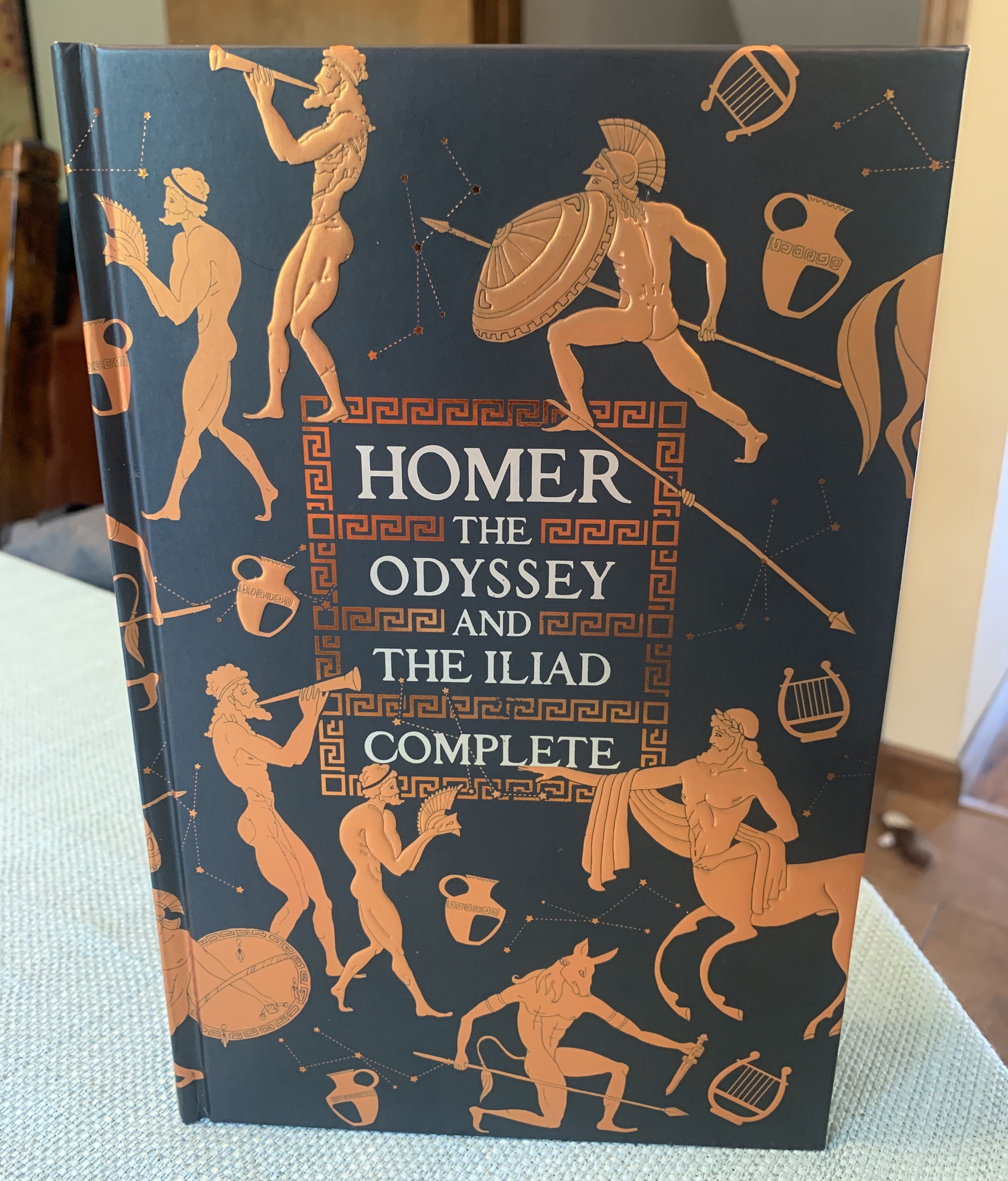
Tell it to me, and tell it to me true. And so I shall. About 2,750 years late to the party, I’ve finally read Homer’s two epic works, The Iliad and The Odyssey, both collected in a beautiful 2022 edition translated by Samuel Butler. The impetus for finally reading these two epics in the Western canon is a likely source for me: Christopher Nolan’s newest film out in July 2026, an adaptation of The Odyssey. While I think I would have eventually found my way to these works, Nolan being my favorite director, I needed to read the source material before seeing the film. Instead of reviewing both works separately, since they were collected in this single edition, I’m going to review them together.
Butler’s original translation of The Iliad was published in 1898, with The Odyssey in 1900. While I don’t know what makes one translation of these works better than another, this is important to context because, unlike other English translations, given when Butler did his, he uses the Latinized names of the Greek Gods since those would have been more familiar to a 19th century audience. So, for example, Zeus is Jove, Athena is Minerva, and Odysseus is Ulysses (which is still a bad-ass name). For the purposes of this review, I’m going to stick to Butler’s Latinization choice for the names.
Overall, The Iliad is a challenging work for someone like me, who wasn’t well-versed in the classics, and owing to its heavy focus on names and genealogy. However, it’s overall story of valor, loyalty, comradery, jealousy, and anger is as familiar to modern minds as ever. For its part, The Odyssey reads relatively easier, as it were, because it’s a part-adventure and fantasy journey story and part-revenge story, which was particularly compelling, and again, modern minds can relate to a dude just wanting to get home to his wife and son, and likewise, the wife and son pining for said return.
The Iliad
Homer’s epic picks up nine years into the 10-year war between the Greeks and Trojans. The war started over a woman, naturally. The Trojan prince, Paris, had the choice of the respective gifts on offer from Juno, Minerva, and Venus. He chose Venus’ gift, which upset Juno and Minerva. What Venus was offering Paris would get the most beautiful woman in the world, who was Helen, wife of the Greek Menelaus. Of course, Helen will be blamed for this, but it doesn’t seem like she had much choice in the matter! Paris’ “judgement” angered Juno and Minerva, such that they were ready to destroy the city of Troy. Jove, however, did not want to see the city destroyed. So, while we have the mortals on Earth waging this war, with the Greeks seeking to reclaim Helen, the real war is between the gods of Olympus, and particularly, the whims of Jove.
And nine-years into the war, we have trouble brewing between the famed Achilles and the “King of Men” King Agamemnon, both on the Greek side. King Agamemnon took a woman as war spoils who belonged to Achilles. This is such an affront to Achilles, and King Agamemnon is too stubborn to relent, that Achilles refuses to fight. This causes Juno and Jove, in turn, to quarrel. In addition to this issue, some of the Greeks believe a dream Agamemnon had to be an indication from Jove that they should go home, but other Greeks don’t want the last nine years of warring to be in vain, this despite how badly they want to go home to their wives. It is Ulysses who rallies the Greek troops. Diomed, another Greek warrior, is among my favorites featured in The Iliad; he was seemingly unstoppable (everyone was afraid of him!), and would have been, if not for the gods. I’d put him only behind Ulysses for my favorite characters.
With respect to the Trojans, their biggest, strongest warrior, who has the favor of Jove, is Hector. At one point, his wife begs Hector to not return to battle, but he tells he can’t be a coward. Indeed, he’d rather die than see her taken away to bondage. The gods induce Hector to challenge a Greek to a one-on-one fight, to which Ajax, another great Greek warrior, steps up. They fight, but the gods do not want them to kill each, for the gods also abide by the fates of mortal men. Another example of this is Paris, who tries to fight, too, by challenging someone on the Greek side to a fight, but he’s ineffectual and a bit of a loser. Plus, Menelaus responds! I wouldn’t challenge the King of Sparta, Paris. Paris gets scared, to which Hector … hectors him about it. That’s one of the funniest parts about both books, by the way, is the taunting and gibing (as it’s spelled here) throughout, even amid the fury of battle, one warrior will taunt another, including those on his own side to spur him on. For the record, Menelaus wins, but Paris is saved from certain death by Venus. Again, the gods of Olympus are regularly intervening. So much so that eventually Jove threatens all gods and goddesses to stop meddling in the war, but thereafter, he proceeds to meddle himself! He can because he is Jove, after all. The marital arguments between him and Juno, who does not want to see the Greeks destroyed, were laugh-out-loud funny. Jove tells her at one point, “You may go on and on till you get there, I shall not care one whit for your displeasure; you are the greatest vixen living.” Later, in another amusing moment, Juno convinces Sleep to put Jove to sleep, so that she can turn the tide of war in favor of the Greeks. During this trickery, as Jove is talking to Juno, he tells her he’s so enamored by her (part of the trickery was making herself more desirable), he’s more enamored than he was by a slew of women he goes on to mention having had sex with and impregnated. Sheesh.
Another facet of Homer’s two epics I wasn’t prepared for, although I should have been: the unflinching brutality and gore inherent to war, both in action and speechifying (taunting!). One scene I noted is when Peneleos, a Greek, chops off someone’s head and holds it up for other Trojans to see to scare them off. Or with respect to taunting, take Agamemnon, who admonishes Menelaus for considering giving quarter, or mercy, to a Trojan begging for his life. He says to Menelaus, “Let us not spare a single one of them — not even the child unborn and in its mother’s womb; let not a man of them be left alive, but let all in Ilius perish, unheeded and forgotten.” Oof. Then again, Diomed decides not to fight, Glaucus, a Trojan, on account of his name and family history. That’s the reason family names and lineage are spoken about repeatedly throughout the books, primarily this one, including during the heat of battle: one’s family name confers certain status, although it doesn’t always prevent the wrath of the gods, clearly. Hector provides some violent barbs of his own against Ajax, talking about how he knows the day will bring the destruction of the Greeks, he continues, “… and you shall fall among them if you dare abide my spear; it shall rend your fair body and bid you glut our hounds and birds of prey with your fat and your flesh, as you fall by the ships of the Achaeans.” On one hand, violent and brutal taunting, and on the other, it’s hilarious that the violent skirmishes are interspersed with such oratorical putdowns. I love it!
Achilles is a big baby. When the Trojans seem close to vanquishing the Greeks, Agamemnon, after encouragement from Diomed, cajoles Achilles with words and gifts to enter the battle and rescue their ships from burning. But Achilles will not relent, and in fact, he plans to go home. But Agamemnon is formidable in his own right. He starts wrecking the Trojans: “… and many a noble pair of steeds drew an empty chariot along the highways of war, for lack of drivers who were lying on the plain, more useful now to vultures than to their wives.” What a freaking line, and while I would hesitate to call The Iliad an antiwar story — after all, valor and honor in war are among the highest of virtues in this society — lines like that lend to the understanding of war as hellish. Back to Achilles and his stubbornness; it results in his best friend and comrade, Patroclus, literally using Achilles’ armor in battle because he knows it will frighten the Trojans. It does, but then he is killed by Hector, who takes Achilles’ armor. This is what will finally draw Achilles into the fray. This also opens up another abiding virtue in this society: the treatment of the dead. Earlier in the war, during a pause, they allowed each other the time to burn their respective dead. After Patroclus’ body, they fight over it, with the Greeks obviously wanting to give him a proper send-off and the Trojans wanting to essentially desecrate it as the spoils of war. Achilles, after much grieving, utters a war cry that is so fearsome, it frightens the Trojans enough for the Greeks to reclaim Patroclus’ body. Comradery and deep friendship permeates these books, such that Achilles is aggrieved at his friend’s death, and men are repeatedly talked about as crying for their fallen friends. It makes sense; you are warring side-by-side for nine years together at that point. But as it concerns Achilles finally joining the war, one of my favorite lines in both books is when Hector is warned that the Trojans ought to turn back before Achilles becomes involved, to which Hector ignores that advice: “… and the Trojans, fools that they were, shouted in applause.” Unflinching!
As the war is set to resume, the gods take sides. Juno, Minerva, Neptune, Mercury, and Vulcan (who created new godlike armor for Achilles) are on the side of the Greeks, with Mars, Apollo, Diana, Leto, Xanthus, and Venus on the side of the Trojans. Mars also tries to fight Minerva, but she easily beats him up, and then beats up Venus in turn, who had helped Mars retreat. Juno then beats up Diana who was crying to Jove about it all. And Jove just laughs, enjoying the gods fighting. At different turns, the gods save Achilles and Hector from dying just yet. Then, Achilles is nearly killed by the river (meaning, a god) because he keeps piling dead Trojans into it.
Finally, it comes to a climax with Achilles chasing Hector to avenge Patroclus’ death, and surprisingly, Hector is initially scared and running away. I get it’s Achilles, but c’mon, Hector, don’t be a coward! Minerva tricks him into standing tall and fighting Achilles, though, who easily kills him. Womp, womp. Instead of abiding by any covenant to treat the slain body of Hector with respect, Achilles ties Hector to his chariot and drags him through the city of Troy for all to see, and this, mind you, after other Greek warriors had stabbed Hector’s dead body. The gods, upset with the way Achilles has treated Hector’s body, then intervene and protect it so that it receives proper treatment and mourning. They then help Hector’s father, Priam (who had 50 children!), ransom for his body and bring it back to where the Trojans give it a proper burial. After Achilles gives them 12 days to mourn him, they attack the Trojans.
The gods are so meddlesome. Even at the end when the Greeks are holding games during the funeral for Patroclus (games include racing, boxing, wrestling, dueling, quoit, archery, and javelin throwing), the gods meddle in that to help certain people they want to win, including Ulysses. But for mortal men, they don’t see it as meddlesome, but as gods giving favor to certain people who have merited it per se.
The Odyssey
This book is set 20 years after Ulysses set out to fight the Trojan War, with 10 of those years dedicated to the fighting and then 10 years to trying to return home to Ithaca, where he is chief, and again, his wife, Penelope, and his son, Telemachus, who he left as an infant, await his return. Initially, I think the gods are making it difficult for him and the other Greeks to return home because of their pompousness and hubris. Some, like Agamemnon, who was reluctantly joined by Ulysses, stayed in Troy to continue to revel. Then, Ulysses is further prevented from returning home by Neptune because Ulysses poked out the eye of his son, Polyphemus, King of the Cyclops.
The first four books (as opposed to being separated by “chapters”) set the stage of what life at home has been like for Penelope and Telemachus; what the waging of war has wrought for domestic life, which is a nice touch. Since it’s been 20 years, upwards of 100 suitors regularly visit Ulysses’ home to ostensibly court Penelope into marriage. Instead, they largely spend their time eating all of the estate’s meat and drinking all of its wine, much to the chagrin of Telemachus, who is now old enough to be aware of what’s going on. For her part, Penelope doesn’t want to marry anyone. She’s still loyal to Ulysses, and even does what she can to stall what seems like the inevitable. When Telemachus complains, the suitors blame his mother for “putting on airs.” Minerva intervenes and convinces Telemachus to seek out word of his father’s status, if he’s alive or dead. Telemachus, like his mother, is pessimistic.
It was also useful to read The Iliad prior because then I was familiar with the characters who reappear here, like Agamemnon and Achilles. The former was killed upon returning home through the treachery of his wife in conjunction with Aegisthus. Agamemnon’s son avenges him and kills Aegisthus, but what a way to go for the “king of men.” Killed in his own home after such treachery. Because of that, he doesn’t have a favorable view of women, saying even good women now are marred by what his wife did. Achilles is also dead, but we don’t get more detail therein.
For about the past seven years, Ulysses has been imprisoned on a remote island with the goddess Calypso, who wishes to take Ulysses as a husband and make him an immortal. Instead, he stares longingly out to the sea, melancholy about returning home. Jove eventually decides Ulysses can be allowed to return home, but not without peril. And Neptune, for his part, is still trying to prevent his return.
Ulysses’ first battle after sacking Troy is with the Cicons, after sacking their city and taking their wives, mind you. That battle only occurred because after said sacking, the Trojans once more wanted to revel in it with food and drink. At this point, Ulysses has 12 ships of men. He will lose every single ship and every single man with him. Indeed, one of the more destructive encounters to his numbers is meeting the aforementioned Cyclops, who doesn’t give a crap about the gods of Olympus. He starts off by eating two of Ulysses’ men in front of him and then promptly going to sleep. That’s how imposing and powerful this Cyclops creature is. And Ulysses and his men can’t even go anywhere because they’re stuck in the cave with the Cyclops, owing to a giant stone blocking the entrance/exit only he could move. They eventually poke the Cyclops’ eye out with a piece of his own wooden club and are able to escape. Even in their escape, though, Ulysses can’t help but taunt the Cyclops. His hubris once more came to the forefront! Neptune will be none too pleased.
Then it’s the land of the Laestrygonians; King Antiphates’ wife is a giantess, described to be “big as a mountain.” The King and a score of ogres attack Ulysses and his men. These ogres are also maneaters. After that, Ulysses’ men encounter Circe, who turns his men into pigs and imprisons them, with the memories of their ordeal. Mercury, however, helps Ulysses best Circe and convince her to turn the pigs back to men. Ulysses even has to journey to Hades to talk with the ghost of the Theban prophet Teiresias, who I think is the one that tells Ulysses he’ll eventually need to go to a land where they don’t salt their food, make a few sacrifices to the gods, and he’ll die an old man. That will happen off page.
You would think traveling to Hades would be the end of the peril. Alas, Ulysses and his men are soon stuck between Scylla, with her six heads and also a maneater, and Charybdis, a deadly whirlpool. After somehow surviving this latest ordeal, Ulysses’ men are told not to eat the cattle and piss off the sun god, but after running low on other food, they relent and are promptly punished for eating the sun god’s cattle. Jove strikes their ship, killing everyone on board, and after floating for nine days in the water, Ulysses arrives at the Calypso’s island.
After being freed from Calypso’s island, Ulysses arrives at Scheria, ruled by King Alcinous, whose daughter, Nausicca, helps Ulysses after his raft is torn asunder by Neptune and he swims to shore. Immediately upon meeting Ulysses, King Alcinous is ready to have him marry his daughter. That made me laugh-out-loud. Another abiding virtue, though, of ancient times is being hospitable to foreigners! Imagine that. That means much merriment, feasting, and games. Of course, Ulysses is just like, dude, I want to go home. But he partakes in the games after being insulted by King Alcinous’ son, Laodamas. The latter challenged Ulysses to participate in the games, and Ulysses, being stronger than anyone perhaps on Earth, easily throws a heavier disc further than anyone else.
Finally, Ulysses makes it home, with the help of King Alcinous, whose people are known for escorting ships (Neptune, with Jove’s agreement, is still mad, so he’s allowed to turn the escort ship into a rock and bury the entire city under a mountain!), but he still cannot confront the suitors or even reunite with Penelope and Telemachus. First, Minerva wants him to pretend to be an old beggar to test everyone’s loyalty. Everyone is still skeptical that Ulysses will ever come home, even as Ulysses is telling them this on the guise of being someone who knew Ulysses 20 years ago. In those 20 years, by the way, Ulysses’ mother essentially died of grief (he has a conversation with her in Hades!), and his father, Laertes, while still alive, is poor and downtrodden, overcome with grief.
Slowly but surely, Ulysses reveals himself to his pig farmer, who is loyal still, and Telemachus, who has returned home. The suitors were plotting to kill Telemachus, but thanks to the gods, he’s able to avoid their scheming. Again, Ulysses wants to wait and test the suitors. Antinous is the ringleader, if you will, of the suitors, and treats Ulysses, as the beggar, the worst. In an interlude of humor, another beggar, Irus, tries to assert himself as “king of the beggars” and challenges Ulysses to a fight. Let’s just say it doesn’t go well for him.
For her part, Minerva is goading all of this on, first by making Penelope even more desirable than ever to the suitors, and by egging Eurymachus, another of the “ringleaders” of the suitors, on. But Ulysses is the best of the orators, and uses those skills to shut Eurymachus down: “You are insolent and cruel, and think yourself a great man because you live in a little world, and that a bad one. If Ulysses comes to his own again, the doors of his house are wide, but you will find them narrow when you try to fly through them.” The barbs, man! That line about being a “great man in a little world” is going to stick with me for a long time.
Penelope has a dream that portends Ulysses’ return, but she’s still skeptical, and therefore, decides to hold a tournament to see who will be her suitor. All they have to do is string Ulysses’ mighty bow and shoot a few axes. Easy peasy, right? None could do it. Only Ulysses can, of course, which he does, and then the melee, or the revengeful massacre is more like it, begins, with Ulysses shooting Antinous in the head. Eurymachus begs for his life after seeing Antinous fall, but there will be no quarter here. Agamemnon would have been proud. It’s also a Rorschach in Watchmen moment — “I’m not locked in here with you; you’re locked in here with me” — because he had the stockman, also in league with Ulysses, lock the outer doors. After rather easily dispatching the 100-some suitors, Ulysses also rounds up the dozen women who slept with and helped the suitors and kills them, too — after he made them clean up the massacre in his home.
After 20 years, Ulysses and Penelope reunite, but even then, she’s hesitant, unsure if she’s being deceived or not. And honestly? Fair! In a world where the gods are always meddling and can take any form, how could you know? Even when Ulysses proves certain things that only he would know, that’s still something a god would know! Still, she realizes it is Ulysses and they make lots of love and he tells her all about his journey. Ulysses also goes to see his dad, who is grateful to see him.
The suitors’ ghosts go to Hades, where they essentially blame Penelope, but for his part, Agamemnon says she’ll be known for all of human history for her loyalty to Ulysses. Ulysses and the others prepare for battle, though, knowing that the suitors’ parents and other townsfolks are going to rise up against them for having killed so many “promising youth.” While a few are killed, Minerva steps in, with the approval of Jove, to create a peace between everyone so that the parents and the rest of the town “forgive and forget.”
I certainly won’t forget my experience finally reading The Iliad and The Odyssey. I’m admittedly, humbly proud of myself, especially for making it through The Iliad, and I don’t mean that in a negative way. The book was challenging in a good way; I’m okay with a book challenging me. The story itself was still compelling and the themes resonant. But yes, like a lot of people, I preferred The Odyssey for being a more straightforward narrative story: a guy seeking to get home, stymied by all manner of gods and creatures alike, and then plotting his revenge against suitors of his wife and pillagers of his estate upon his return. How can you not root for Ulysses to wreck shop, both verbally and physically? With his cunning and his strength? It’s a blast. I’d encourage anyone else to give both books a try, but depending on your predilection, you may find a translation that uses the Greek names more helpful.


One thought