
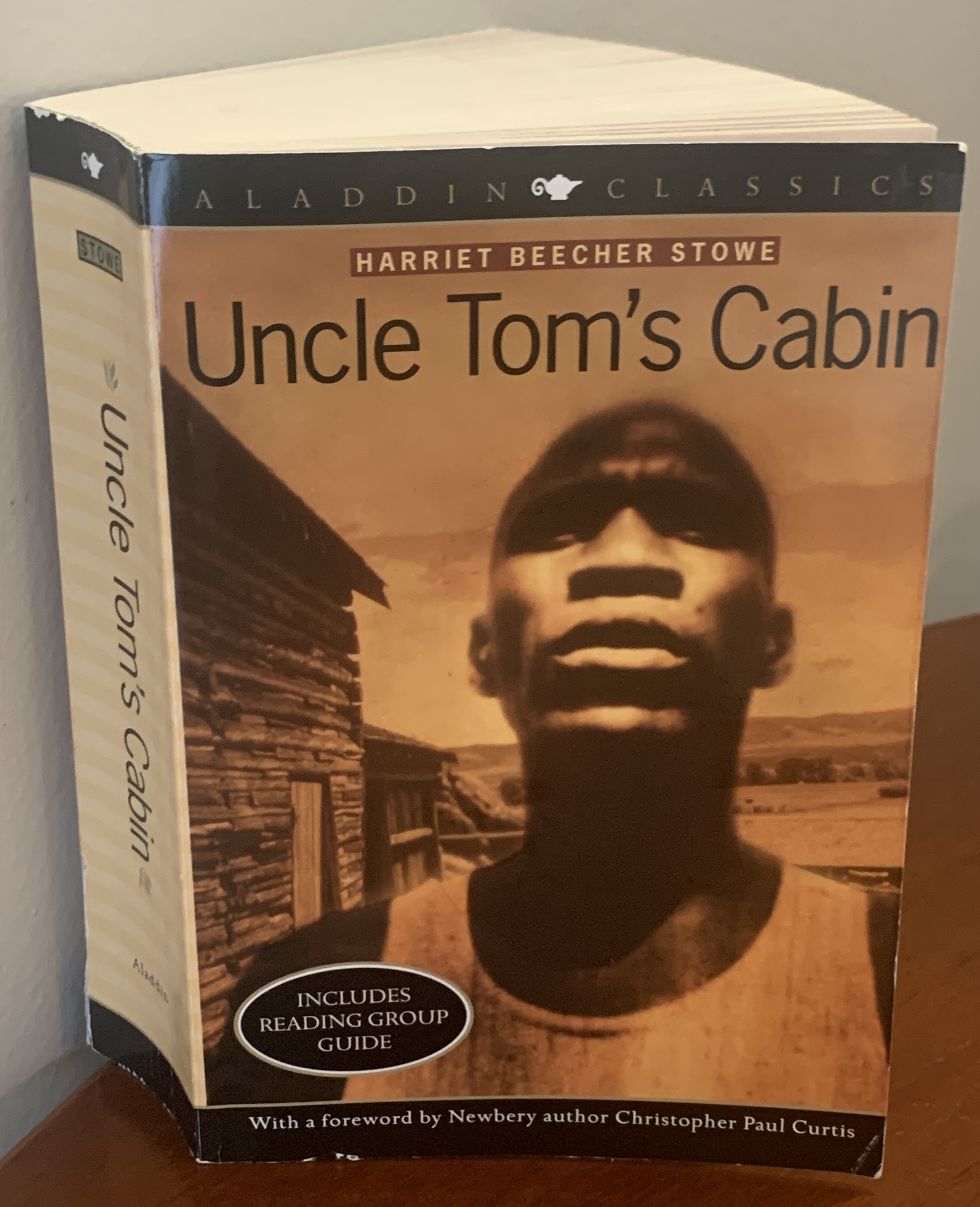
Part of political maturation is surely realizing that peaceably ending slavery in the United States was never going to occur; rather, the issue needed to be forced and hard-won by blood and sacrifice, unfortunately. That said, it also surely the case that the end of slavery needed impassioned, intellectual, and moral cases to be made. Enter Harriet Beecher Stowe’s seminal 1852 antislavery book, Uncle Tom’s Cabin. I had the opportunity for the first time to tour the Harriet Beecher Stowe House in Cincinnati last year, where I also bought her famous book. Uncle Tom’s Cabin is one of the best books I’ve yet read, first on the merits of its courage for the time, and second, as a literary work in and of itself. The story of the pious titular Tom, who is unflinching in his faith as he faces the relative pleasures of being held as a slave and its worst degradations, up to and including his martyrdom death, is riveting, revolting, and resonant. All men seek freedom, first and foremost of bodily autonomy, and then the freedom to call what is his his, to seek an education, and to worship as he chooses. For a nation so conceived to shroud the institution of slavery in something compatible therein, both in law and Holy Scripture, is an affront to everything Stowe witnessed and experience with her own eyes and ears, and understood to be right. The simple calculation she made was that if more people were to bear witness to the reality of slavery rather than compartmentalizing or rationalizing or downplaying its horrors, they would feel as she felt. Indeed, it is said that while many Union soldiers may not have sought war to end slavery, once they were in the South and witnessed it, they were ready to go scorched-Earth to rid the land of its evil. Perhaps a seed of that sentiment began with Stowe’s widely read and disseminated book. What was particularly astute and pointed about Stowe’s commentary, though, which permeates the book and ends it under the chapter “Concluding Remarks,” is that Stowe did not just implore the Southerners to reconsider slavery, but for the Northerners to reconsider their connection to slavery as well. After all, while they may have considered themselves more righteous than the Southerners for not engaging directly in slavery, by otherwise enabling it, they granted their righteousness to it, nonetheless, Stowe argues. As such, slavery is an indictment of all of America and all Americans, not just the South and Southerners.
If there is to be a most ignominious participant in slavery, it may be that of the slave-trader, who evaluates men, women, and children for the money they may offer him, and who willingly, callously splits families. We meet this trader at the beginning of the book in Kentucky, on the plantation of the Shelby family, who owns Tom and a number of other slaves. The trader is Haley, who is ready to trade Tom and Eliza away, along with Eliza’s baby, Harry, as a sort of debt-clearing with Mr. Shelby. Eliza fears being split away from her child, though, and decides, like her husband, George, she is going to make a run for it to Canada, which received a fair number of African American refugees fleeing the bondage of slavery and the shadow of the slave-catchers and bounty hunters. Tom, though, is rather resigned to his fate because he’s so confident in his faith that what will be will be and wherever he goeth, He goeth. He remarks to his wife, Chloe, who is worried about the treatment he’ll face in the South, “There’ll be the same God there, Chloe, that there is here.” Which is essentially the thesis of Stowe’s argument throughout the book!
What makes someone like Haley particularly odious is that they think they’re a perfectly humane fellow. To use modern vernacular, Haley would say something like “it’s just business, nothing personal.” Except, of course, it’s very personal. Later, on a boat heading down South from Kentucky, an unbothered woman will echo the same sentiment that feelings don’t have anything to do with it. Indeed, when it comes to the “brutish” Blacks, you can’t ascribe feelings to them. As Stowe reflects, for men like Haley, the affront is not to separate the family, but the “agitation” the separated family shows upon learning about it. Agitation is a window into the unsavoriness of slavery, after all. After Haley has separated and sold a slave named Lucy’s child, she’s ready to jump into the river and kill herself instead. (We later learn of another woman, Cassy, who preferred to kill her newborn child rather than it face the reality of servitude and degradation that awaited it.) Lucy realizes that the only state that will never give up a fugitive is death itself. She commits the act she intended.
For her part, Emily Shelby leans more toward abolitionism, or at least, is aghast at Haley, and at the notion of selling Tom, Eliza, and Harry, especially of splitting up the mother-and-son. Likewise, Emily’s son, George, is friendly with Tom and doesn’t seem to be following in his father’s footsteps of endeavoring to own slaves. Mr. Shelby is a coward, though, so cowardly that he feigns an excuse to be off the plantation when Tom is taken by Haley. He also, in a misogynistic rebuke to his wife, argues that he doesn’t have the money to buy back Tom and she knows nothing of business as a woman. Meanwhile, we later learn, he has the money to buy a slew of new colts.
The first people Eliza and Harry encounter as they flee from the Shelby plantation and Mr. Haley, along with two slave-catchers, Tom and Marks, is Senator John Bird and his wife, Mary. John just voted for a new law in Ohio that banned people from helping escaped slaves coming across the Ohio River, as Eliza and Harry did (on a floating piece of ice, no less!), into Ohio. Again, here is another way in which the North was complicit in slavery’s horrors. Mary, like Emily, abhors slavery, thinking it cruel. However, the feelings argument comes up again, as John argues there’s a “difference between public versus private feelings.” My rejoinder to that would be, yes, the difference is one of courage. That said, John still does right by Eliza and Harry, conveying them to the Quaker network of people, who are helping escaped slaves journey on to Canada. He even gives her $10.
George, who is also escaping, is able to pass as a Spanish white man, and encounters a former, relatively kinder, master. The former master implores George to give up the charade because it’s too dangerous. But George is righteous and indignant, and it should be said, atheistic in contrast to Tom, bellows, “I’m ready for ’em! Down south I never will go. No! if it comes to that, I can earn myself at least six feet of free soil,—the first and last I shall ever own in Kentucky!” What a line of dialogue, and again, a nice contrast to Tom, who some would argue is docile in the face of his predicament.
Eventually, Haley sells Tom to the affable, lackadaisical Augustine St. Clare. While his wife, Marie, is a nasty, heartless woman who is all in favor of slavery and treating the slaves terribly (but I repeat myself) — she even thinks she is the real slave because her Mammy is selfish in attending to her ailments because Mammy would rather mind her two children, of whom Marie calls “dirty little things” —, and contrary to his twin brother Albert, who owns many slaves with an iron fist, Augustine is technically against slavery and the violence needed to control them. But he’s also — I was going to say, despair, but he’s too whimsical to despair — unsure what to do about it when looking at the institution of slavery as a whole, so, prefers to do nothing. He’s also an atheist, but he has good reason for skepticism toward Christianity. He explains why to Miss Ophelia, his Vermont cousin, this way, and indulge me the long, brilliant quote, “My view of Christianity is such that I think no man can consistently profess it without throwing the whole weight of his being against this monstrous system of injustice that lies at the foundation of all our society; and, if need be, sacrificing himself in the battle. That is, I mean that I could not be a Christian otherwise, though I have certainly had intercourse with a great many enlightened and Christian people who did no such thing; and I confess that the apathy of religious people on this subject, their want of perception of wrongs that filled me with horror, have engendered in me more skepticism than any other thing.” Tell it, Augustine! But his child, Eva, is not only devoutly religious, but is almost fashioned a Christ-like child character by Stowe, who dotes on Tom and the other slaves with kindness. Showing the example of how racism and cruelty is a learned behavior in some cases, Henrique, the son of Alfred, and Eva’s 12-year-old cousin, is her opposite. He’s merciless with his slave, Dodo, until Eva tries to cajole him into being nicer. Upon Eva’s deathbed from some respiratory disease, she implores her father to free all of his slaves. (Stowe has a great line after Eva’s death about grief, “But in real life, we do not die when all that makes life bright dies to us.”) In fact, Augustine intends to free Tom, but doesn’t quite get there before his own death after a bar fight he tried to play the Good Samaritan during.
Contrary to him, but also to Marie, is the aforementioned Miss Ophelia, or “Vermont,” as Augustine calls his cousin. She’s come down to New Orleans where Augustine’s plantation is, to take care of Eva because Marie is too pathetic, lazy, and heartless to do it (despite her protestations to the contrary). While Miss Ophelia, on principle, is against slavery, in practice, she still harbors resounding prejudice against Blacks. So much so, that when Augustine buys her her own slave, Topsy, a little girl, to educate, she’s afraid to touch Topsy, which of course, Topsy notices and despairs over. Miss Ophelia is the character stand-in for Stowe’s indictment of the North.
Since Tom wasn’t properly freed, he is sold next to Simon Legree, a savage man, who also is an atheist. Again, it feels like Tom is continually challenged in Job-like fashion, both by circumstances and cruelty and by unbelievers. At Simon’s plantation, he meets Cassy, who had her daughter separated from her. That daughter? Eliza! But Cassy, at this point in her life, is dejected and ready for the liberation her death would provide. It is only Tom, and his unyielding faith and goodness, that turns Cassy around. So much so, that Cassy comes up with a scheme to escape with a little girl recently separated from her mother. While Simon isn’t religious, he is superstitious. Cassy plays on that, pretending that the garret (or attic) is haunted. Then, after having set that macabre table, she feigns escape so that the overseers, hounds, and Simon set out to catch her and the child with her. Instead, they circle back to the garret and hold out there until the coast is clear to fully escape. Which they do! But before I say what comes of them, I have to return to Tom. Because of Simon’s inability to find Cassy, he thinks Tom knows, and Tom does know, but he won’t give them up. Tom will never participate in cruelty, even if it means cruelty is visited upon him. Which it is by Simon, nearly to his death. Before his death, though, George, the son of Mr. Shelby, finally comes calling to buy Tom and bring him back to Kentucky (Mr. Shelby has since died). George is enraged to find Tom in such a state, but Tom is ready to meet Jesus in Heaven. Just before he dies, Tom ministers the Word of God and Jesus to the two Black overseers who were cruel and mean to him, but saw Tom’s martyrdom as a sign to believe. After Tom’s death, George punches the bully Simon to the ground with no defense forthcoming, as is the case with bullies. Then, he gives George a proper burial. It is then when the two stories converge: George is on the same boat that Cassy and the child are, as well as a French woman. The French woman is the sister of George, the one married to Eliza, who was also separated from him, but who married a rich husband. She’s now a rich widow and trying to find George. Cassy and the child accompany her to Canada, where a family reunion takes place. Thanks to his sister, George is able to go to university in France, after which he’s decided to go to Liberia and hope that the “council of nations” that Liberia will belong to can end the scourge of slavery in America, for a nation can more easily do that than an individual, he surmises. He adds, “To your fathers, freedom was the right of a nation to be a nation. To him, it is the right of a man to be a man and not a brute.” When George Shelby returns home, he frees all of his slaves. So, Stowe does give us a happy ending per se.
What a phenomenal book for its time, or any time, as a clarion call to the dignity of all men, women, and children to be the owners of their own bodies and their own destinies, and just as importantly, for all men and women of good character, and if it is your predilection, faith, to speak out against obvious injustices and wrongs in society, to not be cowed by apathy or seduced by the fever of cruelty around them. A book that is as relevant now as then, even if the cruelties and injustices are of a different kind.


