
Spoilers! Which is funny to say for an adaptation of a nearly 3,000-year-old story, but there are differences!
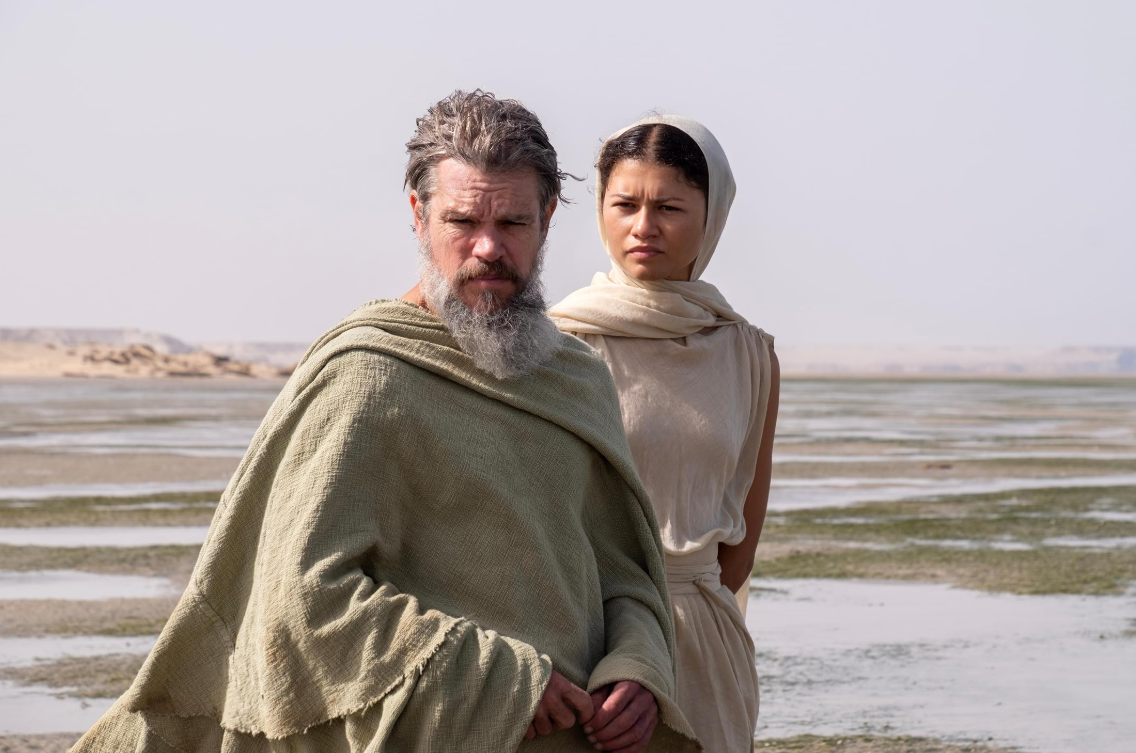
Man’s hubris may not so much be in defying the gods, although that brings forth consequences in its own right, but in setting upon a path of destroying one’s fellow man and in so doing, laying the groundwork for their own destruction. Christopher Nolan has been exploring some iteration of this theme for much of his career, whether with Batman, testing the limits of man’s ability to be the hero, or most recently with 2023’s Oppenheimer, where the titular character wrestles with what he wrought bringing the nuclear bomb to fruition. Nolan’s 2026 film, The Odyssey, also co-written by him, feels like the culmination, at least for now, to his morality play on man’s hubris, which he does by using the most famous, long-running story there is, adapting Homer’s nearly 3,000-year-old story. At this juncture, Nolan, who extols the virtues of practical filmmaking and engendering a moviegoing experience, is well-known for his grand set pieces, spectacle, and epic vision. All of which is on full display with The Odyssey, quite literally, as the entire film was shot with IMAX cameras for IMAX 70mm, but I think where Nolan’s film triumphs, much like with Oppenheimer, is in the quieter moments. The quiet moments with Matt Damon’s face as Odysseus, or a look Anne Hathaway gives as his wife, Penelope, or the moments when violence, fire, and death occur on the screen with Ludwig Goransson’s somber music accentuated. These quiet moments are the testament — the monument — to man’s hubris. Nolan is telling us throughout his nearly 3-hour adaptation, but especially directly at the end with Odysseus’ monologue to Penelope at the end of the film, albeit she still thinks him a traveler and a beggar, that we tear down what makes civilization great at our own peril, and as it happens, we’ve had to go through such a cycle multiple times because the act of tearing down also results in tearing down the memory of man’s hubris. Perhaps, instead, we ought to work on preserving and cherishing what makes life so grand and wonderful, often invisible to our day-to-day lives, instead of seeking to destroy that which we largely do not understand, particularly the ramifications if it were to crumble. Hubris is the folly resulting from man’s lack of imagination more than anything. Fortunately for us moviegoers and those who have read The Odyssey, as I finally did in preparation for the film, Nolan (and Homer) provide plentiful imagination, horrifically and unflinchingly. Indeed, what a revelation this film was in how Nolan leaned into the horror inherent to Homer’s epic tale — a world of violence, sacrifice, and cruelty, all under the guise of honor and duty — and how adept Nolan was at navigating it. Please make a full-on horror movie, Nolan! But I digress.
Damon will surely be a strong contender, or ought to be, for an Academy Award for Best Actor, an award for which he’s been nominated twice, but hasn’t won. What he does throughout the course of this film is nothing short of remarkable. Again, his face tells the story just as well as his words. The desperation and devotion he feels to his men, as they traverse one calamity after another. The haunted look he has dealing with Calypso (played by the always-great Charlize Theron) and trying to regain his memories. The realization that overcomes him as he and his men sack Troy on the back of his ingenious idea with the Trojan horse, which is the first fissure in the breaking-down of civilization: violating Zeus’s law of offering good will and friendliness to strangers. His steely determination to assess his palace once he finally makes it back to Ithaca, lest he face the same fate as Agamemnon (played by Benny Safdie), where his wife conspired with her lover to kill him as revenge for Agamemnon sacrificing their daughter to receive a strong wind as the Greeks set sail for their war with Troy. Heck, I’d give Damon the Oscar for the sirens part of the film alone: as he and his men pass by the sirens, he is the only one who declines to put wax in his ears so he can hear their songs. It’s agonizing and mentally draining, as they sing songs that elucidate his regrets and mistakes. Which again goes back to the running theme of Nolan’s adaptation, wherein Odysseus is remorseful and guilt-ridden over the primary role he played in sacking Troy, the men killed in service to that goal, then getting more of his men killed on the journey home, and finally, the lost years when he could have been home in Ithaca with Penelope and his son, Telemachus (played by Tom Holland). Now, notably, such remorse is not evidenced by Homer’s story. While Odysseus does lament his fallen brothers and is prone to weeping about it, he does not have remorse about the sacking of Troy or his other decisions. Such remorse is a function of Nolan’s adaptation, and I personally like it as the core of the theme about men’s hubris.
Speaking of Ithaca, while we’re learning what has become of Odysseus since the sacking of Troy, owing to it being nearly 20 years having gone by (10 years of war, plus seven years of Odysseus being imprisoned on an island by Calypso), dozens and dozens of suitors have spent at least three of the most recent years drinking his wine, eating his food, and making merriment at his estate to woo Penelope to take one of them for a husband. And they all have animus directed against Telemachus, who they see as in their way to ascending to the throne (Ithaca needs a new king!), and honestly, a bit of a twerp at that. The primary suitor and antagonist is Antinous (played with such devilish glee by Robert Pattinson, who steals every scene he’s in, at least until Damon comes around). Penelope, though, is doing what she can to delay the suitors, still pining after Odysseus.
I wish I could be a film critic and take notes during the movie like a true nerd, but also to remember everything. There’s just so much going on in the best way possible, and whether it’s the big action scenes, horrific and unnerving scenes, or the aforementioned intimate scenes of dialogue and music, Nolan’s film never lets up and isn’t slow for a moment. It is not a film that felt like its nearly 3-hour runtime by any means. All of which is to say, I think five scenes stand out to me in addition to what I already mentioned with the sirens.
- Telemachus visits Sparta to learn the fate of his father and speak to King Menelaus (played by Jon Bernthal, who is a force-of-nature in the best possible way in everything he does). Menelaus gives more detail into Odysseus’ ruse with the Trojan horse. That entire flashback sequence is a breathtaking exercise in tension, suspense, spectacle, and horror. But the singular best part is when Odysseus’ men manage to get the gates of Troy open and the fearsome, glorious Agamemnon is standing there head and shoulders above his onrushing men. He saunters into Troy. Phew. I echo every other person that would love to see The Iliad adapted next so we get more of Agamemnon! He’s a bad-ass in that one. Nolan clearly alludes to that throughout the film.
- When Odysseus’ men wander into the Cyclops’ dwelling is where Nolan gets to exercise his horror chops. He’s monstrous and giant, towering over them. Without a word, he eats some of Odysseus’ men right in front of him. They must find a way out. Using the Cyclops’ own wooden club sharpened to a point, they stab him in his one eye. What a gruesome scene! But not satisfied with that, and his hubris coming to the forefront again, Odysseus, who managed to escape the cave with the rest of his men, turns back and shoots an arrow into the Cyclops. That aggravates him even more, causing him to chase after them to their ships. Worse still for his Odysseus and his men, the Cyclops is Poseidon’s son. Oops.
- My goodness everything involving Circe (played by Samantha Morton, who also should be up for a Best Supporting Actress nomination) had my skin crawling. She turns Odysseus’ ravenous, hungry men into pigs personifying, as she argues, their true spirit and intentions. The scene of her turning them into pigs was somehow, arguably, even more horrific than the Cyclops scenes!
- Lumping the emotional scenes together, a couple of them got to me. First, the arc of the (is it Athena?) pin that Penelope gives to Odysseus brought the waterworks; instead of in the book where she tests him with her olive-tree bed, here it’s the pin. Only by the pin would she know it’s truly Odysseus, as she’s sick of strangers pretending. Second, of course I’m going to mention the dog! Agh! Argos is Odysseus loyal hunting dog, who nearly 20 years after he left, is hanging on until his owner returns. Man’s best friend indeed because after being treated poorly by Antinous, Argos does hang on just enough to see Odysseus’ return; his tail tries to wag one more time, and then he dies. Jesus, even writing that gets me going again.
- Odysseus, as mentioned, didn’t want to rush into his palace and reveal himself. He had to assess. He leaned on his pig herder, Eumaeus (played in a rather remarkable way by John Leguizamo), to gather the knowledge he needed. When Eumaeus implores Odysseus to bring the vengeance, Odysseus replies that he’s going to bring it all. Goosebumps! Soon thereafter, Penelope concocts a test for the suitors to string Odysseus’ bow and shoot an arrow through the axes lined up. She knows nobody can except him, and indeed, nobody can until the beggar, Odysseus, steps up and does it. The look on Penelope’s face made me emotional. After which, without any preamble or speechmaking, Odysseus shoots one of the suitors through the neck. Hell yeah!
I should mention that throughout Odysseus’ ordeal, Athena (played by Zendaya, who didn’t get a whole lot to do, but she did great with it, nonetheless), the goddess of wisdom and warfare, has been following along and helping him. I was emotional again during Odysseus’ monologue to Penelope at the end when he reaches out and grasps Athena’s hand. Additional shout-outs to Lupita Nyong’o, who has dual roles as Helen of Troy and her twin sister, Clytemnestra, who is the one that conspires to murder her husband, Agamemnon. I can certainly see why Lupita would be the “face that launches a thousand ships.” Elliot Page as Sinon, who really shines during Odysseus’s trip to Hades (another great moment of horror), lamenting being lied to about the Trojan horse. And finally, Himesh Patel’s performance as Eurylochus, Odysseus’ second-in-command, will likely be overlooked by all the standout performances in this movie, but he provided the counterbalance through the character in storyline to Odysseus’ force-of-will and as a performance to Damon’s onscreen presence.
Throughout the movie, the people of Ithaca and other places, like Sparta, are fearful of the “people from the sea.” These are people notorious for violently violating Zeus’s law. What Penelope, and in turn, Odysseus, come to realize at the end, is that they are the people from the sea. The Greeks. The “are we the baddies?” meme personified. What a moment that was.
Off the top of my head, I only thought of two moments from the book missing from the film that could have been interesting to adapt and include. First, the gods deliberate a lot in The Odyssey book, with their own machinations, jealousies, insecurities, motives, power moves, and so on. That obviously wasn’t represented in the movie; Athena was more fleeting, intentionally so. But I also don’t know if the story Nolan was telling, so focused on Odysseus’ guilt and remorse, would have been served well by diverting to the deliberations of the gods. After all, it’s really supposed to be about his choices, even though we know Athena is helping and that Zeus won’t let him die. Secondly, I would have loved Achilles to also show up in the Hades scene. In the book, Odysseus tries to comfort Achilles, as it were, by insinuating that Achilles, who is exalted by the Greeks for his deeds, is now king of the dead. But Achilles famously responds, “Far rather would I drudge for hire under some poor man’s roof that has scarce bread for his household, if only I might be alive upon the earth, than reign over all the nations of the dead.” Alas, we did not get Achilles or that fire line.
I cannot finish off this review of Nolan’s epic adaptation without reiterating how fantastic Ludwig Goransson’s music is, which I can’t wait to dive into. He captures both the epic scale of Nolan’s film, as well as those intimate moments and scenes I keep discussing. He’s done great work with Ryan Coogler, most notably last year’s Sinners, and Nolan, too, including Oppenheimer, so his genius isn’t a surprise, but I wanted to note it again.
So, what are we to do about hubris? The obvious answer, as I alluded to before is preservation: preserving that which makes our world good and right. That doesn’t mean it can’t be improved upon, as it most certainly can be, but perhaps that is the path forward: improving upon instead of burning it to the ground. Preservation starts with awe-inspired humility and gratitude. Odysseus and his family, who are now going to live in exile in the West after killing most of the military-age men of Ithaca, as well as to fulfill the instructions from Tiresias (played by James Remar), who Odysseus talked to in Hades, I believe it was to make a sacrifice there, seem prepared for a life of humility now. And Nolan’s film ends optimistically, at least if you go with Penelope remarking that, “Civilization will rise again.” For his part, Odysseus says when the new dawn comes over the “darkened world,” their mistakes will be “once again forgotten.” That is the pesky thing about us humans; we tend to like to burn it down, but we’re also great at building it back up anew, hence why we’re all here despite the former impulse.


One thought