
Spoilers!
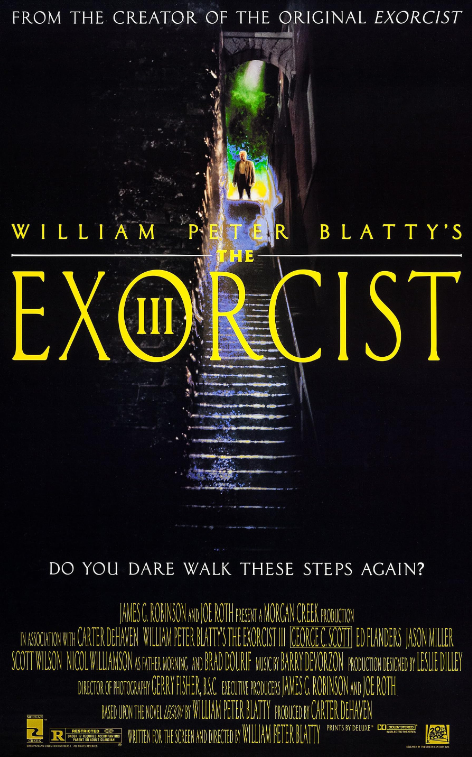
As I’ve written before, 1973’s The Exorcist is the second greatest horror film of all time, and one of the all-time great movies in its own right. Somehow, I’d stayed away from the sequels, though. But I’ve long-heard that the third one is worth watching. So, on this Halloween, I finally did. What’s fascinating to me is that 1990 saw the release of two second sequels to classic 1970s films, this one, and The Godfather Part III. There are myriad reasons to pay attention to The Exorcist III, which I wish I had taken note of before: William Peter Blatty’s involvement again, adapting his own novel (his 1983 book Legion), and this time, directing as well, and for my money, the brilliant performances of George C. Scott as Lieutenant William Kinderman and Brad Dourif as the Gemini Killer. Taking the supernatural elements that worked to terrifying perfection in the 1973 film, but putting them into a detective mystery was so brilliant. I found the entire film, from its production to its performances to the story itself, mesmerizing and spellbinding. I couldn’t look away. Arguably, The Exorcist III has to be one of the greatest horror movie sequels of all time.
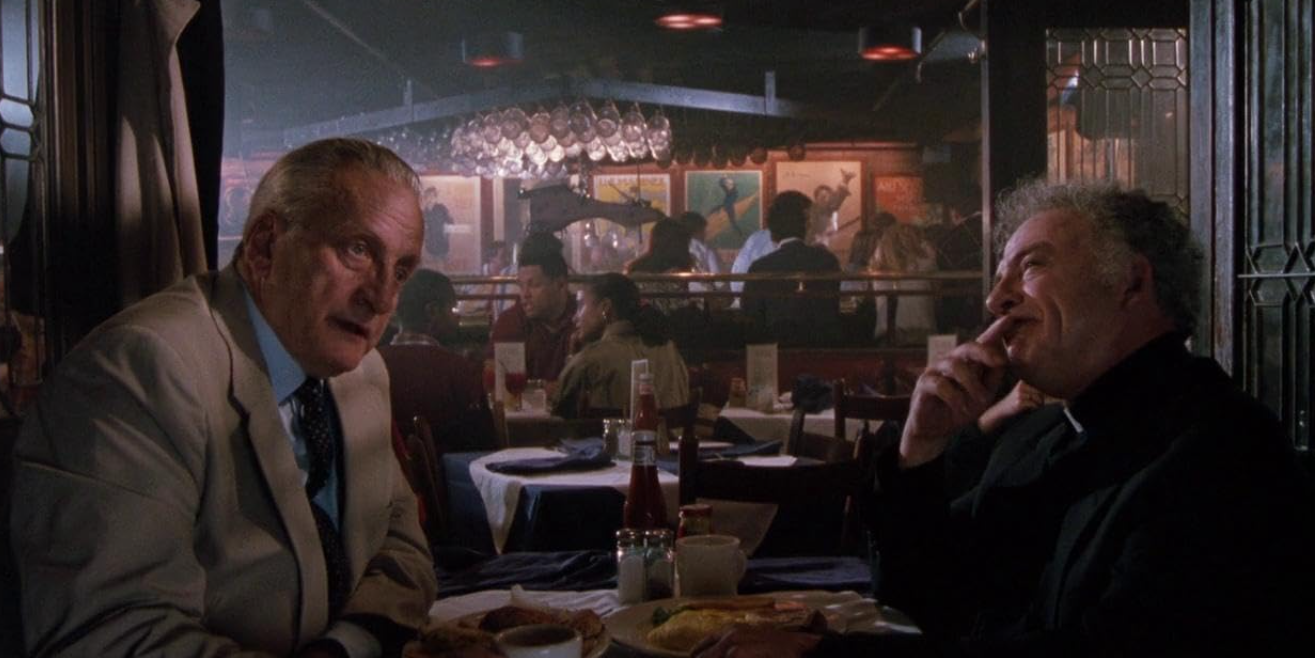
Set in Georgetown still, but 15 years after Regan MacNiel’s exorcism in the first film, Kinderman reminisces with his friend, Father Joseph Dyer (played by Ed Flanders), about the late Father Damien Karras, who died to save Regan. Kinderman and Dyer had such great chemistry together, and it was particularly poignant given that Kinderman is an atheist and of course, Dyer is a man of the cloth. Notably, they go and see It’s a Wonderful Life together. Ominous foreshadowing.
Evil is afoot again, and if it wasn’t clear by the wind blowing through the House of God and a figure of Jesus opening its eyes, then it was made abundantly clear by the murder of Thomas Kintry, a Black boy, who was crucified, and then decapitated with his head replaced by the head of Jesus from a statue. Jesus, literally. These demonic forces do not shy away from the House of God, as they attack Father Kanavan as he’s giving confessional. He’s also decapitated. Wow. That scene was creepy, too, when the seemingly old woman is confessing to slitting a girl’s throat. What’s bewildering to Kinderman is that even though the MO is the same for both murders, they each have different fingerprints at the scene. That means what we know it means: a demonic spirit possessing different people to carry out the murders.
Dyer is ill and is staying at a hospital, which also a psychiatric ward for the elderly (suffering from Alzheimer’s, autism, etc.). It is such a 1990’s thing to see the doctors and nurses not only smoking, but doing so openly within the hospital itself. Anyhow, Dyer is killed next, and almost all of his blood is drained and collected in jars left next to his body. Perfectly captured, that is. Except for the blood that was used to write, “It’s a Wonderful Life,” on the wall above his bed. What the hell. That’s when Kinderman begins to suspect that the MO could also reflect the Gemini Killer, but that’s not clarifying since the Gemini Killer was given the electric chair 15 years ago (!). He’s dead. And yet.
Weirder still is that the chain-smoking doctor relays the fact of a catatonic patient in the psych ward, who came in 15 years ago (!), and now claims to be the Gemini Killer. When Kinderman interviews him, he learns that it’s … Father Damien Karras (reprised by Jason Miller). Holy hell! It’s just that, the Gemini Killer’s spirit, thanks to the help of the devil (or the Master, as he calls him), is now possessing Karras’ body to continue killing. The Gemini Killer wants fame, but Kinderman will not oblige him. The killings will continue then. Indeed, the demon uses the poor and unfortunate elderly souls in the psych ward to carry out the killings. It’s genius, if horrific.
Kinderman tries conferring with another Catholic priest about everything, learning essentially that the demonic force possessing Karras’ body with the spirit of the Gemini Killer is taking its revenge upon those who played a part in the 1973 exorcism: Kanavan for sanctioning the exorcism, Dyer for being a friend of the family, and Kintry’s mother for decoding one of the demonic messages. Father Paul Morning (played by Nicol Williamson), who has experience in exorcisms (his hair is said to have turned white from it!), then jumps into the fray to provide the titular exorcism at the end. Before that though, Kinderman has to race home, thinking a possessed nurse is about to kill his family. Thankfully, Morning had stepped foot in the psych ward, disrupting the demon’s plans. I wasn’t sure how Morning even became aware of any of this or where to go, but apparently, he “sensed a calling” to perform another exorcism. Morning is nearly killed before Kinderman returns and then Kinderman himself is splayed on the opposite wall of the Gemini Killer by the demonic force. Kinderman then delivers a great monologue about what he “believes in.” Morning is revived long enough to intervene once more, Karras fights through the possession, and Kinderman ends it all the only way a grizzled old cop can: shooting Karras to “death.” Karras finally has a proper burial.
What a freaking film. I loved everything about it. It is absolutely a worthy successor to The Exorcist, with its filmmaking, storytelling, acting, and horror. While it didn’t have some of the moments we now consider classics from the first film, there were still memorable moments that will linger with me, like the hallway scene, the ceiling scene, and really, anything Dourif said as the Gemini Killer. He was fantastic and scary. I could listen to Scott give dialogue on anything and everything all day long. It’s difficult for me to put it into words, but there’s a kind of filmmaking on display here you just don’t quite see anymore, and part of that certainly owes to the aesthetic difference with digital, but there’s more to it, and it was great to revel in it here.


