
Spoilers!
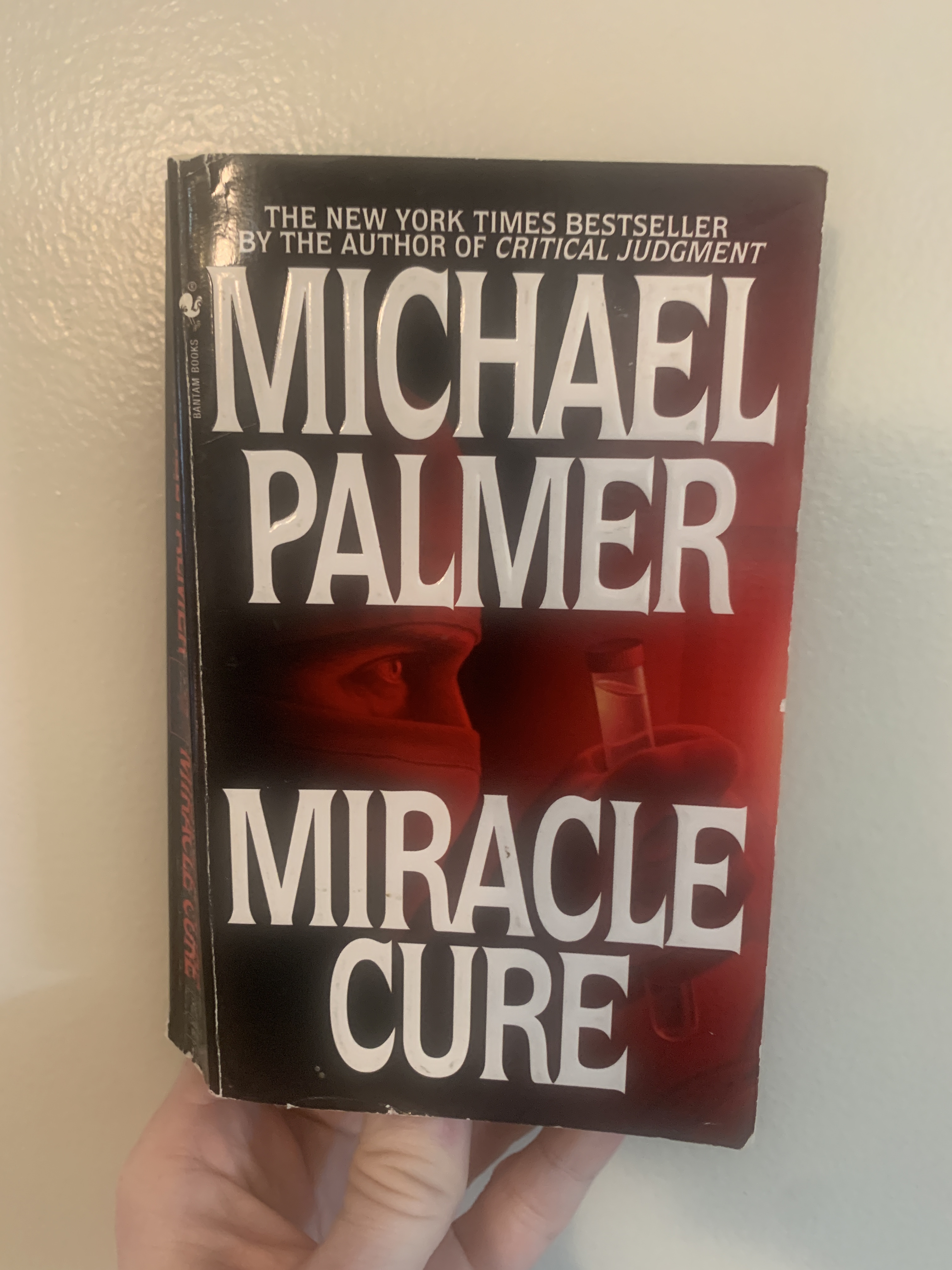
What’s fun about reading a medical thriller is that it inherently makes me uncomfortable even before any of the “thriller” plot points necessarily kick in. Oh, you’re writing about cardiovascular disease and chest pains? I can’t breathe already. But in Michael Palmer’s case, the plot points are thrilling, too, if a bit ridiculous in a suspension-of-disbelief way. Palmer’s 1998 thriller, Miracle Cure, is a conspiracy yarn unfurling at the highest echelons of medicine and science in Boston, with death and chaos along the way. I was highly entertained by this palate cleanser of a book.
Vasclear is being touted as a “miracle cure” for the deadliest disease Americans face: cardiovascular disease, targeting its underlying cause of atherosclerosis (plaque build-up in the artery walls). The intravenous treatment is said to clear the artery walls and reverse symptoms. In 2024, nearly 700,000 Americans died because of CVD, outpacing even cancer-related deaths. Imagine if there was a cure! It would be a media, government, scientific, and medical bonanza, which is what happens in Palmer’s book.
First, there is Republican Senator Louderman (lol), who is true to his namesake, and wants the Food and Drug Administration commissioner to fast-track the approval process with the pharmaceutical company, Newbury Pharmaceuticals, similar to how the regulatory body did so (in real life) for AZT in 1987, an HIV treatment. The gay community pitted against “flyover country.” Classic rabble-rousing. Second, there is our protagonist, Dr. Brian Holbrook, whose father, Jack, is in need of this miracle cure. After a particularly rough go of recovering from a bypass surgery, the elder Holbrook would prefer Vasclear, even in its clinical testing phase, than another bypass surgery. Brian, who was a star football player in high school (and coached by his dad!), became addicted to opiates after an injury ended his football career. That addiction would also derail his medical practice, costing him his license. At 37, with an ex-wife and two kids, he’s now working as a bouncer while taking care of his dad. However, he’s at least been in treatment and hasn’t touched any drug or drink in months. It helps that he has a sponsor, Freeman (lol), that he can rely upon from the Fairweather (lol) rehab facility. Freeman becomes something of an deus ex machina to help Brian when the proverbial shit hits the fan later.
Then, an opportunity comes up at the Boston Health Institute, where Vasclear is undergoing trials, for Brian to join the team and have his license restored. Brian was in the hospital with Jack, who was experiencing chest pains, when he was able to help an old college friend, Dr. Phil, with a patient with a difficult-to-diagnose issue. That impressed the director of the BHI, who brought Brian on. He’s now working with Dr. Carolyn Jessup in the Vasclear clinic. What was maddening is that literally the first day of his new job at BHI, Brian was already considering stealing the vials of Vasclear to give to his dad, if he couldn’t get him into the trial study. Damn! I get the classic medical ethics question presented there, but you just got your job and livelihood back!
Brian does ultimately steal the vials and administers Vasclear to his dad at home, although he rationalizes it that the way the trial study phases in the drug treatments, he’s not doing any harm to the other patients. Then, Jack is legitimately put in the trial anyway. All this to avoid another bypass surgery. Jack’s only 63, by the way. What confused me is that Jack was still taking his nitroglycerin pills. I’m not a doctor, but wouldn’t you want him to stop taking those to see if Vasclear actually works or not? Or is two separate situations? Regardless, Jack dies after another cardiac event. Vasclear didn’t save him. He didn’t see the miraculous reversal of artery blockage that the other patients did. Brian is adrift, grieving, but also questioning his decision to go with Vasclear instead of bypass surgery.
That’s when Brian and his doctor friend, Phil, begin looking more deeply into Vasclear and the patients. Brian suspects that the first phase patients had a lung issue that resulted from taking Vasclear, and then, they also died thereafter, sometimes in bizarrely violent deaths, like a house explosion and a convenience store robbery. The latter happened to a Holocaust survivor, no less, so that particularly propels Brian forward to seek answers.
Meanwhile, Brian has also befriended Teri, the FDA Commissioner’s star medical bureaucrat, who has sought Brian’s help to report anything amiss with Vasclear prior to the planned signing ceremony at BHI with the President of the United States and the FDA Commissioner announcing Vasclear’s fast-tracked approval. Their friendship turns sexual, of course, but I figured she was going to end up being one of the bad guys, and she was. She was the one tipping off the pharmaceutical company, which apparently was a shell company for the Chechen mafia’s money laundering scheme, that would then send Russian mobsters after Brian. It’s these mobsters who already killed the first phase trial patients. Indeed, Dr. Jessup herself was also contributing to faking results for a measly $2 million. There was no miracle cure or reversal of symptoms and artery blockage. Instead, she was faking the testing results. Somehow, all of that was getting past the FDA. Maybe because of Teri?
Still, Jessup ended up having an about-face and helping Brian, who faced perilous moments with the Russian gangsters, including one who just wouldn’t die after being bludgeoned not once, but twice by Brian (Brian ultimately shot him to death), and being tortured. Brian was also framed for Phil’s death and for setting a fire at BHI that was really the mobsters trying to hide evidence of their fraud. Fortunately, to clear Brian’s name and bring the truth about Vasclear to light, there was one more piece of evidence in Jessup’s office: Senator Louderman was receiving “treatments” and the evidence would show that it was faked. Boom.
In an explosive moment reminiscent of 1993’s The Fugitive (I wonder if that movie influenced Palmer, as it is referenced by him!), Brian and one of the Russian gangsters, Leon, crash through the dome where the presidential signing was about to occur, with Secret Service everywhere, of course.
Meanwhile, Dr. Art Weber, the head of the Vasclear research project at Newbury Pharmaceuticals, slips away. He’s been the devilish maestro behind everything, including turning on Jessup (she was “cajoled” into it by the money and his sexual advances). In the first Epilogue, he thinks he’s successfully evaded the law and the media by going to Bogotá, Colombia. He even meets an extremely beautiful woman he thinks he’s wooing. Instead, she stabs him to death. Who was she with? Probably the Chechen mafia. Or our CIA? Who knows!
What is truly interesting about the book is that there is constant risk-benefit analysis for any new drug brought to market. As Brian reflects, “Every single drug on the market has toxicities — many of them lethal. Risk-benefit ratio was the very backbone of clinical pharmacology.” It’s almost a punchline at this point how many side effects are rattled off for any drug commercial. But that’s the risk-benefit ratio! Or you know, the perfectly legal opioids that Brian became addicted to (the criminal part was prescribing them to himself). In other words, why was Brian so hellbent on proving Vasclear wasn’t exactly a miracle cure even though it was presumably reversing symptoms in 75 percent of patients? Which would indeed still be miraculous comparatively! Obviously, for the story, he had to keep digging, and ultimately, it was good that he did, but that risk-benefit ratio is fascinating to consider.
And it’s also interesting that the FDA is largely the hero in this story, notwithstanding that dastardly Teri and her eyerolling “romance” with Brian, because the AIDS story is the story of the FDA being a barrier to saving lives.
Overall, what a fun ride. I haven’t read all that many medical thrillers (I’ve only read one other Palmer book), but whenever I dip my toes into them, I enjoy the experience.


