
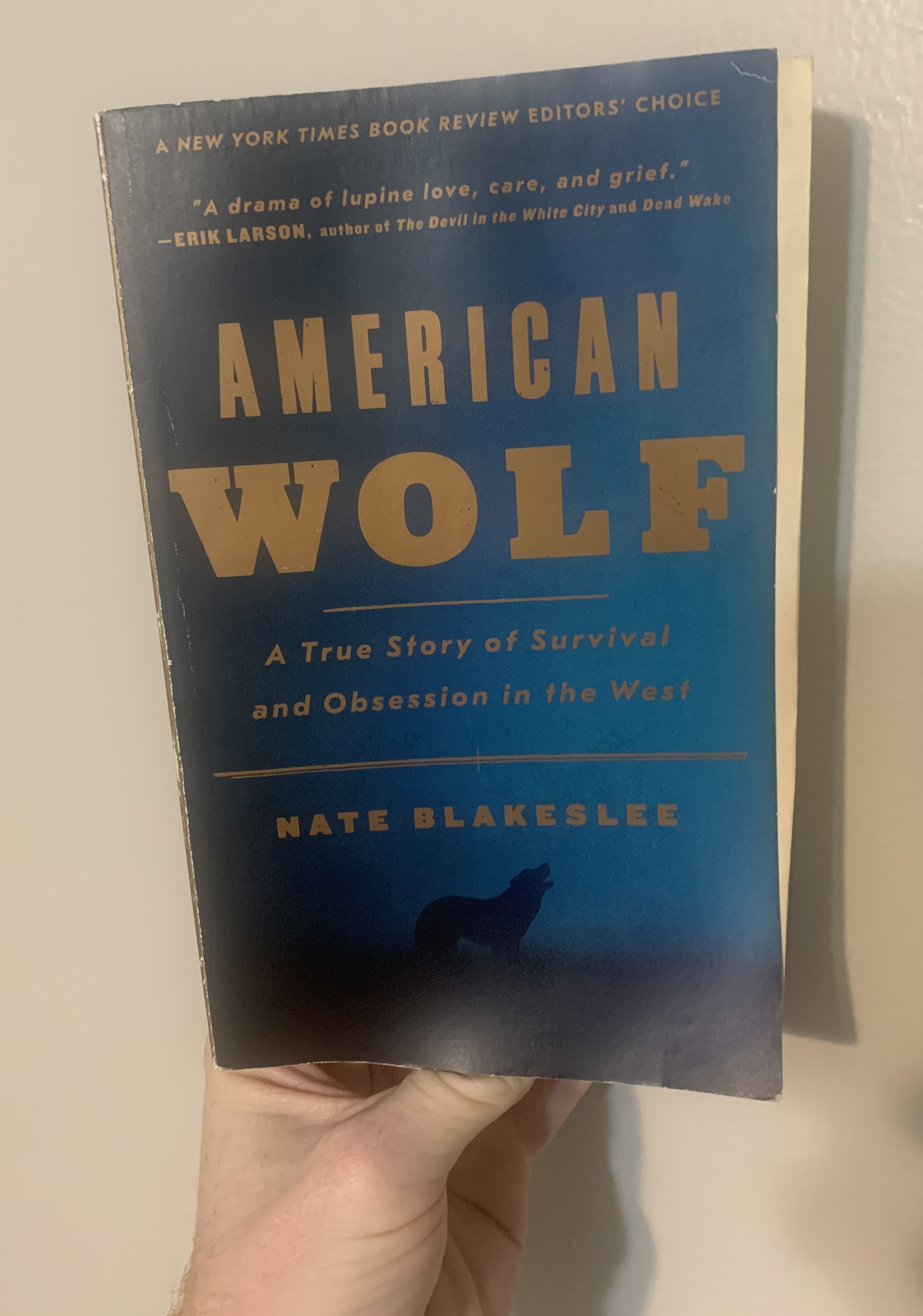
The story of the American wolf, and its intentional reemergence in Yellowstone National Park, is a story of man vs. wolf (a story as old as both species), man vs. man (the political fight over public government lands, pitting states versus the federal government, and sometimes different agencies within the federal government against each other), and wolf vs. wolf (naturally). But it’s also the story of storytelling: the stories we tell ourselves about ourselves, about other beings within the natural world and what we owe them, and the line between sentimentality and practicality, science and politics, nature and anthropomorphizing. Journalist Nate Blakeslee’s 2017 book, American Wolf: A True Story of Survival and Obsession in the West is riveting, heart-pounding, and emotionally gutting, whether it’s playing out in the snowy tracks of Yellowstone or in an overheated courtroom. Fascinating and illuminating, Blakeslee’s book is a must-read for anyone who wants to understand not only wolves more, but indeed, our fellow Americans.
In 1995, the United States Fish and Wildlife Service reintroduced gray wolves to the Yellowstone ecosystem after decades without their presence, which the plentiful elk, lazily grazing, certainly appreciated. The reasoning was to cull the elk, which the wolves preyed upon. Culling elk also would help, ostensibly, restore plant life that those elk were grazing upon in large numbers. Of course, hunters and ranchers were against such a move, worried what it would mean to protect wolves with the Endangered Species Act, and their livelihoods with respect to both their cattle and their plentiful source of meat: the elk. The three states that border the area just outside of Yellowstone, Montana, Idaho, and Wyoming, might as well be foreign countries to me with respect to hunting and ranching culture. But these pro-wolf and anti-wolf factions were fascinating to read about.
Since U.S. Fish and Wildlife Service is not a zoo, the reintroduced wolves ferried from Canada didn’t have pet names or anything like that; they just have numbers or identifiable nicknames, like Middle Gray or Shy Male. Still, for those who are invested, scientifically, in their introduction and therefore, are following their movements and lives daily, they grew a certain attachment to the animals. Yes, gang warfare-like clashes between wolfpacks are going to result in dead wolves, as are diseases, like mange, but outright shooting them to mount on your cabin wall as a trophy? That feels categorically different, especially when Yellowstone wolves in particular that were reintroduced are collared (which is how they are tracked and it even lets the trackers know if they’ve faced a “mortality” event) and travel beyond the park limits, as they’re are likely to do, and shot. Even when they were a protected species, some hunters in those aforementioned surrounding states had the motto of “shoot, shovel, and shut up.”
What a peculiar and marvelous thing it is, by the way, that humans are such conscious, multifaceted beings, and of course, rich enough, to be not only stewards of a species, such as the gray wolf, but the overall ecosystem of Yellowstone. At least, inasmuch as we can influence such a species and a system, whatever known and unknown downstream effects may occur. But reintroducing the gray wolf paved the wave for fights that would reverberate in statehouses and courtrooms in Idaho, Montana, and Wyoming, as well as Washington D.C. Tucked away from it all, only concerned with maintaining his Cal Ripken Jr.-like daily streak alive of spotting wolves is Rick McIntyre. Originally with the National Park Service in Denali National Park and Preserve in Alaska, McIntyre came over to Yellowstone right at the time of the gray wolf’s reintroduction. To say seeking out sightings of the wolves and noting their activities became an obsession with him would be underselling it. He took copious notes, such that if McIntyre finally wrote the seminal book on wolves that he wanted to, he could have six volumes, with each volume matching the entire length of the King James Bible, and still have enough leftover for a sizable book. He was a hoarder of notes, if you will, compulsively detailing everything he saw, the mundane and the extraordinary. His true gift, though, became helping to explain wolves to visitors to Yellowstone and then helping them to spot wolves. His meticulous notes, along with another spotter enthusiast, Laurie Lyman, provide the basis for much of Blakeslee’s book that involve generations of wolves and their movements. Contrastingly, Blakeslee also tells Steven Turnbull’s story, a pseudonym for a Wyoming hunter eager to bag his first wolf when hunting season opens up. He’d have to wait many years, though, as litigation between the state and the U.S. Fish and Wildlife would stymie his longings and that of other hunters.
Through Rick’s eyes, we learn the story first of the dominant Druid Peak Pack, who survived a number of years with its alpha 21M at the helm, along with his mate 42F, an important matriarch to their ever-growing litter of pups. Then 42F was killed by wolves from the Mollies Pack, and 21M was adrift, howling forlornly, his life ending on Specimen Ridge, hoping to glean one last sniff of 42F’s scent. At least, that’s the romantic telling from Rick. To Rick, he answers in the affirmative if a wolf in the wild can experience what we know as joy and happiness, and conversely, sorrow. 21M epitomizes as much. That’s why Blakeslee surmises at the end that Rick doesn’t need to release a book; he just needs to keep telling the stories of these wolves. That impact has reached thousands, if not millions, of people all over the world.
But the real “protagonist” of the book is O-Six, so named by Lyman because she was first spotted in 2006. O-Six came from the Agate Creek Pack, which was an offshoot of 21M’s and 42F’s coupling. Eventually, she mated with 755, two years younger than her, despite 755’s brother, 754, also pining after her. To be clear, O-Six was the alpha of the Lamar Canyon Pack, as it became known, with 755 as her fellow mating alpha, which meant 754 would be subservient. He ended up being a great, playful, and helpful “uncle” to their three litters in the years from 2010 to 2012, where they had 13 pups. What made O-Six stand out compared to other wolves, and this was before she was inadvertently darted and collared, was her poise, strength, cunning, and ability to survive and bring her progeny forward. She was also unafraid of humans and crossing our paved blacktops, unlike other wolves. That made the likelihood of visitors being able to spot her more common. As a reader, I naturally began caring about O-Six through Rick’s eyes, and this without having seen her or the way she cared for her pups or cemented her alpha status. So, even when the Mollies come back around trying to encroach and takeover O-Six’s territory — obviously, wolves are very territorial animals, hence the gang warfare analogy earlier — my heart was racing and it became like a thriller movie to see if O-Six would survive, especially because she had just had babies and was nesting them with them in her den. She escaped, and another in their group, I believe 820F, was able to protect the den while O-Six evaded the trailing and scenting Mollies.
Unfortunately, what O-Six couldn’t evade — indeed, wouldn’t even think to evade given her encounters in Yellowstone with humans — was a human intent upon shooting her. It never even occurred to me, despite this usually being the case in a book, that the dichotomous stories Blakeslee was telling with O-Six (and Rick) and Turnbull would actually come to a head. I was shocked when it was Turnbull who shot O-Six in December 2012. Again, there is just something that feels innately wrong about it. It’s one thing to kill a wolf in self-defense, although they don’t tend to attack humans, or to protect your livestock, which is your livelihood, but it’s another to kill it for the vanity of having it as a trophy. Which again, is what Turnbull sought.
Blakeslee was able to meet Turnbull through his connections and reporting even though his name was never released after O-Six’s death blew up in the national and worldwide news media. He granted Turnbull anonymity to share his side of the story. And if anything, Turnbull’s own telling of the shooting makes it all the more melancholy. After he shot her, O-Six’s mate, 755, came and sat down, unafraid of Turnbull, and howled until the rest of the Lamar Canyon Pack returned. It was like a collective mourning circle over the death of their alpha, O-Six. While Turnbull talks a big game about engaging in a “fair catch” when it comes to shooting game (and he typically uses a bow and arrow), I don’t see what’s ethical or noble about trophy hunting. When Blakeslee met Turnbull, not only did he show him O-Six’s mounted body, but professed his absent of regret over shooting her; he said he’d do it again. And yet, he doesn’t want to be thought of as an asshole. Anyhow, O-Six’s mounted body, that image, is such a window into this precarious line we straddle between our dual commitments as man vs. nature and man as stewards of nature. Blakeslee describes the sight of O-Six’s body, “It was impossible not to think of the countless stories I’d heard about what she’d done with those tireless legs and those formidable teeth, the elk she’d taken down single-handedly, the territorial battles she’d won, the pups she’d reared, the loyalty and love and fear she’d inspired, and the enormous and magnificent stage upon which she’d done it all, in front of her thousands of fans. Now she was hanging from a plastic hook in a two-room cabin with an audience of just Turnbull and myself and Bubba [Turnbull’s parakeet], silently looking on from his cage.” Blakeslee’s instinct is correct that it feels “profane,” but there’s no world in which someone like Turnbull would understand (and vice versa, for that matter). Magnificent writing from Blakeslee; that passage is a microcosm of how wonderfully written the entire book is throughout.
All told, the wolf reintroduction program at Yellowstone was a success. Biologists released 15 wolves in 1995, with an additional 17 the following year. By the winter of 2003, the wolf population numbered 174 across 14 packs throughout the expanse of the park. But that success is also when the fights intensified between the pro-wolf and anti-wolf factions, particularly when those wolves were straying beyond Yellowstone’s boundaries. Crandall, Wyoming is the hotbed of this fight, and where Turnbull traverses. The thing is, most land in that area of the Northern Rockies belongs to the federal government. That obviously frustrates residents of Idaho, Montana, and Wyoming, who don’t want to take orders from federal judges and bureaucrats in Washington D.C., hence “shoot, shovel, and shut-up.” Just as expected with the growth in the wolf population, the elk populated had correspondingly declined, although not all of that decrease can be accounted for with wolf predation. From a peak of 19,000 before reintroduction, by 2010, the elk population was down to 6,000. It was also argued that the remaining population, now accustomed to the predator in its midst, was harder for hunters to kill. Blakeslee notes that as a result in Crandall, between the guides, the cooks, the wranglers, the horses, the insurance, and the fees, it cost $25,000 per year to run a camp for big game hunting. The business wasn’t there for it anymore. Which I have a hard time mourning!
What’s also particularly perplexing about the Fish and Wildlife’s posture with wolves is that they left wolves on the endangered species list in Wyoming, while moving forward with delisting in Idaho and Montana, a move that seemed more grounded in politics and backrooms deals than science or biology. Wyoming was suing the federal government instead of coming up with a suitable state management plan for wolves, if they were delisted. The federal government’s ultimate wish seemed to be returning the matter to the states to “deescalate” tensions. And it’s all terribly confusing and contradictory within the federal government. Blakeslee outlines it thus: “One federal agency was reintroducing predators on public land, a second was leasing adjacent land to ranchers, and a third was dispatching trappers or men in helicopters to kill those same predators when they inevitability crossed paths with livestock.” Madness. Politics is toxic to the environment. Even though a judge ruled that wolves needed to be returned to the endangered species list throughout the Northern Rockies, thanks to more politics intervening, subsumed and marked by the 2011 Tea Party vs. President Obama budget fights, a tiny paragraph was introduced in a budget that was passed, known as a budget rider, that voided the judge’s ruling essentially, a rare case of Congress intervening in the execution of the Endangered Species Act. The rider was inserted as a favor to the Democratic Senator from Montana, John Tester, to shore up his constituents’ support ahead of his reelection, which he narrowly won in 2012. After O-Six’s well-publicized death, things turned a corner for wolf advocates, though. First, Fish and Wildlife published its proposal to delist wolves throughout most of the Lower 48; an expert panel rejected the proposal in 2014, saying “it wasn’t based on the best available science.” A federal judge returned wolves to the endangered species list in Wyoming later that year. That ruling effectively canceled the state’s fall hunt for wolves. A District Court judge then ruled that the Upper Midwest must return wolves to the endangered species list, too. The judge said “enough is enough” as it regarded the killing of wolves (1,500 killed in Wisconsin and Montana alone in a three-year span).
If I had a stance on this issue of man vs. wolf, it would be three-fold: 1.) I don’t understand the utility of trophy hunting, especially big game hunting; 2.) Science, where it can inform our politics, ought to, and politics should never inform science; and 3.) I believe because of our peculiar nature and ability as humans, we do have a duty to steward species and ecosystems, inasmuch as we can, and especially so long as we maintain humility.
Reading Blakeslee’s book, you’d be hard-pressed to come away not sympathizing with the American wolf and the Americans who stewarded their resurgence and documented it. Beautiful and moving, tender even in the most natural of moments, and thought-provoking, I was enthralled by American Wolf and will recommend it to anyone going forward.


