
Spoilers!
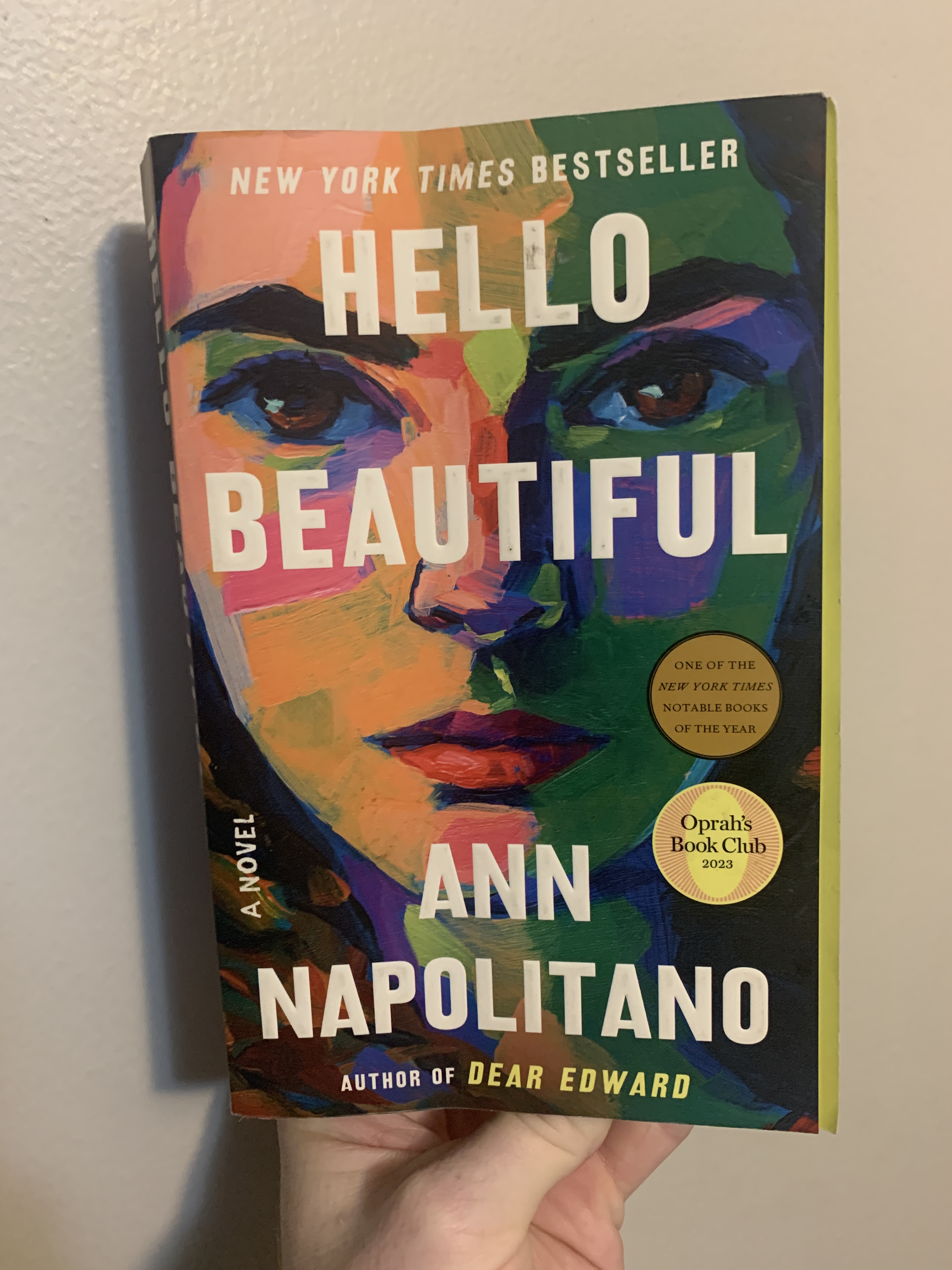
The Gretchen Rubin quote, “The days are long, but the years short,” has been on my mind. Family. Love. Forgiveness. How one reconciles that with pain, longing, and regret as the years get shorter and shorter is a difficult question to answer. Indeed, the bitter irony of life is that what once made the days seem long — the pain, longings, and regrets — come to define the years long after as they become shorter. We are nothing if not the amalgamation of our families, for better or for worse, and our lives either become a full blossoming of that amalgamation or an attempt at unstitching it. Anna Napolitano’s 2024 book, Hello Beautiful is a tour-de-force reckoning of this tension through generations of a family dealing with the failings that make us human, that push us away from one another, and that ultimately draw us back. Hello Beautiful is a beautiful, heartbreaking, and lovely book about the power of love, and how often its most animating force is often, sadly, absence, death, and grief. I’m so fond of books that are told through multiple generations, weaving together a story across time and space, because you not only connect with the characters on a profound level, but therefore, come to love them a great deal. That was the case here with the Padavano sisters, William, and the children that began the next generation.
1960. Boston. William is born. For his parents, this was fine. They had him and his older sister, Carolyn. Then, she died, and with it, any sense of parental concern or stewardship of William. He was bereft of love. Nonetheless, William eventually found his way to Chicago, and specifically, Northwestern University, thanks to his height and love of basketball. It’s at Northwestern where William meets Julia Padavano, the oldest of the four Padavano sisters. They begin dating shortly after that. Because they’re a unit (an amalgamation!), the other three sisters join Julia to watch one of William’s games: Sylvie, the bookish one, and the twins, Cecelia, the arty one, and Emeline, the nurturing, motherly one who loves children already. Julia then invites William over to their house, where William meets their parents, Rose and Charlie. To William, who didn’t have loving parents or siblings to interact with, he sees the Padavanos as the ideal, loving family. When William and Julia are married shortly thereafter — Julia has first daughter syndrome, where she has to control everything, solve everything, and plan everything —, William will even take to calling Rose Mom. Charlie is the one who says “hello beautiful” to his daughters. This is a greeting Napolitano read in postcards from her uncle, who lived in Chicago, another inspiration for this story as its setting.
But of course, to the uninitiated, most families may seem ideal and loving from the outside. On the inside, it could be a different story. The Padavanos love … in their way. Rose is a God-fearing Catholic, obsessed with her garden, and perpetually disappointed by Charlie, his head-in-the-sky attitude, his drinking, and his lack of ambition and money. Her dream is for all four daughters to attend college, like she was unable to do. Then, everything begins breaking apart, first slowly and then all at once, as it tends to go. Cecelia, almost 18, is pregnant. She doesn’t reveal this to Julia yet because she learns of it at Julia’s wedding. But once Julia does learn of it, first daughter syndrome kicks in, chagrined that she wasn’t first, she decides she and William will have a baby, even though it wasn’t part of her original plan (or his!). Rose, who was shunned by her mother for having a child (Julia!) out of wedlock, turns around and does the same thing to Cecelia! She refuses to speak to her. We also begin to see the early signs of deterioration in Julia’s and William’s marriage. They are only 23 here, by the way. William reflects at one point that, “When Julia gazed at William, she was trying to see the man she wanted him to be. She couldn’t see, or didn’t want to see, who he actually was.” He was another problem to be solved and fixed. Another box to be checked.
Then, the one-two punch of tragedy and disruption occurs: Charlie suddenly drops dead of a heart attack shortly after Cecelia gives birth to Izzy (he at least gets to hold her and say, “Hello beautiful.”), and in response, Rose decides to leave their home and move to Florida with her friends. So, in a short amount of time, the ostensibly happy, loving Padavano family went from living together in their modest Chicago home to Julia marrying young and moving to an apartment on Northwestern’s campus; Cecelia becoming pregnant and her and Emeline moving in together at a neighbor’s house down the street (twins stick together!) after Cecelia was disowned by Rose; Charlie dies of a sudden heart attack; Sylvie begins sleeping on Julia and Williams’ couch because Rose doesn’t want anyone around after Charlie’s death; and then Rose decides to sell their childhood home and move to Florida. What?! Change is compounding like that.
As all of this is progressing, we’re oscillating between the narrative perspectives of Julia, William, and Sylvie through months or years at a time. As the aforementioned is occurring, Julia is adrift, realizing none of that is anything she can control or solve. Sylvie has no anchors, as she feels like an imposition at Julia’s apartment, even though she and Julia have always been the closest, and the twins are doing their own thing. William is depressed because of his unprocessed childhood trauma and the progression of his adult life: it’s been orchestrated and carefully planned by Julia, but is it what he wants? He certainly doesn’t want a child. He fears, as I’ve also feared (although I’m also just not a kid person), that his “brokenness” or his “darkness” will be contagious and plague his child. His very existence in her life will do her harm. So, after Alice is born, triggered by the sudden death of William’s history professor, that’s when the next one-two punch comes. First, William decides he is leaving Julia and Alice; they are clearly better off without him, according to his distorted-by-depression thinking. Second, William decides he’s going to kill himself. He walks into Lake Michigan. By that point, however, Sylvie, who has felt a special connection to William ever since she read his “book” about basketball, which contained footnotes clearly alluding to his deteriorating mental state, and when they shared a late night conversation on a bench outside William’s apartment where they each felt seen by someone for the first time, mounts a search-and-rescue operation upon learning of William leaving Julia (knowing about the footnotes!). She calls in Kent, William’s fellow teammate and best friend, and the rest of the basketball team, and they search all over Chicago for William. In a dramatic scene, they chase after ambulances heading toward the shore of Lake Michigan, where Kent and the other teammates pull William’s limp body out of the water. Sylvie, pretending to be his wife, goes with William in the ambulance, holding his cold hand all the while. I’m getting goosebumps even writing about that scene! That was my response reading it, too, along with some tears. So powerful and sad.
Julia is aghast and flabbergasted. First, that William left her and Alice, of course, but also that he tried to kill himself. Surely she would have known the signs ahead of time? But then, she realizes she doesn’t know William all that well. She didn’t even know he had a sister who died! They were so young in their courtship and she had such a checkbox mindset: boyfriend, marriage, house, baby, successful job. For someone we’re introduced to as a questioning, inquisitive type, she stopped questioning somewhere along the way. She partly sees it as a betrayal that instead of commiserating with her, Sylvie formed that search-and-rescue operation to find William, and then kept seeing him in the hospital. But then partly, Julia is relieved because then she doesn’t have to be there. She never goes to the hospital. Instead, Sylvie returns and returns, eventually giving up the ruse to the doctors that she’s the wife, to be sure, but she’s present. She’s showing up. And that just furthers the connection she and William have. Unlike Julia, Sylvie shows interest in William’s basketball passion. Cecelia and Emeline are too loving to cast off William, too, so while they don’t visit, they aren’t turning away, either.
Eventually, the next momentous moment in the book is caused by Sylvie and William acknowledging their feelings for each other. They love each. Surely that is a betrayal of Julia, right? For Sylvie to fall in love with her now ex-husband. How complicated. When a job opportunity comes up for Julia in New York City, she takes it, moving her and Alice to the city. She’s done with Sylvie, and by extension, for some reason, the twins, too. She does spottily talk to Rose (who still hasn’t reconciled with Cecelia or started a relationship with her actual first granddaughter, Izzy), however. The family is torn asunder yet again.
Julia won’t talk to them for 25 years. 25 years! Again, I struggle with where to find the line with such decisions and choices. Forgiveness matters. Forgiveness is love, as Napolitano has a character reflect. But surely there are also scenarios one can imagine where it is appropriate to stop talking to a family member, where familial bonds are rightly severed and irreparable for one’s own mental health and well-being. While I didn’t sympathize with Julia through much of the book — mostly because I’m on the side of anyone experiencing a mental health crisis! — and I have a hard time understanding the 25 years of silence, particularly with the twins, I do understand her sense of betrayal and attempts to regain control over her life, along with her admirable desire to assert her independence. That said, like Rose’s mother with her, and Rose with Cecelia, our choices reverberate down the generations. Julia’s decision to sever ties with her family in Chicago means Alice will never know her loving aunts, never get an opportunity to know her dad (she tells Alice when she’s 5 that he died in a car accident), and never know her cousin of a similar age, Izzy. While she doesn’t grow up experiencing depression (something both Julia and William were worried about), she is guarded and myopic in her worldview to protect herself. And, just as importantly, to protect Julia. She’s always on eggshells around her to protect her feelings and deflect from judgement. It also can’t be easy knowing your mother is holding pertinent information from you, as Julia is with Alice. That’s the other change in this part of the book, is that we start getting Alice’s perspective as well. Like any kid, she’s going to be curious about her family she doesn’t know but has heard of from Rose. However, she ultimately decides to stymie that curiosity in service of Julia’s feelings.
The next, and final, one-two punch of the book occurs when Sylvie, nearly 50 years old now, is diagnosed with a terminal brain tumor. Ugh. I was so sad. At this point, her Chicago life is great. She’s been married to William for 25 years (no children, and it’s interesting that conversation is never even entertained on the page); Cecelia is flourishing in her art career and self-assured in her skin; Izzy is a grown woman in her mid-20s now; and Emeline, after confessing to being a lesbian to her sister I think in the early 1990s, is in love with a woman named Josie at the daycare she works at, and they become a couple who fosters toddlers (in a twist-of-fate, the sister who most wanted to be a mother would never be one the “traditional” way); and they’re all living together in a “super-duplex,” or essentially two houses constructed together. It’s all lovely until Sylvie’s diagnosis. Which makes Sylvie, Kent, and of course, William worry if William is going to fall back into depression and suicidal thoughts. Can he survive Sylvie’s death? At least they have six months to figure it out …
When William — yes, William — calls Julia to tell her about Sylvie’s diagnosis and prognosis, she doesn’t want to come to Chicago. Even for that. Wow. Then, 10 days later, she surprises Sylvie at the local library where she’s head librarian (she’s worked there since she was a teenager). Julia will come back one additional time, where they go and see a movie together and touch for the first time in 25 years by holding hands. In my opinion, though, they didn’t have a full-fledged reconciliation. It was more like an unspoken understanding. I would have liked the former, though!
Here comes the final one-two punch: Sylvie suddenly dies, much earlier than what was expected. It’s fascinating to me that even though, as a reader, we know Sylvie is going to die, the suddenness of dying sooner than the anticipated timeframe still shocks and saddens. What makes it even more of a whirlwind for the Padavanos, though, is that Sylvie drops dead the same day Alice decides to fly to Chicago, with the help of her great two best friends, and meet William. Previous to that, Julia finally told Alice in a one-two punch of her own that not only is your Aunt Sylvie dying, but that actually, your father is alive and is married to Sylvie. That’s a lot to take in! Alice stops talking to her mother for a bit after that, realizing how long her mother has been lying and holding back from her. Like great-grandmother like grandmother like mother. Generational pain and silence.
But as I alluded to at the top, death and grief have a way of flattening the bitterness and pain and what had been unspoken and unseen for decades, or at least it did in this case. Everyone, including Alice, William, Julia, and the rest, gather at the super-duplex to mourn Sylvie. At the exact same time, Alice and William seek each other out to talk, finally. William realizes he can no longer be scared of hurting Alice. In fact, by choosing to not be in her life, he was still shaping it, just via his absence. That’s the tricky business of having a child! For her part, Alice realizes that she has found her mirror in her father after growing up being singled out and bullied for her height and not fully understanding who she is outside of Julia’s shadow.
Regarding the beautiful cover of Napolitano’s book, I was wondering which sister it could be since there are four sisters. And we get at least two of the sisters’ perspectives in the narration. Cecelia is the artist, who likes to do portraits and giant murals of women and families, including her sisters, that dot the Chicago streetscape. One portrait she did was of St. Clare of Assisi, of whom Cecelia was given a portrait of by Rose as her “Scarlett Letter” after her pregnancy reveal. For Cecelia, St. Clare of Assisi, who forfeited her wealthy life to live one embracing poverty and her devotion to God, became a symbol of independence and bravery. Who knows what attributes Rose was ascribing to her though in chastising Cecelia (devotion to her?). Regardless, I thought perhaps that is the woman on the cover of Hello Beautiful and that interpretation works. But I think there’s a better interpretation, also hinted at by me at the beginning: the cover is an amalgamation of all four sisters, Julia, Sylvie, Cecelia, and Emeline, because they can’t exist without the other, even when there’s 25 years of silence between them. We are our family, and our family is us. That’s quite beautiful indeed.
I was completely immersed within the world constructed by Napolitano, loving Sylvie and William (notwithstanding his treatment of Julia and Alice; he is fallible, and to be pointed, of course one can be both depressed, suicidal even, and still make blameworthy mistakes), and absolutely yearning for Alice to meet her Chicago family. It was heartbreaking that Alice never got to meet Sylvie, at least an adult since Sylvie did meet Alice when she was a baby. Great writing, flow, and thought-provoking dynamics about family, love, relationships, and what we owe each other. I highly recommend Hello Beautiful.


