
Spoilers!
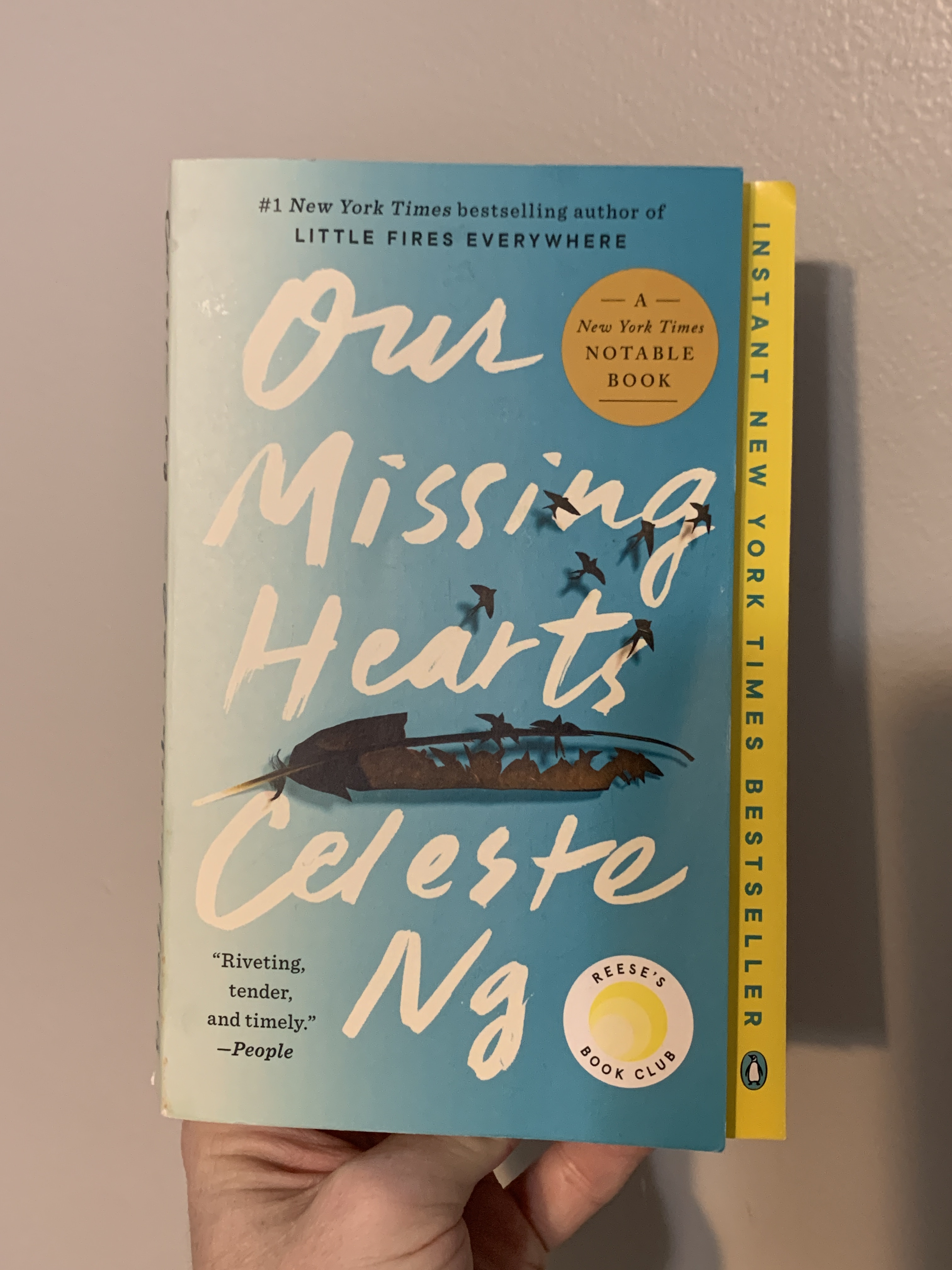
Children are naturally rebellious and radical, unfettered as they are by adult concerns, such as social politeness and norms necessarily, and often with an insatiable curiosity. Which is what makes viewing a dystopian version of America through the lens of a 12-year-old boy poignant. And it especially makes sense in a world burning books, pulping books, and banning books, that librarians — who are helping those curious children, like the boy — are the most subversive citizens of all. Celeste Ng’s 2022 book, Our Missing Hearts, is an urban fairy tale, poetic and lyrical, but with the raw, unavoidable trappings of dystopia. After all, as the boy reflects, even fairy tales have monsters. What if the monsters are your fellow citizens, though? Your own government? Ng’s rendering of this America echoes our sordid history of separating families, including in the present day. Myriad examples exist of this separating of families, of separating children from their parents, of castigating and casting out the “undesirables” in the name of security and economic prosperity. Most conflagrations like this throughout our history, as well as that of other countries, is not necessarily the story of the unambiguously evil architects and unashamed supporters of the action, although it’s that, too, but the story of the masses who look away and in so doing, acquiesce and accept the horror. I found the book profoundly moving in capturing such a dynamic, self-assured in its storytelling patience, and a beautiful ode to the power of individuals to push back against tyranny in grandiose and intimate ways alike.
The boy in question is Bird, living in Cambridge, whose mother, Margaret, is the descendant of East Asian parents, and liked to tell Bird a wide array of fairy tales and stories, believing in the power of stories to ignite our imaginations and passions. Bird’s father, Ethan, is white, with a proficiency for words and their etymology, so, naturally, he works at the library, albeit a step down from his previous job as a professor. For reasons that are not immediately clear yet, Margaret is gone. She left three years ago. It’s just Bird and Ethan in their rather ho-hum life: Bird to school, where he’s lonely and picked on, except for the stalwart, confident Sadie at his side, and Ethan to his job stocking shelves with approved books.
As Ng will patiently unfurl for us: America went through what was known as the Crisis, so economically and socially deleterious that it surpassed even comparison to the Great Depression, hence the all-enveloping term of Crisis. At this unyielding time of such despair and upheaval, politicians and the public began to single out China as the perpetrators of the economic downturn, and therefore, the beneficiaries of it. This cast all Asian Americans into a nefarious light as potential infiltrators, traitors, and usurpers-in-waiting. Even before anything was codified into law, white Americans were taking the law into their own hands, with random, brutal attacks on Asians that would go unpunished. Out of this was passed the PACT Act, or the Preserving American Culture and Traditions Act. That’s a helluva euphuism ripped right from the past 10 years of American life, i.e., the Great Replacement theory. Under the PACT Act, it outlawed promotion of “un-American” values and behavior, and required all citizens to report potential threats. Thus, American citizens became anonymous informers on their fellow citizens, from the trivial to the often made-up crimes. Tucked away in the PACT Act was a provision to re-place (a great word choice here by Ng) children, if their parents were seemingly unpatriotic and too sympathetic to China. This is why in places like Chinatown, New York, or just among any Asian Americans trying to keep their head down to avoid attention, they would often make big donations to local schools or the police or individual police officers. Asian Americans making such donations was a way of saying, I’m a real American. These donations also funded neighborhood watch groups, like a roaming band of HOA miscreants, but with the full backing of the U.S. federal government. Of course, there was anti-PACT resistance and protests, but they turned violent, including with the “poster child” of that resistance, a Black college student named Marie, being killed.
A few years ago, the resistance shifted to nonviolent artistic displays that sought to rouse the conscience of their fellow Americans rather than through protesting that inconvenienced them or could turn violent (often because of the police!). Ng took inspiration for this “guerilla art” from real-world examples, such as the nude statue of Donald Trump that appeared seemingly overnight, or yarn “bombings.” A thematic throughline with the art is this concept lifted from Margaret’s poetry, written before PACT, with the last line, “Our missing hearts.” In other words, reunite these torn apart families, and bring back our missing hearts. There’s also a bit of dark humor, perhaps, in that Margaret’s sort of throwaway poetry where “tens of people” bought it became a viral sensation and the calling card of the anti-PACT movement. Because the guerilla art is using Margaret’s poetry, and because she’s of East Asian descent, Margaret is being harassed, and then doxed, by loudmouth pundits and politicians on TV. It’s only a matter of time until they come for her. So, she and Ethan decided it’s best if she leaves of her own volition and they pretend to not want anything to do with Margaret. (Ethan’s despicable parents even turn on Margaret during this time, buying into the propaganda; Ethan disowns his parents thereafter, thankfully.)
But kids. They’re too damn curious (complimentary), and naturally, Bird was going to wonder what became of his mother, and what is going on in the world he lives in. He’s going to question. And when he has questions that he knows his dad will not entertain, then he will use the loose leash he has — his dad assumes Bird is a ruler follower to a fault — to turn to someone who can help him: a librarian. While at the library, he notices what appears to be some clandestine communication occurring, where patrons are leaving notes in books that the librarian then “reshelves.” As it turns out, enabled by Margaret once she leaves Cambridge for New York City, and then travels all around, there is an “underground” librarian and library network passing messages, accounting for the missing, and trying to reunite families. So bad-ass! I loved that.
With the help of a note his mother left behind and the local librarian, Bird realizes he needs to trick his father (pretend he forgot his lunch at home, so he could return and then leave for NYC), use the money he has available to him, and travel to NYC by himself. One of the most subtle and effective descriptive scenes in the book is when Bird does arrive in NYC, and he crosses through Chinatown. Chinatown looks rundown, like it was deliberately stripped of anything that made it vibrant and lively before, and in the case of displaying anything with Chinese characters, it was. The businesses all seem to be competing to show how patriotic they are with their American flags and their American flag lapel pins and the “100% American” signs. Then, Bird crosses into the other neighborhoods of the city, where it’s like Mayberry, with less needs to show off patriotism. It was a haunting juxtaposition that will stick with me. After seeing a violent assault on an Asian woman and fleeing, Bird turns, once more, to a local librarian for help. The librarian knows Margaret and Bird is able to reach the house of the Duchess, which is a rich friend of Margaret’s before the Crisis. (Margaret left behind her name and address as a breadcrumb she rightly assumed Bird would understand and investigate.) Bird and Margaret are reunited, and eventually, even Bird and Sadie, who through her own force-of-nature willpower, made it to NYC, seeking out her own parents who were forcefully separated from her.
That brings us to Part II of the book, and we learn much of the aforementioned regarding the Crisis, the PACT Act, and the underground librarian communication system from Margaret’s perspective. Again, what is haunting about slides into authoritarianism like this, where the entire citizenry becomes willing informants on each other for the jackboots, is how much of it is passive acceptance or a misguided understanding of the scope and downstream effects. Which is to say, even Margaret, when the PACT Act was enacted, supported it, because who wouldn’t want to be patriotic and go after the most violent of the violent? The most subversive of the subversive? Surely, they don’t mean me, right? Of course, it does mean you. It does mean those who aren’t actually violent or subversive at all. Because you’re easier to arrest than the truly violent and truly subversive. It doesn’t even matter if you’re actually of Chinese origin or not, as the law supposedly originally intended (not that that would be okay, either) because, for example, Margaret was derisively referred to as “kung-PAO” or Person of Asian Origin. We’ve seen such scenarios play out in real-time, both in the first Trump administration, and in the second these past two years, where Hispanic immigrants assumed they wouldn’t be targeted by raids and deported. It’s predictably awful and sad.
Duchess’ father made his riches in electronics. Using that as inspiration, she and Margaret are leaving bottle caps with transmitters throughout the city, inconspicuously in spots where they wouldn’t be disturbed, like on the underside of trash cans and in homeless encampments. The plan is another, more grandiose guerrilla art-like performance. In this case, Margaret will take all the stories she spent the past two-and-a-half years collecting throughout the country of separated families, and tell those stories through the transmitters. People, she hopes, will be forced to stop and listen. Perhaps it will plant a seed of discontent and disobedience that will blossom, even if not in the short-term, at least in the long-term. The first family Margaret visited, in fact, when leaving Cambridge was Marie’s in Philadelphia, where she felt like she had to atone as the writer of the poem. What that experience taught Margaret, and what she would take with her throughout the country in talking to families, is that what they most want is someone to listen, to remember, to speak the tragedy and brutality into existence. Which is what Margaret’s project becomes. Do not let it be normalized. Do not acquiesce. Do not forget what is being done in your name. The transmitter concept seems to work: people stop and listen. Ng’s compares the scenes in NYC to Pompeii, which would make this artwork volcanic, keeping people in place. Margaret realizes to stop speaking would go against the spirit of this art. That is, “When are you ever done with the story of someone you love?” She adds, “Who ever thinks, recalling the face of the one they loved who is gone: yes, I looked at you enough, I loved you enough, we had enough time, any of this was enough?” It’s never enough. So, she must keep speaking.
Indeed, Margaret burns a little too bright with her idea, speaking and speaking until the police are quite literally breaking down the door. She’s presumably arrested. Margaret mused, though, in what gives me goosebumps thinking about, “If the world was on fire, you might as well burn bright.” She sure did. Upon realizing Margaret’s likely predicament, Duchess drives to Cambridge, retrieves Ethan, and now, this misfit band of “un-Americans,” the Duchess, Ethan, Bird, and Sadie, are going to stay committed to the cause: working with the underground librarian system, seeking to reunite families, and maybe even, hopefully, find Sadie’s parents, all inspired by what Margaret was trying to do. They can’t go back to their normal lives now, not after everything. If you’re Bird, you can’t unknow what you’ve learned, and Ethan is going to stick with Bird. Sadie certainly isn’t going to rollover. And the Duchess has the money to maintain her rebellion.
What a profound book about how easy is to otherize our fellow humans, to look the other way, to go on as if any of this is normal, and to rationalize more draconian measures as the Overton window shifts. What’s so insidious about it all is how incrementally that Overton window does shift until before you know it, you’re accepting what would have been unequivocally unacceptable previously. That’s how it happens. It’s not usually one Big Moment. But Our Missing Hearts is also the story of the individuals who won’t sit idly by: whether it’s the librarian quietly rebelling, while still risking a great deal, or the guerilla artists, who aim for something more grandiose to dislodge the complacency and acceptance from the brains of their fellow citizens. Just as importantly, Ng’s story is also about the power of a mother’s love throughout: doing what she thought was the right thing at the right time during Bird’s birth/early years (accepting PACT), running away (to protect Bird), and counterintuitively, realizing some things are bigger than even a mother’s love (what is morally right, thus staying to tell more stories at the cost of arrest and separation once more from Bird), albeit, still in service to a mother’s love, just all mothers’ love. When we imagine our worlds too small, we shrink love to something that can turn hateful and ugly. Which is to say, we stop seeing that other mother’s love as the same to ours. We otherize it.
Our Missing Hearts is a must-read, not only as a beautiful, if tragic, story about hearts torn asunder by forced family separation, but about the masses who are also “missing their hearts.” Empathy matters, cringe or not. Empathy is that thick line between caring when people begin disappearing off the streets or not. Empathy is the difference between freedom and authoritarianism. Empathy is always the first casualty. Ng’s book is a lovely bulwark, and clarion call, against letting that happen.


