Spoilers!
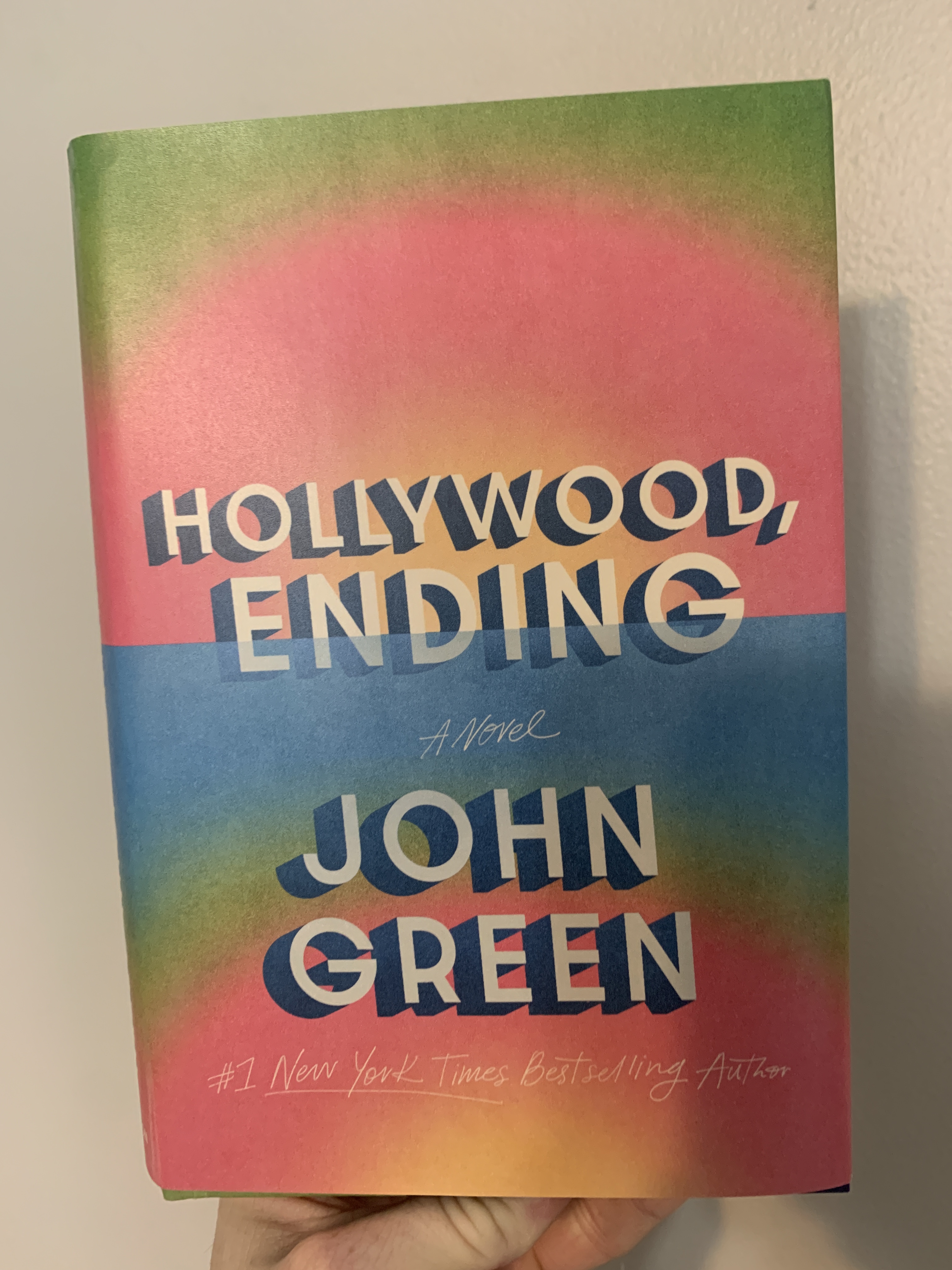
At a recent John Green interview I attended, Green talked about how weird it is to be a conscious human around other conscious humans. His latest book, 2026’s Hollywood, Ending, is triptych representation of being a human in the world where “to be” is relative, even to yourself. Green is interested in art, how we consume and engage with art, and the power of art as a “third thing” for companionship. Art then, of course, is tied up into our being human because to be human is to create and consume art. There is something innate about such need, but that yearning, in either direction, gets complicated when wrapped around celebrity and monetization. Hollywood, Ending explores these themes in Green-like fashion, which is to say, with thought-provoking probing of its characters’ inner thoughts, raw dialogue, and of course, humor. I thoroughly enjoyed it, and as we close out 2026, I’ll remember Hollywood, Ending as one of my favorite reads of the year.
Set in 2019, Juniper was a child actress, who now in her early 20s, wants to prove herself as a serious actress who can garner the lead roles in films, critical acclaim, and success. Success is inextricably bound up with her self-worth. She’s studious, stubborn, and immensely prepared. Much of that is traumatically tied up in her upbringing by her mother, an abusive alcoholic. Her mother is also now dead, which then allowed Juniper to tell the world about her trauma. Being an actress was her mother’s dream imposed upon her. And yet, Juniper is good at it and wants it, right? That’s the other complication of being human: knowing that what we want is actually what we want and we’re pursuing it for the right reasons, whatever those are. Having read her book this year, too, I wondered if Green’s Juniper was inspired by Jennette McCurdy’s 2022 memoir, I’m Glad My Mom Died. Green even references the iCarly reboot! (I could be wrong since the reboot occurred in 2021.)
Part of Juniper’s effort to separate herself from her child actress years and “counter any child-star narratives” is her purposefully calibrated (another way of saying staged!) Instagram feed. Still, Juniper insists she is unflappably earnest. That irony bores her. “And ‘cringe’ is what people can’t feel things call feelings.” Fire line by Green.
Appropriately, given that Green’s book is about art and the way we consume art and the way artists present themselves to the public, whether through their art or otherwise, Juniper is starring in a new film about Andy Warhol called, Andy Warhol Never Gets Old. Warhol was someone, who through his art and his own presentation of himself, was fascinated by consumerism, its mass repetition and replication, and celebrity and popular culture. Did anyone, at least publicly, know the real Any Warhol? At a certain point, did Warhol know himself anymore? Who were the private self and the concocted public self? As Juniper reflects, the paradox of fame is that it makes you big, but it also makes you two-dimensional. Necessarily so, as to be digestible to the masses. By becoming two-dimensional and digestible, you become more a thing (a commodity?) than a person. I also think it’s notable to consider the line between Warhol’s work as a critique of that repetition and replication versus being a critique of art snobbery for ignoring popular culture. Or both. Because that sensibility exists with Juniper, wanting to be taken seriously, but also wanting success and sometimes success means doing the “less serious” roles, like starring in a space-fantasy sword-and-sandals epic, Gods of Andromeda, after this Warhol movie.
In the Warhol movie, the titular character is played by an immensely globally famous older actor named Matthew Malone, who has starred in Marvel movies, of course, and is now lending his fame to this small budget ($14 million) arthouse-type film. After all, what American audience is going to see an Andy Warhol biographical film? Nobody sees movies with “five words” in the title, either, according to Hollywood agents. Juniper is playing Carly, a journalist interviewing Warhol in his waning days. Warhol’s assistant, Jude, is played by Kai, in his first movie role. Just eight months ago, Kai was waiting tables. (The server is another interesting role in society, a form of “acting” where the patrons forget that the server is a person, not merely a vehicle for food and drinks, and so, as Kai notes, you hear a lot of conversations you normally wouldn’t be privy, too.) Kai is an insecure, doe-eyed 20something, thrust into Hollywood opposite the hard-working Juniper and the dazzling star power of Malone. He also has his own trauma, we come to learn, wherein he was sexually abused at 14 by his high school teacher. He ultimately testified against said teacher, sending him to prison. The teacher died in prison of a heart attack, but the memories of that trauma, the way it became bound up in Kai’s idea of sex and his identity, linger. As Juniper and Kai become close during the course of shooting the Warhol film, the classic Obstacle, as Juniper calls it — even in this situation, Juniper can’t help but think of their burgeoning relationship through the lens of storytelling, where a romantic couple inevitability has some Obstacle that must be overcome to be together — is Kai’s trauma, which prevents him from kissing her. Throughout the book, Kai will wonder if he’s allowed to “want what I want.” Again, that’s a trauma response. Interestingly, Kai’s “thing” is to say, “I love you”, even if that “love” isn’t actually fully realized (or heard) per se. So, he’s already casually saying it to Juniper. And indeed, a lot of their time together is spent … watching movies, i.e., that “third thing” Green talked about, wherein a relationship is often about experiencing a third thing together, like movies. It’s a lovely kind of companionship that blossoms, tenderly and incrementally between Juniper and Kai. (I felt old because when they watched the 2006 film, The Pursuit of Happyness, Green referred to it as “the old Will Smith movie.”)
During the Green Q&A, someone asked Green about his view on using tragedy and trauma in his books and straddling the line between tragedy and trauma as storytelling versus exploitation. Certainly in his nonfiction work, Green said he receives permission from the subjects or else the work wouldn’t move forward, but in fiction, the line is fuzzier because storytelling is the way in which to work through tragedy and trauma. Even if there is still an element of using it in order to tell the story. Green quoted Iranian-American poet Kaveh Akbar’s “The Palace” poem, “Art is where what we survive survives.” And a theme throughout Hollywood, Ending, literally through to the last sentence, is about surviving and how art is a showcase of what we have survived. Still, it’s fascinating to consider all of this in a meta way: Green unpacking trauma as storytelling in using two main characters who have trauma in their backgrounds and then within the story itself, their respective traumas are used to bolster the potential box office of the Warhol film during the marketing press junket.
Speaking of that junket, that is also where the “self” becomes subsumed beneath layers wrought by the Hollywood machine. That is, an actor is already playing somebody else. Then, what is ultimately presented to us, the consumer, as the final product isn’t even necessary what the actor wanted. Which is to say, the final shot of their performance is what the director and film editor decided upon. This creates consternation for Juniper, who has copious notes and suggestions for the Warhol film’s director on which shot to use, ultimately knowing it won’t matter. When marketing the film at these laborious, repetitive press junkets, Juniper and Kai are paired together (because they’re money, the studio says, hinting at a possible relationship as a selling point) and give the same answers over and over again regarding each other, Malone, the film, and indeed, their traumas — another nod to Warhol, wherein “with repetition, you lose meaning.” Where is the self in all of that? Kai, of course, did not want his trauma to become public precisely because that makes it no longer his, but the publics. Yet, it was leaked. He suspects it was leaked by the studio. Similarly, when Juniper and Kai were leaving a bar, an overzealous fan (to put it mildly) tried to jump into the car with Juniper and Kai tossed him out. He looked like the “hero” in the entertainment press thereafter. Kai wondered if it was staged, though, even if Juniper’s reaction to it was legitimate (it terrified her). Later, he found out it was staged by the studio. Even when Kai isn’t on the stage, the stage is there.
In a jaw-dropping moment, precisely at the time it occurred to me, I’m shocked Malone has been a good guy this whole time, given this is Hollywood, and he hasn’t been an asshole or a sex pest or anything of the sort; he’s genuinely been helpful to Juniper and Kai, including ensuring Juniper gets the lead role in Gods of Andromeda, the other shoe dropped and Malone became an unrepentant asshole. He leaked Kai’s story, again, to bolster the potential box office of their Warhol film. Upon learning this, and after the film opens in Paris and the United States, Kai quits. Literally. He leaves his phone in a trash can and flies to Jamaica. As he does so, Kai reflects, “I wonder sometimes if I enjoy fucking up my life, if there’s something down deep within me that wants to see everything torn to rags, that wants to walk away calmly from the explosion of my self.” Sometimes, the biggest Obstacles is ourselves. Maybe most often. At this point, Kai and Juniper are an item, as he was finally not only able to tell Juniper about his trauma, but able to consummate their relationship, but when he told Juniper what Malone had done, her first reaction was to ask, “What are we gonna do?” As in, her response was oriented around their careers, not with concern over how Malone’s betrayal affected Kai. I did not like Juniper in that moment nor the subsequent one where she is compelled by the studio to go to Jamaica and retrieve Kai or else she’s fired from Gods of Andromeda. In other words, it was hard sometimes to disentangle Juniper’s affection for Kai as in and of itself or yet another element in a stage performance to further her career. The latter comes up throughout the book in Juniper’s Instagram persona, yet another form of “acting.” Another self presented to the world. Even after a brutal verbal fight between Juniper and Kai once she reaches him in Jamaica, she’s still thinking about that weekend’s box office returns and critical response (only an A-minus on CinemaScore?!) for the Warhol film. When she’s first told of potentially being fired from the film, her response was, “You’re gonna fire me because some boy skittered off to Jamaica?” Some boy! So, I worried about her.
But also, Kai was an asshole and unlikeable in his fight with Juniper in Jamaica. First, the ghosting of her was triggering since that’s what her alcoholic, negligent mother would do. So, he shouldn’t have ghosted her like that, even if he was upset with how she responded to Malone’s betrayal. Kai tells Juniper they have nothing in common, saying it was all a fabrication, an edifice, of their time together making the movie and doing the press junket. (Actors do talk about how, when you’re making a movie, it feels like you’ll be lifelong friends with the other actors and crewmembers you’ve spent long days working with, and then how it dissipates once the film is over.) Kai adds that the only thing they have in common is they’re both trainwrecks, saying, “I just want to blow up my life, and you’re still chasing your dead mother’s dream.” Oof. That’s a low blow. But it’s one that is such a low blow because Juniper wonders that, too. Is she chasing her dead mother’s dream? Does she like, and is good at, what she likes and is good at because she likes it and is good at it, or because her mother liked it and made her good at it? Or both? That’s the fucked up thing about trauma: her mother was an abusive alcoholic who foisted Hollywood upon Juniper, and yet, this Hollywood thing has given her the life she now has. McCurdy talked about how complicated untangling that is, and ultimately, she retired from Hollywood and pursued a dream of her own stymied by her mother: writing.
This, of course, is the real Obstacle between Juniper and Kai: Hollywood. Juniper’s wanting of the thing, and Kai not knowing if he wants the thing, especially if it comes at the cost of his “self.” Juniper thinks about an Emily Dickinson poem, “You there, I here, with just the door ajar.” There’s an “unsolvable distance” between them now. She reflects on the irony of that, “… the way I can’t get into his head and he can’t get into mine even if we’re both pretty good at getting into other people’s heads.” Therein is the rub of being a conscious human around other conscious humans! You simply can’t get into someone else’s head. Not fully.
After her fight with Kai, Juniper fires her agent because the agent agrees with what Malone did, calling exploiting the trauma for the marketing of the Warhol film “gold.” So, it seems like Juniper’s turned a corner of sorts in terms of getting her priorities in order. And obviously, given how he phrased it, Kai is self-aware that he’s self-immolating out of panic and fear. They were both being assholes in different ways, furthering that seemingly unsolvable chasm between them. I particularly liked Juniper pushing back against Kai, apologizing that she didn’t respond to Malone’s betrayal right in the moment, but that she is practical, ambitious, and does want success. She shouldn’t be shamed or chastised for it. (And she was also right, when talking to the studio head, that a male actor can fuck off to Jamaica and be implored to come back, whereas if a female actor did, it would be received very differently. As in, men get to be artistes, she calls it, and the women never get such a luxury.) The firing of her agent makes Kai realize that Juniper actually does care about him and love him, even if it costs her job opportunities and critical acclaim. She tells Kai, “I don’t care if you run from the Industry, but I care a lot if you run from me.” Aww. Ultimately, Kai makes the decision that he doesn’t want her to get fired from the Gods of Andromeda, so he calls the studio head and gets him to keep both of them on, reinforcing the point that the studio head doesn’t own them.
The funny thing is, after all of that, Gods of Andromeda is delayed due to the onset of COVID-19. But Juniper and Kai continue on; she even goes to Indianapolis to meet his parents. Once the Gods of Andromeda is released, and they’re back to doing a press junket together, Kai is in control and dismisses any questions about his trauma. After it’s over, Juniper marvels at surviving another press junket, this one across three continents, no less: “It’s a dirty lie that what doesn’t kill you makes you stronger, or that everything happens for a reason, but this much is true: You survive.” It all comes back to art is where what we survive survives. For Akbar. For Green. For Juniper and Kai. For me. As I said, Green carried this theme of survival through to the last line of his book, which I loved, “You survive, and you survive, until one day, you survived.” That past tense on survive is a revelation when it happens. I’ve experienced as much.
As for the title itself, why the comma between “Hollywood” and “Ending” since obviously, the usual saying is a “Hollywood ending”? Because the ending of this book wasn’t a Hollywood ending. It was Juniper’s and Kai’s ending. Intentionally so. They reclaimed their respective selves. They stopped, inasmuch as they could, being subservient to the Hollywood machine. What a beautiful message.
Indeed, what a beautiful, phenomenal book I’m going to be digesting for some time. Like Green, I’m fascinated by the weirdness of being human and being so with other humans, and the loveliness and complications inherent to making art and engaging with art. The oddity of celebrity and popular culture. Where the stage begins and ends, if at all. How we survive what we survive. Hollywood, Ending is a must-read, as it grapples with all of these themes with dynamic, fallible, but loveable, characters.