
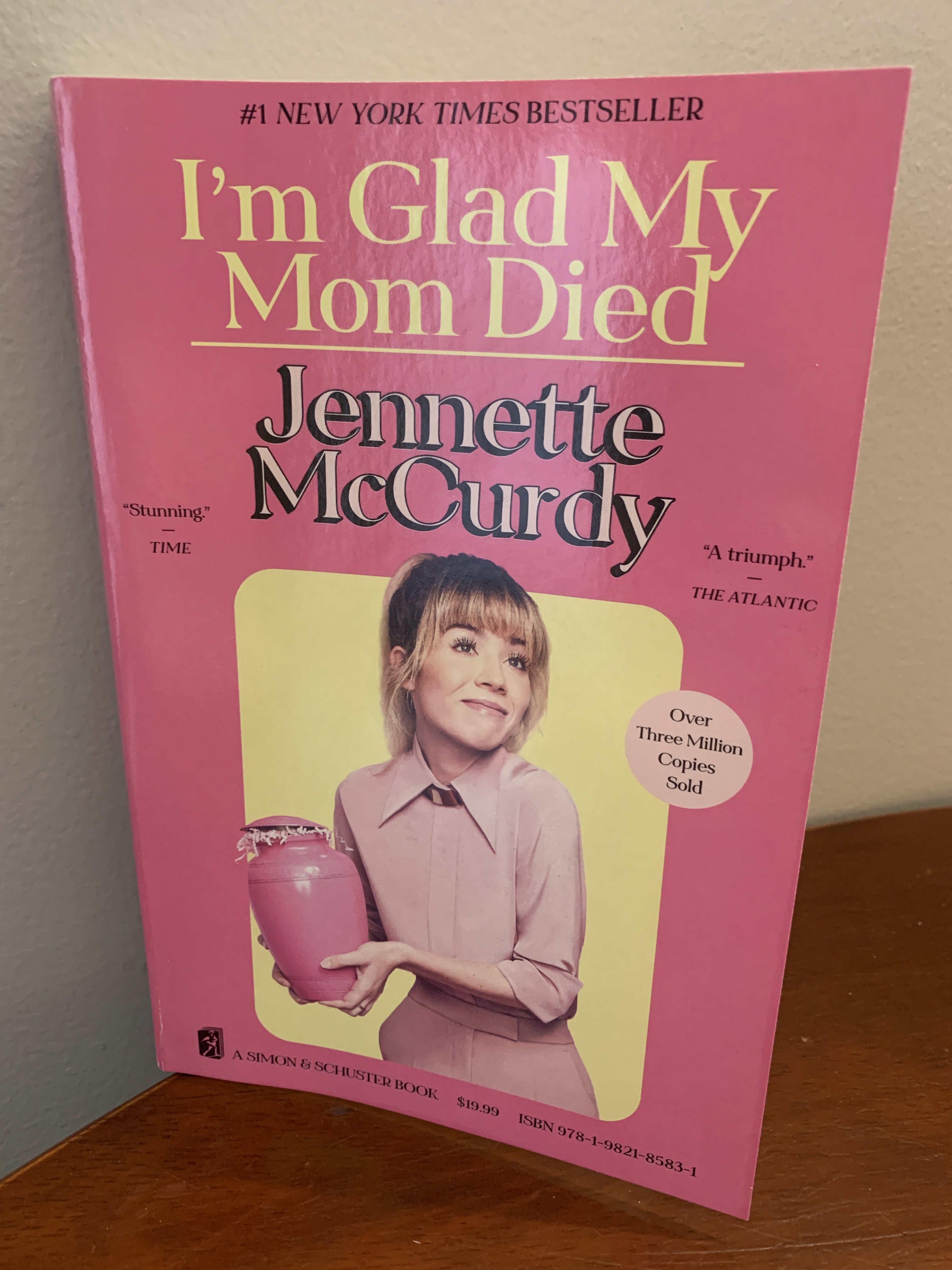
Jennette McCurdy’s ultimate performance as an actress wasn’t on guest spots with Law and Order: SVU, or Malcolm in the Middle, or even her breakout role as Sam Puckett in Nickelodeon’s iCarly. Rather, her greatest performance was keeping her mother, Debra, happy, often at the expense and suppression of her own happiness. As a child actress beginning around the age of eight, McCurdy was the adult in the relationship with her mother. Not only was Debra living vicariously through McCurdy’s Hollywood success, but emotionally and physically, she was in a codependent relationship with her daughter, who she nicknamed “Net,” her “best friend.” Once your child becomes an adult, you can form a best friend relationship with them, but in childhood, that’s a red flag with a parent. This was only one of many details in McCurdy’s sensational, raw 2022 memoir, I’m Glad My Mom Died. An all-time book title, where the image of McCurdy holding her mother’s ashes with a hint of opaque expression, neither a smile nor a sneer, is telling: her mother often told her to show her teeth when she smiled for auditions and demo reels. No teeth here. The baring of teeth is reserved for the written words inside. Moreover, the title could be taken in the obvious manner. After Debra’s many-year battle with cancer, she’s glad her mother is dead in the sense of not suffering anymore. But as we come to learn, I think it’s more apt to suggest McCurdy’s glad the odious pall of her mother is no longer over her head. Indeed, McCurdy’s career and personal life is marked by her mother’s obsession with her, her subsequent death, and consequences still unfurling years after her death. I’m Glad My Mom Died is one of the most enthralling books I’ve read in a long time, horrifying and hilarious at various turns. As McCurdy remarks during her mother’s funeral, there has to be some levity or it would all be too much. And life is so damn absurd as it is — and McCurdy’s more so within an absurd industry — that while such absurdity elucidates horrors, one also has to laugh.
“You want to be mommy’s little actress?” Debra asks McCurdy. No, but that was Debra’s dream, and so now it’s her dream for McCurdy. And so McCurdy was for nearly 20 years, beginning as a background performer with no speaking parts. Her mother soon ensured she would become a lead performer, though. She enrolled McCurdy in acting classes, hopped from one “hottest” kid agent in Hollywood to another, and even had her take a string of additional classes, like dance and even learning how to pogo, to ensure her “Special Skills” for her resume. But her best skill was crying on command, an ironic skill considering how much in real life she repressed her tears to keep her mother even-keeled.
McCurdy, at such a young age, had become a keen observer of her mother’s temperament, unlike her dad, Mark, and brothers, Marcus, Dustin, and Scottie, that she became an expert navigator of those tumultuous, unpredictable waters. This is no way for a child to grow up, to state the obvious. Her primary way of ensuring calm waters, whether with her mother or casting directors or acting coaches or whomever, was to not ask questions. Such a peculiar thing to me how discouraged, apparently, asking questions was, especially in an acting class! In turn, McCurdy always felt “monitored” by her mother. When other moms weren’t allowed to see performances in the acting class, Debra shouldered her way in, buoyed by her breast cancer experience. She wasn’t afraid to use her breast cancer experience to get ahead, or get McCurdy ahead, as it were. This monitoring extended to shoring up McCurdy’s “beauty,” with hair and eyebrow treatments, teeth whitening, and calorie restricting. Again, she’s a child, a point worth reiterating throughout. Even more insidious and abusive, Debra’s monitoring extended to showering McCurdy well into her teen years, sometimes with Marcus who was 16 at that point, as well as wiping her butt when McCurdy was a 8-year-old (Debra argues this needed to continue until McCurdy was at least 10). Those shower sessions included breast and vaginal “exams” on the pretense of checking for cancer. The clear insinuation is that it was sexual abuse. Debra’s overall project, which bleeds into McCurdy’s psyche and belief about herself, is to keep McCurdy childlike. This so scars McCurdy’s understanding of her identity and body image that she freaks out about the development of her breasts and that’s when the calorie restricting happens, her mother’s giddily-supplied “solution.” During a regular visit to the doctor, the doctor notices how severely underweight McCurdy is, and tells Debra this privately, but Debra lies, lies that McCurdy overhears, further confusing her, albeit introducing the word “anorexia” to her consciousness. On the surface level, the thinking with curtailing growing older is that growing up for a child actor is a death knell. As long as you can play young, you’ll keep getting roles. On the darker subconscious level, though, I think Debra’s project is a reflection of her sick and distorted relationship with McCurdy. McCurdy was less of a daughter and more of a doll-like plaything for Debra. Playthings can’t feel anything; they can only be played with and molded for future play. That’s why even when McCurdy runs a 103 fever, her mother “coaches” her to chug Gatorade and continue auditioning. Another weird detail that plays into this plaything/childlike attitude is that McCurdy was riding in a booster seat well-past when it ought to have been needed. Seriously, she’s 14 and receives the news of getting the iCarly gig while still riding in a booster seat!
What’s interesting is that for how much control Debra exerted over McCurdy, that same control didn’t seem to extend to Dustin (she apparently told him outright he was her least favorite child) and Scottie. Marcus was pushed into acting as well, but to a much lesser degree from McCurdy’s telling. As for Mark, she repeatedly goes through cycles of kicking him out of the house. She even pulled a knife on him once. What’s further compelling about this control dynamic is it also didn’t extend to her own household, which was a hoarding house. So bad was this house that the children slept on Costco mats.
At a young age, when McCurdy discovers writing and the power the page has to enable her to truly be herself for once without monitoring or someone else directing her, be it her mother or a director, Debra instantly throws a fake tantrum (her Special Skill was manipulative crying on command and these tantrums) and effectively crushes this as an outlet for McCurdy for many, many years. I wonder if she has any interest in screenwriting again, as this was a screenplay.
McCurdy’s grandparents on Debra’s side live with them, and you can kind of see where the mom’s narcissistic and neediness came from: the grandmother, Debra’s mother, is the same way. The grandmother only gets worse after Debra’s death, incessantly harassing McCurdy, and calling her a “bitch.” For his part, while not doing anything to intervene on McCurdy’s behalf, her grandpa at least seems to recognize that none of this is normal and McCurdy ought to be able to have a real childhood. In that way, the grandpa is similar to Mark, who is largely an absentee father. He works at Home Depot, and in a throwback, Hollywood Video, creating their cardboard cutouts. There’s a job I didn’t even think about being eliminated, although perhaps theaters still need those cutouts.
As if her mother wasn’t enough, the showrunner of iCarly, who McCurdy refers to as “The Creator,” is a sleazeball, to put it mildly. Reminder, this is a television show being produced at Nickelodeon for children and teens. First, we are told of an uncomfortable scene of McCurdy needing to try on two-piece bikinis — again, she already has body image issues and is still a child — and have her picture taken for The Creator to have “options.” Debra encourages McCurdy, of course. Then, imagine that your first kiss is on television and you have this Creator doing take after take while admonishing your kissing abilities and coaching you on how to kiss. They did seven takes. Soon, he starts taking McCurdy to dinners. Just the two of them. And like any predator attempting to groom someone, he promises McCurdy her own spin-off show if she follows his direction. He gives McCurdy her first sip of alcohol at 18. Then he begins massaging her shoulders. Later, when Nickelodeon can no longer ignore the Creator’s bullying (and likely sexually harassing) ways, their solution? First, to separate him from the cast and crew, but allow him to still be on set, for all intents and purposes. What? Secondly, to offer McCurdy a $300,000 hush money payment, which is what she immediately and rightly clocks it as, to never speak about The Creator again after iCarly. Smartly, McCurdy declines.
Debra foisting acting upon McCurdy, who never liked it and feels ashamed to do it, wasn’t enough apparently. She also foists a country music career on McCurdy. It does have one silver-lining, which is macabrely aided by a recurrence of Debra’s breast cancer: separation from her mother. It’s the first time McCurdy is able to get some modicum of distance from her. Around this time, McCurdy even starts dating a co-star named Joe (I’m not sure if that’s a fake name or not), who is 32 while she’s 18. He breaks up with his girlfriend of five years to be with her, although he had already been cheating on this girlfriend with McCurdy. He’s a loser, though, and if you ask me, pressured her into giving him her first blowjob. She also helps him pay off his debts.
Even when it seems like McCurdy will get true healthy separation from her mother by moving into her own apartment at 18, Debra shoulders her way in yet again. And it’s not even just that Debra is there creating that sense of claustrophobia and unhealthy codependency again; she’s literally sleeping in the same bed with McCurdy “clinging to her all night.” Ugh.
Thanks to the paparazzi learning of McCurdy’s, uh, dalliance, with Joe, that means the public knows, which means Debra knows, which means Debra harassing McCurdy with dozens of phone calls, voicemails, and vicious emails. In one breath (of the email), she’s disowning McCurdy and calling her a whore and an UGLY MONSTER, and in another, she’s asking McCurdy to buy them a new refrigerator because theirs broke. There is humor in the darkness. You laugh to not cry.
Outside of Joe and her mother, McCurdy did seem to get along swimmingly with Meredith Cosgrove, the actress who plays the titular Carly on the iCarly show. However, McCurdy has a poignant and pointed reflection on this, too, when iCarly ends. She says she doesn’t like knowing people in the context of things, whether that’s working with someone or through a book club because once that “thing” ends, then it puts the relationship in peril and it can end, too. She continues, “I yearn to know the people I love deeply and intimately — without context, without boxes — and I yearn for them to know me in that way, too.” That’s perhaps the most profound statement in the book because up to this point, I’m not sure anyone has known the real McCurdy. She’s always been performing out of necessity. I don’t think McCurdy even knows the real McCurdy yet. Fortunately, her friendship with Miranda outlasts the end of iCarly, although it did seem to taper off later as they grew up.
After Debra dies, McCurdy switches from anorexia to bulimia, what she sees as switching from control (regimented calorie restriction) to chaos (binging and purging). She’s also become an alcoholic, although I don’t think she uses that term in the book. Once her bulimia condition fully blooms, we learn McCurdy is binging and purging five to 10 times a day while also drinking at least eight or nine shots of hard liquor a night. Add to this she’s punishing her body with obsessive working out: half marathons every two weeks and six miles a day. Also, she grew up Mormon, so, initially she thought the Holy Ghost was speaking through her, but later realized she suffers from OCD.
McCurdy dumps Joe, casually sees another loser during the ongoing death of her mother, and then someone named Liam takes her virginity. In my humble opinion, she seemed to have been taken advantage of by her drunkenness. She moves on from Liam shortly thereafter.
I cannot stress enough the juxtaposition between Nickelodeon being what it is — a production company for children — and the treatment of its stars, and no, I haven’t seen the documentary about it all yet. I say this to bring up how McCurdy was regularly receiving lewd comments about, you guessed it, her body. In a more professional capacity, McCurdy also received a blow when she was told she’d no longer get to direct an episode of her spin-off show, Sam & Cat, which I had no idea also starred Ariana Grande, who McCurdy was forthrightly jealous and bitter about. Directing was her proverbial “light at the end of the tunnel.” That was taken from her, too. She suffers a panic attack upon learning this, and takes to puking and puking and puking. Here’s where the absurdity that becomes funny enters again: right after this scene, the prop master enters the room to hand McCurdy her character’s signature buttersock. You can’t make this stuff up.
McCurdy started out, thanks to the toxic influence of her mother, wanting to preserve in amber her childlike look and qualities. But by this point in her career, she resents it all. She resents the fame and its attendant toxicity, including with oblivious and obnoxious fans. And contrary to before, she now seeks to grow without the eyes of the world upon her, to no longer be always preserved in amber as the child she once was. Such is the quintessential curse of being a child actor. She says the world won’t let her be anyone else. While she feels some modicum of self-consciousness around her bitterness about fame — since she already knows the rejoinder coming from fans: wow, how terrible to be famous! — it pales in comparison to the unbridled truth. She says, “… I was not the one who dreamed of being famous. Mom was. Mom pushed this on me. I’m allowed to hate someone else’s dream, even if it’s my reality.” Mic fucking drop. Seriously. I’m less sympathetic to adults who get into entertainment, athletics, or politics and bemoan the attendant attention and fame, but children? They don’t ask for it, and even the ones who do want to act, their parents should do everything in their power to protect them rather than enable all the worst features of the entertainment business, as Debra’s mom did.
The next boyfriend, and McCurdy’s first true love, is Steven. He initially seems good for her actually, as he’s the first person to introduce the idea of therapy into McCurdy’s life. She tries it, but I think the therapist, who McCurdy calls Lauren, overstepped in trying to begin to unpack McCurdy’s relationship to her mother and it scared McCurdy off. While she’s dealing with that, Steven decides he’s going to be religious now, begin attending church, and even takes a vow of celibacy (it doesn’t last).
McCurdy’s book, which is her life, keeps ratcheting up. In a jaw-dropping moment — I don’t say that with flourish; my jaw literally dropped for a page and a half —, we learn that Mark is not McCurdy’s “bio-dad,” as she takes to calling him, nor is he Dustin and Scottie’s. So, all this time Debra was accosting and accusing Mark of cheating, she was projecting. Worse than just cheating, she had three children by a different man! And went to her deathbed never telling McCurdy. That hits hard for McCurdy. Just as she’s beginning to grapple with the reality of her mother — instead of this saintly woman on a pedestal who heroically did everything to put McCurdy’s needs first, she’s actually a narcissistic, lying, manipulative, controlling monster —, this new information is dropped on her. But in McCurdy-like fashion, she follows such information up with a genuine laugh-out-loud moment, even if ultimately it’s not. She wants to tell Steven this news before she flies out to Australia, but he has big news of his own to share with her. McCurdy implores him to go first. He declares that he’s Jesus Christ reincarnated. Wow. This gets chalked up to a schizophrenic episode. They seem to be okay for a spell, but once McCurdy begins seeing a new eating disorder therapist, he helps her to realize she’s in yet another codependent relationship and breaks it off with Steven in a fucking swan boat, if memory serves, in another hilarious juxtaposition between the severity of the moment and the aesthetic.
Also, I just have to note how bizarre it is that Mark apparently had no plan to tell McCurdy he wasn’t her bio-dad. Rather, he was encouraged to by Karen. Who is Karen? A very minimal side character mentioned earlier in the book: Debra’s high school best friend, who is now Mark’s girlfriend. A bit weird. Nonetheless, with the help of two of her friends, including Miranda, McCurdy does briefly meet her dad at a jazz concert he’s performing at. Ironically, the dad also has connections to showbusiness through music.
The book ends with McCurdy at her hoarding mother’s hoarding tombstone (the family couldn’t decide on an adjective to describe her, so they used all the adjectives), reflecting on what it means to reckon with her mother’s true identity and character. Because doing so means obliterating the edifice upon which she understood herself and her life for the past 26-some-years at that point. Sure, she’s left acting behind, as well as codependent boyfriends, and she’s working on her bulimia, but the question remains. Who am I now? I think I’m Glad My Mom Died is the fruits of that reckoning and a form of catharsis for McCurdy. It doesn’t mean she’s now coming out of this book fully formed and realized. She went through too much for that to be the case already. But it’s an encouraging, empowering start. Most importantly, it’s her start and her dream. That’s the beginning of building a new, healthier edifice and identity.
I cannot recommend this book enough. Everyone should read it.


