
I don’t go as in-depth with my reviews of each of the short stories, but I’d still avoid the blurbs if there’s a short story you haven’t read.
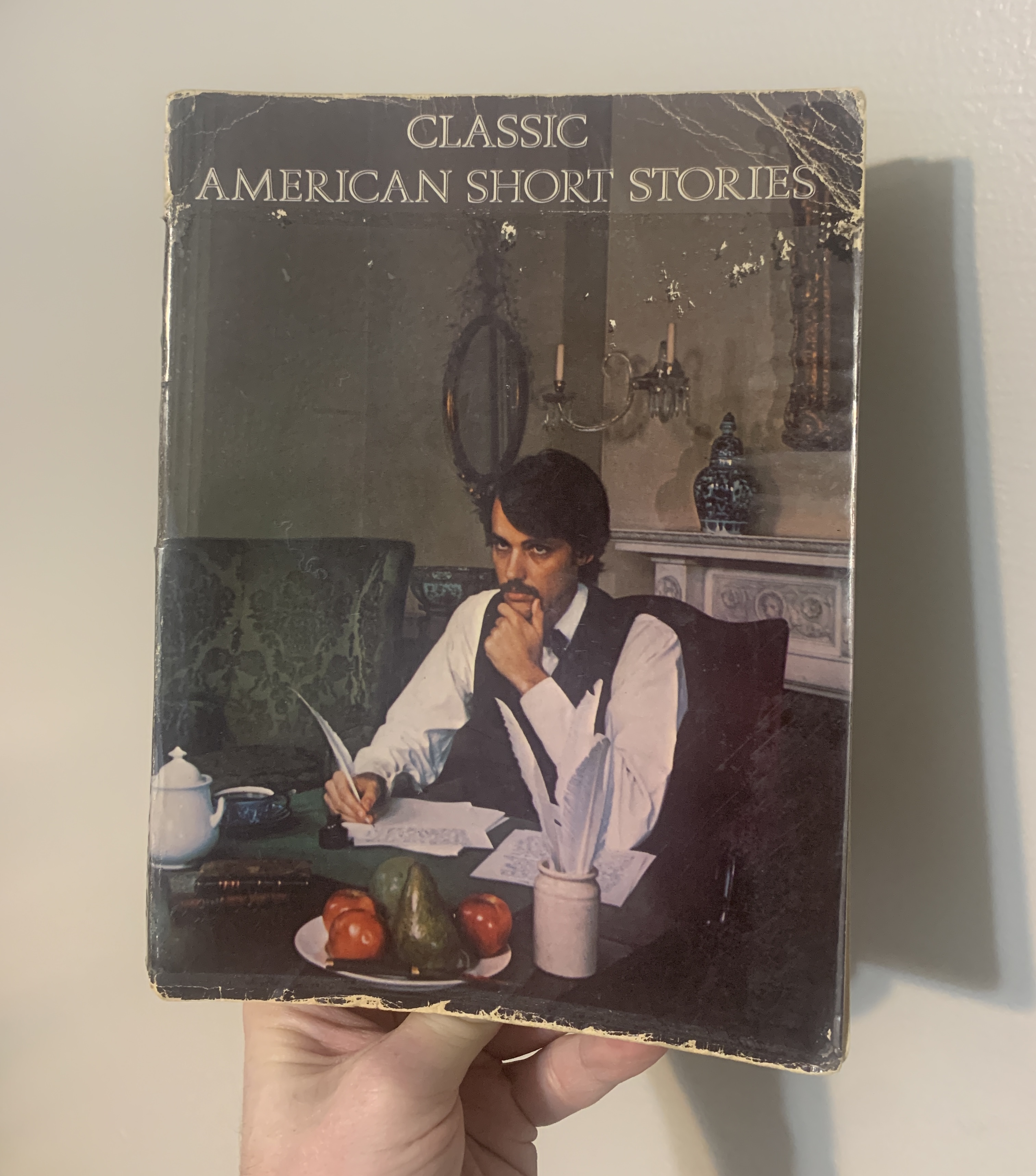
Short stories are among my favorite stories to read precisely because of the craft it takes to pull off a short story. Limited by the structure (albeit, the length varies from a few hundred words to just under a novella), authors have to be judicious with their words, descriptions, and characterizations. Even with those limitations, though, authors have found ways to introduce tension, suspense, humor, social commentary, and twist endings. The short story really had its start in America, popularized by the greats who lent their considerable skills to the endeavor. Classic American Short Stories is a 1977 book by Series Editor Theodore W. Hipple that features 17 stories published from 1820 to 1927, ranging from horror to suspense to domestic life to nature and the absurd. What I always find fun when assessing a short story collection of any kind, including this one, is uprooting any throughline themes that evince the milieu of the time. In this case, I was particularly interested in 19th century America as it evolved from Washington Irving’s day in 1820 to the last throes in Mark Twain’s day (1899). Similarly, with the advent of the 20th century. In this collection, I think you do see emergent themes: the unwavering hospitality of normal Americans to open their homes even to strangers; the lingering fears that the war dead, and the land itself, will haunt us; that life, whether in marriage, on a farm, or at the outer reaches of the Arctic Circle, is always a bid for survival, offering myriad travails; and that ostensible goodness in word does not always mean true goodness in deed. Like many authors have explored throughout American literature, there is also always the tension between personal lives and social lives, and how when they overlap, disruption often occurs followed by an unraveling. Overall, I had a blast with this collection, and I especially enjoyed the illustrations from various artists accompanying each piece. Some stories made me shudder in horror (Poe, London), others made me think (Hawthorne, Twain), and yet still, others made me laugh-out-loud (Stockton and Butler). To read fiction, I think one owes it to themselves to read short stories. I highly recommend making this collection your starting point (if you can find it still in print; I picked it up from a used book sale, and it was a discarded school book — the same school I attended back in the day!).
Since there’s 17 stories here, I’m not going to do my usual recounting of the characters and story beats — after all, they are short — but I will try to summate my feelings … briefly.
You’ll also see I put the year next to each one. That wasn’t done in the collection, which surprised me: I always find it helpful, even with fiction, to place it within the context it was written!
“The Legend of Sleepy Hollow” by Washington Irving (1820)
The author credited with kicking off the American short story (before this with 1819’s “Rip Van Winkle”), Irving’s tale of the Headless Horseman of Sleepy Hollow continues to endure for a reason: it’s a damn good story! The feared Headless Horseman is a Hessian soldier. In other words, you have to remember, Irving wrote this only 37 years after the end of the Revolutionary War, which still would have been in living memory of a great deal of Americans, including Thomas Jefferson and John Adams! (I’m tickled at the thought of those two also knowing this story.) That seems important to the edifice of the horror here. My two takes: a.) Ichabod Crane didn’t care about Katrina Van Tassel, as he just sought the wealth of her father!; and b.) I’m convinced that “Brom Bones,” the pranking bully, used the legend of the Headless Horseman to prank Ichabod and ride him out of town, not that the Headless Horseman actually killed him. Also, a pivotal lasting image from the story is that of a smashed pumpkin. That image has also endured for more than 200 years!
“Dr. Heidegger’s Experiment” by Nathaniel Hawthorne (1837)
Ah, the Fountain of Youth. If it were real, and the old scientist of this story offered it to you as a drink, would you partake? His four experimental subjects do, with unyielding avarice. A story as resonant today as it was then: age is no matter if wisdom has not been gained.
“The Tell-Tale Heart” by Edgar Allan Poe (1843)
One of my all-time favorite stories. In fact, I sometimes wonder, upon recollection, if this was the story that made me not just a lifelong reader, but a lover of horror and the macabre. Just a pitch-perfect horror story everyone should read. It lingers.
“The Lightning-Rod Man” by Herman Melville (1854)
This one made me laugh because Melville, like many who will come after him, is already lampooning greedy entrepreneurs, like the titular character in his story, trying to profit off of a particularly nasty thunderstorm by selling a lightning rod. I quite enjoyed how masterfully, and succinctly, Melville created the two characters and built the tension with great dialogue.
“A Struggle for Life” by Thomas Bailey Aldrich (1867)
Written shortly after the end of the Civil War, this must be one of the first stories to offer a twist ending. Instead of a man being seemingly entombed with his lover and then surviving the ordeal, as the narrator thinks, he’s been led astray by a trickster and looks the fool when he tries to talk to the “buried alive” man. A playful, if macabre, story. Also I think it speaks to another throughline theme of this collection: Americans’ ready willingness to believe high tales and fabrications, or as in the case of Melville’s previous story, to be susceptible to fear and superstition.
“The Man That Corrupted Hadleyburg” by Mark Twain (1899)
Twain’s story may be my overall favorite story of the collection, and another one that could fit comfortably in the year 2026, fresh and resonant as ever. A scorned man decides to take revenge on the “honest-to-a-fault” Hadleyburg village, out to expose that when they are actually tested with temptation, the village residents will crumble. Honesty means nothing if temptation can break it! A must-read story.
“An Occurrence at Owl Creek Bridge” by Ambrose Bierce (1890)
Another story in the wake of a great war (the Civil War) that reckons with war’s hell and man’s desire to live. In this case, the Union Army is set to hang a Southern sympathizer for trying to booby trap the titular bridge. The man thinks he’s somehow survived not only the hanging, not only the drop into the water below, but the musket shots and cannon firings from above to make it back home to his wife. Nope. He died. Also a twist here!
“The Griffin and the Minor Canon” by Frank R. Stockton (1885)
A fun fairy tale also playing, as Twain did, on the social dynamics of a community. The community is, to be fair, somewhat rightly, afraid of the lion-eagle monster. They are afraid that the monster, who comes to the village to admire a stone depiction of himself, will eat their children. They are even willing to sacrifice other children to save theirs. A local priest, the titular Minor Canon, manages to get close to the Griffin, but is sent away by the village in hopes the Griffin will follow. The Griffin doesn’t. The irony is, had they left well enough alone, the Griffin would have eaten the Minor Canon in the end and left their village sooner. Luckily for the Minor Canon, that doesn’t happen. Fear and prejudice make fools of us all.
“The Luck of Roaring Camp” by Bret Harte (1868)
The next four stories here are what Hipple refers to as “local color stories.” Meaning, the authors tell a story, yes, but they are also trying to paint a picture of a particular place and time. With Harte’s story here, it centers on a roving band of criminal gold diggers (actual gold diggers heading further West into California). A pregnant Indian woman stumbles into their party, gives birth, dies, and the all-male Roaring Camp decide to raise the baby, now known as Luck, as their own. It’s sort of a boy-raised-by-wolves story, where the boy’s presence helps to mollify the wayward ways of the men. I found it a solid read.
“A White Heron” by Sarah Orne Jewett (1886)
Another story where the characters allow a stranger into their home; in this case, one who seeks to find the white heron and shoot it. The little girl of the household can’t understand why someone who ostensibly loves birds so much would then want to kill one. So, even when she finds the best vantage point to set eyes upon the white heron (a beautiful scene), she doesn’t tell the man. To be sure, her poor family could have used that $10, but some things (morals) can’t be bought. A subtle, lovely story.
“Under the Lion’s Paw” by Hamlin Garland (1891)
Perhaps the story of the collection with the strongest, most despicable villain, and it’s another villain rooted in unrelenting greed. A local farmer and his family are sweetly taken in by another poor farmer (hospitality again!), and while at that farmhouse, he works hard to build up a nearby bit of land that Butler has rented to him. He’s redone the fences, the well, everything. When he meets again with Butler, Butler demands far more money now for the farm because of all the upgrades that have been done. “The land is more valuable now,” sort of thing. But it’s more valuable because of what the farmer did! The farmer is rightly infuriated, but has no real recourse (he was going to shoot Butler until he heard his children’s laughter). Oof. I keep talking about the historical context, and obviously, the late 1800s was ripe for frustration during the Gilded Era.
“A Village Singer” by Mary E. Wilkins Freeman (1889)
Admittedly, this was one of the weaker stories, but hey, I’m not going to love all 17. But still, I enjoyed the dynamics once more of social norms and a collective versus an individual. In this case, churchgoers pushing out their aging singer in favor of a younger one, but being rather cowardly about it (the older singer had a great line “… but to go an’ spill molasses, as it were, all over the threshold, tryin’ to make me think it’s all nice an’ sweet”). The older singer rebels and holds her ground (after all, the older man in the church still had his position of authority!) until her untimely death where she relents with her grudges. Actually, the more I analyze it, the more I like it.
“The Bride Comes to Yellow Sky” by Stephen Crane (1898)
While Crane didn’t live in the Wild West, this was his foray into describing it, and importantly, conveying how it was in its death throes as the 20th century was knocking. You have a kooky drunk, Scratchy Wilson, long the problem child of the town, ready to have a gunfight with someone — all the while, the bar closes and everyone shores up their homes, used it to as they are — and the town marshal, Potter, who just got married, returns to town. As Potter arrives with his bride and sees Scratchy, Crane gives us this great line, “There was as silence. Potter’s mouth seemed to be merely a grave for his tongue.” But now Scratchy doesn’t want to fight Potter because he’s a new groom and unarmed. Is this the Wild West or not?! It’s been domesticated. Tamed. Alas. Such a fun story!
“Pigs is Pigs” by Ellis Parker Butler (1905)
Such a funny freaking story that lampoons the absurdity of customer support. We see even today satirical shows lampoon such a thing, and Butler was doing it in 1905! Essentially, two men — one bringing Guinea pigs home to his son, and the other the stalwart, rules-be-rules railway express agent — quarrel over whether pigs is pigs! If they’re pigs, then they’re 30 cents a pop to transport, or 60 cents total for the dad. If they’re pets, then only 25 cents a pop, or 50 cents total. The dad addresses a letter to the head of the railway express company, who refers him to the Claims Department, which then refers him to the Tariff Department — that’s what makes the customer service difficulties even more absurd here is the long wait time to only be told, “Actually, you need to address your complaint to so-and-so.” Meanwhile, the agent is trying to figure out what to do with all the Guinea pigs: they’re reproducing with reckless abandon! In the time it takes the Audit Department at the company to reimburse the agent, the fee has already gone up because the number of Guinea pigs, and their cabbage needs, have gone up. Even though it’s decided that they are indeed pets and the 50 cents the father wanted to pay makes sense, the cost has now soared to more than $800. Lmao. The father packs up his family and leaves town. So, so good.
“A Service of Love” by O. Henry (1906)
Hipple presents these next two stories as two different depictions of marriage. In this one, which also turns out to have a funny ending, two artists (one a painter, the other a pianist) marry. They abide by the same mantra, “When one loves one’s Art no service seems too hard.” But when their fortunes with the arts seem to be dwindling, they both secretly take up jobs at an industrial laundry. Unbeknownst to the other until they reveal it in the final scene, the husband had helped his wife whose hand was burned by an iron on the job. In other words, yes, on the surface they were willing to endure any service to maintain art, but at a deeper level, they were willing to endure any service (and shame) to maintain the art of their loved one, as they thought they were doing. That’s quite lovely!
“Marriage — For One” by Theodore Dreiser (1927)
On the other hand, Dreiser’s story is more bleak, at least for the man (his own doing!). Wray sought out a woman in the seemingly simple Bessie, he could marry and then shape into his image of what a woman ought to be. Instead, Bessie flourished with her reading and love of intellectual pursuits, such that she began to find Wray oppressive in his boredom, indifference, and bitterness. She leaves him, but he wrangles her back, as it were, with a child. Even then, she leaves once more, this time with the child. I was surprised she took the child, though, because at least through Wray’s telling (which itself is then told by the narrator), she felt the child was a chain upon those aforementioned intellectual pursuits. Alas. I like both depictions of marriage offered: the lovely and the foolhardy.
“Love of Life” by Jack London (1907)
What else would you expect from a Jack London story other than one of endurance and survival in a seemingly inhospitable environment? The story really encroaches upon one’s skin when the wolf enters the story. By this point, the main character, who is out somewhere near the Arctic Circle, adrift and feverish with hunger, is trekking along trying to find a boat, when the wolf appears, also struggling for survival and feverish with hunger. Who is going to die and who is going to feast first? It is utterly fascinating how much our bodies, and yet not our minds, can endure. Our bodies can be pushed to the absolute brink, and yet there will be something inside of us humming with the will to survive. Whereas the mind seems to deteriorate much quicker, operating at a different capacity. Regardless, the man does survive, albeit he’s going to be haunted forever at the prospect of facing hunger again.
Like I said, this was a delightful collection of American short stories that will linger with me. I’d recommend ultimately engaging with any of these stories. If you do, let me know which ones you read! I’m sure at this point most can be found online freely available.


