
Spoilers!
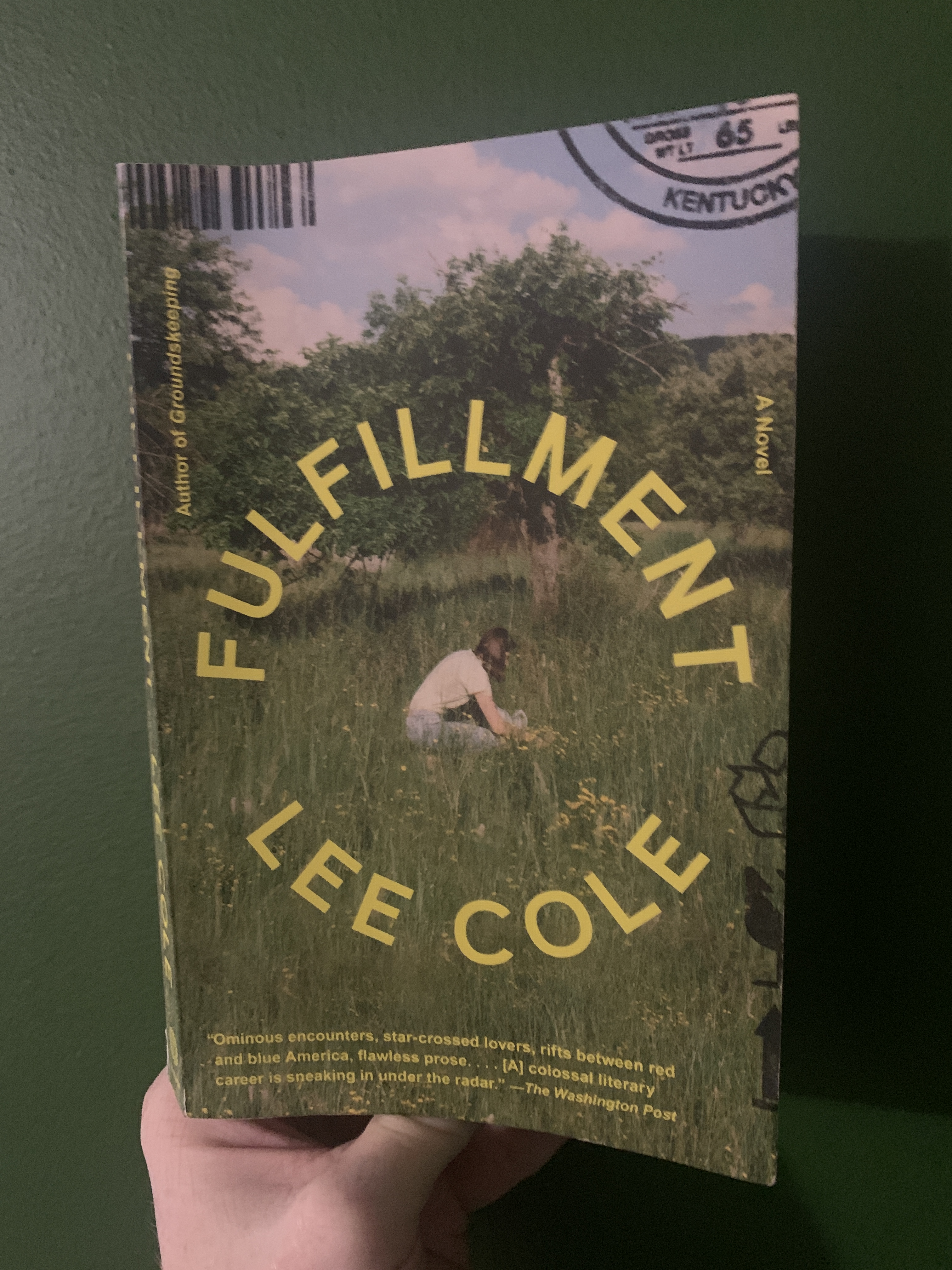
There is a thin line between desire and despair, and often in chasing desire you court despair instead. The inherent problem with the chase, whether that’s moving to a new city, a new bed, a new dream, is that you’re still fundamentally you. That which courts despair is still there. Until you address it, there isn’t much room left for manifesting the outcomes of your desire. Lee Cole’s 2025 Southern Gothic book, Fulfillment, is a lamentation against this polarity of desire and despair and the broken people left in its wake. By situating this polarity on two brothers in Kentucky, both unfulfilled in different ways, Cole is able to explore the full range of what it is to be a human in the modern milieu’s miasma that makes desire and despair ever harder to discern. Fulfillment is going to be a sneaky dark horse favorite read of the year for me. I gravitate to the kind of grounded and raw characters Cole’s etched out of the bluegrass soil and the philosophizing, penetrating dialogue he’s imbued them with.
Nothing is ever as it seems with humans. Take Joel. His story seems downright JD Vancian, if JD Vance stayed a liberal critic of the Trump administration. Which is to say, Joel wrote his own version of Hillbilly Elegy about the rural despair in late-stage capitalism affecting his home state of Kentucky, and then he absconded to New York City with his wife, Alice. When he returns to visit his mother, Kathy, back in Paducah, Kentucky, who always has Fox News on — Cole has a great observation through Joel about what makes Fox News so omnipresent in the lives of many Americans, noting, “It was not a transmission of information or entertainment, nor was it propaganda, precisely, in the old sense of the word. It was a panoptic work of art. An enormous mirror, reflecting the primal fears and nostalgias of its viewers with such verisimilitude that all they could manage, in response, was to stare—wonderstruck, vindicated. Fox News was the Absolute Truth, not about the world, but about them.” It’s much more difficult, and the implications more far-reaching and troubling, to consider this rendering of Fox News than the typical understanding of it being a propaganda spigot that if only we could turn off, then all would be well — and keeps an arsenal of guns throughout the house and more in a shed out back (securely locked with a Bible verse code, of course), they tend to argue about politics. She bans uttering Marx’s name in her house. But she also dotes upon her oldest son because he’s successful, even if she disagrees with his book. He’s made something of his life. And yet. Joel is secretly taking antidepressant pills even Alice doesn’t know about from a shady, serendipitous delivery service. He’s unfulfilled because he feels like a fraud, someone capitalizing on his roots. Joel knows he’s someone who is always intellectualizing instead of feeling. That’s relatable. And he’s well aware that his marriage is faltering and that it’s faltering because he won’t acknowledge to himself, and certainly not to Alice, his unhappiness.
As for Joel’s younger half-brother, Emmett, he’s bounced around from job to job, like preparing Outback Steakhouse’s famous Bloomin’ Onion or going to New Orleans just to experience something different, only to return to his bluegrass roots, too, and take a job at Tempo, an Amazon-like fulfillment center. Irony. But what he really pines for is to write the next great screenplay. He just doesn’t know how. In the meantime, he’ll drink beers with his workmate, Kaleb, and do coke in the latter’s Corvette. Emmett also returns home. Upon his return on the Greyhound bus, Emmett observes the state of modern America. It’s rather bleak in Cole’s writing, but worth replicating in full:
“One saw the brushstrokes of irrelevance in the landscape itself. The rhyme of towns, the patchwork fields. The illusion of movement. Most of America was like this. Traveling by Greyhound had a way of inflicting realism on even the most ardent dreamer. One saw, as Emmett saw now, the glowing corporate emblems, the name and symbols hoisted on stilts. One saw prisons that looked like high schools. High schools that looked like prisons. One saw the blaze of stadium lights above the treeline, heard the faint echo of the anthem, of military brass and drums. One saw the salvage yards of broken machines. The mannequin of Christ pinned to the cross. The moon-eyed cattle, standing in smoky pastures at dusk. One saw huge flags rippling above car dealerships. Combines blinking in fields at night. One could see all this, unreeling frame by frame, and understand, as Emmett understood, the immense bitterness of exile.”
That was on page 10. Suffice it to say, I knew I’d be all in on this book.
Emmett’s observation could have been in Joel’s book about rural despair and late-stage capitalism that Emmett resents. Or at least, resents the success therein. The “immense bitterness of exile” is the defining feature of so many wayward men (and women) in modern America. Exiled within hollowed-out communities. Exiled within bustling cities. Exiled within loving families. Exiled within themselves. Exile sometimes leads to radicalization, as we’ve seen — which we also see in Cole’s book, there’s a repeated motif, a sort of background noise, a thematic point in and of itself, of mass shootings throughout the United States — but most often, it just leads to the day-to-day existence of an unfulfilled life.
When Emmett does reach Paducah and Kathy (interesting that he always refers to her as Kathy and not “mom”), he’s constantly in Joel’s shadow as measured by his mother. So he thinks. Funny enough, Grandma Ruth, Kathy’s mother, who is racist and also going senile, keeps thinking Joel is Emmett. Anyhow, it turns out that Alice, who comes along with Joel, is also unfulfilled. She can’t remember what made her fall for Joel in the first place. (Later, she’ll think there’s something about her that has always been drowning and she sought out Joel as a buoy, a refuge.) Or why she quit her philosophy Ph.D. program. Or why she doesn’t chase her dream of a garden. She also is an alcoholic, although she doesn’t think so yet. When Emmett and Alice see each other again for the first time since the wedding, it’s like their twin despairs (and desires?) spark a path that can only lead to ruin. But they allow it to happen because it’s something. Something new. Something different. Something reckless. Something beyond the status quo, ho-hum drudgery of their lives. I felt bad for Joel. He’s so aloof and intellectualizing that he can’t see what’s right in front of him: Alice’s unhappiness nor her unfolding affair with his brother.
Alice and Emmett begin dreaming as if they’re not too fish swimming in a polluted fish bowl, to bastardize a Pink Floyd lyric. Worse still for Alice, even after she breaks it off with Joel, she never expected Emmett to plop out of the fish bowl and leave her behind. Which he does. He goes to Los Angeles to chase his screenwriting dream. She ends up going back to Springfield, Illinois, and with the help of her dad, buys a house and starts planting her garden. She’s down to one drink. As for Joel, when he learned of his brother’s treachery (through another “brother” that Emmett betrayed, Kaleb, scorned over a drug scheme he didn’t get to enjoy the riches of, only Emmett), he confronted Emmett with a gun. The liberal professor and writer with a gun! He certainly brandishes it at Emmett, but ultimately decides not kill him. About nine months later, when Joel catches up with Emmett in another part of California — to tell him that their Grandmother Ruth died and that Kathy is worried about him — they essentially let bygones be bygones because they are brothers, after all. The sneakiest of desires is the one that pulls us back toward the status quo. Swimming against the current is arduous work, even for a dreaming fish.
Fulfillment is a wonderful, aching book of modern fiction, mirroring, one must think, the real sense of angst that occurs as we all straddle, in one way or another, that polarity of desire and despair. Wherever we land, fulfillment itself is like pursuing happiness, it’s bound to confound and be labyrinth-like. Maybe there is something to be said for finding the path of happiness within paths that seem like ones without an outlet. Maybe that’s the real trick of it all.


